August 25, 2026
Critical Maritime Infrastructure Vulnerabilities Shape Global Energy Architecture
Global energy markets face unprecedented structural vulnerabilities as approximately 47% of internationally traded petroleum flows through just four critical maritime chokepoints. These narrow waterways represent singular points of failure that could trigger cascading economic disruptions affecting multiple continents simultaneously. Understanding the complex interplay between military protection strategies, commercial risk management frameworks, and geopolitical tensions has become essential for energy security planning in an increasingly volatile world, particularly when considering the oil price rally analysis that demonstrates how maritime security concerns directly impact global commodity markets.
The concentration of energy transit through these constrained corridors reflects decades of infrastructure development and geographical reality, but also exposes the inherent fragility of current global supply chain architecture. Recent events in the Red Sea and ongoing tensions in the Persian Gulf highlight how rapidly maritime security threats can evolve and impact global markets.
When big ASX news breaks, our subscribers know first
Strategic Maritime Chokepoint Dependencies Define Energy Security Risks
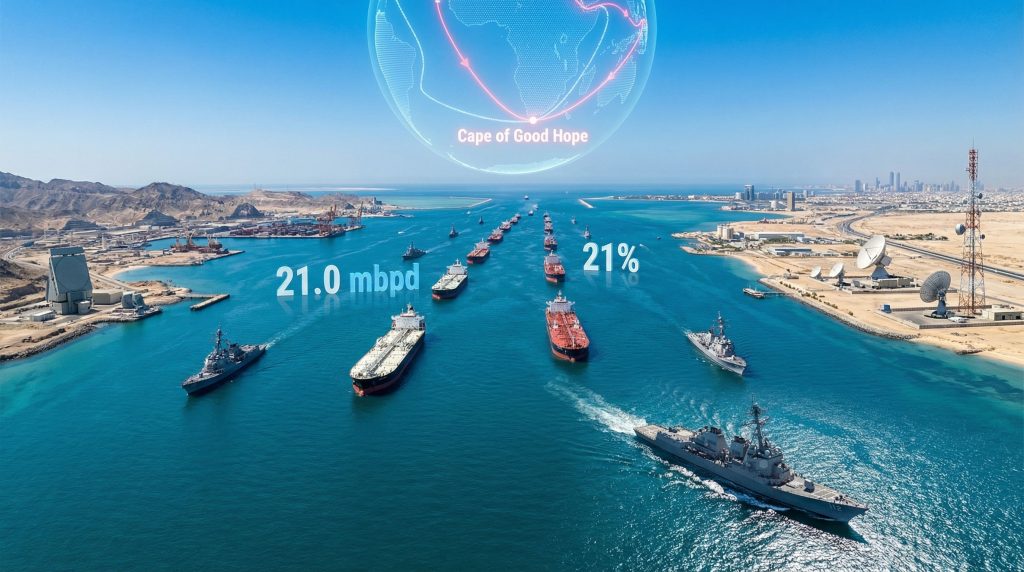
The Strait of Hormuz stands as the most critical energy transit corridor globally, facilitating the movement of approximately 21 million barrels per day representing roughly 21% of global petroleum trade. This narrow waterway, measuring only 21 miles at its widest point with a navigable deepwater channel of merely 2 miles, creates an inherent vulnerability that no single alternative route can adequately compensate for.
Global Energy Transit Vulnerability Analysis
| Chokepoint | Daily Oil Flow (mbpd) | Global Share | Alternative Routes |
|---|---|---|---|
| Strait of Hormuz | 21.0 | 21% | Cape of Good Hope |
| Strait of Malacca | 16.0 | 16% | Lombok/Sunda Straits |
| Suez Canal | 5.5 | 5% | Cape of Good Hope |
| Panama Canal | 4.0-4.5 | 4% | Limited alternatives |
The combined flow through these four corridors represents nearly half of global petroleum trade, creating a concentration risk that extends beyond simple supply disruption scenarios. Furthermore, recent developments in trade war oil movements illustrate how geopolitical tensions compound these maritime vulnerabilities. A coordinated attack or simultaneous closure of multiple chokepoints would eliminate approximately 42 million barrels per day from global markets, exceeding any individual country's production capacity to offset such losses.
Economic Impact Modelling reveals that a complete one-month closure of the Strait of Hormuz would generate an estimated global GDP impact between $1.5-2.5 trillion, equivalent to approximately 1.5-2% of global economic output. Historical precedent demonstrates that crude oil prices typically spike 30-50% during supply disruption scenarios affecting this critical waterway.
Alternative Route Economics and Limitations
The Cape of Good Hope route, serving as the primary alternative to Hormuz transit, adds approximately 3,800 nautical miles to shipping distances, resulting in:
- Additional transit time: 10-14 days
- Increased fuel costs: $200,000-400,000 per voyage
- Reduced global shipping capacity due to longer cycle times
- Higher insurance premiums for extended voyage exposure
These economic penalties demonstrate why alternative routing cannot seamlessly substitute for chokepoint closures without significant market disruption and cost increases that ultimately affect global energy prices. Consequently, the US oil production decline compounds these challenges by reducing available supply buffers when alternative routing becomes necessary.
Naval Protection Strategies Versus Commercial Risk Management Approaches
US Navy escort of tankers in the Strait of Hormuz represents one strategic option among several available risk mitigation frameworks. Understanding the comparative effectiveness and cost structures of different protection models provides insight into optimal resource allocation for maritime energy security.
Military Escort Operation Economics
U.S. Navy escort operations require substantial resource commitments, with estimated costs of $5-8 million per week for a single carrier strike group deployment. Year-round Hormuz escort coverage would necessitate approximately $260-416 million annually for two rotational strike groups, distributed across fuel, personnel, and maintenance requirements.
However, military escort capacity faces significant operational constraints:
- Limited throughput capacity: 5-10 vessels per day maximum per escort unit
- Rules of Engagement restrictions that may limit response effectiveness against non-state actors
- Diplomatic complications when foreign naval forces operate in regional waters without explicit bilateral agreements
- Escalation risks that could worsen regional tensions rather than stabilise them
Commercial Insurance and Political Risk Coverage
The announcement regarding U.S. International Development Finance Corporation political risk insurance represents a market-based alternative that operates independently of military escalation. This approach provides predictable cost structures enabling shipping companies to budget for geopolitical risks, alongside comprehensive market volatility hedging mechanisms.
Commercial maritime insurance costs vary significantly based on perceived risk levels:
- Enhanced insurance premiums for high-risk zones: 2-5% additional premium above baseline
- Baseline maritime insurance: 0.5-1.5% of cargo value
- For a typical $100 million VLCC cargo: $500,000-1,500,000 baseline plus $10,000-75,000 additional high-risk premium
Private Maritime Security Contractor Model
Private security contractors have demonstrated 99.2% success rates in preventing successful attacks on escorted vessels during 2023-2024 operations in piracy-affected waters. This approach offers operational flexibility allowing vessel-specific deployment rather than convoy-based approaches, scalable coverage that can be deployed rapidly without diplomatic negotiations, and cost-effectiveness at $2,500-5,000 per day per vessel.
Historical Naval Protection Operations Provide Strategic Lessons
Operation Earnest Will: 1980s Tanker War Analysis
The most relevant historical precedent for current US Navy escort of tankers in the Strait of Hormuz discussions comes from Operation Earnest Will during the Iran-Iraq War. This 11-month operation from August 1987 to July 1988 protected 11 Kuwaiti tankers through 275+ successful transits at a cost of approximately $600 million in 1987 dollars.
Key operational metrics from this historical case include:
- Vessels damaged despite escort protection: 8 incidents with minor damage, no total losses
- Naval resources deployed: 1 Guided-Missile Cruiser, 1-2 Guided-Missile Frigates, multiple helicopter support
- Cost per protected transit: approximately $2.2 million (in 1987 dollars)
- Threat environment: surface-fired missiles, naval mines, naval gunfire
Modern Threat Evolution Challenges
Contemporary threat environments differ significantly from 1980s scenarios, presenting new challenges for naval escort effectiveness:
- Advanced missile technology: hypersonic anti-ship missiles with reduced warning times
- Autonomous systems: drone swarms and unmanned naval vehicles
- Cyber warfare capabilities: attacks on navigation and communication systems
- Asymmetric non-state actors: irregular forces with sophisticated weaponry
Strategic Assessment: Modern naval escort operations face fundamentally different threat profiles compared to historical precedents, requiring updated tactical approaches and potentially higher resource commitments for equivalent protection levels.
Multi-Framework Risk Assessment for Energy Security Investment
Escalation Dynamics and Regional Response Scenarios
Increased naval presence in the Persian Gulf triggers complex multi-actor strategic considerations that extend beyond immediate shipping protection objectives. In addition, broader implications for US–China trade war strategies must be considered when implementing maritime security measures.
Iranian Strategic Response Options include asymmetric escalation through proxy forces and irregular naval tactics, international law challenges to escort operations in territorial waters, economic countermeasures including domestic energy export restrictions, and regional alliance building with competing naval powers.
Regional Power Dynamics encompass Gulf Cooperation Council coordination requirements for sustained operations, Chinese Belt and Road maritime security interests potentially conflicting with U.S. operations, European Union energy security policy alignment with or against military approaches, and international maritime law implications for escort operations in disputed waters.
Market Psychology and Price Volatility Modelling
Energy market responses to maritime security announcements follow predictable patterns based on historical precedent:
- Immediate price reactions: 5-15% crude oil price movements within 72 hours of major security announcements
- Volatility persistence: elevated price volatility typically continues for 2-4 weeks following initial announcements
- Risk premium incorporation: permanent 2-5% price premium for sustained high-risk environments
- Alternative energy acceleration: increased investment in renewable energy projects during prolonged maritime security crises
The 2019 Saudi Aramco attacks demonstrated market sensitivity to supply disruption threats, with crude oil prices increasing from $88 to $103 per barrel within 10 trading days following drone attacks that temporarily reduced global supply by 5.7 million barrels per day.
Technology Solutions and Infrastructure Diversification Strategies
Next-Generation Maritime Protection Systems
Advanced maritime security technologies offer potential alternatives to traditional naval escort models:
- Autonomous vessel protection systems with integrated defence capabilities
- Satellite-based monitoring and early warning systems for threat detection
- Blockchain-secured documentation and cargo tracking for supply chain visibility
- Artificial intelligence-powered route optimisation and risk assessment
These technological solutions could potentially reduce dependence on military escort operations whilst maintaining equivalent or superior protection levels for commercial shipping.
Strategic Infrastructure Development
Long-term infrastructure diversification represents the most sustainable approach to reducing maritime chokepoint vulnerabilities through pipeline development projects, including Trans-Arabian pipeline expansion to bypass Hormuz entirely, Central Asian pipeline networks reducing Middle Eastern dependencies, and floating production and storage unit deployments for strategic positioning.
Strategic Storage Expansion encompasses national strategic petroleum reserve capacity increases, commercial inventory buffer enhancement programmes, and regional distribution hub development outside traditional chokepoints.
The next major ASX story will hit our subscribers first
Investment Framework Implications for Energy Security
Corporate Risk Management Adaptation Requirements
Energy companies must fundamentally restructure risk management frameworks to address maritime security uncertainties. For instance, multi-scenario planning incorporating various disruption durations and intensities, real-time monitoring systems for geopolitical risk assessment and early warning, supplier diversification acceleration to reduce concentration risk, and alternative routing contingency planning with pre-negotiated commercial agreements.
Insurance Portfolio Optimisation includes political risk insurance integration with traditional maritime coverage, captive insurance company development for self-insured risk retention, consortium risk sharing arrangements among industry participants, and catastrophic loss coverage for simultaneous multi-chokepoint disruptions.
Capital Allocation Strategic Shifts
Investment decision frameworks require adjustment to incorporate maritime security considerations through premium valuations for energy assets located outside traditional chokepoint dependencies, infrastructure investment acceleration toward secure supply routes and alternative transportation modes, technology investment priorities emphasising supply chain resilience and visibility, and joint venture structures enabling shared risk distribution among multiple participants.
Long-Term Structural Implications for Global Energy Markets
Permanent Market Architecture Changes
Sustained maritime security concerns will likely produce lasting structural changes in global energy markets through geographic price differentials reflecting maritime security risk premiums, temporal pricing volatility increased during geopolitical tension periods, alternative energy acceleration as traditional supply chain reliability decreases, and regional energy hub development reducing reliance on long-distance maritime transport.
How Will Geopolitical Realignment Affect Maritime Security?
International cooperation frameworks for maritime energy security face several potential development paths:
- Multilateral naval coalitions sharing escort operation responsibilities
- Commercial insurance consortiums backed by multiple national governments
- Technology sharing agreements for advanced maritime protection systems
- Infrastructure development partnerships reducing chokepoint dependencies
According to the Financial Review, recent policy announcements regarding US commitments to escort oil tankers through the Strait of Hormuz highlight the evolving nature of these international frameworks. However, as Lloyd's List reports, conflicting statements about naval convoy prospects demonstrate the complex diplomatic considerations surrounding such operations.
The effectiveness of US Navy escort of tankers in the Strait of Hormuz ultimately depends on broader strategic coordination among consuming nations, regional allies, and commercial stakeholders. No single approach provides complete security against the complex array of threats facing maritime energy infrastructure.
Risk Assessment Conclusion: Maritime energy security requires integrated strategies combining military deterrence, commercial risk management, technological innovation, and infrastructure diversification. The optimal approach varies based on specific threat environments, resource availability, and broader geopolitical objectives, necessitating flexible policy frameworks that can adapt to evolving circumstances.
Disclaimer: This analysis is based on publicly available information and historical precedent. Energy market investments carry inherent risks, and geopolitical developments may differ from scenario projections. Readers should conduct independent research and consult qualified professionals before making investment decisions related to energy security or maritime trade.
Ready to Capitalise on Energy Security Investment Opportunities?
Discovery Alert's proprietary Discovery IQ model delivers real-time alerts on significant ASX mineral discoveries, helping investors identify actionable opportunities in energy-critical commodities like uranium, lithium, and rare earth elements that are reshaping global supply chains. Explore how major mineral discoveries can generate substantial returns and begin your 14-day free trial today to position yourself ahead of the market during these volatile times.