July 29, 2026
Global supply chain resilience in the clean energy sector faces an unprecedented challenge as the world transitions toward renewable technologies. The critical metals processing bottleneck represents far more than a simple supply constraint—it embodies a strategic vulnerability that could fundamentally reshape the timeline and economics of the energy transition. Furthermore, modern clean energy technologies require materials processed to extraordinary levels of purity and precision, creating dependencies that extend well beyond traditional mining operations.
Understanding the Complex Foundation of Global Critical Materials Vulnerabilities
Supply chain resilience in the clean energy sector extends far beyond simple mining operations and commodity extraction. The backbone of renewable technology deployment rests on a sophisticated network of specialised processing facilities that transform raw earth materials into battery-grade chemicals and precision alloys. This transformation process represents the most vulnerable component of the global critical materials supply chain.
Modern clean energy technologies require materials processed to extraordinary levels of purity and precision. Electric vehicle batteries demand lithium compounds refined to 99.5% purity, while rare earth permanent magnets need neodymium and dysprosium separated to precise elemental ratios. In addition, these requirements cannot be met through simple mineral extraction, creating a distinct vulnerability separate from traditional mining risks.
When big ASX news breaks, our subscribers know first
What Defines a Critical Metals Processing Bottleneck?
Downstream Concentration vs. Upstream Mining Distribution
The fundamental distinction between mining and processing represents one of the most misunderstood aspects of critical materials security. While mineral deposits exist across multiple continents, the facilities capable of transforming these ores into battery-grade chemicals or precision alloys remain concentrated in remarkably few locations.
According to the International Energy Agency's World Minerals and Metals Strategic Report (2024), rare earth element processing capacity concentration exceeds mining distribution by dramatic margins. China controls approximately 90% of global rare earth separation capacity despite holding only 37% of global proven reserves, as documented by the U.S. Geological Survey Mineral Commodity Summaries (2024).
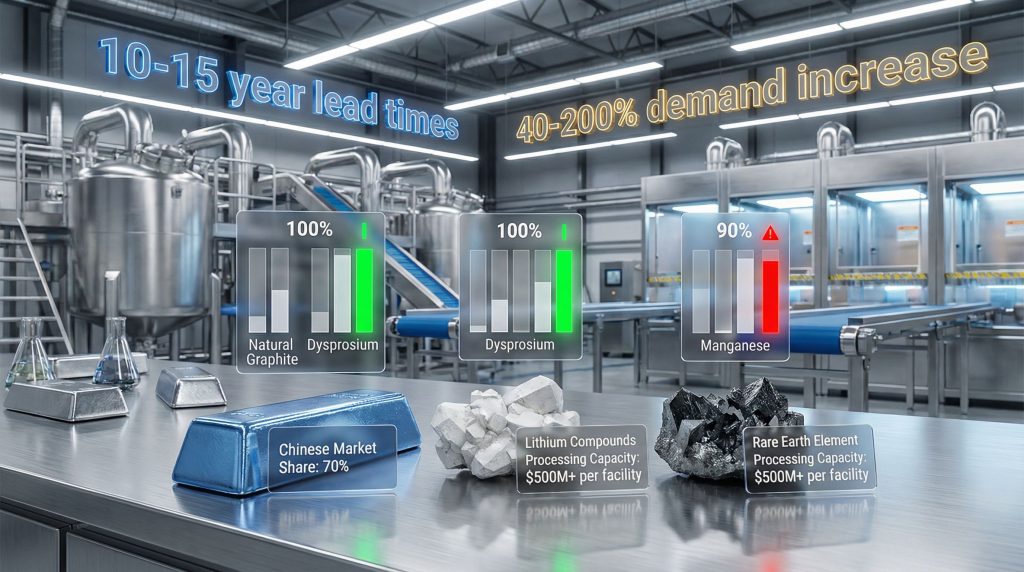
This concentration creates what researchers term "structural lock-in" effects. Processing facilities require massive capital investments, ranging from $500 million to $1.5 billion for full rare earth separation operations. However, the technical complexity involved in these facilities means that lead times from planning to production average 10-15 years, compared to 5-10 years for primary mining operations.
Quantifying Processing Capacity Constraints
The technical barriers to establishing new processing capacity create measurable constraints across multiple metal categories. Consequently, the European CRM facility initiatives face substantial challenges in establishing alternative processing networks.
Processing Stage Requirements:
• Primary Processing: Initial ore concentration requiring specialised equipment for chemical leaching through hydrometallurgical or pyrometallurgical methods
• Intermediate Processing: Separation of mixed oxides and purification stages requiring precise chemical control systems
• Final Refining: High-purity metal production for end-use manufacturing, often requiring clean room environments
• Value-Added Manufacturing: Alloy production and component manufacturing integrating multiple processed materials
Each processing stage demands distinct technical expertise, environmental infrastructure, and regulatory compliance systems. Rare earth processing specifically involves multiple chemical separation steps using hydrochloric acid and other reagents, creating cumulative technical and regulatory barriers that extend development timelines significantly.
Energy and Environmental Intensity:
Rare earth separation requires 10-20 MWh per ton of separated rare earth oxides, according to International Renewable Energy Agency assessments (2021). This energy intensity creates substantial operating cost considerations in jurisdictions with high electricity prices or carbon pricing mechanisms.
Processing facilities generating radioactive waste, particularly thorium-bearing refuse from rare earth processing, face regulatory modification costs averaging $50-100 million in facility upgrades when operating in OECD countries, based on U.S. Geological Survey assessments (2022).
How Does China's Processing Dominance Create Global Vulnerabilities?
Market Share Analysis Across Critical Metal Categories
China's control over critical metals processing extends across virtually every category essential for clean energy technologies, creating systematic vulnerabilities that affect global supply chain security. Furthermore, this concentration represents a critical metals processing bottleneck that could constrain the entire clean energy transition.
| Metal Category | Chinese Market Share | Next Largest Producer | Strategic Vulnerability Level |
|---|---|---|---|
| Natural Graphite Purification | 95-98% | Madagascar (crude production, 8%) | Critical |
| Dysprosium Separation | 100% | Myanmar (ore extraction only) | Critical |
| Rare Earth Separation (overall) | 90% | United States (12%) | Critical |
| Manganese Refining | 85-90% | South Africa (3%) | High |
| Cobalt Refining | 65-70% | Finland (8-10%) | High |
| Lithium Processing | 55-65% | Chile (12%) | Moderate-High |
| Gallium Wafer Production | 95% | Rest of world (5%) | Critical |
Sources: U.S. Geological Survey Mineral Commodity Summaries (2024), IEA World Minerals & Metals Strategic Report (2024), Benchmark Mineral Intelligence Critical Minerals Outlook (2024)
The implications of this concentration become apparent when examining specific supply chain dependencies. Madagascar produces significant crude graphite, but virtually all battery-grade graphite purification occurs in Chinese facilities. Similarly, while the Democratic Republic of Congo produces 70% of global cobalt ore, China refines 65-70% of globally traded cobalt to battery-grade specifications.
Economic Mechanisms Behind Processing Concentration
China's dominance in critical metals processing results from multiple converging economic factors that create competitive advantages difficult to replicate in other regions. For instance, China's processing bottleneck continues to shape global energy transition dynamics.
Historical Cost Advantages:
• Labour Cost Differential Legacy: During the 1990-2015 period, wage differentials of 5:1 to 10:1 versus OECD countries allowed Chinese processors to absorb operational inefficiencies and environmental compliance costs
• Environmental Externality Management: Chinese processing facilities historically operated with lower external environmental cost allocation, reducing total system costs by an estimated 20-30%
• Integrated Supply Chain Benefits: Vertical integration from mining through final manufacturing creates internal supply agreement discounts of 15-20% versus international spot pricing
Technical Infrastructure Integration:
The rare earth processing industry in regions like Baotou, Inner Mongolia, and Shenzhen employs over 50,000 workers with 10-20+ years of experience in specific separation chemistries. This workforce specialisation represents a technical asset that competing regions cannot easily replicate, according to IEA workforce analysis (2024).
Chinese processing facilities benefit from shared chemical feedstock suppliers, integrated waste treatment infrastructure, and metallurgical research centres, reducing per-unit costs by 20-30% compared to standalone greenfield facilities in other regions.
Historical Precedent: The 2010 Rare Earth Export Control
The strategic implications of processing concentration were demonstrated during China's 2010 rare earth export reduction. China decreased rare earth exports from 50,000 tons (2009) to 30,000 tons (2010) due to stated domestic demand prioritisation and environmental policy implementation.
Market Response:
• Global rare earth oxide prices increased 600% within 12 months
• Wind turbine magnet manufacturers in Europe, Japan, and North America faced 18-24 month lead times
• Clean energy deployment timelines extended as manufacturers absorbed 3-4x price premiums
• Military and defence systems experienced component shortages affecting advanced weapons systems
This event demonstrated that a single processing hub could unilaterally constrain global clean energy deployment timelines and defence capabilities simultaneously, highlighting the strategic nature of processing capacity control.
Which Technical Challenges Amplify Processing Bottlenecks?
Metallurgical Complexity in Critical Metal Refining
The technical challenges inherent in critical metals processing create barriers that extend beyond simple capital investment requirements. These metallurgical complexities explain why new processing capacity cannot be rapidly deployed even with adequate funding.
Impurity Management in Recycled Content Integration:
Lithium-ion battery recycling breakthrough technologies face substantial technical challenges in achieving primary material purity standards. Mixed hydroxide precipitate (MHP) from recycling contains 5-15% impurities, including cobalt oxides, nickel compounds, manganese oxides, and copper residues. Primary lithium carbonate from mineral processing achieves 99.5%+ purity in single-stage processing, while secondary recycled lithium requires 2-3 additional purification stages, increasing processing costs by 40-60%.
Intermetallic Phase Formation Challenges:
Advanced alloy production faces precise contamination control requirements. Al₁₃Fe₄ brittle phase formation in aluminium-lithium alloys reduces material ductility by 40-60% if iron contamination exceeds 0.8%. Recycled aluminium from mixed demolition waste typically contains 0.5-2.0% iron content, requiring additional processing stages that primary aluminium smelting avoids through controlled electrolysis maintaining <0.1% iron content.
NdFeB magnet production requires <500 ppm cobalt contamination levels. Recycled magnet material from shredded electric motors contains co-mingled copper, steel, and rare earth elements requiring complex multi-stage separation processes that add significant cost and processing time.
Reagent Supply Dependencies and Chemical Input Constraints
Critical metals processing depends on substantial chemical reagent inputs that create secondary supply chain vulnerabilities often overlooked in supply security assessments. These dependencies represent another layer of the critical metals processing bottleneck.
"Hydrometallurgical processing for battery metals requires massive acid and base inputs, with projected demand increases of 40-200% by 2035 creating potential supply bottlenecks that could inflate both capital and operational expenditures for new processing facilities."
Chemical Input Requirements by Metal Category:
| Process Input | Battery Metal Application | Volume Requirement | Strategic Constraint |
|---|---|---|---|
| Hydrochloric Acid (HCl) | Cobalt, Nickel, Lithium | 3-5 tons per ton refined metal | Global capacity 150M tons/year; battery demand +40-80M tons/year by 2035 |
| Sulfuric Acid (H₂SO₄) | Lithium, Nickel, Manganese | 2-4 tons per ton refined metal | Global capacity 280M tons/year; battery demand +60-120M tons/year by 2035 |
| Sodium Hydroxide (NaOH) | All battery metals | 1-2 tons per ton refined metal | Global capacity 85M tons/year; battery demand +30-60M tons/year by 2035 |
| Process Water | All hydrometallurgical operations | 50-200 tons per ton refined metal | Water-stressed regions face competing agricultural demands |
These reagent requirements create cascading supply chain dependencies. Battery metal processing expansion could consume 20-30% of global chemical reagent production capacity by 2035, potentially creating bottlenecks in chemical supply chains that affect multiple industrial sectors beyond clean energy.
Waste Management and Environmental Compliance Barriers
Processing facility development faces substantial environmental compliance requirements that add both capital costs and development timeline extensions, particularly in OECD countries with stringent environmental regulations. Moreover, these waste management challenges significantly impact project feasibility.
Radioactive Waste Handling:
Rare earth processing generates radioactive thorium-bearing tailings at ratios of 1-2 million tons annually per major facility. Geological containment systems, water treatment infrastructure, and long-term monitoring requirements add $50-100 million in capital costs and $5-10 million in annual operating expenses for facilities in jurisdictions with comprehensive environmental oversight.
Permitting Timeline Extensions:
New critical metals processing facilities in North America and Europe require 5-8 years of environmental assessment and permitting procedures before construction authorisation. These timelines extend total project development to 15-20+ years when combined with construction and commissioning phases.
Community opposition factors significantly affect facility permitting success rates. Processing facilities proposing radioactive waste management or acid processing operations face organised local resistance that can extend permitting timelines by additional 2-5 years through legal challenge processes.
Why Do Recycling Solutions Have Limited Near-Term Impact?
Material Flow Timing Constraints
While recycling represents a crucial long-term supply chain diversification strategy, the timing constraints inherent in material flows limit near-term impact on primary supply dependencies.
End-of-Life Availability Timeline:
Electric vehicle batteries typically achieve 8-15 year service lives before replacement. The massive scale deployment of lithium-ion battery electric vehicles began after 2015, meaning substantial end-of-life battery flows will not emerge until 2025-2030 at earliest. Peak recycled battery material availability will occur in the 2035-2045 timeframe, according to International Energy Agency lifecycle assessments.
Rare earth permanent magnets in wind turbines have 20-25 year service lives. Wind turbines installed during the 2000-2010 growth period are only beginning to reach end-of-life status, limiting current recycled rare earth availability to small volumes from automotive and consumer electronics applications.
Current Recovery Rate Achievements:
European and North American e-waste recycling systems achieve approximately 50% collection rates for consumer electronics containing critical metals. However, recovery efficiency varies dramatically by metal category and technological application.
Technical Limitations in Secondary Processing
Recycling technology faces inherent efficiency limitations that constrain the contribution recycled materials can make to total supply requirements, even with optimal collection systems.
| Metal Category | Current Recovery Rate | Primary Technical Challenge | Cost Premium vs. Primary |
|---|---|---|---|
| Rare Earth Magnets | 15-25% | Complex separation chemistry | 200-300% |
| Lithium-Ion Batteries | 30-40% | Multi-metal extraction coordination | 150-200% |
| Cobalt | 45-55% | Purity specification requirements | 120-180% |
| Natural Graphite | <10% | Structural degradation during use | 400-500% |
Separation Chemistry Complexity:
Rare earth magnet recycling requires complete dissolution and re-separation of neodymium, praseodymium, dysprosium, and iron components. The chemical processes mirror primary rare earth separation but operate on smaller scales with higher contamination levels, reducing economic efficiency significantly.
Battery recycling faces multi-metal coordination challenges because lithium, cobalt, nickel, and manganese must be recovered simultaneously from complex cathode chemistries. Current pyrometallurgical processes recover cobalt and nickel effectively but lose lithium to slag, while hydrometallurgical processes achieve higher lithium recovery but require extensive chemical inputs.
Circular Economy Projections and Realistic Timelines
International Energy Agency scenario modelling suggests recycling could reduce primary critical metal demand by approximately 10% by 2040, providing meaningful but insufficient supply chain diversification for clean energy deployment targets.
Systemic Constraints Limiting Recycling Impact:
• Collection System Fragmentation: Electronic waste collection systems remain fragmented across jurisdictions, reducing material recovery efficiency
• Design Standardisation Requirements: Battery and magnet recycling efficiency depends on standardised designs that facilitate disassembly and separation
• Geographic Mismatch: End-of-life material availability concentrates in developed markets while processing capacity concentrates in Asia
The most optimistic recycling scenarios suggest 15-20% primary demand reduction by 2050, assuming coordinated policy intervention, standardised product design, and substantial recycling infrastructure investment. These projections indicate recycling will complement but cannot replace diversified primary supply chain development.
What Strategic Responses Address Processing Vulnerabilities?
Diversification Investment Requirements
Addressing critical metals processing bottlenecks requires coordinated financial mechanisms that can absorb the high capital requirements and extended development timelines inherent in processing facility development.
Public-Private Partnership Models:
Processing facility development increasingly relies on hybrid financing structures combining government risk mitigation with private sector operational expertise. The U.S. Development Finance Corporation has committed $2.5+ billion to critical mineral processing projects since 2022, providing loan guarantees that reduce private investor risk exposure.
European Union strategic autonomy initiatives include €6.8 billion in direct funding and loan guarantees for critical raw materials processing capacity through the European Raw Materials Alliance, targeting 25% reduction in import dependency by 2030.
Capital Investment Mechanisms:
• Ex-Im Bank Financing: Export-Import Bank loan programmes providing 10-15 year financing for processing facility capital equipment
• Price Floor Guarantees: Government commitments to purchase processed materials at predetermined prices during initial operation phases
• Fast-Track Permitting: Regulatory streamlining reducing environmental assessment timelines from 5-8 years to 2-3 years for strategic projects
International cooperation frameworks with Kazakhstan and Uzbekistan provide access to uranium processing infrastructure that can be adapted for rare earth separation, leveraging existing technical expertise and environmental management systems.
Substitution Research and Performance Trade-offs
Material substitution research addresses processing bottlenecks by reducing demand intensity for the most constrained metal categories, though substitution typically involves performance compromises that affect system-level efficiency. Additionally, direct lithium extraction technologies offer promising alternatives for reducing processing complexity.
Magnet Technology Development:
Lower-dysprosium magnet development programmes target 50% reduction in dysprosium content while maintaining 90% of performance characteristics. Grain boundary engineering and advanced coating technologies can partially compensate for reduced dysprosium content, though operating temperature ranges decrease from 180°C to 150°C maximum.
Battery Chemistry Evolution:
Lithium-iron-phosphate (LFP) battery chemistry adoption reduces cobalt and nickel requirements but involves energy density reductions of 15-20% compared to nickel-cobalt-manganese (NCM) chemistries. This trade-off increases vehicle weight and reduces driving range, creating system-level performance impacts.
Efficiency vs. Material Intensity Optimisation:
Electric motor design optimisation can reduce rare earth magnet requirements by 20-30% through improved magnetic circuit design and advanced control algorithms. These approaches trade increased electronic complexity for reduced material intensity, potentially improving supply chain resilience while maintaining overall system performance.
Stockpiling Limitations and Strategic Reserve Considerations
Strategic material stockpiling provides temporary supply security but faces fundamental limitations that constrain effectiveness for extended supply disruptions.
Storage Degradation Factors:
Refined metal products face oxidation and contamination issues during extended storage. Rare earth oxide powders absorb atmospheric moisture, creating clumping and purity degradation that requires reprocessing before use. Battery-grade lithium compounds have 2-5 year maximum storage periods before chemical degradation affects electrochemical performance.
Emergency Supply Duration Analysis:
Current U.S. strategic stockpile levels provide 30-90 day supply coverage for most critical metals under normal consumption patterns. During accelerated clean energy deployment scenarios, stockpile coverage drops to 15-45 days, insufficient for the 12-18 month timeline required to activate alternative supply sources.
Volume vs. Value Optimisation:
Strategic stockpiles must balance physical storage constraints with economic value preservation. Rare earth elements require climate-controlled storage facilities costing $10-20 million per facility for meaningful volumes, while material degradation rates average 2-5% annually even with optimal storage conditions.
The next major ASX story will hit our subscribers first
How Do Processing Bottlenecks Impact Clean Energy Transition Timelines?
Demand Trajectory Analysis for Net-Zero Scenarios
Critical mineral demand projections for net-zero scenarios reveal potential shortage periods that could fundamentally constrain clean energy deployment rates during the late 2020s and 2030s. Consequently, the critical metals processing bottleneck emerges as a primary constraint on transition speed.
Material Shortage Projections:
International Energy Agency modelling suggests potential shortages across multiple critical metal categories beginning in the early 2030s if current demand trajectories continue without substantial supply chain diversification:
• Lithium: 40% demand-supply gap by 2030 under accelerated EV adoption scenarios
• Cobalt: 20-30% shortage potential by 2035 without substantial recycling capacity development
• Rare Earth Elements: 50-70% processing capacity constraints for dysprosium and terbium by 2030
• Graphite: 25% battery-grade material shortage by 2030 without non-Chinese purification capacity
These shortage projections assume continued clean energy deployment growth rates of 15-25% annually, consistent with net-zero pathway requirements documented in IPCC assessment reports.
Technology Scaling Dependencies:
Wind turbine manufacturing faces direct constraints from rare earth magnet availability. Each 3MW wind turbine requires 600-800 kg of rare earth permanent magnets, creating linear scaling requirements between wind deployment and rare earth processing capacity.
Electric vehicle scaling faces battery material constraints that could limit production growth rates. Tesla's gigafactory model requires 50,000+ tons annually of lithium hydroxide equivalent for 500,000 vehicle production capacity, demonstrating direct material-manufacturing scaling relationships.
Investment Risk Assessment for Energy Transition Projects
Processing bottlenecks create multiple risk categories for clean energy investment portfolios that require specialised risk management approaches. Furthermore, the development of battery-grade refinery operations becomes increasingly critical for supply security.
"Processing bottlenecks in critical metals create three primary risks for clean energy investments: (1) price volatility from concentrated supply chains, (2) project delays from material shortages, and (3) technology performance compromises from substitution requirements."
Price Volatility Documentation:
Benchmark Mineral Intelligence data from 2020-2024 demonstrates rare earth oxide price fluctuations of 200-400% annually due to processing capacity constraints, compared to 20-40% volatility in agricultural commodities with distributed production. This volatility creates project economics uncertainty that affects financing availability and investment returns.
Project Timeline Risk Factors:
Wind farm development projects face 12-24 month delays when magnet suppliers cannot meet delivery schedules due to rare earth processing constraints. Solar panel manufacturers report 6-18 month lead time extensions for silver paste and other critical inputs when processing capacity operates at maximum utilisation.
Electric vehicle manufacturers increasingly sign long-term supply agreements (5-10 years) with battery material suppliers to secure price certainty, effectively transferring supply chain risk to automotive OEMs and reducing supplier market flexibility.
Policy Coordination Requirements for Supply Security
Addressing critical metals processing bottlenecks requires coordinated policy intervention across multiple government agencies and international frameworks, extending beyond traditional mining and energy policy domains.
Industrial Policy Integration:
Critical mineral processing development requires coordination between energy policy, trade policy, environmental regulation, and national security objectives. The U.S. Critical Minerals and Materials 2024 Assessment identifies 50+ federal agencies with overlapping jurisdiction over critical mineral supply chains.
Permitting Reform Priorities:
Processing facility development timelines depend critically on environmental assessment streamlining and regulatory coordination. Current best practices reduce permitting timelines through:
• Concurrent Review Processes: Multiple agency assessments conducted simultaneously rather than sequentially
• Categorical Exclusions: Pre-approved environmental assessment categories for strategic processing facilities
• Federal Coordination: Single lead agency coordination for multi-jurisdictional projects
International Coordination Mechanisms:
NATO Critical Raw Materials Report (2024) identifies rare earth supply disruption as a collective defence vulnerability affecting alliance military capability and renewable energy transition coordination. This security assessment framework provides justification for coordinated allied investment in non-Chinese processing capacity development.
What Does the Future Processing Landscape Look Like?
Emerging Processing Capacity Outside China
Alternative processing capacity development outside China faces substantial technical and economic challenges but shows measurable progress across multiple jurisdictions and metal categories.
North American Capacity Development:
MP Materials Corporation is developing separation capacity at the Mountain Pass facility in California, targeting 10,000 tons annually of separated rare earth oxides by 2025. This capacity represents approximately 6-8% of global rare earth separation capability and maintains dependence on Chinese intermediate processing during the development phase.
USA Rare Earth Inc. has proposed a comprehensive rare earth processing facility in Oklahoma with planned 15,000 tons annual capacity by 2027, though the project requires $350+ million in capital investment and faces permitting uncertainties.
European Strategic Autonomy Initiatives:
The European Raw Materials Alliance has identified 37 critical raw material projects across member states, including rare earth processing facilities in Estonia (Silmet), Sweden (LKAB rare earth processing), and France (Orano chemical processing adaptation).
Lynas Rare Earths operates the only major rare earth separation facility outside China at Mount Weld, Australia, producing approximately 12,000 tons annually of separated rare earth oxides with expansion capacity to 20,000+ tons by 2026.
Capacity Development Timelines:
Current non-Chinese processing capacity development suggests 25-35% diversification by 2030 under optimistic scenarios, assuming coordinated government support and successful permitting. Conservative projections indicate 15-20% diversification by 2030 with market-driven development only.
Technology Innovation Pathways for Processing Efficiency
Advanced processing technologies offer potential pathways to reduce capital costs, development timelines, and environmental impacts associated with critical metals processing facility development.
Modular Processing Design:
Modular rare earth separation systems reduce initial capital requirements from $500M+ to $50-100M for smaller-scale operations (1,000-2,000 tons annual capacity). These systems sacrifice economies of scale but enable distributed processing networks with shorter development timelines.
Containerised processing units allow rapid deployment and operational flexibility, though per-unit costs increase 40-60% compared to integrated large-scale facilities.
Advanced Separation Techniques:
Molecular recognition technology and selective ion exchange resins reduce chemical reagent consumption by 30-50% compared to traditional rare earth separation processes. These innovations decrease environmental impact and operating costs while maintaining separation efficiency.
Continuous processing systems replace traditional batch separation with flowing systems that reduce processing time from weeks to hours for specific separation steps, improving capital utilisation and reducing facility footprint requirements.
Artificial Intelligence Applications:
Machine learning optimisation systems can improve processing efficiency by 10-20% through real-time optimisation of chemical addition, temperature control, and separation timing. These systems reduce skilled operator requirements and improve consistency in processing quality.
Predictive maintenance applications reduce processing facility downtime by 15-30% through equipment failure prediction and optimised maintenance scheduling, improving overall capacity utilisation rates.
Long-term Strategic Scenarios for Supply Chain Evolution
Future critical metals supply chain configurations will depend on the interaction between policy intervention intensity, technological advancement rates, and geopolitical stability factors that remain uncertain.
| Scenario | Timeline | Key Assumptions | Non-Chinese Processing Share | Clean Energy Impact |
|---|---|---|---|---|
| Accelerated Diversification | 2025-2035 | Coordinated government support, streamlined permitting | 40% | Limited deployment constraints |
| Gradual Market Evolution | 2025-2040 | Market-driven development, moderate policy support | 25% | Periodic shortage episodes |
| Status Quo Continuation | 2025-2050 | Limited policy intervention, Chinese dominance maintained | 15% | Significant deployment delays |
| Technology Breakthrough | 2025-2030 | Revolutionary processing technologies, substitution | 60%+ | Accelerated transition possible |
Disclaimer: These scenario projections involve speculative analysis based on current trends and policy proposals. Actual outcomes may vary significantly based on technological developments, geopolitical changes, and policy implementation effectiveness not captured in current modelling frameworks.
Investment Implications by Scenario:
Under accelerated diversification scenarios, early-stage processing facility development projects offer potential returns of 15-25% annually but require 10-15 year investment horizons and substantial regulatory risk tolerance.
Gradual evolution scenarios favour established processing companies with existing operations and expansion capabilities rather than greenfield development projects that face extended permitting and development timelines.
Technology breakthrough scenarios could render current processing capacity investments obsolete while creating opportunities for early adopters of advanced separation and substitution technologies.
Frequently Asked Questions About Critical Metals Processing
How Long Does It Take to Build New Processing Facilities?
Comprehensive rare earth processing facility development requires 10-15 years from initial planning to commercial production, including 3-5 years for feasibility assessment and permitting, 2-4 years for construction, and 1-2 years for commissioning and optimisation.
Battery metal processing facilities (lithium, cobalt, nickel) typically require 5-8 years from planning to production due to less complex separation chemistry, though environmental permitting still requires 2-4 years in OECD jurisdictions.
Fast-track development approaches using modular systems and expedited permitting can reduce timelines to 3-5 years but typically involve higher per-unit capital costs and reduced economies of scale.
Which Metals Face the Most Severe Processing Constraints?
Dysprosium and terbium represent the most constrained critical metals processing bottlenecks, with 100% of global separation capacity located in China and no announced alternative capacity development outside China.
Natural graphite purification for battery applications faces 95%+ Chinese processing concentration, though technical barriers to alternative development remain lower than rare earth separation complexity.
Gallium processing for semiconductor applications represents an emerging constraint with 95% Chinese capacity, though volumes remain smaller than battery material requirements.
Can Recycling Eliminate the Need for New Mining Operations?
Recycling cannot eliminate new mining requirements within relevant policy timelines for clean energy transition targets. Maximum recycling potential achieves 10-15% primary demand reduction by 2040 under optimistic scenarios.
End-of-life material availability depends on service life cycles that extend 10-25 years for clean energy technologies, limiting recycled material flows during the 2025-2035 critical deployment period.
Recycling economics currently require 120-300% cost premiums versus primary production, making recycled materials economically viable only under supply shortage conditions or with policy support mechanisms.
What Role Do Government Policies Play in Processing Development?
Government intervention provides essential risk mitigation for processing facility investment through loan guarantees, purchase commitments, and regulatory streamlining that private markets cannot provide independently.
Permitting reform represents the single most impactful policy intervention, potentially reducing development timelines by 3-5 years through coordinated agency review and categorical exclusions for strategic projects.
International coordination through allied government frameworks enables risk sharing and market scale that justifies processing facility investment in multiple jurisdictions, reducing single-country dependencies.
Strategic stockpiling and purchasing commitments provide demand certainty that justifies private sector capital investment in processing capacity expansion projects with extended payback periods.
Need to Stay Ahead of Critical Metals Supply Disruptions?
Discovery Alert's proprietary Discovery IQ model delivers instant notifications about significant ASX mineral discoveries, helping investors identify opportunities in critical metals processing and mining companies before broader market awareness. Explore historic examples of major mineral discoveries that have generated substantial returns, and begin your 30-day free trial to gain immediate insights into actionable opportunities across the entire critical materials supply chain.