June 18, 2026
The Hidden Complexity Behind Heavy Rare Earth Supply Chains
The global rare earth industry is frequently misunderstood by mainstream investors, and that misunderstanding tends to cluster around one critical distinction: not all rare earths are created equal. The periodic table groups the lanthanide series together, but from a commercial and strategic standpoint, the divide between light rare earth elements (LREEs) and heavy rare earth elements (HREEs) could not be more consequential. Understanding this divide is the key to grasping why the Critical Metals Tanbreez project drilling campaign, currently underway in southern Greenland, carries significance well beyond a standard junior mining programme.
LREEs such as cerium, lanthanum, and praseodymium are relatively abundant and widely produced. HREEs, by contrast, including dysprosium, terbium, holmium, and erbium, are far scarcer in terms of economically viable deposits outside of China. They are also functionally irreplaceable in the most demanding magnet applications. Dysprosium, for instance, is added to neodymium-iron-boron permanent magnets specifically to maintain coercivity at elevated operating temperatures, a property critical to electric vehicle motors and wind turbine generators. There is currently no commercially viable substitute for this function, which means the strategic value of HREE-rich deposits is structurally elevated in a way that is unlikely to change in the near term.
When big ASX news breaks, our subscribers know first
Why Tanbreez Occupies a Rare Position in Global Rare Earth Development
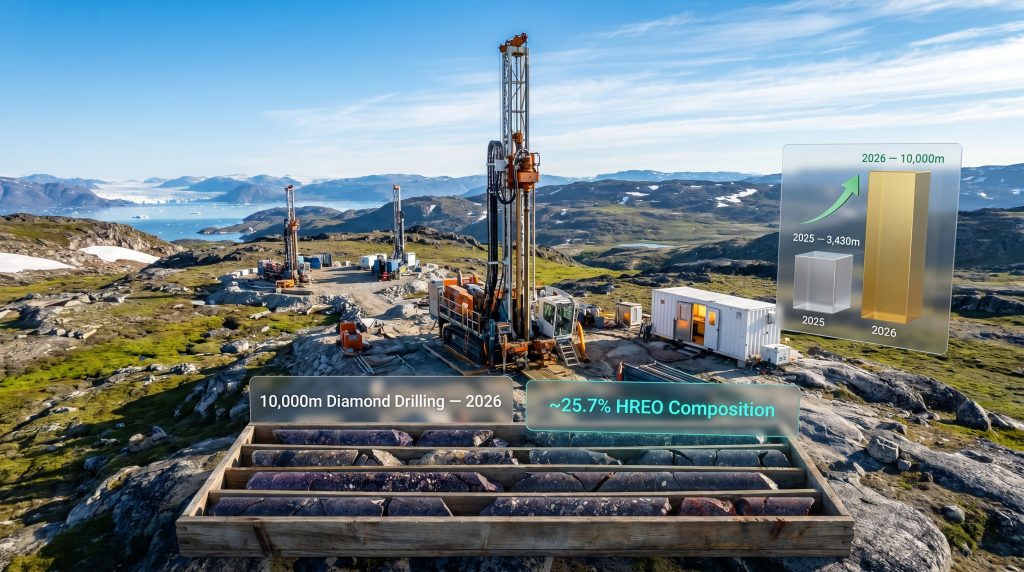
Located in southern Greenland, the Tanbreez REE deposit is wholly owned by Critical Metals Corp (CRML) and is frequently cited among the largest undeveloped rare earth deposits on Earth. What distinguishes it from the majority of rare earth projects in active development is its composition. The 2025 drilling campaign, which covered 3,430 metres across the Fjord, Upper Fjord, and Area B zones, returned total rare earth oxide plus yttrium (TREO+Y) grades ranging from approximately 0.35% to 0.77%, with an average heavy rare earth oxide (HREO) proportion of approximately 25.7% of total rare earth oxides.
That figure deserves context. Most commercially operating rare earth mines globally are dominated by LREEs, with HREO fractions typically falling well below 10% of total oxide content. Chinese ionic clay deposits in Jiangxi Province are among the few geological settings globally that naturally concentrate HREEs at meaningful grades, and they have historically underpinned China's dominance of the HREE supply chain. A deposit averaging roughly 25.7% HREO composition sits in a genuinely rare category of projects globally, outside of China's ionic clay base.
Furthermore, the broader context of Greenland critical minerals development has drawn increasing international attention, with Greenland's geological endowment now considered one of the most strategically significant mineral frontiers outside of established producing nations.
The strategic implications are significant: Western manufacturers of EV drivetrains, defence electronics, and high-performance industrial equipment are actively seeking non-Chinese HREE sources, and the pool of viable candidates is extremely shallow.
The Geological Character of Tanbreez: What Makes It Distinctive
Tanbreez is hosted within an alkaline igneous complex, specifically a nepheline syenite intrusion associated with the Ilímaussaq complex in southern Greenland. This geological setting is characteristic of rare earth mineralisation associated with peralkaline rocks, which tend to concentrate HREEs through specific fractionation processes during magmatic cooling. The primary rare earth minerals at Tanbreez include steenstrupine and mosandrite, which are less commonly encountered than the bastnasite and monazite mineralogy typical of the world's largest LREE producers such as Mountain Pass in California or Bayan Obo in Inner Mongolia.
This mineralogical distinction has processing implications. Steenstrupine is a relatively complex silicate phosphate mineral, and extracting rare earths from it requires more sophisticated hydrometallurgical approaches than processing bastnäsite concentrates. The rare earth processing challenges involved are considerable, but so too is the strategic value of the output, given the HREE weighting of the recoverable oxide suite.
What the 2026 Drilling Programme Actually Involves
The 2026 Critical Metals Tanbreez project drilling programme represents a substantial operational step-up from the prior year's campaign. The current programme targets 10,000 metres of diamond core drilling across priority mineralised zones, nearly three times the scale of the 3,430-metre 2025 effort. According to Critical Metals Corp's project update, this acceleration reflects the company's confidence in the deposit's potential following strong 2025 results.
Diamond drilling was selected over reverse circulation (RC) methods for technically sound reasons. In complex, structurally heterogeneous geological settings, diamond core drilling recovers intact rock cylinders that allow geologists to:
- Measure true dip and strike of mineralised intervals
- Capture structural features including foliation, fracturing, and contact relationships
- Obtain representative samples for detailed geochemical and mineralogical analysis
- Conduct oriented core measurements to build three-dimensional geological models
The programme targets three key zones identified and partially characterised during the 2025 campaign:
| Target Zone | 2025 Status | 2026 Objective |
|---|---|---|
| Fjord Zone | Drilled in 2025; contributed to revised MRE | Further resource definition |
| Upper Fjord Zone | Partially drilled in 2025 | Active drill-out for resource continuity |
| Area B | High-grade HREE results confirmed | Extension and depth testing |
Infrastructure and Logistics: The Unseen Foundation of Arctic Drilling
One aspect of the Tanbreez programme that is easy to overlook is the infrastructure complexity involved in executing a large-scale drilling campaign in a sub-Arctic Greenlandic environment. Completing on-site accommodation and operational support facilities ahead of drill mobilisation is not a minor logistical footnote. It represents weeks of preparatory work in a remote location with constrained seasonal access windows, limited ground transport options, and significant environmental compliance requirements.
The two-to-three week pre-drilling ground preparation phase involves:
- Geological surface mapping to verify target zone characteristics
- Ground condition assessments confirming final drill collar positions
- Blast site marking for planned access route development
- Finalisation of drill pad locations and access improvements
- Collar surveys and ongoing environmental, health and safety monitoring
Each of these steps directly influences the quality of the data ultimately produced. A poorly positioned drill collar, for instance, can result in a hole that misses the mineralised interval entirely, wasting both time and capital.
The Mobile Geochemical Laboratory: A Strategic Operational Advantage
One of the less widely discussed elements of the Tanbreez development approach is the acquisition of a mobile geochemical analysis laboratory. In conventional remote drilling programmes, drill core samples are shipped to external laboratories for assay, a process that can take several weeks from sample dispatch to results receipt. During active drilling, this lag creates a significant bottleneck: geologists cannot make informed decisions about drilling targets, depth extensions, or resource model updates until assay results are returned.
A mobile laboratory deployed on-site compresses this feedback loop dramatically. Near-real-time elemental analysis allows the geological team to:
- Redirect drilling resources toward higher-grade intervals as they are identified
- Adjust drill hole depths based on observed mineralisation trends
- Accelerate resource model updates by integrating assay data faster
- Reduce the risk of under- or over-drilling any given target zone
For a programme of 10,000 metres across multiple zones with variable grade characteristics (0.35% to 0.77% TREO+Y), this operational agility is genuinely value-additive, not merely a convenience.
How 2025 Results Are Shaping 2026 Geological Strategy
The 2025 drilling programme was not simply a precursor to 2026. Its results directly shaped the current campaign's design. The data fed into a revised Mineral Resource Estimate and informed mine-planning studies, which in turn defined where the 2026 drill holes are positioned and what geological questions they are designed to answer.
The grade variability observed in 2025, spanning roughly 0.35% to 0.77% TREO+Y, indicates that Tanbreez contains meaningful internal heterogeneity. This is not unusual for large alkaline intrusion-hosted deposits, but it does require careful geological modelling to distinguish higher-grade domains from lower-grade matrix material. The 2026 programme is, in part, a systematic effort to resolve this heterogeneity at the deposit scale and establish the geological controls on grade distribution.
Understanding what drives grade variability within a deposit is as important as knowing the average grade. It determines whether a deposit can be selectively mined for higher-value material and how that selectivity affects project economics over the mine life.
Deposit-Scale Resource Expansion: Why Metres Drilled Translate to Commercial Value
For a project at the pre-feasibility stage, increasing the total volume of mineralisation that can be classified at higher resource confidence categories (Indicated or Measured under JORC or NI 43-101 standards) directly reduces technical risk in the eyes of project financiers and potential offtake partners. Drilling converts Inferred resources into more reliable categories by demonstrating geological continuity between drill holes. The 10,000-metre 2026 programme, particularly if it confirms continuity across the Upper Fjord and Area B zones, has the potential to substantially upgrade the confidence classification of a meaningful portion of Tanbreez's resource inventory.
Risk Factors Specific to Sub-Arctic Rare Earth Development
No analysis of the Critical Metals Tanbreez project drilling programme would be complete without a frank assessment of the risks involved. Several categories deserve investor attention. In addition, the evolving landscape of rare earth supply chains adds further complexity to the commercial environment surrounding projects like Tanbreez.
Operational and Seasonal Risks
- Greenland's seasonal weather window constrains the annual drilling calendar, creating schedule compression risk
- Remote logistics for equipment, personnel, and consumable supplies add cost and lead time uncertainty
- Ground conditions in periglacial environments can be unpredictable, affecting drill pad stability and access route integrity
Technical and Geological Risks
- Grade variability between 0.35% and 0.77% TREO+Y across zones suggests that resource definition will require dense drill spacing to achieve reliable estimation
- The complex steenstrupine mineralogy at Tanbreez introduces processing uncertainty that will need to be resolved through metallurgical test work before feasibility studies can be finalised
- Geotechnical data collection, running parallel to drilling, is critical for any future open pit or underground mine design
Corporate Execution Risk
- CRML is simultaneously managing the 10,000-metre drilling campaign and advancing the ~$835 million (A$1.19 billion) proposed acquisition of European Lithium, announced via a letter of intent in April 2026. Executing both in parallel demands significant management bandwidth and capital allocation discipline.
Disclaimer: The above risk factors are provided for informational purposes only and do not constitute financial advice. Investors should conduct their own due diligence and consult qualified advisers before making investment decisions.
The next major ASX story will hit our subscribers first
The Broader Corporate Context: Building a Diversified Critical Minerals Platform
The European Lithium transaction, if completed, would position CRML as a multi-commodity critical minerals developer with exposure to both rare earths and lithium, two of the most strategically contested mineral categories in the current energy transition landscape. Tanbreez would serve as the rare earth anchor of this platform, while European Lithium's assets would add lithium exposure relevant to battery cell manufacturing supply chains.
This diversification strategy reflects a broader trend among critical minerals developers: building portfolios that span multiple battery and magnet supply chain inputs, reducing single-commodity concentration risk and potentially attracting a wider pool of strategic investors and offtake counterparties. However, China's export restrictions on key rare earth elements have further accelerated Western interest in securing alternative sources, making projects such as Tanbreez increasingly relevant to policymakers and industrial buyers alike.
Comparative Framework: Where Tanbreez Sits Among Global HREE Projects
| Characteristic | LREE-Dominant Projects | HREE-Rich Projects (e.g., Tanbreez) |
|---|---|---|
| Primary Elements | Ce, La, Nd, Pr | Dy, Tb, Ho, Er |
| Magnet-Grade Relevance | Moderate | Very High |
| Global Supply Concentration Risk | Moderate | Very High (China-dominated) |
| Processing Complexity | Lower (bastnäsite/monazite) | Higher (complex silicates) |
| Strategic Buyer Profile | Broad industrial base | Defence, EV, wind energy OEMs |
| HREO as % of TREO (typical) | Under 10% | ~25.7% (Tanbreez 2025 results) |
The rarity of HREE-rich projects outside of China's ionic clay deposit belt is precisely what makes the Tanbreez deposit geologically and commercially distinctive. Projects with this composition profile are uncommon, and the current geopolitical climate has materially increased the urgency with which Western industrial supply chains are seeking to identify and develop alternatives. Consequently, reporting from specialist publications has highlighted Tanbreez as one of the more credible non-Chinese HREE development prospects currently advancing through the resource definition phase.
Frequently Asked Questions: Critical Metals Tanbreez Project Drilling
What is the total scale of the 2026 Tanbreez drilling programme?
The programme encompasses 10,000 metres of diamond core drilling across multiple priority mineralised zones at the Tanbreez Rare Earth Project in southern Greenland, initiated in June 2026.
What grades did the 2025 Tanbreez drilling campaign return?
The 2025 programme covered 3,430 metres across the Fjord, Upper Fjord, and Area B target zones, returning TREO+Y grades of approximately 0.35% to 0.77%, with an average HREO composition of roughly 25.7% of total rare earth oxides.
Why are heavy rare earth elements strategically important?
HREEs such as dysprosium and terbium are functionally critical in high-performance permanent magnets used in EV drivetrains, wind turbines, and defence systems. Their global supply is heavily concentrated within China, making alternative sources in Western-aligned jurisdictions commercially and strategically significant.
What role does the mobile geochemical laboratory play in the programme?
The on-site mobile laboratory accelerates assay turnaround for drill core samples, enabling faster geological model updates and more informed decisions about drilling targets during the active campaign.
What development outcomes is the 2026 drilling designed to support?
Results from the programme are intended to contribute to updated Mineral Resource Estimates, feasibility study inputs, geotechnical assessments, mine planning, and infrastructure development decisions.
What is the significance of the European Lithium acquisition in this context?
CRML's April 2026 letter of intent to acquire European Lithium in a transaction valued at approximately $835 million (A$1.19 billion) indicates a broader corporate strategy to build a diversified critical minerals portfolio, with Tanbreez positioned as the flagship rare earth asset within that platform.
Want to Track the Next Major Critical Minerals Discovery Before the Market Does?
Discovery Alert's proprietary Discovery IQ model delivers real-time alerts on significant ASX mineral discoveries — including critical minerals such as rare earths — instantly converting complex geological data into actionable investment insights for both short-term traders and long-term investors. Explore how historic discoveries have generated substantial returns on Discovery Alert's dedicated discoveries page, and begin your 14-day free trial today to position yourself ahead of the broader market.