May 10, 2026
Critical Mineral Dependencies Expose Western Defense Vulnerabilities
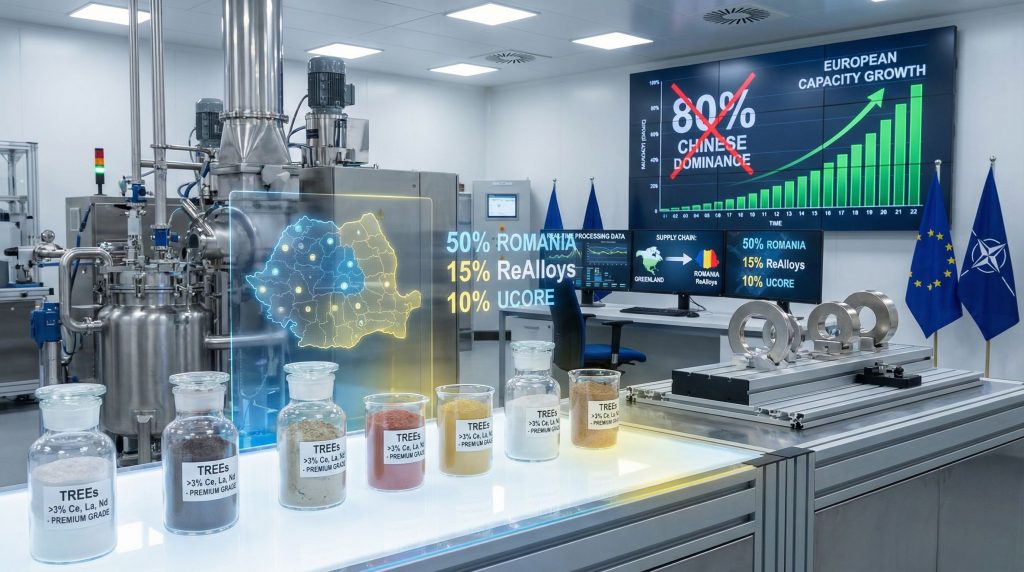
Western defense industries face unprecedented strategic vulnerabilities as China's processing monopoly over rare earth elements reaches approximately 80% of global capacity. The CRML and Romania joint venture for European rare earth supply chain development represents a critical response to this concentration, which creates what military strategists term "chokepoint dependency" across NATO's most advanced weapons systems, from precision-guided munitions to electronic warfare platforms.
European aerospace manufacturers currently rely on Chinese-processed rare earth materials for permanent magnet production in radar systems, missile guidance components, and advanced avionics. The dependency extends beyond raw materials to specialised processing knowledge that typically requires 5-10 years to develop independently. Furthermore, Chinese dominance encompasses both light rare earth elements (LREEs) and heavy rare earth elements (HREEs), with particular control over critical separation and purification technologies.
Supply Chain Bottlenecks in Defense Manufacturing
NATO defense procurement faces immediate risks from this dependency structure. In addition, the development of an European CRM facility becomes increasingly urgent. Critical applications requiring rare earth elements include:
• Neodymium-iron-boron (NdFeB) permanent magnets in precision weaponry
• Dysprosium-enhanced magnets for high-temperature military radar systems
• Electronic warfare components requiring 99.95% purity specifications
• Electromagnetic systems in advanced fighter aircraft
The concentration risk becomes acute during geopolitical tensions, when supply disruptions could affect military readiness within 6-12 months. Historical precedent from 2009-2012 demonstrated how rare earth supply constraints impacted Western defense manufacturers, forcing procurement delays and emergency stockpiling initiatives.
Military-grade rare earth materials require specialised processing chains involving roasting, leaching, solvent extraction, and final refinement. Each processing stage demands environmental controls and technical expertise concentrated primarily in Chinese facilities. This creates what defense analysts describe as "technology moat protection" around Chinese market dominance, highlighting the importance of critical minerals energy security.
Economic Impact of Strategic Dependency
European defense spending on critical minerals supply chain security remains disproportionately low compared to operational procurement budgets. Current estimates suggest NATO nations allocate less than 2% of defense budgets toward supply chain independence initiatives, despite rare earth elements being fundamental to 85% of advanced weapons systems.
The economic vulnerability extends beyond immediate procurement costs. Supply chain disruptions could force European manufacturers to source alternative materials at premium pricing, potentially increasing defense procurement costs by 15-25% during crisis periods. This premium reflects the lack of substitutable processing capacity outside Chinese facilities.
When big ASX news breaks, our subscribers know first
Revolutionary Partnership Models Challenge Mining Economics
The CRML and Romania joint venture represents a fundamental departure from conventional mining finance structures. Traditional mining partnerships typically require 40-60% capital contribution from private partners, creating substantial equity dilution and financial risk exposure. However, the Romanian model eliminates these conventional requirements through innovative carried interest arrangements.
Under this structure, CRML receives a 50% equity stake without capital expenditure requirements for facility construction. The Romanian government, through FPCU (Fabrica de Prelucrare a Concentratelor de Uraniu), assumes capital funding responsibility whilst CRML contributes operational expertise and mining assets. This arrangement represents what financial analysts term "strategic risk reallocation" where government entities prioritise supply chain security over traditional investment returns.
Offtake Commitments as Strategic Assets
The venture allocates 75% of total Tanbreez concentrate output through predetermined offtake agreements:
• 50% allocated to Romania through the FPCU joint venture
• 15% committed to ReAlloys for downstream processing
• 10% designated for UCORE Technologies
• 25% available for additional commercial arrangements
This allocation structure transforms rare earth concentrates from commodity market exposure to contract-based supply chains. Traditional rare earth pricing follows volatile spot market dynamics, whilst this model establishes cost-of-production-plus pricing formulas that reduce commercial risk for both upstream mining operations and downstream processors.
Long-term offtake commitments provide revenue stability that enables project financing through government grants rather than traditional debt-equity structures. The €3.5 billion ($4.07 billion) Critical Raw Materials Act funding from the European Union specifically supports such strategic partnerships between state entities and private operators.
Funding Innovation Through State Partnership
Both CRML and the Romanian government pursue financing through EU Critical Raw Materials Act grants, representing a departure from conventional project finance where 60-70% of capital typically comes from commercial banks. This funding mechanism acknowledges that strategic mineral processing may require government investment to achieve supply chain independence objectives.
The carried interest structure eliminates traditional mining finance constraints including debt service requirements, equity dilution through multiple financing rounds, and commercial return optimisation. Instead, the partnership prioritises operational scale, technical knowledge transfer, and long-term supply security over immediate financial returns.
Romania's Strategic Positioning as European Processing Hub
Romania's selection as Europe's rare earth processing centre reflects multiple geographic, infrastructure, and regulatory advantages that position the country as an optimal hub for critical minerals strategy development. The existing FPCU uranium processing facility provides foundational metallurgical infrastructure directly applicable to rare earth element processing.
Uranium and rare earth processing share common technological requirements including acid leaching capabilities, solvent extraction columns, crystallisation systems, and analytical quality control laboratories. This technology transfer advantage reduces capital requirements by an estimated 40-50% compared to greenfield facility development, whilst accelerating production timelines by 3-4 years.
Existing Industrial Infrastructure Benefits
FPCU's operational capabilities include specialised equipment directly transferable to rare earth processing:
• Chemical laboratories with expertise in radioactive material handling
• Solvent extraction systems for metal separation and purification
• Environmental remediation infrastructure for radioactive waste management
• Skilled workforce experienced in metallurgical and chemical processing
• Transportation networks connecting to European manufacturing centres
The Romanian facility's location provides logistical advantages for connecting Greenland mining operations to European magnet manufacturers. Transportation distances from Romanian processing facilities to Northern European aerospace and defence manufacturers are significantly shorter than routing through non-EU alternatives.
EU Policy Framework Supporting Development
Romania's EU membership and NATO alliance status provide regulatory certainty and security cooperation frameworks unavailable to non-aligned processing locations. The €3.5 billion Critical Raw Materials Act specifically prioritises EU-based processing capabilities to reduce dependence on Chinese facilities.
European Economic Security Strategy objectives emphasise "strategic autonomy" in critical minerals processing, with Romania positioned to capture significant portions of this funding allocation. The regulatory environment favours domestic processing capabilities through streamlined permitting, co-investment incentives, and technology transfer facilitation.
Environmental permitting in Romania follows established EU protocols for radioactive materials processing, leveraging existing regulatory frameworks rather than developing new approval processes. This regulatory familiarity reduces project development timelines and compliance costs compared to alternative European locations.
Technical Specifications Drive Premium Market Positioning
The Tanbreez project targets total rare earth element (TREE) concentrates exceeding specific quality benchmarks that enable aerospace and military-grade magnet production. These specifications represent significant improvements over standard commercial-grade concentrates and position European processing for premium defence applications.
Aerospace-grade rare earth magnets require purity standards typically exceeding 99.9%, with military electronics applications demanding 99.95% purity levels. These specifications are substantially more stringent than commercial rare earth materials, which typically achieve 95-99% purity standards sufficient for consumer electronics and automotive applications.
Value Creation Through Processing Integration
The Romanian facility will produce finished aerospace and military-grade magnets rather than intermediate rare earth concentrates. This downstream integration captures substantial value multiplication:
• Rare earth concentrates: $15-20 per kilogram of TREE content
• Processed rare earth oxides: $25-35 per kilogram
• Finished permanent magnets: $150-250 per kilogram
This represents 10-15x value multiplication through integrated processing and manufacturing. The premium pricing reflects both higher purity requirements and the limited availability of NATO-specification processing capabilities outside Chinese facilities.
Military-specification magnets require additional controls on grain size distribution, magnetic coercivity uniformity, and thermal stability across extreme operating conditions. These specifications are particularly demanding for precision-guided weapons systems, where magnetic performance must remain stable under temperature ranges from -40°C to +150°C and withstand vibration, pressure, and electromagnetic interference.
Traceability Requirements for Defence Applications
NATO-specification materials necessitate documented provenance from mining through final magnet production, with third-party verification of purity and composition at each processing stage. This "chain of custody" requirement eliminates commingling with non-NATO-specification materials and provides complete supply chain transparency.
Traceability systems must document rare earth element sources, processing parameters, quality control results, and handling procedures throughout the supply chain. This documentation enables defence procurement officers to verify material compliance with military specifications and ensures supply chain security for classified defence applications.
The Romanian facility design incorporates segregated processing lines for military-grade materials, with separate storage, handling, and quality control systems that prevent cross-contamination with commercial-grade products. This segregation enables premium pricing whilst maintaining military specification compliance.
Market Dynamics Threaten European Independence Initiatives
Chinese rare earth processors may respond to European independence initiatives through competitive pricing strategies designed to undermine Western processing economics. Historical precedent suggests Chinese producers have capacity to reduce pricing by 20-30% during periods when market share faces competitive threats.
China's processing cost advantages stem from decades of government investment in specialised infrastructure, technical expertise concentration, and integrated supply chains from mining through finished product manufacturing. These advantages enable aggressive pricing during market competition whilst maintaining operational profitability.
Competitive Response Scenarios
Potential Chinese strategic responses include:
• Targeted pricing reductions in European markets to challenge new facility economics
• Technology transfer restrictions affecting processing equipment availability
• Alternative supply chain development with non-NATO allied nations
• Export controls on specialised processing equipment and technical expertise
Chinese processors maintain cost advantages through economies of scale, with total processing capacity exceeding 200,000 metric tons annually compared to planned European capacity of 5,000-10,000 metric tons in initial phases. This scale differential enables Chinese facilities to achieve lower per-unit processing costs whilst maintaining profitability at reduced pricing levels.
Scaling Challenges for Western Processing
European rare earth processing independence requires significant capital investment beyond the Romanian facility. Industry analysis suggests achieving meaningful supply chain independence would require 6-8 additional processing facilities across NATO nations, representing total capital investment exceeding €15-20 billion over 10-15 years.
Technical expertise represents a critical bottleneck for European processing expansion. Rare earth metallurgy requires specialised knowledge in separation chemistry, environmental controls, and quality management systems that typically takes 5-7 years to develop. Current European technical expertise in rare earth processing remains limited to research institutions rather than commercial production experience.
Timeline constraints for achieving meaningful production volumes present strategic challenges. The Romanian facility may require 4-5 years from construction to full commercial operation, during which European defence industries remain dependent on Chinese processing capacity for critical materials.
Geopolitical Risk Factors Influence Investment Decisions
NATO alliance coordination in supply chain security has become increasingly critical as rare earth dependencies affect collective defence capabilities. The CRML and Romania joint venture for European rare earth supply chain represents recognition that individual nation procurement strategies cannot address systemic supply chain vulnerabilities affecting alliance-wide defence readiness.
Burden-sharing mechanisms for critical minerals infrastructure mirror NATO's approach to defence spending, where individual nations contribute proportionally to collective security capabilities. Consequently, the Romanian processing facility may serve as a model for additional NATO-sponsored critical minerals infrastructure across member nations.
Economic Security Through Mineral Independence
European rare earth processing independence could improve trade balance positions through reduced import dependence on Chinese processed materials. Current European rare earth imports from China exceed €2-3 billion annually, representing significant foreign exchange outflows that could be retained through domestic processing capabilities.
Industrial competitiveness gains from supply chain security enable European manufacturers to compete more effectively in defence and aerospace markets. Supply chain reliability becomes a competitive advantage for European companies bidding on international defence contracts, where procurement agencies prioritise suppliers with secure, allied-nation supply chains.
Employment creation in specialised processing sectors provides additional economic benefits beyond supply chain security. Rare earth processing facilities typically employ 200-400 skilled technicians, engineers, and support personnel, creating high-value employment in advanced manufacturing regions.
Strategic Autonomy Objectives
The European Economic Security Strategy emphasises "strategic autonomy" in critical technologies and materials essential for defence and economic competitiveness. Rare earth processing represents a foundational capability enabling European aerospace, defence, and renewable energy industries to operate independently of geopolitical adversaries.
Military alliance coordination extends beyond NATO to include security partnerships with Japan, South Korea, and Australia, all of which face similar rare earth supply chain vulnerabilities. The Romanian facility could serve as a processing hub for broader allied-nation supply chains, enhancing collective strategic autonomy.
The next major ASX story will hit our subscribers first
State-Private Partnership Financial Mechanisms
Romania's investment strategy through FPCU represents a sophisticated approach to state participation in strategic industries. The carried interest structure eliminates traditional private sector capital requirements whilst maintaining operational expertise and management capabilities through private partnership.
State ownership through FPCU provides technology transfer benefits from international partnerships whilst retaining long-term control over strategic processing capabilities. This approach enables knowledge acquisition in rare earth processing whilst building indigenous technical capabilities for future expansion.
EU Funding Integration Strategy
The €3.5 billion Critical Raw Materials Act funding specifically supports state-private partnerships in strategic minerals processing. Grant allocation processes prioritise projects that demonstrate European supply chain integration, technology transfer capabilities, and alignment with defence security objectives.
Private sector co-investment requirements vary based on strategic importance and technical complexity. The Romanian facility benefits from relaxed co-investment requirements due to its defence security significance and technology transfer potential for European rare earth processing development.
Development committee oversight ensures milestone achievement and technical progress monitoring throughout facility construction and commissioning. This oversight structure provides accountability for government investment whilst enabling private sector operational flexibility and expertise application.
Long-Term Economic Development Impact
Romanian government objectives extend beyond immediate supply chain security to long-term economic development in advanced manufacturing sectors. Furthermore, rare earth processing capabilities enable downstream industry development in permanent magnets, specialised alloys, and precision manufacturing applications.
The facility positions Romania as a regional hub for critical minerals processing, potentially attracting additional investment in related technologies and manufacturing capabilities. This clustering effect could establish Romania as Central Europe's centre for strategic minerals processing and advanced materials manufacturing.
Operational Milestones Determine Project Success
Technical development phase requirements for the Romanian facility include specialised plant design specifications for rare earth concentrate processing, environmental permitting compliance, and integration planning between Greenland mining operations and European processing capabilities.
Plant design specifications must accommodate both current Tanbreez concentrate characteristics and potential future feedstock from additional European strategic minerals operations. This flexibility enables facility expansion and adaptation as European critical minerals supply chains develop.
Environmental and Regulatory Compliance
Environmental permitting for rare earth processing requires sophisticated waste management systems for radioactive tailings containing thorium and other naturally occurring radioactive materials. Romanian environmental regulations follow EU standards for radioactive waste handling, storage, and disposal.
Regulatory approval timelines typically require 18-24 months for complex processing facilities involving radioactive materials. The Romanian facility benefits from FPCU's existing regulatory relationships and compliance experience, potentially reducing approval timelines compared to greenfield operations.
Integration planning between Greenland mining and Romanian processing requires coordination of concentrate specifications, transportation logistics, and quality control protocols. Supply chain optimisation ensures consistent feedstock quality and delivery scheduling to maximise facility utilisation rates.
Commercial Viability Benchmarks
Production capacity targets for European market penetration require achieving 5,000-7,500 metric tons annually of processed rare earth materials within 3-5 years of commercial operation. This capacity level enables meaningful supply to European defence and aerospace manufacturers whilst establishing cost-competitive processing economics.
Cost competitiveness analysis versus Chinese alternatives requires achieving processing costs within 15-20% of Chinese facilities despite smaller initial scale. Premium pricing for NATO-specification materials provides margin cushion that enables competitive positioning despite scale disadvantages.
Market share objectives in defence and aerospace applications target capturing 25-30% of European military-grade rare earth magnet demand within 5-7 years of operation. This market penetration enables facility expansion and additional European processing development.
Replication Potential Across Critical Mineral Supply Chains
The Romanian rare earth processing model provides a template for similar state-private partnerships across other critical mineral supply chains essential for European strategic autonomy. Lithium, cobalt, and nickel processing present similar opportunities for carried interest structures and long-term offtake security arrangements.
Battery mineral processing requires comparable technical expertise, environmental controls, and strategic supply chain security considerations. The Romanian model's financing mechanisms and partnership structure could enable rapid development of European battery materials processing capabilities.
Technology Sharing Between Allied Nations
Similar partnership structures for battery mineral independence could distribute processing capabilities across multiple NATO nations, reducing individual country investment requirements whilst building collective supply chain resilience. Geographic distribution strategies prevent single-point-of-failure vulnerabilities in critical processing capabilities.
Technology sharing mechanisms between allied nations enable knowledge transfer and technical expertise development across European critical minerals processing. The Romanian facility could serve as a training and technology transfer centre for additional European processing development.
Investment attraction strategies for mining companies emphasise carried interest models that reduce capital requirements whilst providing operational leverage and revenue security through long-term offtake commitments. This structure enables smaller mining companies to participate in strategic supply chain development without traditional financing constraints.
Risk Sharing Innovation
Risk sharing between state entities and private operators creates sustainable financing mechanisms for strategic industries requiring long-term investment horizons and security considerations. The Romanian model demonstrates how government participation can enable private sector expertise application without traditional commercial return requirements.
Long-term offtake security serves as financing enabler for upstream mining operations, providing revenue certainty that supports project development and operational expansion. This security enables mining companies to invest in capacity expansion and quality improvements without market volatility exposure.
The partnership model's success could accelerate adoption across critical minerals supply chains, establishing Europe as a centre for strategic minerals processing and advanced materials manufacturing whilst reducing dependence on geopolitical adversaries for defence-critical materials. This aligns with broader critical minerals policy initiatives that recognise the importance of securing mineral independence.
Moreover, the mining-technology.com reports that this joint venture represents a significant milestone in challenging China's dominance in rare earth processing. This development has implications for global supply chains and strategic mineral security across allied nations.
This analysis is based on publicly available information and should not be considered investment advice. Critical minerals markets involve significant technical, commercial, and geopolitical risks that may affect project outcomes and investment returns.
Looking to Capitalise on Europe's Critical Minerals Independence Movement?
Discovery Alert's proprietary Discovery IQ model delivers real-time alerts on significant critical minerals discoveries across the ASX, instantly empowering subscribers to identify actionable opportunities ahead of the broader market. Begin your 30-day free trial today and secure your market-leading advantage in this rapidly evolving strategic sector.