July 18, 2026
Critical Mineral Dependencies in the Global Battery Supply Chain
The transformation of global transportation systems hinges on a delicate network of mineral extraction, processing, and manufacturing that spans continents. As nations pursue electrification targets, the underlying vulnerability of battery supply chains has emerged as a defining constraint on energy transition ambitions. The intricate web of dependencies between raw material sources, processing facilities, and end-market demand creates systemic risks that extend far beyond individual country borders.
India's lithium-ion dependence and supply risks amid China export controls exemplifies the strategic challenges facing emerging economies as they navigate the transition to electric mobility. The nation's pursuit of transportation electrification occurs within a context of near-complete reliance on imported critical minerals, creating exposure to supply disruptions that could fundamentally alter the trajectory of its clean energy goals.
Recent policy developments in China have introduced new dimensions to these supply chain vulnerabilities, with export licensing requirements for lithium-ion batteries, cathode materials, and artificial graphite anodes potentially reshaping global availability patterns. These measures underscore the intersection between resource security, technological sovereignty, and geopolitical strategy in the battery materials sector.
When big ASX news breaks, our subscribers know first
Understanding India's Strategic Resource Vulnerability
The Foundation of Import Dependence
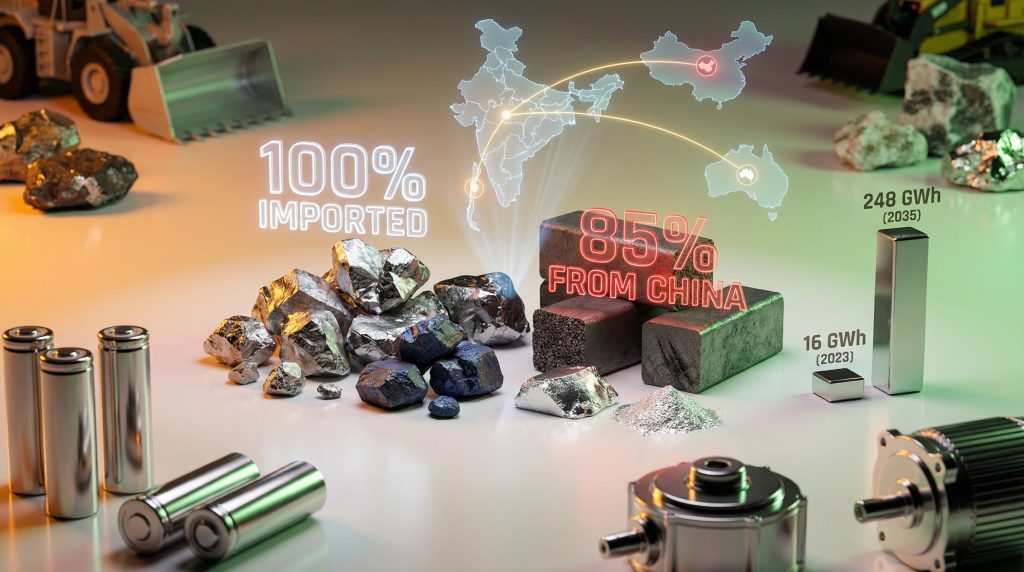
India's lithium-ion dependence represents one of the most significant strategic vulnerabilities in its energy transition planning. According to government statements from the Ministry of Heavy Industries, domestic demand for lithium-ion battery materials continues to be satisfied entirely through imports, establishing a baseline of complete external reliance for this critical component.
This dependency extends across the full spectrum of battery minerals essential for electric vehicle production. The supply chain architecture reveals several critical chokepoints:
- Lithium extraction: Complete dependence on international sources, primarily from South American brine operations and Australian hard-rock mining
- Cobalt procurement: Concentrated exposure to Democratic Republic of Congo production, with limited alternative sourcing options
- Nickel supply: Substantial reliance on Indonesian and Philippine laterite operations
- Graphite processing: Heavy dependence on Chinese artificial graphite production facilities
The absence of domestic processing capabilities compounds these raw material dependencies. India's current battery manufacturing ecosystem focuses primarily on cell assembly and pack integration, with minimal involvement in the upstream chemical processing that transforms raw minerals into battery-ready materials.
Supply Chain Concentration Risks
China's dominance in midstream processing creates additional layers of vulnerability for India's EV manufacturers. The concentration of cathode material production, anode processing, and battery cell manufacturing within Chinese industrial clusters means that supply disruptions can cascade rapidly through the global battery supply chain.
Key risk factors include:
- Processing bottlenecks: Limited global capacity outside China for converting raw lithium into battery-grade compounds
- Technology dependencies: Reliance on Chinese manufacturing equipment and process technologies
- Quality standards: Established supply relationships that are difficult to replicate quickly with alternative sources
- Scale economics: Chinese facilities benefit from production volumes that create significant cost advantages
The Society of Indian Automobile Manufacturers has highlighted these dependencies as a central concern for the sector's long-term competitiveness. Furthermore, the organisation's analysis indicates that diversification efforts remain insufficient to meaningfully reduce exposure to supply disruptions in the near term.
China's Export Control Framework and Market Impact
Licensing Requirements and Operational Constraints
China's implementation of export controls and licensing requirements for high-performance lithium-ion batteries, cathode materials, and artificial graphite anodes represents a significant shift in global battery supply dynamics. These measures introduce regulatory uncertainty for international buyers while potentially constraining global availability of critical components.
The licensing framework covers several essential battery materials:
- High-performance lithium-ion batteries: Complete cells meeting specific energy density and cycle life criteria
- Cathode materials: Lithium iron phosphate (LFP), nickel manganese cobalt (NMC), and other advanced chemistries
- Artificial graphite anodes: Processed graphite materials essential for battery negative electrodes
- Manufacturing technologies: Process equipment and technical know-how for battery production
For Indian manufacturers, these controls create operational challenges that extend beyond simple procurement. The licensing process introduces timeline uncertainties that complicate production planning and inventory management. In addition, companies must now factor regulatory approval timelines into their supply chain strategies, potentially requiring larger buffer stocks or alternative sourcing arrangements.
Price Formation and Market Dynamics
Lithium, cobalt, and nickel trade in global markets where pricing reflects complex interactions between supply availability, demand growth, and speculative positioning. Export restrictions introduce additional variables into price formation mechanisms, potentially creating volatility that extends beyond fundamental supply-demand balances.
The integration of regulatory constraints with market dynamics creates several potential outcomes:
- Price premiums: Licensed exports may command higher prices to reflect regulatory compliance costs
- Market fragmentation: Different pricing structures for regulated versus unrestricted materials
- Supply allocation: Preferential access for certain buyers or end-use applications
- Inventory strategies: Increased stockpiling behaviour among buyers facing supply uncertainty
Indian EV manufacturers must navigate these evolving market conditions while maintaining cost competitiveness in domestic and export markets. The potential for supply cost increases creates pressure on vehicle pricing strategies and profitability projections.
Economic Impact Assessment for India's EV Ecosystem
Financial Exposure Analysis
The financial implications of supply chain dependencies vary significantly across different segments of India's EV ecosystem. Two-wheeler manufacturers face particular exposure due to their reliance on imported battery cells and limited ability to absorb cost increases through premium positioning.
Battery Cost Structure Vulnerabilities:
| Component Category | Share of Battery Cost | Import Dependency | Price Volatility Risk |
|---|---|---|---|
| Active Materials | 60-70% | Near complete | Very high |
| Separators & Electrolytes | 15-20% | Substantial | Moderate |
| Current Collectors | 8-12% | Moderate | Low |
| Cell Assembly | 10-15% | Low | Low |
The concentration of value and import dependency in active materials creates disproportionate exposure to supply disruptions. For instance, a 20-30% increase in cathode material costs could translate to 12-21% increases in total battery costs, significantly impacting vehicle economics.
Manufacturing Sector Implications
India's battery manufacturing sector faces a complex optimisation challenge between cost competitiveness and supply security. Current manufacturing approaches emphasise assembly efficiency and quality control, with limited integration into upstream chemical processing.
Companies operating gigafactory-scale facilities encounter specific challenges:
- Procurement scale: Large-volume requirements that limit supplier diversification options
- Technical specifications: Precise material quality requirements that constrain alternative sourcing
- Contract structures: Long-term supply agreements that may not reflect current geopolitical risks
- Working capital: Increased inventory requirements to buffer against supply disruptions
However, the transition toward greater supply chain resilience requires substantial capital investment in processing capabilities, quality control systems, and alternative supplier development. These investments compete with capacity expansion priorities and may temporarily impact competitive positioning.
Strategic Response Frameworks for Supply Security
Domestic Capability Development Initiatives
India's approach to reducing critical mineral dependencies encompasses multiple parallel strategies, ranging from domestic resource development to recycling infrastructure expansion. The National Critical Mineral Mission represents a coordinated effort to identify and develop domestic mineral resources that can support battery manufacturing requirements.
Key Development Priorities:
- Exploration and extraction: Systematic geological surveys to identify lithium and other critical mineral deposits
- Processing infrastructure: Investment in domestic facilities for converting raw minerals into battery-grade materials
- Technology acquisition: Partnerships and licensing agreements to access essential processing technologies
- Workforce development: Technical training programmes for specialised mineral processing and battery manufacturing roles
The recycling sector presents near-term opportunities for reducing import dependencies while addressing end-of-life battery management challenges. Consequently, projected growth in electric vehicle adoption creates a substantial future feedstock stream for recycling operations, though current volumes remain limited.
Government policy support includes duty exemptions for critical battery components and incentives for circular economy initiatives. These measures aim to improve the economic viability of domestic processing whilst encouraging investment in recycling infrastructure. Recent developments, including a battery recycling breakthrough, demonstrate the potential for technological advancement in this space.
International Diversification Strategies
KABIL's overseas acquisition strategy represents India's most significant effort to secure direct access to critical mineral resources. The organisation's activities in Argentina's lithium-rich regions aim to establish Indian equity stakes in upstream production, though operational timelines remain uncertain.
Partnership Development Framework:
- Resource access agreements: Direct investment in mining operations to secure long-term supply commitments
- Technology transfer arrangements: Collaborations with international partners to access processing expertise
- Trade facilitation: Bilateral agreements to reduce tariffs and streamline critical mineral imports
- Investment promotion: Incentives for foreign companies to establish processing operations in India
Partnerships with Australia and Chile offer potential access to established lithium production, though competition from other importing nations continues to intensify. The effectiveness of these diversification efforts depends on successful project execution and favourable resource development timelines. For example, initiatives like the battery-grade lithium refinery in India represent significant steps towards reducing import dependency.
Alternative battery technologies present long-term opportunities to reduce dependence on scarce materials. Sodium-ion batteries for grid storage applications and lithium iron phosphate chemistries for certain vehicle segments could minimise cobalt and nickel requirements.
Investment Analysis and Market Positioning
Risk-Return Evaluation Framework
Investors evaluating India's EV sector must balance supply chain vulnerabilities against substantial market growth potential. The transition to electric mobility creates significant long-term value creation opportunities, though near-term volatility from supply disruptions presents meaningful risks.
Investment Risk Categories:
- Operational risks: Supply disruptions affecting production schedules and capacity utilisation
- Financial risks: Input cost volatility impacting margins and profitability
- Strategic risks: Technology shifts or policy changes affecting competitive positioning
- Regulatory risks: Import restrictions or duty changes affecting cost structures
The clean energy investment opportunity in India extends beyond vehicle manufacturing to encompass charging infrastructure, grid storage, and renewable energy integration. Estimated investment requirements of $200-250 billion by 2030 reflect the scale of transformation across multiple sectors. These developments highlight the increasing importance of critical minerals in energy transition.
Stock performance analysis following the announcement of China's export controls revealed varied responses across different EV sector participants. Companies with greater vertical integration and supplier diversification demonstrated relative resilience, whilst those with concentrated Chinese supply dependencies experienced increased volatility.
Policy-Driven Investment Opportunities
Government initiatives to strengthen battery supply chains create targeted investment opportunities in processing infrastructure, recycling facilities, and technology development. The proposed ₹1,500 crore battery recycling scheme represents one example of policy support for supply chain localisation.
Investment Focus Areas:
- Mineral processing: Facilities for converting imported raw materials into battery-grade chemicals
- Component manufacturing: Production of separators, electrolytes, and other specialised battery materials
- Recycling infrastructure: Collection, processing, and material recovery systems for end-of-life batteries
- Research and development: Advanced battery chemistries and manufacturing process lithium industry innovations
Public-private partnership models offer mechanisms for sharing development risks whilst leveraging government support for strategic projects. These arrangements can facilitate technology transfer and provide access to patient capital for long-gestation infrastructure projects.
The next major ASX story will hit our subscribers first
Long-Term Strategic Scenarios for Energy Transition
Battery Independence Pathway Analysis
India's trajectory toward reduced battery import dependence requires coordinated progress across multiple dimensions. Projected battery demand growth from 16 GWh in 2023 to 248 GWh by 2035 at a 26% compound annual growth rate creates both challenges and opportunities for domestic capability development.
Success Metrics for Battery Independence:
- Domestic content: Percentage of battery value chain located within India
- Supply diversification: Geographic distribution of critical mineral sources
- Technology sovereignty: Ownership of essential processing and manufacturing technologies
- Cost competitiveness: Ability to produce batteries at globally competitive costs
The integration of battery manufacturing with renewable energy deployment and grid storage requirements creates synergies that can support larger-scale domestic production. Grid-scale storage applications may provide initial market demand for domestic battery production before vehicle market penetration reaches sufficient scale.
Recycling infrastructure development offers potential to create closed-loop supply chains that reduce dependence on primary mineral extraction. Projected battery recycling capacity of 115 kT by 2030 could provide substantial quantities of recovered materials, though quality and cost considerations remain important factors. Furthermore, development of a critical raw materials facility demonstrates the global trend towards supply chain security.
Geopolitical Risk Management
The intersection of energy transition goals with supply chain security creates complex policy challenges that extend beyond traditional trade and investment considerations. India's lithium-ion dependence and supply risks amid China export controls offers lessons for other emerging economies pursuing similar electrification strategies.
Strategic Risk Mitigation Approaches:
- Diversified sourcing: Multiple suppliers across different geographic regions
- Strategic stockpiling: Emergency reserves of critical materials and components
- Technology development: Indigenous capabilities in key processing and manufacturing areas
- Alliance building: Multilateral cooperation on critical mineral security
The failure of certain large-scale battery projects globally highlights the importance of realistic timeline expectations and adequate technology development support. Project execution capabilities, regulatory frameworks, and market development must align to achieve successful supply chain localisation.
Technology sovereignty considerations extend beyond cost and availability to encompass control over essential manufacturing processes and quality standards. The development of indigenous technological capabilities requires sustained investment and may involve trade-offs with short-term cost optimisation.
Building Resilient Supply Chains Through Strategic Diversification
Immediate Risk Mitigation Priorities
EV manufacturers in India face urgent requirements to strengthen supply chain resilience whilst maintaining cost competitiveness and production schedules. Near-term strategies focus on supplier diversification, inventory optimisation, and alternative material evaluation.
Operational Response Framework:
- Supplier qualification: Accelerated approval processes for alternative battery material suppliers
- Contract restructuring: Flexible terms that accommodate supply uncertainty and price volatility
- Inventory management: Strategic stockpiling of critical components with long procurement lead times
- Quality assurance: Enhanced testing and certification capabilities for diverse supplier bases
The development of supplier relationships outside China requires significant time and resource investment. Technical qualification processes, quality certification, and volume scaling typically require 12-24 months, creating near-term constraints on diversification speed.
Consequently, companies must balance the urgent need for supply security with the practical realities of supplier development timelines. This challenge is particularly acute for manufacturers facing immediate production requirements whilst China implements stricter export controls.
Medium-Term Infrastructure Development
India's medium-term supply chain strategy emphasises building domestic processing capabilities that can reduce dependence on imported battery-ready materials. This approach requires coordinated investment in processing infrastructure, technical expertise, and quality control systems.
Investment priorities include facilities for lithium carbonate and hydroxide production, cathode material synthesis, and anode processing. These investments compete with manufacturing capacity expansion for capital allocation and management attention.
The timeline for achieving meaningful supply chain localisation extends well beyond immediate risk mitigation requirements. Realistic planning assumes 5-7 years for substantial processing capability development, requiring bridge strategies to manage supply risks during the transition period.
In addition, India's lithium-ion dependence and supply risks amid China export controls will continue to shape investment decisions and strategic planning throughout this development phase. The success of these initiatives will ultimately determine India's ability to achieve greater energy security whilst maintaining competitive positioning in global markets.
Disclaimer: This analysis contains forward-looking statements and projections based on currently available information. Actual outcomes may vary significantly from discussed scenarios due to market volatility, technological developments, regulatory changes, and other factors beyond current visibility. Investors should conduct independent research and consider their risk tolerance before making investment decisions. Supply chain dynamics and geopolitical relationships can change rapidly, affecting the validity of current assessments.
Looking to Capitalise on Critical Mineral Investment Opportunities?
Discovery Alert's proprietary Discovery IQ model delivers real-time alerts on significant critical mineral discoveries across the ASX, helping investors identify actionable opportunities in lithium, cobalt, nickel, and other battery materials before broader market recognition. Visit Discovery Alert's dedicated discoveries page to explore how historic mineral discoveries have generated substantial returns, then begin your 14-day free trial to position yourself ahead of the evolving critical minerals market.