August 4, 2026
Understanding Critical Mineral Dependencies in Global Supply Chains
The global economy increasingly relies on materials that exist in finite quantities and concentrated geographic locations. Among these, rare earth elements represent perhaps the most stark example of supply chain vulnerability in modern industrial systems. The rare earth independence gap has become a pressing concern for Western nations, as these seventeen metallic elements power everything from smartphone screens to military radar systems, yet their production and processing remain dominated by a single nation through deliberate industrial policy spanning three decades.
The concept of supply chain independence extends beyond simple mining operations to encompass the entire value chain from extraction to finished products. For rare earth elements, this chain involves multiple complex stages, each requiring specialised knowledge, equipment, and regulatory compliance. The concentration of processing capabilities creates systemic risks that ripple through defence, technology, and clean energy sectors simultaneously.
Strategic Foundation of Critical Mineral Dependencies
Modern military and civilian technologies depend heavily on rare earth elements for their unique magnetic, optical, and electronic properties. Fighter aircraft require these materials for avionics systems and precision guidance. Wind turbines and electric vehicle motors rely on permanent magnets containing neodymium, dysprosium, and other rare earth elements. Data centres use hard drives with rare earth-based recording media.
The processing concentration represents the core vulnerability. While mining operations are distributed across multiple continents, with significant reserves in Australia, the United States, Brazil, and other nations, approximately 85-90% of global rare earth processing capacity resides within China, according to the U.S. Geological Survey's 2024 mineral commodity summaries.
Furthermore, this concentration emerged through coordinated state investment, technology acquisition, and willingness to operate processing facilities at margins that displaced international competitors. Historical analysis reveals how this dependency developed.
During the 1980s and 1990s, Chinese industrial policy deliberately targeted rare earth processing as a strategic sector. State-backed enterprises invested in separation chemistry expertise, environmental compliance systems, and integrated supply chains while global competitors focused on higher-margin activities. By the 2000s, this approach had effectively captured the processing bottleneck.
Measuring Independence Across the Value Chain
Supply chain independence requires examination at each stage of production. Current global capacity distribution shows the extent of processing concentration:
| Supply Chain Stage | China's Share | Technical Barriers | Capital Requirements |
|---|---|---|---|
| Mining | ~70% | Environmental permits, geology | $500M-$2B per operation |
| Concentration | ~80% | Beneficiation expertise | $100M-$500M |
| Separation | ~90% | Complex chemistry, reagents | $200M-$1B |
| Metal Production | ~95% | Metallurgical processes | $50M-$200M |
| Magnet Manufacturing | ~95% | Precision equipment, quality control | $100M-$500M |
The separation stage represents the primary technical bottleneck. This process requires solvent extraction or ion-exchange chromatography to isolate individual rare earth elements from mixed concentrates. However, the chemistry involves proprietary knowledge, specialised reagents, and complex waste management systems.
Most Western separation attempts still rely on Chinese-supplied reagents or technical expertise. Geographic distribution analysis shows reserves versus processing capacity misalignment. Australia possesses approximately 22% of global rare earth reserves, the United States holds 13%, and Brazil contains 18%, yet none operate significant separation facilities.
This gap between resource endowment and processing capability underlies current strategic vulnerabilities. Consequently, understanding these dependencies is crucial for developing effective critical minerals energy transition strategies.
When big ASX news breaks, our subscribers know first
Current Western Response Strategies and Their Limitations
Western nations have implemented various approaches to address rare earth supply vulnerabilities, ranging from direct government investment to allied cooperation frameworks. These efforts reflect growing recognition of strategic risks but remain fragmented across agencies and nations.
Federal Investment Frameworks and Their Limitations
The United States has deployed multiple investment mechanisms targeting different stages of the rare earth supply chain. The Department of Defense's Office of Strategic Capital represents a novel approach, providing equity investments and loan guarantees for critical mineral projects deemed essential for national security.
Recent investments include significant support for domestic processing capabilities. The Pentagon has committed substantial funding to support rare earth processing and magnet manufacturing through equity stakes, loan guarantees, and long-term purchase agreements. These arrangements typically include price floor mechanisms designed to provide investment certainty for capital-intensive projects.
Price floor mechanisms address a fundamental market failure in rare earth investments. Traditional commodity markets experience significant price volatility, making long-term capital investments financially unattractive. By guaranteeing minimum purchase prices over extended periods, government support can stabilise revenue projections and attract private capital.
However, loan guarantees and equity stakes alone do not address technical knowledge gaps. Processing rare earths requires specialised expertise in separation chemistry that cannot be acquired quickly. Many Western projects remain dependent on Chinese reagents, equipment, or technical consulting, limiting their effectiveness during supply disruptions.
Multi-Agency Coordination Challenges
Federal rare earth initiatives span multiple agencies with distinct mandates and budget cycles. The Department of Defense focuses on military applications and supply security. The Department of Energy manages research and development for clean energy applications. The Department of Interior oversees domestic mineral resources and permitting processes. The Department of Commerce handles export controls and industrial policy coordination.
This organisational structure creates coordination challenges. Each agency operates under different statutory authorities, appropriation cycles, and performance metrics. The Government Accountability Office identified these coordination gaps as impediments to effective critical minerals strategy implementation in their February 2022 report on strengthening federal efforts.
The Inflation Reduction Act introduced additional complexity by creating tax incentives for domestic critical mineral processing managed through the Internal Revenue Service. While these incentives provide market-based support for domestic production, their interaction with agency-specific programs requires careful coordination to avoid duplication or conflicting requirements.
Allied Partnership Models Under Development
International cooperation represents a crucial component of Western rare earth strategy. The United States has established bilateral agreements with Australia, Japan, Canada, and the European Union covering critical mineral cooperation, technology sharing, and investment coordination.
The U.S.-Australia partnership focuses on downstream processing of Australian mineral resources. Australia possesses significant rare earth deposits but limited processing capability. American investment and technology could enable Australian processing facilities serving allied markets. However, technology transfer restrictions and export control requirements complicate such arrangements.
Japanese companies bring advanced manufacturing expertise and significant demand for rare earth materials through automotive and electronics industries. U.S.-Japan cooperation could integrate Japanese manufacturing capabilities with American processing investments and Australian raw materials. Historical precedent exists from Japan's response to the 2010 rare earth supply disruption, when Japanese companies successfully diversified supply sources and improved recycling technologies.
European Union initiatives under the Critical Raw Materials Act established targets for domestic processing capability. EU goals include securing 10% of rare earth processing capacity domestically by 2030 through coordinated investment and regulatory reform. European expertise in environmental compliance and advanced manufacturing could complement American and allied capabilities. Moreover, the European critical raw materials facility represents a significant step towards reducing strategic dependencies.
Six Critical Bottlenecks Preventing Strategic Independence
Analysis of current rare earth independence efforts reveals six fundamental bottlenecks that prevent effective supply chain diversification. These barriers operate across technical, organisational, and market dimensions, requiring coordinated solutions.
Allied Supply Chain Coordination Failures
Current international agreements remain largely bilateral and advisory rather than binding and operational. Unlike NATO's coordinated defence procurement, rare earth cooperation lacks unified command structures, shared financing mechanisms, or standardised technical requirements.
Technology transfer restrictions create additional barriers. U.S. Export Administration Regulations and International Traffic in Arms Regulations limit sharing of critical technologies even with allied nations. While these controls serve legitimate security purposes, they prevent the integrated technical cooperation necessary for supply chain resilience.
Joint venture structures could address some coordination challenges by creating shared risk and reward mechanisms. However, existing proposals remain in early planning stages without committed capital or defined governance structures. Successful models from other strategic sectors, such as aircraft manufacturing partnerships, could provide frameworks for rare earth cooperation.
Key coordination requirements include:
• Standardised technical specifications across allied processing facilities
• Shared financing for capital-intensive infrastructure projects
• Coordinated regulatory approval processes for environmental compliance
• Unified response protocols for supply disruption scenarios
• Joint workforce development and technology transfer programs
Centralised Strategic Leadership Gaps
No single authority currently coordinates rare earth policy across federal agencies. This fragmentation creates inefficiencies, conflicting priorities, and gaps in accountability. The National Security Council provides high-level coordination, but lacks operational authority or dedicated budget control.
Proposals for a Critical Minerals Czar with cabinet-level authority have circulated in policy discussions but remain unimplemented. Such a position would require Congressional authorisation to coordinate across agency boundaries and manage unified appropriations for critical mineral initiatives.
Historical precedents demonstrate both possibilities and challenges. The Office of Technology Assessment provided cross-agency technical analysis until its elimination in 1995. The Office of Management and Budget coordinates agency budgets but lacks operational authority. The COVID-19 response created temporary coordination mechanisms that could inform permanent structures.
Unified leadership would address:
• Budget coordination across Defense, Energy, Interior, and Commerce departments
• Strategic priority setting for limited investment resources
• Performance measurement and accountability for independence targets
• International negotiation authority for allied cooperation agreements
• Crisis response coordination during supply disruption scenarios
Market Price Stabilisation Mechanism Inadequacies
Rare earth markets experience significant price volatility due to concentrated supply, inelastic demand, and geopolitical influences. This volatility creates investment uncertainty that deters private capital from long-term processing projects requiring 5-10 year payback periods.
Current stabilisation efforts remain limited to individual company agreements rather than market-wide mechanisms. While these arrangements provide security for specific projects, they do not address broader market failures that prevent competitive domestic processing industry development.
Strategic reserve concepts could provide additional price support, but the United States maintains no dedicated rare earth stockpile comparable to the Strategic Petroleum Reserve. Historical precedent exists through the National Defense Stockpile, which maintained rare earth reserves during the Cold War but liquidated holdings as Chinese supply became available. In this context, the Australia strategic reserve initiative offers valuable lessons for similar Western efforts.
Effective stabilisation requires:
• Strategic reserve sizing based on defence consumption analysis
• Coordinated allied purchasing to achieve market influence
• Price floor mechanisms calibrated to encourage investment without market distortion
• Contingency purchasing authorities for supply disruption scenarios
• Integration with existing commodity stabilisation programs
Downstream Demand Creation Insufficiencies
Supply chain investments require assured demand to justify capital deployment. Current federal procurement mandates remain limited and often include exceptions that undermine investment incentives. Defence contractors may source components internationally if domestic alternatives are unavailable or significantly more expensive.
Clean energy mandates under the Inflation Reduction Act create substantial potential demand for domestic rare earth processing and magnet manufacturing. However, these requirements phase in gradually through 2032, creating timeline mismatches with processing facility construction schedules.
Federal buying power could provide crucial early-stage demand for domestic rare earth products. The Department of Defense represents one of the world's largest institutional buyers of permanent magnets for military systems, satellites, and advanced electronics. Coordinated procurement policies could guarantee markets for domestic production during the transition period.
Demand creation mechanisms include:
• Defence procurement preferences for domestic rare earth products
• Federal fleet electrification requirements using domestic magnets
• Clean energy project domestic content requirements
• Federal building efficiency standards requiring domestic rare earth components
• Research and development procurement for advanced applications
Workforce and Technical Expertise Deficiencies
Rare earth processing requires specialised knowledge in separation chemistry, metallurgy, and advanced materials science. The United States currently lacks sufficient technical workforce in these areas, particularly compared to Chinese capabilities developed over decades.
University programs in rare earth science remain limited, with most expertise concentrated in a few research institutions. Industry partnerships for workforce development are nascent, lacking the scale and coordination necessary to support major processing facility deployment.
International talent acquisition faces immigration restrictions and security clearance requirements that limit access to experienced practitioners. Most rare earth separation expertise exists within Chinese companies or research institutions, creating potential security concerns for technology transfer approaches.
Workforce development requirements:
• University curriculum expansion in separation chemistry and metallurgy
• Industry apprenticeship programs for technical trades
• Immigration pathway enhancement for critical skills
• Government-industry research collaboration expansion
• Technical training centre establishment near processing facilities
Capital Formation and Risk Distribution Problems
Private capital markets demonstrate persistent failure to fund rare earth processing investments at required scale and timeline. Traditional project finance models struggle with long payback periods, commodity price volatility, and technology risks specific to rare earth separation.
Current government support mechanisms remain insufficient for the capital intensity required. Processing facilities require hundreds of millions in investment before generating revenue, exceeding the risk tolerance of most private investors without substantial government de-risking.
National investment vehicle designs from other strategic sectors could provide models for rare earth financing. The Overseas Private Investment Corporation (now DFC) demonstrates government-backed investment capabilities. Export-Import Bank provides financing for strategic exports. The Federal Financing Bank enables government-guaranteed lending for infrastructure projects.
Capital formation improvements needed:
• National critical minerals investment fund with equity capabilities
• Insurance mechanisms for technology and market risks
• Tax incentive optimisation for multi-year construction periods
• Public-private partnership frameworks for integrated supply chains
• International development finance coordination for allied projects
Development Timeline Challenges and Strategic Vulnerabilities
Time represents perhaps the most critical constraint in achieving rare earth independence. The extended development cycles for mining and processing projects create vulnerability windows that adversaries can exploit through export restrictions or market manipulation.
Project Development Cycle Analysis
Rare earth mine development typically requires 8-12 years from initial exploration to commercial production. This timeline includes geological assessment, environmental impact studies, permitting processes, construction, and operational ramp-up. Heavy rare earth deposits, which contain the most strategically critical elements, often require longer development periods due to complex geology and processing requirements.
Processing facility construction involves 4-6 year implementation cycles, assuming technology transfer and environmental approvals proceed smoothly. Separation chemistry facilities require specialised equipment, much of which is currently manufactured in China or requires Chinese technical expertise for installation and optimisation.
Magnet manufacturing scale-up represents the final stage, typically requiring 2-3 years to achieve commercial production levels. This process involves precision equipment installation, quality control system development, and workforce training for specialised manufacturing processes.
Competitive Timeline Pressures
Geopolitical tensions create pressure for accelerated timelines that may conflict with technical and regulatory realities. Export control tightening cycles often follow geopolitical events, creating windows of vulnerability during extended development periods.
Technology advancement in alternative materials proceeds in parallel with rare earth independence efforts. Breakthrough developments in rare earth-free magnets or recycling technologies could alter strategic calculations during multi-year project development cycles. Furthermore, mining industry innovation trends are accelerating the development of new extraction and processing technologies.
Demand growth projections across defence and civilian sectors suggest increasing vulnerability during the transition period. Electric vehicle production, renewable energy deployment, and defence modernisation all depend on rare earth materials with growing consumption requirements.
Critical Timeline Scenario Modeling
Three primary scenarios emerge from current development trajectory analysis:
Accelerated Independence Scenario (5-Year Achievement)
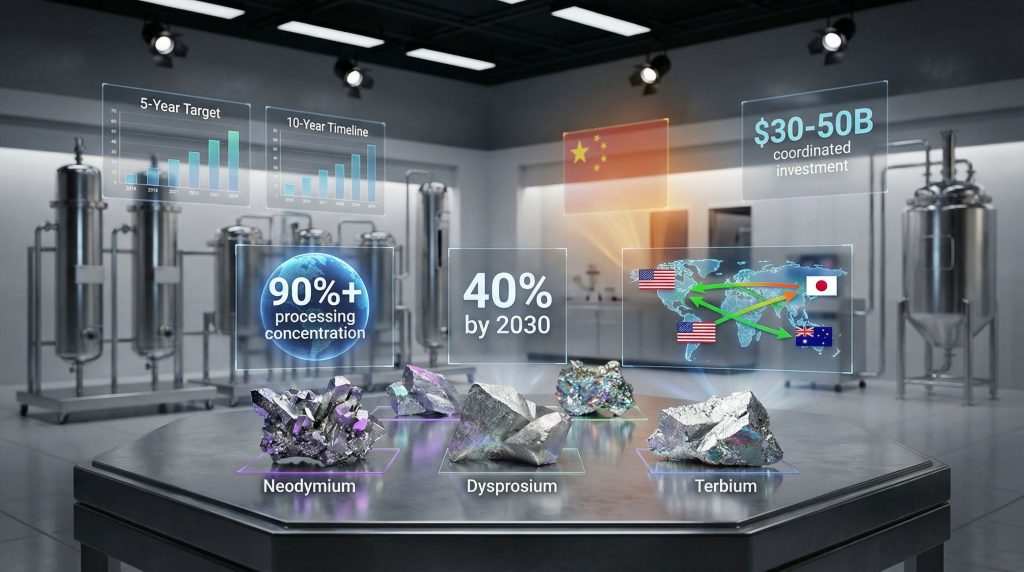
This pathway requires unprecedented coordination and investment acceleration. Success depends on streamlined environmental review, technology transfer facilitation, and massive capital deployment. Estimated requirements include $30-50 billion in coordinated government and private investment with probability of achievement around 25% under optimal political and economic conditions.
Gradual Diversification Scenario (10-Year Timeline)
This represents the most likely outcome under current policy trajectories. Steady progress across multiple projects with coordinated allied cooperation could achieve meaningful supply diversification within a decade. Required investment levels of $15-25 billion distributed across multiple facilities and technologies show 65% probability of success with sustained political commitment.
Status Quo Continuation Scenario
Without policy acceleration or major investment increases, current fragmented approaches may perpetuate existing vulnerabilities indefinitely. Limited progress on individual projects without integrated supply chain development would maintain strategic dependency with associated geopolitical risks.
Key timeline acceleration factors include:
• Regulatory streamlining without compromising environmental standards
• Technology transfer facilitation through allied cooperation frameworks
• Capital deployment coordination across public and private sectors
• Workforce development acceleration through intensive training programs
• Market stabilisation to encourage private investment participation
Global Player Strategies in the Independence Challenge
Major economic powers have developed distinct approaches to rare earth supply security, reflecting different resource endowments, industrial capabilities, and strategic priorities. Analysis of these approaches provides insights into alternative pathways and potential cooperation opportunities.
Chinese Strategic Positioning and Response Patterns
China maintains its dominant position through integrated industrial policy combining domestic consumption prioritisation, export control mechanisms, and technology transfer restrictions. Recent export control implementations target military applications while maintaining commercial availability for civilian uses.
Domestic consumption prioritisation policies require Chinese rare earth producers to serve domestic magnet manufacturers and technology companies before fulfilling export orders. This approach ensures Chinese industrial advantages while creating supply uncertainty for international buyers.
Technology transfer restrictions limit foreign investment in Chinese rare earth processing facilities and prevent equipment export that could enable competing processing capabilities. Joint venture requirements for foreign companies accessing Chinese rare earth supply chains provide technology access while maintaining Chinese control.
Chinese competitive advantages include:
• Integrated supply chains from mining through finished products
• Decades of accumulated technical expertise and industrial infrastructure
• State coordination enabling below-market pricing for strategic objectives
• Regulatory flexibility supporting rapid capacity expansion or restriction
• Downstream manufacturing dominance creating self-reinforcing demand
European Union Critical Materials Strategy
The EU's Critical Raw Materials Act establishes binding targets for supply diversification and domestic processing capability development. Strategic autonomy objectives aim to reduce dependency on single-source suppliers while maintaining technological competitiveness.
Green Deal integration attempts to align critical mineral security with environmental objectives. This approach emphasises recycling, circular economy principles, and environmental standards for new mining and processing operations.
Partnership frameworks with resource-rich nations focus on development finance, technology transfer, and long-term supply agreements. African mineral partnerships represent a particular focus area given geographic proximity and existing economic relationships.
EU strategic elements include:
• Domestic processing targets: 10% of consumption by 2030
• Recycling capacity development for circular economy integration
• International partnership emphasis on sustainable development
• Technology innovation funding for alternative materials research
• Regulatory harmonisation across member states for investment facilitation
Australian Resource Diplomacy and Processing Ambitions
Australia combines significant rare earth reserves with geographic proximity to major Asian markets and strong allied relationships with the United States and Europe. This positioning enables unique strategic options for integrated supply chain development.
Downstream processing investment incentives target value-added manufacturing rather than raw material export. Government support includes infrastructure development, technology partnerships, and market access facilitation for Australian processing facilities.
Technology partnerships with allied nations aim to combine Australian mineral resources with foreign processing expertise and market access. The AUKUS framework provides potential mechanisms for technology sharing and integrated defence supply chain development.
Critical minerals export policies balance economic benefits with strategic considerations. Australia maintains the flexibility to restrict exports during supply crises while developing domestic processing capabilities for long-term value capture.
Investment Models for Accelerated Independence
Achieving rare earth supply chain independence within strategic timelines requires innovative investment approaches that address market failures while leveraging private sector efficiency. Multiple models offer different risk-sharing mechanisms and implementation pathways.
National Investment Vehicle Design Principles
National investment vehicles could address the capital formation challenges that prevent adequate private investment in rare earth processing. Successful models require careful balance between government backing and private sector efficiency incentives.
Equity vs. debt financing decisions significantly impact project economics and risk distribution. Equity investments provide upside participation for successful projects while sharing downside risks. Debt financing offers lower returns but greater security for government investors with predictable repayment schedules.
Risk-sharing mechanisms between public and private sectors can optimise capital deployment while maintaining commercial incentives. Government de-risking of technology and market uncertainties enables private capital to focus on execution and operational efficiency.
Performance metrics and accountability structures ensure public investment achieves strategic objectives rather than simply subsidising private profits. Output targets, timeline requirements, and domestic content commitments provide measurable success criteria.
Comparative Investment Model Analysis
| Investment Model | Government Role | Private Role | Risk Distribution | Timeline Impact |
|---|---|---|---|---|
| Pure Private Market | Regulatory only | Full investment | Market risk on private | 10+ years |
| Loan Guarantees | Risk backing | Primary investment | Shared downside only | 7-9 years |
| Equity Co-investment | 25-50% equity | Majority investment | Shared up/downside | 6-8 years |
| Strategic National | Majority equity | Operational expertise | Government bears market risk | 5-6 years |
Pure private market approaches demonstrate persistent inadequacy for rare earth processing investments. Market failures including price volatility, technology risks, and long payback periods prevent sufficient private capital deployment without government intervention.
Loan guarantee programs provide government backing for debt financing while maintaining private ownership and operational control. This approach works best for projects with proven technology and established markets but may be insufficient for emerging rare earth processing capabilities.
Equity co-investment models enable direct government participation in project returns while sharing risks and rewards with private partners. This structure aligns incentives and provides government influence over strategic decisions while leveraging private operational expertise.
Strategic national investment involves government majority ownership during development phases with potential private sector participation or eventual privatisation. This model enables rapid deployment but requires careful governance to maintain efficiency and avoid political interference.
Technology Transfer and Intellectual Property Frameworks
Technology access represents a critical constraint for Western rare earth processing development. Most separation chemistry expertise resides within Chinese companies or research institutions, creating dependencies even for domestically located facilities.
Licensing agreements with established processors could provide technical knowledge transfer while respecting intellectual property rights. Such arrangements require careful structuring to ensure knowledge transfer without creating ongoing dependencies on foreign expertise.
Joint research and development initiatives between government, universities, and industry can develop indigenous technical capabilities over time. However, this approach requires sustained funding and may take years to achieve commercial readiness.
Patent sharing arrangements among allied nations could accelerate technology dissemination while maintaining security restrictions on sensitive technologies. Existing frameworks from defence cooperation provide models for controlled technology sharing.
Technology transfer mechanisms include:
• University research partnerships with industry application requirements
• International talent recruitment programs for technical specialists
• Joint ventures with allied companies for knowledge sharing
• Government-funded demonstration projects for technology validation
• Intellectual property pools for critical technologies among trusted partners
The growing complexity of global trade tensions, particularly regarding US-China trade war impacts, further emphasises the importance of developing independent technology capabilities.
The next major ASX story will hit our subscribers first
Success Metrics and Performance Measurement Frameworks
Effective rare earth independence strategy requires clearly defined success metrics that balance supply security, economic competitiveness, and implementation timelines. These measurements must account for both quantitative targets and qualitative strategic objectives.
Independence Measurement Frameworks
Supply chain independence metrics must differentiate between various levels of security across different rare earth elements and applications. Light rare earths used in catalysts and polishing compounds pose different strategic risks than heavy rare earths required for permanent magnets and military electronics.
Processing capacity targets should be element-specific given different strategic importance and supply characteristics. Neodymium and praseodymium for permanent magnets represent higher priority than cerium for catalytic applications due to defence and clean energy requirements.
Geographic diversification indices measure progress toward reducing single-source dependencies. Effective diversification requires not just multiple suppliers but suppliers from politically stable regions with aligned strategic interests.
Strategic stockpile adequacy calculations must account for different consumption scenarios including normal operations, crisis surge requirements, and extended supply disruptions. Defence applications require higher security standards than civilian uses.
Key independence metrics include:
• Domestic processing capability as percentage of national consumption
• Allied source diversification index across supply chain stages
• Strategic reserve coverage in months of critical application consumption
• Technology independence score based on indigenous capability development
• Supply chain resilience testing through scenario analysis
Economic Competitiveness Indicators
Long-term sustainability requires economic competitiveness rather than permanent subsidisation. Cost parity timelines establish targets for achieving market-rate pricing competitive with existing suppliers.
Market share development in downstream applications demonstrates commercial viability beyond government purchasing. Private sector adoption indicates genuine competitiveness rather than artificially supported production.
Export potential development shows progress toward industrial competitiveness and could provide additional market support during domestic demand fluctuations. Allied markets offer potential expansion opportunities for successful domestic producers.
Innovation advancement metrics track progress in process improvement, cost reduction, and new application development. Technological leadership could provide competitive advantages beyond simple cost parity.
Key Performance Indicators Dashboard
Supply Security Achievement Targets:
Domestic processing capacity should reach 40% of national consumption by 2030 across critical rare earth elements. Allied source diversification should achieve 60% non-Chinese sourcing by 2032 for defence and clean energy applications. Strategic reserve coverage should provide two years of defence consumption for critical applications.
Economic Viability Benchmarks:
Cost competitiveness should achieve pricing within 15% of Chinese suppliers by 2030 for major rare earth products. Private investment attraction should reach $10 billion in committed capital across the supply chain by 2035. Technology advancement should deploy at least three breakthrough innovations in processing or recycling by 2030.
Performance monitoring requirements include:
• Quarterly supply chain resilience assessments
• Annual cost competitiveness benchmarking against international suppliers
• Biannual technology advancement reviews for process improvements
• Regular allied cooperation effectiveness evaluation
• Ongoing market development progress tracking for downstream applications
Long-Term Strategic Implications and Future Pathways
Rare earth independence efforts will reshape geopolitical relationships, industrial capabilities, and economic structures across multiple sectors. Understanding these broader implications helps inform current investment decisions and policy priorities.
Geopolitical Stability and Alliance Structures
Resource diplomacy evolution reflects changing power dynamics as traditional suppliers face competition from emerging alternatives. Successful diversification could reduce leverage of concentrated suppliers while creating new interdependencies among allied nations.
Trade relationship impacts extend beyond rare earths to broader economic interactions. Countries losing market share in critical materials may seek compensation through other economic sectors or could retaliate through alternative supply restrictions.
Technology competition dynamics in critical materials will intensify as nations recognise strategic importance. Innovation in processing, recycling, and alternative materials becomes a key competitive arena with national security implications.
Alliance structures may need adaptation to address resource security challenges effectively. NATO-style coordination for critical minerals requires new institutional frameworks and burden-sharing mechanisms.
Industrial Base Transformation Requirements
Manufacturing ecosystem development extends beyond rare earths to broader critical materials processing capabilities. Successful rare earth independence could provide foundation for addressing vulnerabilities in lithium, cobalt, nickel, and other strategic materials.
Workforce development across technical specialisations creates human capital that supports multiple strategic industries. Separation chemistry and advanced materials expertise applies to semiconductor, pharmaceutical, and specialty chemical sectors.
Innovation capacity building in materials science generates competitive advantages across multiple technology sectors. University research capabilities and industry partnerships create lasting technological foundations.
Regional economic development around processing facilities could revitalise industrial regions while creating strategic production capabilities. Communities with appropriate infrastructure and workforce may benefit from critical materials investment.
Environmental and Sustainability Considerations
Processing technology advancement must address environmental concerns that historically limited Western rare earth production. Advanced separation techniques, waste treatment, and recycling capabilities can reduce environmental impact while achieving strategic objectives.
Circular economy integration through recycling development could reduce primary production requirements while creating domestic supply sources. End-of-life magnet recycling from wind turbines and electric vehicles offers growing feedstock opportunities.
Community acceptance requires transparent environmental compliance and meaningful local benefit sharing. Social licence for rare earth processing depends on demonstrating environmental responsibility and economic benefits. Academic research on critical dependence on rare earth minerals provides valuable insights into sustainable development approaches.
Regulatory compliance frameworks must balance environmental protection with strategic security requirements. Streamlined but rigorous environmental review processes can accelerate deployment while maintaining standards.
Long-term sustainability requires:
• Technology advancement reducing environmental impact of processing
• Recycling capacity development for circular economy integration
• Community engagement ensuring social acceptance of new facilities
• International cooperation on environmental standards and best practices
• Innovation support for alternative materials reducing rare earth dependence
Understanding these implications helps policymakers and investors recognise that the rare earth independence gap represents more than simple supply security. Success creates foundation for broader technological competitiveness, alliance coordination, and industrial resilience that extends far beyond the rare earth sector itself. As highlighted by recent analysis on why the west can't escape China's rare earth dominance, addressing this challenge requires sustained commitment and coordinated action across multiple fronts.
Looking to Capitalise on Critical Minerals Investment Opportunities?
Discovery Alert's proprietary Discovery IQ model delivers instant notifications on significant critical mineral discoveries across the ASX, transforming complex geological data into actionable investment insights. Explore Discovery Alert's dedicated discoveries page to understand how major mineral discoveries have historically generated exceptional returns, or begin your 30-day free trial today to position yourself ahead of the market in this strategic sector.