May 10, 2026
Understanding the Strategic Architecture of Critical Mineral Dependencies
Modern industrial economies face unprecedented vulnerabilities in their supply chains for critical materials, particularly rare earth elements that power everything from wind turbines to military defense systems. The supply chain crisis for critical minerals extends far beyond simple commodity relationships, creating systemic risks that threaten national security, economic stability, and technological advancement across multiple sectors.
The transition toward electrification and advanced manufacturing has exposed fundamental weaknesses in global supply networks that traditional market mechanisms have failed to address. Unlike conventional commodities, rare earth supply chain challenges exhibit unique characteristics including extreme processing concentration, environmental complexity, and geopolitical leverage that create structural vulnerabilities requiring coordinated strategic responses.
As nations increasingly recognise these dependencies, the challenge extends beyond simply diversifying suppliers to fundamentally restructuring entire value chains. This transformation requires understanding not just where materials originate, but how processing bottlenecks, environmental constraints, and technological barriers create persistent vulnerabilities that market forces alone cannot resolve.
When big ASX news breaks, our subscribers know first
How Processing Monopolies Create Systematic Market Failures
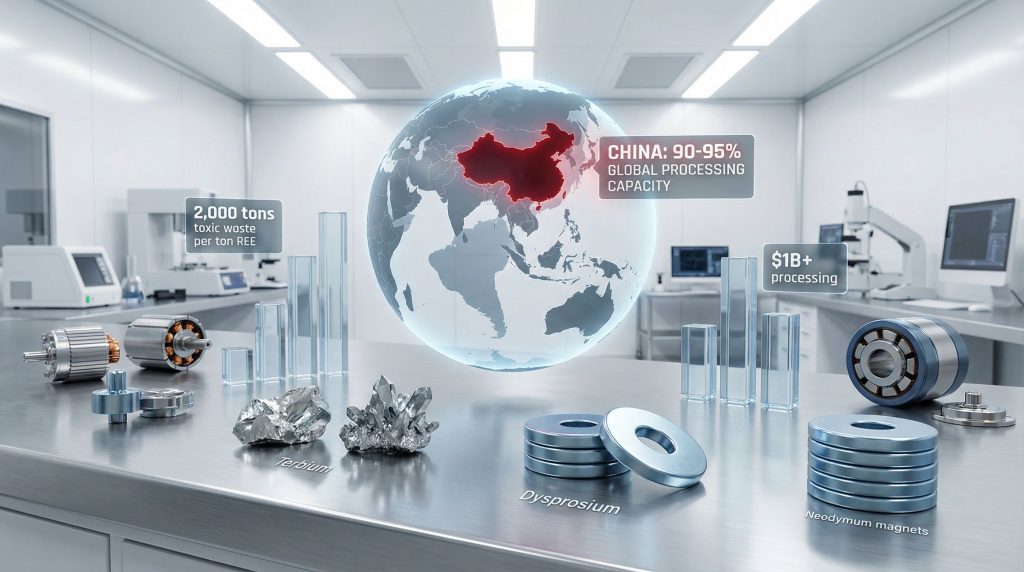
The global rare earth market demonstrates an extraordinary concentration of processing capabilities that fundamentally differs from other commodity sectors. Current estimates suggest that approximately 90-95% of global rare earth refining capacity remains concentrated within a single nation, creating unprecedented supply chain vulnerabilities across multiple industries.
This concentration extends throughout the entire value chain, from initial ore processing through final magnet manufacturing. The architecture of this dominance encompasses several critical elements that highlight rare earth supply chain challenges.
Oxide production facilities controlling primary rare earth separation represent the foundation of this concentration. Furthermore, intermediate processing capabilities for individual element refinement create additional bottlenecks. Magnet manufacturing infrastructure for permanent magnet production adds another layer of dependency, while technology transfer restrictions limiting global capability development ensure continued concentration.
Export Control Mechanisms and Strategic Leverage
Recent regulatory developments have introduced sophisticated control mechanisms that extend beyond traditional trade policies. The International Energy Agency highlighted how non-automatic licensing systems now govern exports of seven critical heavy rare earth elements including samarium, gadolinium, terbium, dysprosium, lutetium, scandium, and yttrium.
These licensing requirements create deliberate uncertainty in global supply chains, with approval processes extending through November 2026 according to current regulatory frameworks. Consequently, the strategic impact affects multiple sectors with varying degrees of vulnerability.
| Sector | Impact Timeline | Strategic Risk Level |
|---|---|---|
| Defence contractors | 18-24 months | Critical |
| Electric vehicle manufacturing | 12-18 months | High |
| Renewable energy systems | 24-36 months | Moderate |
| Consumer electronics | 6-12 months | Variable |
The India Automotive Case Study
India's automotive sector illustrates how processing concentration creates vulnerabilities even in high-growth markets. The sector achieved 4.5 million units sold in 2025, representing growth from approximately 4.3 million units in 2024, with forecasts suggesting 6-7% annual growth through 2026.
However, this expansion remains constrained by rare earth supply dependencies. India's electric vehicle and hybrid motor manufacturing requires permanent magnet motors dependent on neodymium, praseodymium, and dysprosium – all subject to processing concentration and export controls.
The disconnect between India's automotive ambitions and supply chain realities demonstrates a broader pattern affecting multiple emerging economies. Market growth projections assume continued access to critical materials, yet alternative processing infrastructure remains years from commercial viability, highlighting the complexity of rare earth supply chain challenges.
Environmental Physics and Geographic Constraints
Rare earth processing generates disproportionate environmental impacts that create fundamental barriers to supply chain diversification. For every ton of rare earth elements produced, operations typically generate approximately 2,000 tons of toxic waste materials, creating permanent environmental liability challenges.
Waste Generation Breakdown
The environmental burden of rare earth processing includes multiple waste streams requiring specialized management. This complexity directly contributes to mining waste management solutions becoming increasingly critical for industry development.
| Waste Category | Volume per Ton REE | Treatment Requirements |
|---|---|---|
| Dust particles | 13 kg | Air filtration systems |
| Waste gas emissions | 9,600-12,000 m³ | Scrubbing and monitoring |
| Contaminated wastewater | 75 m³ | Treatment and neutralisation |
| Radioactive residue | 1 ton | Long-term containment |
Water and Energy Intensity Constraints
Rare earth refining operations demand approximately 22 times more water and energy resources compared to initial mining activities. This intensity creates geographic constraints that limit viable processing locations, particularly in regions seeking supply chain diversification such as Greenland, Australia's interior, or Middle Eastern jurisdictions.
The water requirements stem from multiple processing stages including leaching, precipitation, and washing that require specific water quality parameters. Combined with radioactive byproduct management requirements, these technical demands generate community opposition that extends permitting timelines to 10-15 years outside established mining jurisdictions.
Long-term Contamination Patterns
China's largest rare earth operation at Bayan-Obo demonstrates the long-term environmental consequences of rare earth processing. Unlined tailing pond contamination advances toward major water sources at an estimated 20-30 meters annually, illustrating permanent environmental liability challenges.
Similar patterns in Myanmar's illegal extraction operations show acid leaching contamination affecting river systems and causing community displacement. These precedents influence regulatory approval processes and community acceptance across alternative processing locations, further complicating rare earth supply chain challenges.
Processing Infrastructure Gaps and Development Constraints
Current non-Chinese rare earth processing capacity remains severely limited, with only three operational facilities at commercial scale located in California, Estonia, and Malaysia. Even established operations like Lynas (Australia) continue sending oxide concentrates to Chinese facilities for final refining through at least 2026.
Development Timeline Challenges
New processing facility development faces extended timelines due to technical complexity, environmental permitting, and community acceptance issues. For instance, current industry analysis suggests average development cycles of 29 years for new mines, though this timeline varies significantly by jurisdiction and project characteristics.
Critical projects targeting production in the next five years include several key initiatives. The Tanbreez Project (Greenland) targets Q1 2026 offtake agreements with 75% pre-sold capacity. Additionally, Browns Range (Australia) plans staged dysprosium production beginning 2027. U.S. domestic initiatives encompass multiple projects in early development phases, while the European CRM facility focuses on downstream capabilities.
Capital Investment Requirements
Supply chain diversification requires substantial capital commitments with extended payback periods. Industry estimates suggest $500 million+ for mining operations and $1 billion+ for integrated processing facilities, creating financing challenges that slow alternative capacity development.
Investment risk factors create significant barriers to addressing rare earth supply chain challenges. High upfront capital requirements with uncertain returns represent the primary concern. Furthermore, extended development timelines exceeding typical investment horizons complicate financing decisions. Regulatory approval uncertainties across multiple jurisdictions add additional risk layers.
Market price volatility affecting long-term project economics creates planning difficulties. Finally, technical expertise availability constraints globally limit development capacity, regardless of capital availability.
Strategic Responses and Market Transformation
Magnet-First Supply Chain Development
Strategic responses increasingly focus on securing magnet production capabilities rather than upstream mining operations, recognising that permanent magnet manufacturing represents the highest value-added segment of rare earth supply chains. This approach addresses the reality that automotive and defence applications depend primarily on finished magnets rather than raw rare earth elements.
Priority areas for strategic investment include several key technologies. Neodymium-iron-boron magnet production for automotive and wind applications represents the largest market opportunity. Heavy rare earth processing capabilities for high-temperature motor applications serve specialised defence and aerospace requirements.
End-of-life magnet recycling infrastructure can create secondary supply sources, reducing primary production dependencies. Alternative magnet chemistry research aims to reduce critical element dependencies through materials innovation.
Geographic Diversification Frameworks
Allied nations are pursuing coordinated diversification strategies that leverage regional comparative advantages while reducing collective dependence on single-source suppliers. This approach recognises that complete supply chain independence may be economically unfeasible, but managed diversification can reduce strategic vulnerabilities inherent in rare earth supply chain challenges.
Regional strategy frameworks demonstrate different approaches to supply security. Greenland offers mineral resources access, making upstream extraction partnerships attractive. Australia provides technical expertise, supporting downstream processing development initiatives.
The Middle East presents energy cost advantages, enabling cost-competitive refining facilities. North America offers market integration opportunities for integrated supply chain development.
China-Plus Sourcing Strategies
Global manufacturers are implementing pragmatic "China-plus" sourcing strategies that maintain Chinese supply relationships while developing alternative capacity to reduce concentration risks. This approach acknowledges the reality that immediate decoupling remains technically and economically unfeasible for most applications.
Market transition indicators include several evolving practices. Diversified supplier qualification programs now extend beyond cost optimisation to include supply security considerations. Strategic inventory management approaches balance cost with supply security requirements.
Long-term offtake agreements provide project financing for alternative capacity development. Technology partnership development outside traditional Chinese supply networks creates alternative technical capabilities.
Economic Drivers and Investment Considerations
Market Psychology and Investment Opportunities
The disconnect between policy rhetoric and technical reality creates unique investment opportunities in addressing rare earth supply chain challenges. Market attention often focuses on downstream growth metrics (automotive sales, renewable energy installations) while overlooking upstream supply constraints that determine long-term viability.
India's automotive sector exemplifies this pattern. Growth headlines emphasise market expansion and model launches, yet fundamental supply chain vulnerabilities remain unaddressed. Investment opportunity exists less in showroom momentum and more in companies solving upstream critical mineral processing and supply chain resilience challenges.
Risk Assessment and Timeline Realities
Traditional investment analysis often underestimates the timeline and complexity required for supply chain transformation. Unlike software or service industries where scaling can occur rapidly, physical infrastructure for rare earth processing requires decade-plus development timelines that extend beyond typical investment horizons.
This temporal mismatch creates market opportunities for patient capital willing to accept extended development periods. However, it also creates vulnerabilities for companies and nations assuming rapid supply chain diversification without understanding technical constraints.
The complexity of rare earth supply chain challenges requires fundamentally different risk assessment approaches compared to traditional commodity investments.
Technology Transfer and Capability Development
Processing concentration creates knowledge concentration, where technical expertise, operational experience, and process optimisation remain concentrated within existing supply chains. Developing alternative capacity requires not just capital investment, but technology transfer and capability development that incumbent suppliers may resist.
This dynamic explains why many alternative processing projects continue relying on Chinese intermediate processing even when attempting to develop independent capacity. The technical knowledge required for complete rare earth separation and purification represents decades of accumulated expertise difficult to replicate rapidly.
The next major ASX story will hit our subscribers first
Future Scenarios and Strategic Implications
How Will Accelerated Decoupling Transform Markets?
Rapid escalation in geopolitical tensions could accelerate supply chain separation beyond current market-driven timelines. The US‑China trade tensions impact demonstrates how quickly trade relationships can deteriorate, creating short-term shortages and price volatility while potentially catalysing faster alternative capacity development.
Under accelerated decoupling, governments might prioritise supply security over economic efficiency, fundamentally altering project economics through subsidies, guaranteed offtake agreements, and expedited permitting processes. However, technical constraints and environmental requirements would persist regardless of policy urgency.
What Role Will Technological Breakthroughs Play?
Materials science advances could fundamentally alter rare earth demand patterns and reduce critical element dependencies. Research into global rare earth supply chains suggests several potential breakthrough areas that could reshape the entire industry.
Alternative magnet chemistries reducing or eliminating heavy rare earth requirements represent the most promising near-term opportunity. Advanced recycling technologies creating economically viable secondary supply sources could dramatically alter supply dynamics.
Substitution materials for specific high-risk applications might reduce overall demand pressures. Process innovations reducing environmental impact and permitting timelines could accelerate alternative processing development.
Such breakthroughs could rapidly obsolete current strategic planning assumptions, making investments in traditional processing infrastructure economically unviable while creating opportunities for next-generation technologies.
Could International Cooperation Frameworks Emerge?
International cooperation frameworks could emerge that balance supply security with economic efficiency through coordinated capacity development and strategic reserve management. This development would directly impact energy security in critical minerals across allied nations.
Such frameworks would require unprecedented cooperation among traditionally competitive nations. Multilateral financing mechanisms for alternative processing capacity could pool resources and reduce individual nation risks. Coordinated strategic reserve policies ensuring adequate buffer inventories might provide stability during supply disruptions.
Technology sharing agreements accelerating capability development could overcome technical expertise barriers. Environmental standard harmonisation reducing permitting complexity might accelerate project development timelines.
However, rare earth supply chain challenges may provide sufficient strategic motivation to overcome historical barriers to international cooperation.
Strategic Imperatives for Supply Chain Resilience
Rare earth supply chain challenges represent a fundamental test of modern economies' ability to manage strategic dependencies in an increasingly complex global system. The concentration of processing capabilities, environmental constraints, and extended development timelines create vulnerabilities that require coordinated responses extending beyond immediate political cycles.
Success in addressing these challenges depends on sustained investment in alternative processing capacity, technological innovation, and international cooperation frameworks that balance security concerns with economic realities. The transformation timeline extends well beyond current policy planning horizons, requiring strategic patience and consistent support to achieve meaningful diversification.
Managing transition risks and costs requires careful coordination between private sector capabilities and public sector strategic objectives. The disconnect between growth optimism in dependent sectors and supply chain realities suggests fundamental reframing is necessary.
Traditional market mechanisms have proven insufficient to address concentration risks, indicating the need for strategic interventions that treat rare earth supply chain challenges as infrastructure rather than commodity issues. This perspective shift could enable the sustained investment and policy coordination necessary for meaningful supply chain transformation.
Disclaimer: This analysis contains forward-looking statements regarding rare earth supply chain developments, processing capacity timelines, and market projections that involve significant uncertainties. Actual outcomes may differ substantially from projections due to technological developments, regulatory changes, geopolitical events, or other factors beyond current forecasting capabilities.
Looking to Capitalise on Critical Mineral Supply Chain Disruptions?
Discovery Alert's proprietary Discovery IQ model delivers instant notifications on significant ASX mineral discoveries, particularly in the critical minerals sector where supply chain vulnerabilities create exceptional investment opportunities. Explore Discovery Alert's dedicated discoveries page to understand how major mineral discoveries have generated substantial returns, then begin your 30-day free trial to position yourself ahead of the market as global supply chain transformations unfold.