June 18, 2026
The Hidden Mechanics Behind a Supply Crisis Fifteen Years in the Making
Most commodity cycles follow a predictable rhythm: prices rise, capital flows in, new supply emerges, and prices correct. Critical minerals are breaking this pattern in ways that have no modern precedent. The forces now reshaping cobalt, nickel, lithium, graphite, and rare earth markets are not cyclical in origin. They are the product of deliberate, compounding policy decisions by resource-holding nations that have spent the past decade studying how to capture more value from their geological endowments, and acting on those conclusions with increasing confidence.
Understanding why critical mineral export restrictions and input cost inflation are now setting durable price floors requires moving beyond trade headlines and into the structural mechanics of how these markets actually clear, who holds pricing power, and why the conventional assumption of supply elasticity no longer applies.
When big ASX news breaks, our subscribers know first
What a Fivefold Increase in Export Restrictions Actually Means for Global Industry
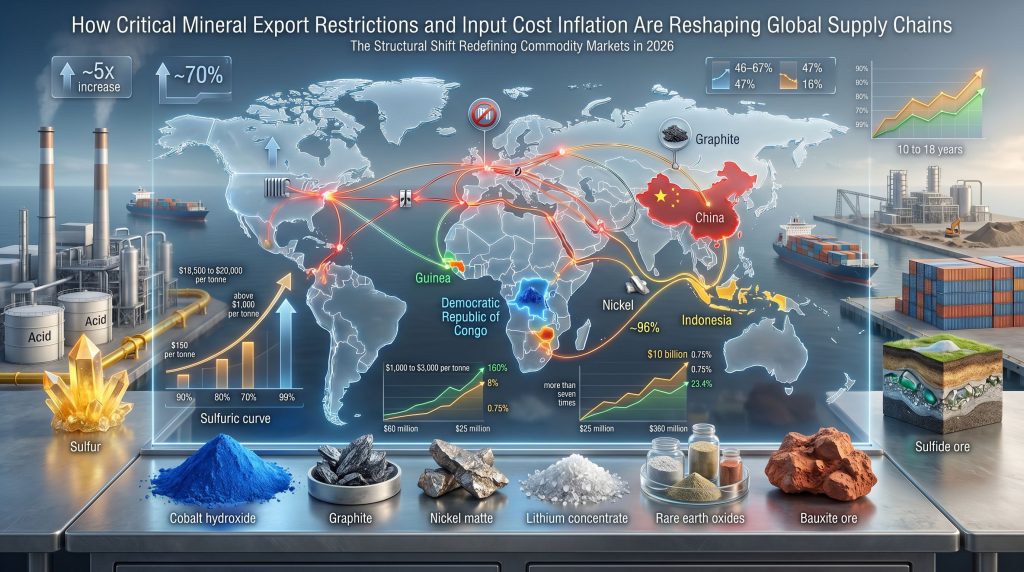
The OECD Inventory of Export Restrictions on Critical Raw Materials, published in April 2026, documents an approximately fivefold increase in restrictive trade measures between 2009 and 2024. This is not an abstract index movement. Each restriction in that count represents a specific policy instrument, whether a quota, licensing requirement, export ban, or local processing mandate, that removes tradable volume from international markets and forces buyers to compete for a smaller pool of available supply.
From Open Trade to Strategic Resource Control: A Decade of Policy Divergence
The scale of concentration across key battery and energy transition minerals makes this trend particularly consequential. According to the same OECD data, three countries control more than 75% of mined production across several critical mineral categories. The Democratic Republic of Congo alone supplies approximately 70% of global cobalt. Indonesia dominates refined nickel output. Approximately 90% of rare earth element production is concentrated among just three producing nations. Furthermore, critical minerals demand growth across clean energy sectors is intensifying competition for this already constrained supply base.
Key Statistics: The Scale of Critical Mineral Trade Restriction at a Glance
| Metric | Data Point | Source |
|---|---|---|
| Growth in export restrictions (2009-2024) | ~5x increase | OECD Inventory, April 2026 |
| Share of cobalt/manganese exports restricted (2022-2024) | ~70% | OECD |
| Rare earth elements trade affected by restrictions | 46-67% | OECD |
| Graphite exports facing at least one restriction | 47% | OECD |
| Overall critical raw material trade restricted | 16% | OECD |
| Africa's share of global critical mineral exports | 10.6% | OECD, April 2026 |
| Top 3 producers' share of cobalt, lithium, nickel | >66% | OECD |
| Top 3 producers' share of rare earth elements | ~90% | OECD |
Why Revenue Capture, Not Just Geopolitics, Is Driving Export Restrictions
A common misreading of export restriction policy frames it purely as geopolitical leverage. The OECD data tells a more nuanced story: nearly half of all new restrictive measures introduced in recent years are motivated primarily by domestic revenue generation objectives rather than national security considerations. Producing nations are executing a deliberate industrial transition from raw material exporter to value-added processor, capturing downstream margins that were previously realised offshore by importing nations with more sophisticated refining infrastructure.
Africa is a useful case study in this dynamic. The continent generates more than 50% of its export revenues from mining, according to the April 2026 OECD data, yet historically captured only approximately 40% of the potential mineral value embedded in those exports. The gap exists because raw and semi-processed ore leaves the continent at low unit value, with the refining margin accruing to facilities in China, Europe, and elsewhere. Domestic processing mandates are designed specifically to close this value gap.
"The policy logic driving export restrictions has evolved from protectionism into a structured industrial development strategy. Producers are not simply trying to limit supply. They are trying to own more of the value chain."
How Specific Country Policies Are Translating Into Commodity Price Floors
The Democratic Republic of Congo: Cobalt Quotas and a 160% Price Shock
The DRC cobalt export ban represents the most dramatic single example of how policy can reset commodity prices within months. The country introduced cobalt export curbs in February 2025, and by October 2025 had transitioned from a full export ban to a strict quota management regime. The consequence was immediate and severe: benchmark cobalt prices rose more than 160% following the policy shift, with cobalt hydroxide prices quadrupling.
The impact on major operators with Congo-based production has been direct. CMOC, which has committed approximately $9 billion to two Congolese copper-cobalt operations since 2016, can currently export only approximately one quarter of its 2024 cobalt production volumes under the active quota. The compression in permitted export volumes demonstrates that quota regimes can constrain supply faster than any mine schedule can adapt, because the bottleneck is administrative rather than geological.
Zimbabwe and Guinea: Lithium Concentrates and Bauxite Ore Restrictions
Zimbabwe moved in February 2026 to ban exports of lithium concentrates, mandating that material must be converted to lithium sulfate domestically before it can leave the country. This policy directly affects Chinese mining groups that have collectively committed approximately $2.8 billion to Zimbabwean lithium projects since 2020, including Sinomine Resource Group and Zhejiang Huayou Cobalt, both of which now face domestic processing obligations that were not part of their original investment calculus.
Guinea has announced parallel intentions to restrict the volumes of bauxite ore supplied to international markets, with the objective of incentivising domestic alumina conversion. Guinea holds some of the world's highest-grade bauxite deposits, making this policy capable of materially tightening alumina feedstock availability for refiners in China, Europe, and the Gulf.
Indonesia's Nickel Quota Compression: One-Year Allocation Windows
Indonesia has shortened its mining quota allocation period from three years to one year, giving the government significantly more frequent opportunities to intervene in supply volumes. The Indonesian nickel industry challenges that have emerged from this shift are considerable, with nickel prices trading within an $18,500 to $20,000 per tonne range in early 2026. Market analysts attribute the price support to quota-related tightening and inventory drawdowns rather than a demand-side acceleration.
The transition to annual quota windows reduces supply predictability across the entire nickel value chain. Smelters, battery manufacturers, and downstream processors that previously structured multi-year supply agreements around three-year Indonesian quota certainty must now operate with significantly shorter planning horizons.
Mark Selby, Chief Executive Officer of Canada Nickel, has characterised Indonesia's policy trajectory as representing a permanent structural shift. His view, expressed in company communications, is that the Indonesian government has consistently prioritised value maximisation over volume maximisation, and that the quota compression reflects this sustained orientation rather than a temporary policy experiment. (Source: Canada Nickel Company investor communications, 2026)
China's Escalating Critical Mineral Controls: A Policy Timeline
The China rare earth export restrictions represent the most systematically constructed restriction regime in the critical mineral space. The sequence has accelerated notably since 2023:
| Year | Action |
|---|---|
| 2023 | Added rare earths to export reporting catalogues; expanded controls to gallium, germanium, and graphite |
| April 2025 | Imposed licensing requirements on seven rare earth elements including terbium, dysprosium, and yttrium, plus rare earth magnets |
| 2025 | Extended controls to tungsten, tellurium, bismuth, molybdenum, and indium |
| December 2025 | Implemented extraterritorial de minimis rule: products containing 0.1% or more of Chinese-origin rare earths require Chinese export licences regardless of manufacturing location |
| November 2025 | Temporarily paused select restrictions, though core strategic controls remained active |
The December 2025 de minimis rule deserves particular attention because of its extraterritorial reach. A manufacturer in Germany, Japan, or the United States that incorporates Chinese-origin rare earth materials into a finished product must now secure a Chinese export licence before shipping that product internationally. This places compliance obligations on Western manufacturers who may not have considered themselves subject to Chinese licensing frameworks, and creates a new lever for supply chain disruption that operates entirely outside the conventional geographic boundaries of trade policy.
What Input Cost Inflation Is Doing to Critical Mineral Production Economics
Sulfur Price Inflation and the Upward Shift in the Global Nickel Cost Curve
The reagent cost crisis in nickel processing is among the least-discussed but most consequential developments in critical mineral economics over the past two years. High Pressure Acid Leach (HPAL) processing, the dominant method for extracting nickel and cobalt from laterite ores, depends on sulfuric acid as its primary reagent. Sulfur prices above $1,000 per tonne represent a more than sixfold increase relative to the historical baseline near $150 per tonne, and this increase translates directly into operating cost pressure for every HPAL operator globally.
The cost transmission is not modest. Estimates derived from HPAL process flowsheets and current sulfuric acid pricing suggest the inflation adds approximately $1,000 to $3,000 per tonne of nickel to laterite operating costs, depending on the specific plant configuration, acid consumption rates, and sourcing geography. Indeed, critical mineral shortage risks of this nature are increasingly flagged by analysts as structural rather than cyclical concerns.
Sulfide vs. HPAL Laterite: The Cost Structure That Is Redefining Project Valuations
This reagent exposure creates a fundamental divergence in project economics between the two dominant nickel ore types:
| Cost Factor | Sulfide Nickel Projects | HPAL Laterite Projects |
|---|---|---|
| Reagent sulfur requirement | None – sulfur contained within orebody | High – requires imported sulfuric acid |
| Estimated cost impact of sulfur inflation | Minimal | +$1,000 to $3,000 per tonne of nickel |
| Example C1 cash cost (2025 Feasibility Study) | ~$0.39 per pound (first quartile) | Variable; many above breakeven at current prices |
| Sensitivity to sulfuric acid supply disruptions | Low | High |
Sulfide deposits carry sulfur as a native component of the ore mineralogy. This means the reagent required for processing is already present within the resource, and the operator does not need to purchase, transport, or store industrial sulfuric acid at scale. Canada Nickel's Crawford sulfide project reported a C1 cash cost of $0.39 per pound in its 2025 Feasibility Study, placing it in the first quartile of the global nickel cost curve and sustaining positive operating margins at price levels where a significant portion of HPAL laterite capacity operates near or below breakeven.
The same sulfuric acid supply constraint is simultaneously pressuring copper heap leach operations. Spot sulfuric acid prices in key copper-producing regions have doubled, and suspended Chinese sulfuric acid exports to Chile have created a critical supply-side bottleneck for Chilean copper producers who depend on imported acid for heap leach processing.
How Manufacturing Input Cost Inflation Transmits Through Industrial Supply Chains
The inflationary pressure is not confined to mine sites. S&P Global PMI data for March 2025 recorded US manufacturing input costs at their highest level since August 2022, with the United States leading input cost inflation across all 33 economies surveyed — the first such occurrence since June 2008. North American factories recorded input cost increases at the fastest pace in nearly three years, while EU and Asia-Pacific manufacturing regions experienced comparatively contained inflation.
The critical distinction in sectors that depend on rare earth elements or battery-grade mineral inputs is the absence of meaningful substitution options. Unlike energy inputs, where manufacturers can adjust fuel mix or improve efficiency, rare earth-dependent processes such as permanent magnet production have no near-term alternative to constrained materials. Consequently, cost inflation transmits with high fidelity from mine to manufacturer to end product.
"Input cost inflation in critical mineral processing is not behaving cyclically. Policy decisions, from processing mandates to reagent export restrictions, are embedding these costs structurally into operating economics in ways unlikely to reverse within the current decade."
Why Mine Development Timelines Are Creating Structural Supply Deficits Through 2030
The 10 to 18 Year Pipeline Problem
The supply side of critical mineral markets cannot respond rapidly to price signals, and this is the central structural feature that makes current price floors durable rather than transient. Mine development from initial discovery to commercial production requires sequential progress through exploration, resource definition, feasibility study preparation, environmental and social permitting, project financing, engineering procurement, construction, and commissioning. Under normal conditions, this process spans 10 to 18 years.
This means that projects capable of delivering meaningful new supply before 2030 are already well advanced in their development pipelines. No project discovered today, regardless of grade or scale, can realistically contribute primary supply within the next five years. The supply response to current price signals will therefore arrive in the mid-2030s at the earliest for projects now at early development stages.
Can Recycling Bridge the Gap? A Realistic Assessment
Secondary supply through battery recycling is frequently cited as a potential near-term solution to primary supply constraints. However, the data does not support this optimism for the pre-2030 period:
| Timeframe | Recycling Contribution Estimate | Primary Mining Requirement |
|---|---|---|
| Before 2030 | Minimal – insufficient end-of-life battery volumes | Dominant supply source |
| By 2040 | 24% to 68% of battery metals demand (WWF EU Battery Supply Chain Report, March 2026) | Significant ongoing role |
The electric vehicle fleet that will generate large-scale end-of-life battery volumes in the early 2030s is still being manufactured today. Current recycling infrastructure, regardless of investment levels, cannot process material that does not yet exist. Battery energy storage systems are forecast to account for 30% to 36% of total lithium demand by 2030, layering grid-scale storage requirements on top of electric vehicle growth and US defence procurement programmes. Primary mining projects entering production between 2026 and 2030 are positioned to sell into a structurally undersupplied market.
How Jurisdictional Risk and Processing Capacity Are Determining Which Projects Secure Financing
The OECD Jurisdiction Premium
Project location has always influenced financing costs, but the degree to which jurisdictional positioning now determines access to capital has intensified sharply. Projects sited in OECD or allied-nation jurisdictions attract lower risk-adjusted discount rates from institutional lenders, which directly lifts Net Present Value at identical cash-flow assumptions. This is not a minor adjustment: moving from a 12% to an 8% discount rate on a large-scale project can shift NPV by hundreds of millions of dollars without changing a single operating parameter.
Fraser Institute jurisdictional rankings are increasingly embedded in institutional lender due diligence frameworks. Government-backed financing facilities, including US Export-Import Bank structures and EU Critical Raw Materials Act preferential channels, are directing capital toward projects in politically stable, well-regulated jurisdictions that align with allied supply chain objectives.
The Non-Chinese Processing Capacity Shortage
China's dominance in critical mineral processing is the defining supply chain vulnerability for Western industrial economies. China controls approximately 90% of global critical metals processing capacity, approximately 80% of the world's cobalt refining supply, and approximately 70% of rare earth mining output. Until 2023, China accounted for an estimated 99% of global heavy rare earth element processing, leaving Western manufacturers with no meaningful alternative processing options for a suite of materials essential to defence systems, clean energy infrastructure, and advanced electronics.
This concentration creates a structural premium for integrated Western platforms that hold licensed, permitted processing capacity outside Chinese control. Energy Fuels' White Mesa Mill in Utah is the only US facility licensed by the Nuclear Regulatory Commission to process monazite into rare earth oxides, positioning it as a uniquely scarce asset within the allied-sourcing framework. The company produced 1.015 million pounds of uranium oxide in 2025 and is targeting 1.5 to 2.5 million pounds in 2026, with long-term uranium contracts priced around $90 per pound.
Energy Fuels CEO Mark Chalmers has articulated the integration argument directly, noting that competing with China's vertically integrated rare earth supply chains requires controlling every step from mining through to refined output. His stated position, expressed in company investor communications, is that partial integration cannot replicate the cost and delivery certainty that Chinese operators achieve through full vertical control. (Source: Energy Fuels investor communications, 2026)
Capital Market Concentration: Where Institutional Funding Is Actually Going
Project finance is concentrating into a narrow cohort of assets that meet four simultaneous criteria:
- First-quartile operating cost position, ensuring survivability across commodity price scenarios
- Large-scale resource base, providing the production longevity required for long-tenor finance structures
- OECD or allied-jurisdiction siting, qualifying for government-backed financing facilities
- Alignment with allied-supply-chain policy frameworks, enabling offtake contract premium pricing
The evidence for this concentration is visible in recent financing outcomes. Energy Fuels raised $700 million in convertible notes at a 0.75% coupon, with institutional demand exceeding supply by more than seven times. This oversubscription ratio at a near-zero coupon reflects the scarcity value of integrated non-Chinese processing platforms in the current market.
Lifezone Metals advanced its Kabanga nickel project financing in Q1 2026, drawing down $25 million from a $60 million project finance facility and releasing $380 million in contracts, advancing toward a construction decision financing milestone. Pilot testwork at the company's PGM recycling operation achieved 99% recovery rates for platinum and palladium, validating the metallurgical model underlying the recycling economics.
CFO Ingo Hofmaier has stated publicly that the Kabanga project is subject to active due diligence from multiple Western government financing programmes, with strong recognition across European capitals, Washington, and Tokyo of its strategic value within the Mineral Security Partnership framework. (Source: Lifezone Metals investor communications, 2026)
Approximately $10 billion has been committed to Zambian mining over the past four years, including KoBold Metals' $2.3 billion Mingomba copper project targeting more than 300,000 tonnes per annum of production.
The next major ASX story will hit our subscribers first
Scale and Cost Position as the Decisive Financing Variables
How Project Economics at the Lowest Cost Position Change the Financing Conversation
Sovereign Metals' Kasiya project in Malawi illustrates how extreme cost position can simplify the financing narrative. The project's Definitive Feasibility Study, summarised in the company's March 2026 Quarterly Report, records a pre-tax NPV of $2.2 billion at an 8% discount rate, an IRR of 23.4%, and operating costs of approximately $450 per tonne. The project is targeting 275,000 tonnes per annum of graphite and 222,000 tonnes per annum of rutile, both classified as critical minerals by the United States and the European Union.
Chairman Ben Stoikovich has argued that Kasiya's cost position eliminates the need for downstream chemical processing to achieve adequate returns, a structural differentiator from higher-cost graphite developments that must invest in downstream conversion to justify their economics. His stated position, expressed in company communications, is that Kasiya is positioned as a mining business rather than a chemistry business, and that this distinction matters for financing structure, risk profile, and execution timeline. (Source: Sovereign Metals investor communications, 2026)
The implication for investors is significant: projects that require downstream integration to generate acceptable returns carry higher capital intensity, longer development timelines, additional execution risk, and greater sensitivity to processing technology changes. In addition, projects that generate first-quartile returns purely from low-cost mining can access conventional project finance structures at lower cost of capital.
Long-Term Price Floor Implications Across Key Critical Minerals
| Commodity | Restriction Driver | Cost Inflation Factor | Price Floor Impact |
|---|---|---|---|
| Cobalt | DRC quota regime (October 2025) | Limited processing alternatives | +160% benchmark price increase post-quota |
| Nickel | Indonesian quota compression | Sulfur/HPAL cost inflation (+$1,000-$3,000 per tonne) | Elevated floor; HPAL breakevens rising |
| Lithium | Zimbabwe concentrate export ban | Domestic sulfate conversion mandates | Tighter seaborne supply; higher contract premia |
| Rare Earth Elements | Chinese licensing requirements and de minimis rule | 99% processing concentration pre-2023 | Structural premium for non-Chinese sourced material |
| Graphite | 47% of exports restricted | Processing concentration in China | Rising contract costs for battery-grade material |
| Bauxite/Alumina | Guinea volume controls (announced) | Limited alternative high-grade sources | Anticipated tightening of alumina feedstock supply |
The convergence of critical mineral export restrictions and input cost inflation across this commodity set creates a reinforcing dynamic. Restrictions reduce tradable supply. Input cost inflation raises the breakeven prices of marginal producers. Together, they establish price floors that lift from both the supply ceiling above and the cost floor below. Projects entering production into this environment, particularly those with first-quartile costs and non-Chinese processing credentials, are positioned to realise prices meaningfully above the base-case assumptions embedded in pre-2025 feasibility studies.
Frequently Asked Questions: Critical Mineral Export Restrictions and Input Cost Inflation
Why do export restrictions cause input cost inflation in downstream manufacturing?
Export restrictions reduce the volume of a commodity available for international trade, forcing buyers to compete for a smaller supply pool. When restricted-jurisdiction material becomes unavailable, buyers must source alternatives at higher unit costs and with longer lead times. This cost increase flows through to manufacturers who depend on these materials as production inputs. The effect is most severe in sectors where substitution is technically difficult, such as rare earth permanent magnets or battery-grade lithium chemicals, because downstream producers cannot readily switch to alternative materials without fundamental product redesign.
Which countries are the most significant sources of critical mineral export restrictions?
Based on OECD data through 2024, India accounts for approximately 19% of restrictive measures, China for approximately 17%, Argentina for 6%, Vietnam for 5%, and Burundi for 4%. However, China's restrictions carry disproportionate market impact given its dominance in downstream processing. Even relatively modest Chinese licensing requirements can create outsized supply chain disruptions because there are few credible alternative processing options for several critical materials.
How does sulfur price inflation affect nickel project economics?
HPAL laterite nickel processing depends on sulfuric acid as a primary reagent. When sulfur prices rise from a historical baseline near $150 per tonne to above $1,000 per tonne, the additional reagent cost translates directly into higher per-tonne production costs for laterite operators, adding an estimated $1,000 to $3,000 per tonne of nickel to HPAL operating costs. Sulfide nickel deposits are structurally insulated from this pressure because the sulfur required for processing is already present within the ore body, eliminating the need to purchase and transport reagent sulfur from external suppliers.
Can recycling realistically replace primary mining before 2030?
No. While long-term projections from the WWF EU Battery Supply Chain Report (March 2026) suggest secondary supply could meet between 24% and 68% of battery metals demand by 2040, the volume of end-of-life batteries available before 2030 is insufficient to generate material supply flows at scale. The electric vehicle fleet that will produce large volumes of recyclable batteries in the 2030s is still being assembled today. Primary mining projects entering production between 2026 and 2030 will therefore operate into a structurally undersupplied market where recycling cannot compete as a meaningful supply source.
What is the de minimis rare earth rule and why does it matter for manufacturers outside China?
China implemented a rule effective December 2025 requiring export licences for any product manufactured anywhere in the world that contains 0.1% or more of Chinese-origin rare earth elements. This extraterritorial measure means a manufacturer in Germany, Japan, or the United States using Chinese rare earth inputs in a finished product must obtain a Chinese export licence before shipping internationally. The compliance burden, licensing delays, and potential for licence denial create significant supply chain risk for any manufacturer reliant on Chinese-origin rare earth materials, regardless of where final assembly occurs.
Why are OECD-jurisdiction projects commanding valuation premiums over comparable assets in other regions?
Institutional lenders apply lower risk-adjusted discount rates to projects in politically stable, well-regulated jurisdictions, which directly increases Net Present Value at identical cash-flow assumptions. Government-backed financing programmes, including US Export-Import Bank loan structures and EU Critical Raw Materials Act preferential financing channels, are directing capital specifically toward projects in allied jurisdictions. This creates a funding eligibility advantage for OECD-sited projects that translates into lower blended cost of capital, higher NPV, and faster progress to construction decisions compared to equivalent projects in higher-risk regulatory environments.
This article contains forward-looking statements and references to market projections and commodity price forecasts. These involve inherent uncertainty and should not be construed as investment advice. Readers should conduct their own due diligence and consult qualified financial advisors before making investment decisions. All financial data, production targets, and feasibility study metrics cited are drawn from publicly available company communications and third-party research reports as referenced.
Want Earlier Insight Into The Next Critical Mineral Discovery?
Discovery Alert’s proprietary Discovery IQ model delivers real-time ASX discovery alerts that help investors spot actionable opportunities before the broader market, especially in tight critical minerals markets where new discoveries can become increasingly valuable. See how historic discoveries have delivered exceptional returns on the Discovery Alert discoveries page and start a 14-day free trial at the Discovery Alert home page.