June 14, 2026
Turning Mine Waste Into Strategic Wealth: The Science Behind India's Secondary Mineral Recovery Race
The global race for rare earth elements rarely makes headlines in the way that gold rushes or oil discoveries once did. Yet beneath the surface of the world's most consequential industrial competition, a quieter contest is unfolding. Nations that once dismissed mining overburden as an operational nuisance are now scrutinising stockpiles accumulated over decades, recognising that the same sedimentary formations that once yielded coal and lignite may also hold the raw materials for electric motors, defence guidance systems, and next-generation battery technologies.
India's strategic positioning in this contest has long been constrained by a singular structural problem: the country consumes significant quantities of rare earth elements but produces a fraction of what it requires domestically. Against this backdrop, the formalisation of the NLCIL and CSIR-CECRI critical mineral extraction MoU on 10 June 2026 at Neyveli, Tamil Nadu, carries implications that extend well beyond a bilateral research agreement between two public sector institutions.
When big ASX news breaks, our subscribers know first
Why India's Rare Earth Dependency Is a Strategic Liability
The Import Exposure Problem
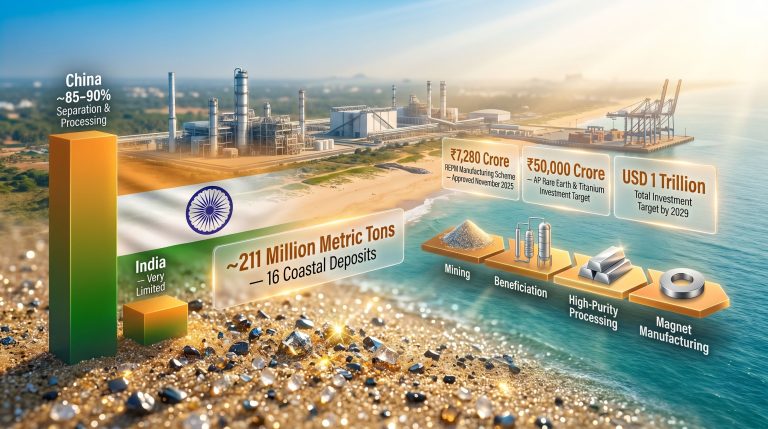
India's rare earth element supply chain exhibits a degree of concentration risk that policymakers have described as strategically untenable. China controls approximately 60% of global REE production and an estimated 85% of global processing capacity, meaning that disruptions to Sino-Indian trade relationships reverberate directly through India's electronics, defence, and clean energy manufacturing sectors.
The downstream exposure is concrete. India's planned electric vehicle manufacturing targets require substantial and growing volumes of neodymium, dysprosium, and praseodymium for permanent magnet motors. Wind turbine installations demand similar inputs. Furthermore, defence electronics — from radar systems to precision-guided munitions — rely on REE-based components where substitution is technically difficult or impossible. In each of these sectors, India's current import dependency ratio exceeds 70% for the minerals involved, according to data from India's Ministry of Mines. Understanding the full scope of critical minerals demand helps contextualise why India's exposure in this space is so significant.
Secondary Resources as Strategic Insurance
What makes the secondary resource conversation strategically interesting is the asymmetry between the regulatory cost of greenfield mineral extraction and the regulatory cost of recovering minerals from existing waste streams. A new mine requires land acquisition, environmental clearance, community consultation, and years of permitting before the first tonne of ore is processed. A secondary recovery operation working from existing overburden stockpiles at an already-operating mine faces a fundamentally different regulatory burden.
This distinction is not merely administrative. It means that secondary mineral recovery can, in principle, be operationalised at a fraction of the time and capital cost required for primary extraction, making it an attractive pathway for nations seeking to build domestic mineral capability quickly.
India's National Critical Mineral Mission, which targets meaningful domestic supply for 30 strategically identified minerals, has explicitly recognised this asymmetry. Consequently, it has positioned mine waste valorisation as a priority mechanism for accelerating supply chain localisation without the multi-year lead times associated with greenfield development. The broader energy security implications of this approach are increasingly shaping how policymakers frame the urgency of domestic mineral self-sufficiency.
The NLCIL and CSIR-CECRI Critical Mineral Extraction MoU: What the Agreement Actually Establishes
Institutional Profiles and Why This Pairing Makes Technical Sense
Understanding the significance of the NLCIL and CSIR-CECRI critical mineral extraction MoU requires appreciating the distinct but complementary capabilities each institution brings to the collaboration.
NLC India Limited (NLCIL) operates as a Navratna Public Sector Undertaking, a classification that grants it substantial operational and financial autonomy within India's state enterprise framework. Its operational footprint at the Neyveli lignite complex in Tamil Nadu represents one of India's largest surface mining operations, with decades of continuous excavation having generated overburden stockpiles of significant volume. Crucially, NLCIL has been actively pursuing critical and strategic mineral exploration from both primary and secondary sources, making this MoU an extension of an existing strategic orientation rather than a new departure.
CSIR-CECRI (the Central Electrochemical Research Institute, operating under India's Council of Scientific and Industrial Research) brings specialised electrochemical research capabilities that are directly applicable to mineral beneficiation from complex secondary matrices. Electrochemical separation methods, which form the core of CSIR-CECRI's research mandate, offer advantages in selectivity and environmental footprint that make them particularly well-suited to recovering trace and rare earth minerals from the heterogeneous composition of overburden and tailings.
The geographic dimension reinforces the institutional logic. Both organisations maintain substantial operations in Tamil Nadu, with CSIR-CECRI headquartered at Karaikudi and NLCIL's primary mining operations centred at Neyveli. This co-location reduces the practical friction of collaborative research — from sample transport to joint pilot facilities — in ways that geographically dispersed partnerships cannot replicate.
Agreement Scope and Technical Commitments
| Agreement Element | Detail |
|---|---|
| Signing Date | 10 June 2026 |
| Location | Neyveli, Tamil Nadu |
| Primary Study Site | NLCIL Neyveli Mines |
| Material Focus | Overburden and tailings |
| Target Minerals | Rare earth elements and trace minerals |
| Technology Goal | Sustainable, economically viable recovery methods |
| Expansion Scope | Additional NLCIL mining and exploration sites |
| Policy Alignment | National Critical Mineral Mission |
The agreement was signed by I.S. Jasper Rose, Executive Director (Mines and Land) at NLCIL, and Dr. K. Ramesha, Director of CSIR-CECRI. The signing was witnessed by NLCIL Chairman and Managing Director Prasanna Kumar Motupalli and Director (Mines) Suresh Chandra Suman. The CMD-level presence is not incidental. In Indian public sector culture, executive attendance at agreement signings signals institutional prioritisation and suggests the kind of leadership sponsorship that helps research partnerships navigate bureaucratic and funding hurdles that often stall well-intentioned collaborations.
Neyveli's Geological Case: Why Lignite Overburden Is a Credible REE Target
Understanding the Sedimentary Connection to Rare Earths
Neyveli is not an obvious rare earth target in the way that laterite deposits or carbonatite intrusions are. Yet the geological rationale for expecting REE concentrations in lignite-adjacent overburden is well-established in the scientific literature. Rare earth elements exhibit a geochemical affinity for organic-rich sedimentary environments, where humic acids and other organic complexes preferentially bind REE ions during sediment formation.
Lignite-bearing formations are, by definition, organically rich sedimentary sequences. The overburden materials excavated to access Neyveli's lignite seams have been deposited and reworked through sedimentary processes that can concentrate trace REEs — particularly the lighter rare earths such as cerium, lanthanum, and neodymium — which have the highest industrial demand for magnet and catalyst applications.
What makes ion-adsorption style REE deposits in clay-rich overburden particularly attractive from a processing perspective is that the REEs are not locked into hard mineral lattices. They are adsorbed onto clay particle surfaces, which means they can potentially be recovered through relatively low-energy leaching processes rather than the energy-intensive grinding and smelting required for hard rock REE ores.
The challenges involved in unlocking this value are well documented; however, advances in rare earth processing challenges are steadily improving the commercial viability of exactly these kinds of secondary recovery scenarios.
The Volume Advantage of Existing Stockpiles
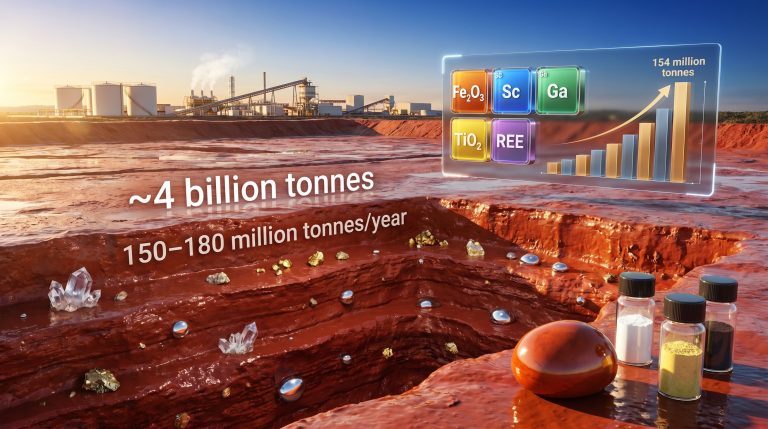
Even at trace concentrations, the sheer volume of overburden accumulated at a mining complex of Neyveli's scale creates a potentially significant aggregate inventory. Decades of lignite extraction have generated overburden on a scale that creates a concentrated secondary mineral corridor, the characterisation of which forms the first phase of the NLCIL-CSIR-CECRI research programme.
This volume dynamic is a frequently underappreciated aspect of secondary mineral economics. Lower grades per tonne can still yield commercially meaningful aggregate tonnages when the source material is measured in hundreds of millions of cubic metres rather than tens of thousands.
India's Policy Architecture: How the MoU Connects to a Larger Framework
NITI Aayog's Role as a Policy Feedback Mechanism
One of the less-reported but strategically significant dimensions of this partnership involves NLCIL Chairman Prasanna Kumar Motupalli's membership on a NITI Aayog committee specifically examining mineral recovery from mine waste, overburden, and tailings. NITI Aayog functions as India's premier government policy think tank, and committee membership creates a direct channel through which operational learnings from the Neyveli research programme could inform national policy frameworks.
This creates a feedback loop with material consequences. Research outcomes from the NLCIL-CSIR-CECRI collaboration could directly shape the regulatory and fiscal environment for secondary mineral recovery across India's broader mining sector. In addition, it could potentially accelerate the adoption of similar programmes at coal mines, iron ore operations, and other large-scale extraction sites managed by public sector undertakings.
India Against the Global Secondary Recovery Landscape
Placing India's approach in comparative context reveals both the opportunity ahead and the distance yet to travel.
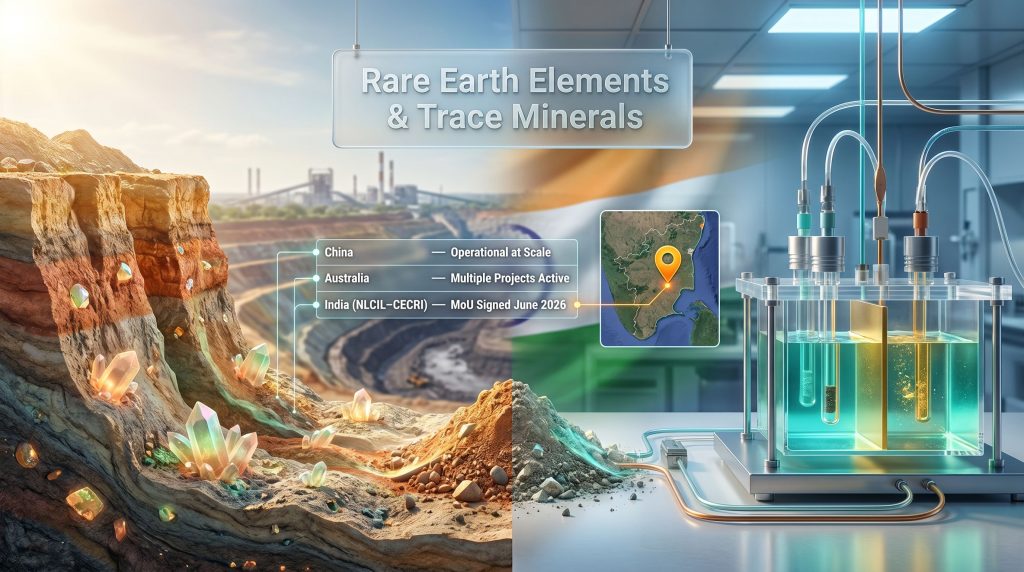
| Country | Approach | Key Minerals Targeted | Status |
|---|---|---|---|
| China | State-directed tailings reprocessing | REEs, lithium | Operational at scale |
| Australia | Commercial tailings retreatment projects | Lithium, cobalt, REEs | Multiple projects active |
| European Union | Critical Raw Materials Act secondary sourcing mandates | REEs, manganese, cobalt | Regulatory framework active |
| United States | DOE-funded mine waste REE recovery programmes | REEs, critical minerals | Pilot and demonstration phase |
| India (NLCIL-CSIR-CECRI) | PSU-research institute collaboration model | REEs, trace minerals | MoU signed June 2026 |
What distinguishes India's approach is its reliance on the PSU-research institute model, which avoids dependence on private sector capital markets while leveraging existing institutional infrastructure. China's rare earth strategy, for instance, demonstrates how state-directed coordination can achieve rapid scale in ways that market-driven models struggle to replicate. The tradeoff for India is pace, as private commercial ventures in Australia and North America can move more quickly when economics are compelling. However, India's model offers a pathway that is more insulated from commodity price volatility and investor sentiment cycles.
The Technology Layer: How Electrochemical Methods Change the Recovery Economics
Why Conventional Processing Falls Short for Secondary Matrices
Traditional REE recovery from primary hard rock deposits typically relies on physical separation followed by acid leaching and solvent extraction — a process that is both chemically intensive and generates significant secondary waste streams. When applied to heterogeneous secondary materials like overburden, these methods face additional challenges because the mineralogy is variable and REE concentrations may be spatially inconsistent.
Electrochemical beneficiation — CSIR-CECRI's core research domain — approaches this problem differently. Rather than applying a uniform chemical treatment to bulk material, electrochemical methods can exploit differences in the electrochemical potential of target minerals to achieve selective separation. This selectivity advantage reduces reagent consumption, minimises the volume of waste generated during processing, and can be tuned to target specific REE fractions depending on their relative value and concentration.
A Step-by-Step View of the Recovery Process
Understanding how secondary mineral recovery actually works from stockpile to potentially recoverable product helps frame realistic expectations for the collaboration's timeline and outputs.
-
Geochemical Characterisation — Systematic sampling and assay of overburden stockpiles to map REE and trace mineral concentrations, identifying high-value zones within the bulk material inventory.
-
Mineralogical Analysis — Determining how REEs are bound within the overburden matrix, whether adsorbed onto clays, incorporated into accessory minerals, or occurring as discrete rare earth mineral grains, as this fundamentally determines which processing route will be most effective.
-
Beneficiation Route Selection — Matching electrochemical, hydrometallurgical, or hybrid processing methods to the specific material profile identified during characterisation.
-
Pilot-Scale Processing Trials — Small-scale extraction tests to validate recovery rates and refine process parameters under controlled conditions before committing to larger infrastructure.
-
Economic Modelling — Cost-per-tonne recovery analysis benchmarked against prevailing REE market prices to determine whether the processing economics support commercial development.
-
Feasibility Determination — A structured go or no-go assessment for infrastructure investment and potential commercial-scale deployment, with findings that could inform similar evaluations at other NLCIL sites.
Sustainability Alignment as a Commercial Differentiator
Secondary recovery from existing waste stockpiles carries an inherent ESG advantage that is becoming commercially material as downstream manufacturers face increasing pressure to demonstrate responsible sourcing. Key sustainability attributes include:
-
Elimination of additional land clearing and habitat disturbance associated with new mine development
-
Potential for simultaneous site rehabilitation and mineral value recovery, converting a liability into a productive asset
-
Substantially lower water and energy intensity per unit of mineral recovered compared to primary extraction
-
Alignment with India's climate commitments and responsible mining frameworks that are increasingly referenced in international trade agreements
According to a report on the NLC India and CSIR-CECRI collaboration, the agreement specifically targets sustainable and economically viable recovery technologies, reinforcing this ESG positioning as a central rather than incidental feature of the programme's design.
The next major ASX story will hit our subscribers first
Commercial and Geopolitical Implications: Reading Beyond the MoU
What Progress Signals to Watch
For those monitoring India's critical mineral development trajectory, several near-term indicators would signal genuine programme momentum rather than institutional optics:
-
Publication of geochemical characterisation data from Neyveli overburden studies, including concentration ranges for specific REEs
-
Reported recovery efficiency rates from pilot-scale electrochemical processing trials
-
Formal expansion of the study framework to additional NLCIL mining or exploration sites
-
Joint intellectual property filings between NLCIL and CSIR-CECRI covering beneficiation process innovations
The Replication Potential Across India's Mining Estate
The most strategically significant aspect of the NLCIL and CSIR-CECRI critical mineral extraction MoU may not be what it produces at Neyveli specifically but rather the model it establishes. India operates numerous large-scale public sector mining enterprises managing coal, iron ore, bauxite, and other deposits, all of which have accumulated overburden and tailings at scale. A validated, replicable methodology for secondary REE and trace mineral recovery from these waste streams could unlock a distributed domestic mineral inventory that requires no new land acquisition and leverages already-permitted industrial sites.
The structural significance of this partnership lies not in its immediate output but in its potential to establish a replicable public-sector template for unlocking latent mineral value from India's existing mining estate — one that sidesteps the capital and regulatory constraints of greenfield development entirely.
Positioning Within the Indo-Pacific Mineral Network
India's secondary resource development sits within a broader strategic context in which Indo-Pacific nations are actively seeking to reduce collective dependence on concentrated critical mineral supply chains. Bilateral mineral agreements, joint processing ventures, and technology-sharing arrangements are proliferating across the region. Furthermore, strengthening rare earth supply chains domestically enhances India's standing as a credible partner in these broader regional arrangements. A credible domestic secondary recovery capability also strengthens India's negotiating position and enhances its potential role as a technology provider to other developing-economy mining nations facing similar challenges.
The formal announcement of the MoU, as detailed in official communications from CSIR-CECRI, confirms that this collaboration has full institutional backing at the highest levels of both organisations, lending it a credibility that distinguishes it from less formally anchored research partnerships in the sector.
Frequently Asked Questions
What is the NLCIL and CSIR-CECRI critical mineral extraction MoU?
The agreement establishes a formal research and development collaboration between NLC India Limited and the CSIR-Central Electrochemical Research Institute to assess extraction potential for rare earth elements and trace minerals from overburden and tailings at NLCIL's Neyveli mines, with scope for expansion to other NLCIL sites.
What minerals are the focus of this agreement?
The primary focus encompasses rare earth elements and other trace minerals present within overburden and tailings generated during lignite extraction at Neyveli. The specific mineral profile will be determined during the geochemical characterisation phase of the research programme.
Why is CSIR-CECRI a technically appropriate partner for this work?
CSIR-CECRI's electrochemical research expertise is directly relevant to the challenge of recovering trace minerals from heterogeneous secondary matrices. Electrochemical separation methods offer selectivity advantages over conventional bulk chemical processing that make them well-suited to the variable mineralogy of mining overburden.
Could this model be applied to other Indian mining operations?
The MoU explicitly includes provisions for extending similar studies to other NLCIL sites, and the broader policy context strongly suggests that a validated methodology could be adopted across India's wider public sector mining estate.
What is NLCIL's CMD's connection to India's broader mineral policy?
Prasanna Kumar Motupalli serves on a NITI Aayog committee examining mineral recovery from mine waste, overburden, and tailings, placing NLCIL at the intersection of operational practice and national policy formation in this space.
This article is intended for informational purposes only and does not constitute financial advice or an investment recommendation. Statements regarding projected outcomes, timelines, and policy developments involve inherent uncertainty and should not be relied upon as guarantees of future results. Readers should conduct independent research before making any investment decisions related to the mining or critical minerals sectors.
Want To Track the Next Major Critical Mineral Discovery Before the Market Does?
Discovery Alert's proprietary Discovery IQ model scans ASX announcements in real time, instantly identifying significant mineral discoveries across more than 30 commodities — including the critical and rare earth minerals reshaping global supply chains — and delivering actionable insights directly to subscribers. Explore historic discoveries and their returns to understand the scale of opportunity, then begin your 14-day free trial at Discovery Alert to position yourself ahead of the broader market.