June 14, 2026
Critical Mineral Dependencies Drive Strategic Seabed Resource Development
The global race for critical minerals has reached a pivotal inflection point, where traditional land-based supply chains face unprecedented vulnerabilities. Nations worldwide grapple with concentrated resource dependencies that threaten both economic security and technological advancement. Against this backdrop, the US deep sea mining industry expansion emerges as a potential game-changing solution, offering access to vast underwater deposits that could fundamentally reshape global supply dynamics.
The strategic importance of minerals like cobalt, nickel, copper, and manganese extends far beyond conventional mining considerations. These elements form the foundation of renewable energy infrastructure, electric vehicle production, and advanced defense systems. Furthermore, as the transition to clean energy accelerates, the demand for these critical materials continues to outpace traditional supply capabilities, creating strategic vulnerabilities that forward-thinking nations seek to address through innovative extraction methodologies.
When big ASX news breaks, our subscribers know first
NOAA's Regulatory Framework Transformation
The National Oceanic and Atmospheric Administration has implemented a consolidated permitting structure that represents a fundamental shift in how the United States approaches seabed mineral extraction. This regulatory transformation merges previously separate exploration and commercial recovery applications into a unified pathway. Consequently, this approach effectively reduces administrative complexity that historically deterred private investment in deep sea mining ventures.
Recent mining permit reforms have accelerated this streamlining process, demonstrating the administration's commitment to reducing bureaucratic barriers. The consolidated framework addresses several key operational challenges:
- Streamlined approval processes that reduce project development timelines
- Integrated environmental assessment protocols spanning exploration through production phases
- Standardised compliance requirements that provide greater regulatory certainty for investors
- Enhanced coordination between federal agencies overseeing maritime activities
This regulatory evolution signals a strategic commitment to positioning the United States as a leader in the emerging deep sea mining sector. However, it also maintains environmental oversight standards essential for sustainable operations.
Economic Forces Accelerating Deep Sea Operations
The economic drivers behind America's accelerated interest in seabed mining reflect both opportunity and necessity. Current supply chain analysis reveals concerning dependencies on foreign-controlled mineral resources essential for national security and economic competitiveness. For instance, global cobalt production remains heavily concentrated in politically unstable regions.
Critical Mineral Import Dependencies
| Mineral | Current Import Dependency | Primary Source Countries | Strategic Priority |
|---|---|---|---|
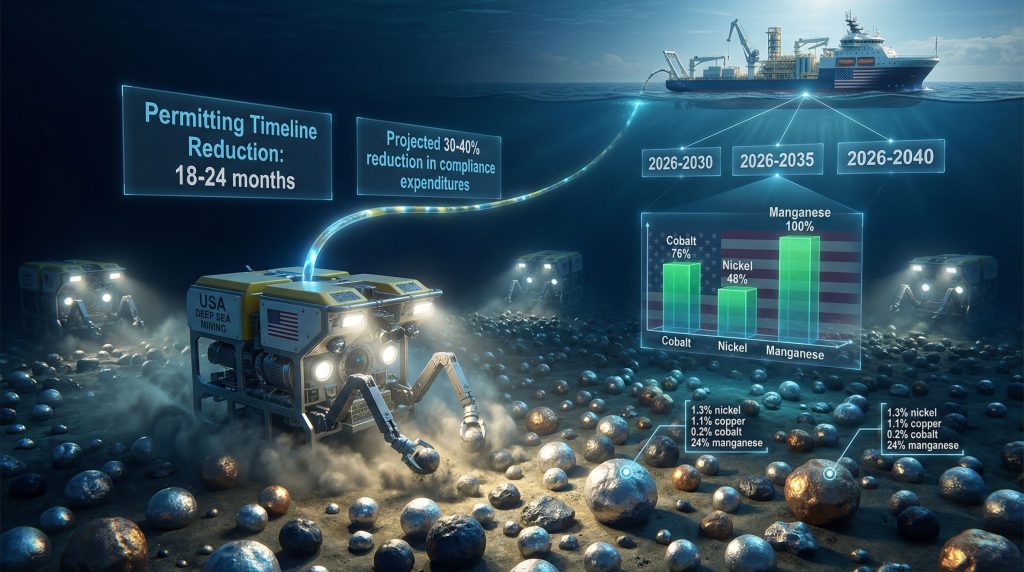
| Cobalt | 76% | Democratic Republic of Congo | Critical |
| Nickel | 48% | Indonesia, Philippines | High |
| Copper | 32% | Chile, Peru | Medium-High |
| Manganese | 100% | South Africa, Gabon | Critical |
These dependencies create significant economic and strategic vulnerabilities. Supply disruptions in source countries can immediately impact US manufacturing capabilities, particularly in sectors critical to national security and clean energy transitions.
Investment Climate Analysis
The US deep sea mining industry expansion benefits from several converging economic factors. Moreover, advances in mining industry innovation continue to reduce operational risks and improve commercial viability.
Capital Market Dynamics:
- Increasing venture capital interest in mining technology innovations
- Strategic partnerships between established mining companies and technology developers
- Government incentives for domestic critical mineral production
- Risk-sharing mechanisms for early-stage deep sea operations
Commodity Price Pressures:
- Sustained elevated prices for critical minerals driven by clean energy demand
- Supply chain security premiums for domestically sourced materials
- Long-term contracts providing revenue stability for deep sea projects
- Technology cost reductions making seabed extraction commercially viable
Jurisdictional Complexities in International Waters
NOAA's assertion of permitting authority in international waters creates unprecedented regulatory complexity within existing maritime law frameworks. The United States operates outside the International Seabed Authority while claiming rights to license activities in areas traditionally governed by multilateral agreements.
Legal Foundation Analysis
The regulatory approach relies on several key legal principles. Additionally, the framework considers how the critical minerals energy transition affects national security priorities:
Domestic Legal Authority:
- Deep Seabed Hard Mineral Resources Act of 1980 provides statutory foundation
- Flag state jurisdiction over US-licensed vessels and operations
- Environmental protection requirements under existing maritime regulations
- National security considerations for critical mineral access
International Law Positioning:
- Freedom of the seas principles support unilateral licensing claims
- Historical precedent for resource extraction outside territorial waters
- Reciprocal recognition agreements with allied nations
- Diplomatic engagement to prevent international legal challenges
Geopolitical Risk Assessment
The unilateral approach carries significant geopolitical implications. According to international legal experts, the complexity of asserting sovereign licensing authority in areas beyond national jurisdiction remains considerable, particularly when competing claims exist from other nations.
International maritime law experts emphasise the complexity of asserting sovereign licensing authority in areas beyond national jurisdiction, particularly when competing claims exist from other nations.
Primary Risk Factors:
- Legal challenges from the International Seabed Authority questioning US jurisdiction
- Diplomatic tensions with allied nations preferring multilateral frameworks
- Chinese counter-claims in overlapping seabed areas of interest
- Environmental litigation challenging deep sea mining operations generally
Technology Requirements for Commercial Viability
Deep sea mining operations require sophisticated technological integration across multiple specialised domains. The successful implementation of commercial-scale seabed mineral extraction depends on advances in robotics, processing systems, and environmental monitoring capabilities.
Operational Technology Components
Extraction Systems:
- Remotely operated vehicles (ROVs) capable of sustained operation at 4,000+ meter depths
- Hydraulic collection systems designed for nodule harvesting without excessive sediment disturbance
- Real-time monitoring networks providing continuous operational and environmental data
- Autonomous navigation systems enabling precise collection pattern execution
Processing Infrastructure:
- Shipboard mineral processing capabilities for initial concentration and dewatering
- Quality control systems ensuring consistent product specifications
- Waste management protocols for processing byproducts and contaminated materials
- Storage and transport systems designed for maritime operational environments
Investment Requirements by Development Phase
| Phase | Capital Investment | Timeline | Key Technologies | Risk Level |
|---|---|---|---|---|
| Exploration | $50-100 million | 2-3 years | Survey, sampling | Medium |
| Pilot Operations | $200-500 million | 3-5 years | Collection systems | High |
| Commercial Scale | $1-3 billion | 5-8 years | Full infrastructure | Very High |
The capital intensity of deep sea mining operations requires innovative financing structures and risk-sharing mechanisms. Consequently, partnerships between private investors and government agencies become essential for project viability.
Geographic Targeting: Clarion-Clipperton Zone Analysis
The Clarion-Clipperton Zone represents the primary focus for the US deep sea mining industry expansion, spanning approximately 4.5 million square kilometres between Hawaii and Mexico. This region contains vast polymetallic nodule benefits that could supply significant portions of global critical mineral demand.
Resource Characteristics
Nodule Distribution:
- Density ranges from 10-30 kilograms per square metre in premium areas
- Mineral composition averaging 1.3% nickel, 1.1% copper, 0.2% cobalt, and 24% manganese
- Water depths of 4,000-6,000 metres, optimal for current extraction technologies
- Total estimated resources potentially exceeding 21 billion metric tons
Operational Advantages:
- Relatively stable ocean conditions suitable for continuous operations
- Distance from major shipping lanes reducing navigation conflicts
- Established research presence facilitating environmental baseline studies
- Proximity to US West Coast ports optimising logistics and supply chains
Alternative Target Regions
Mid-Atlantic Ridge Systems:
- Polymetallic sulphide deposits near hydrothermal vents offer higher grade concentrations
- Enhanced copper and gold content provides additional revenue potential
- Active geological processes create greater technical and environmental challenges
- Deeper water depths require advanced extraction technologies
Pacific Seamount Formations:
- Cobalt-rich ferromanganese crusts provide strategic defence materials
- Substrate attachment requires different extraction methodologies
- Slower formation rates limit sustainable extraction volumes
- Unique biodiversity creates heightened environmental protection requirements
The next major ASX story will hit our subscribers first
Environmental and Social Governance Frameworks
Deep sea mining operations must address unprecedented environmental challenges in largely unexplored marine ecosystems. The development of comprehensive governance frameworks becomes essential for maintaining both operational legitimacy and long-term sustainability.
Environmental Impact Mitigation
Biodiversity Protection Protocols:
- Comprehensive baseline surveys documenting pre-operational ecosystem conditions
- Real-time environmental monitoring systems tracking sediment plumes and habitat disturbance
- Adaptive management frameworks allowing operational adjustments based on environmental data
- Restoration research programmes developing techniques for ecosystem recovery post-extraction
Sediment Plume Management:
- Advanced filtration systems minimising suspended sediment discharge
- Operational timing restrictions during sensitive ecological periods
- Plume modelling capabilities predicting and controlling sediment dispersion patterns
- Long-term monitoring commitments tracking ecosystem recovery over decades
Stakeholder Engagement Framework
| Stakeholder Group | Engagement Level | Primary Concerns | Mitigation Strategy |
|---|---|---|---|
| Environmental Organisations | High | Ecosystem protection | Transparent monitoring |
| Fishing Industries | Medium | Habitat disruption | Compensation protocols |
| Indigenous Communities | High | Cultural preservation | Consultation agreements |
| International Partners | High | Sovereignty issues | Diplomatic coordination |
The success of the US deep sea mining industry expansion depends significantly on maintaining stakeholder support through transparent operations and meaningful engagement processes.
Market Competition and Strategic Positioning
The global deep sea mining landscape involves multiple state and private actors pursuing similar strategic objectives. This creates a complex competitive environment that will significantly influence the trajectory of America's seabed mining ambitions.
International Competitive Analysis
Chinese Strategic Initiatives:
- State-sponsored research programmes advancing deep sea mining technologies
- Extensive ISA exploration contracts providing preferred access to premium sites
- Integrated supply chain approach linking extraction to domestic processing capabilities
- Long-term strategic planning with government backing for sustained investment
European Union Position:
- Precautionary regulatory frameworks emphasising environmental protection
- Technology partnership strategies leveraging advanced engineering capabilities
- Sustainability-focused approaches potentially creating competitive disadvantages
- Diplomatic preference for multilateral governance structures
Private Sector Dynamics
The involvement of private companies in the US deep sea mining industry expansion creates unique competitive dynamics. Furthermore, recent analysis reveals the substantial financial backing driving international competition in this sector.
Investment Patterns:
- Venture capital focus on breakthrough extraction technologies
- Strategic partnerships between mining companies and technology developers
- Risk-sharing arrangements for high-capital early-stage operations
- Intellectual property development in specialised mining equipment and processes
Market Entry Timing:
- First-mover advantages in premium resource site selection
- Technology leadership providing operational efficiency benefits
- Strategic patience benefits from learning from early operational challenges
- Cost optimisation as technologies mature and scale
Economic Models and Commercial Viability
Deep sea mining operations require innovative economic models due to unprecedented capital requirements and operational uncertainties. The development of viable business cases depends on sophisticated financial engineering and risk management approaches.
Cost Structure Analysis
Major Cost Components:
- Capital expenditure ranging from $1-3 billion for commercial-scale operations
- Operational expenditure estimated at $15-25 per ton of processed material
- Regulatory compliance costs representing 5-10% of total operational expenses
- Environmental monitoring requirements accounting for 3-7% of operational costs
Revenue Model Variables:
- Commodity price volatility affecting project economics
- Production volume scalability influencing unit cost structures
- Processing efficiency determining profit margins
- Long-term contract pricing providing revenue stability
Profitability Scenarios by Market Conditions
| Market Scenario | Cobalt Price | Nickel Price | Project IRR | Payback Period |
|---|---|---|---|---|
| Conservative | $25/lb | $8/lb | 12-15% | 8-10 years |
| Base Case | $35/lb | $12/lb | 18-22% | 6-8 years |
| Optimistic | $50/lb | $18/lb | 25-30% | 4-6 years |
The wide range of potential returns reflects both the significant opportunity and substantial risk inherent in deep sea mining investments.
Industrial Policy Integration and Supply Chain Transformation
The successful development of deep sea mining requires comprehensive integration with broader industrial policy objectives. This is particularly relevant for supply chain resilience and domestic manufacturing capabilities related to the US deep sea mining industry expansion.
Supply Chain Resilience Enhancement
Manufacturing Sector Impacts:
- Battery production cost reductions through access to domestically sourced critical minerals
- Defence contractor supply security reducing dependence on potentially unstable foreign suppliers
- Clean energy infrastructure acceleration enabled by reliable mineral supply access
- Advanced manufacturing competitiveness supported by strategic material availability
Regional Economic Development:
- Coastal processing facility development creating high-value industrial employment
- Maritime technology cluster formation leveraging deep sea mining expertise
- Research and development investments in specialised extraction and processing technologies
- Export potential for both minerals and mining technology to international markets
Policy Coordination Requirements
Successful implementation requires unprecedented coordination across federal agencies and policy domains:
Regulatory Harmonisation Needs:
- Environmental protection standards balancing conservation with resource access
- International trade policy coordination addressing potential trade disputes
- Defence industrial base integration ensuring strategic material access
- Research funding prioritisation supporting critical technology development
Infrastructure Development:
- Port facility modifications to handle deep sea mining operations
- Processing plant construction near coastal transportation hubs
- Workforce development programmes for specialised maritime mining skills
- Technology transfer mechanisms from research institutions to industry
Future Outlook and Strategic Implications
The trajectory of the US deep sea mining industry expansion will significantly influence America's position in the global critical minerals landscape. Success in this sector could provide substantial strategic advantages, while delays or failures may exacerbate existing supply chain vulnerabilities.
Key Success Factors:
- Technology development achieving commercial viability for large-scale operations
- Regulatory stability providing investor confidence for long-term capital commitments
- International cooperation preventing destructive legal and diplomatic conflicts
- Environmental performance maintaining public and stakeholder support for continued operations
Strategic Implications:
- Enhanced national security through reduced critical mineral import dependencies
- Industrial competitiveness improvements in clean energy and advanced manufacturing sectors
- Geopolitical leverage through control of strategic mineral supply capabilities
- Economic development opportunities in coastal regions supporting deep sea mining operations
The success of these efforts will depend on navigating complex technological, regulatory, environmental, and geopolitical challenges. Moreover, maintaining the financial viability necessary to attract sustained private investment remains crucial. The stakes extend far beyond the mining sector itself, encompassing fundamental questions of national security, economic competitiveness, and environmental stewardship in the 21st century.
This analysis is based on publicly available information and industry projections. Deep sea mining involves significant technological, environmental, and regulatory uncertainties that could materially affect actual outcomes compared to the scenarios presented.
Ready to Capitalise on Critical Mineral Discoveries Before the Market Reacts?
Discovery Alert's proprietary Discovery IQ model delivers instant notifications on significant ASX mineral discoveries, empowering subscribers to identify actionable opportunities in the rapidly evolving critical minerals sector ahead of broader market awareness. Experience why major mineral discoveries have historically generated substantial returns by exploring Discovery Alert's discoveries page, then begin your 14-day free trial today to secure your market-leading advantage.