June 14, 2026
The Crude Oil Supply Chain and Its Hidden Grip on What You Pay at the Pump
Retail fuel pricing is one of the most politically sensitive and economically consequential mechanisms in any import-dependent economy. Yet the forces driving it are frequently misunderstood by the general public. A thorough fuel prices review based on crude oil supply reveals why price relief rarely arrives as quickly as supply improvements might suggest, and why certain economies remain chronically exposed to international market volatility. Most consumers associate pump price changes with government decisions or refinery behaviour, when in reality the dominant variable sits thousands of kilometres upstream, buried in the geopolitics of crude-producing regions.
When big ASX news breaks, our subscribers know first
Why Crude Oil Supply Dominates Retail Fuel Pricing
The cost composition of retail fuel is often surprising to those unfamiliar with energy economics. While taxes, refining margins, and distribution costs all contribute to what consumers pay, crude oil input costs account for the largest and most volatile share of the final price. Across most major markets, this single input represents roughly half or more of the pump price, making it the primary driver of retail fuel cost movements.
The following breakdown illustrates typical retail fuel price components under normal market conditions:
| Fuel Price Component | Approximate Share of Retail Price |
|---|---|
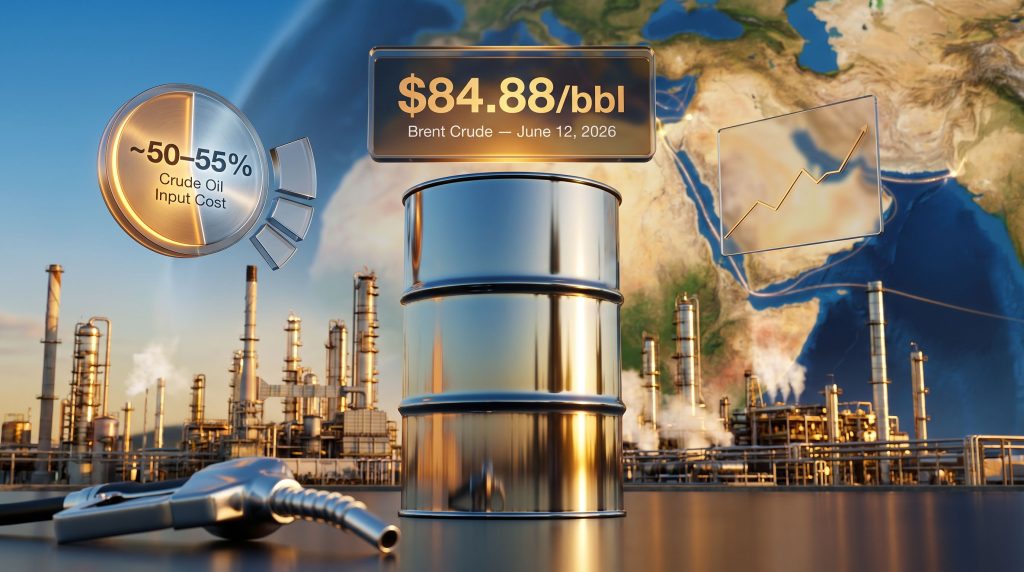
| Crude oil input cost | ~50–55% |
| Refining and processing margin | ~15–20% |
| Distribution and marketing | ~10–15% |
| Government taxes and levies | ~15–25% (varies by country) |
Note: These proportions shift considerably depending on jurisdiction. European markets with high excise duties see the tax component dominate, while South Asian markets with partially subsidised fuel structures may see crude input costs exert a more direct and immediate influence on consumer pricing.
Understanding the crude oil market dynamics helps explain what makes crude supply conditions particularly powerful as a price driver — their volatility relative to other components. Taxes tend to be stable over medium-term periods. Refining margins fluctuate, but within a narrower band. Distribution costs are largely fixed. Only crude input costs can shift by 20 to 40 percent within weeks, which is precisely why upstream supply events so dramatically reshape what consumers pay.
How Supply Disruptions Transmit Through the Fuel Price Chain
The pathway from a crude oil supply shock to a visible change at the petrol station involves multiple sequential steps, each introducing its own timing dynamic:
- A production disruption or geopolitical event reduces available crude volumes in international markets
- Spot and futures prices on benchmarks like Brent crude respond, often within hours
- Refiners face higher feedstock acquisition costs, compressing margins or prompting wholesale price increases
- Wholesale fuel prices adjust upward, affecting what retailers pay to replenish inventory
- Retail stations reprice to protect margins, with visible pump price increases typically appearing within days to two weeks of a significant crude movement
The Rockets and Feathers Effect: A Market Asymmetry Worth Understanding
One of the most consistently documented phenomena in energy economics is the asymmetric speed of fuel price adjustment. When crude oil prices rise, retail fuel prices respond almost immediately. When crude falls, the downward adjustment to pump prices occurs far more slowly. This pattern, widely known in academic literature as the rockets and feathers effect, has been observed across markets from the United States to Europe to Asia.
Research published across multiple energy economics journals consistently confirms that the upward pass-through of crude price increases to retail fuel occurs significantly faster than downward adjustments, with the lag on price reductions often extending several weeks beyond what cost structures alone would justify.
According to research on crude-petroleum price relationships, several structural factors drive this asymmetry:
- Retailers reprice upward immediately when crude rises to protect current and forward inventory costs
- Inventory purchased at elevated prices must be sold before cheaper replacement stock justifies lower pump prices
- Consumer price sensitivity tends to be lower during supply disruptions, reducing competitive pressure on retailers to cut prices quickly
- In regulated or semi-regulated markets, formal review processes introduce additional procedural delays into any downward revision
Global Crude Oil Supply Conditions: A June 2026 Market Assessment
The current pricing environment across multiple fuel categories reflects a period of genuine supply-side stress rather than speculative price inflation. The West Asia region, which functions as one of the world's most critical crude export corridors, has experienced significant disruptions tied to ongoing regional conflict. Furthermore, the cascading effect of these disruptions on international crude benchmarks has been measurable and sustained.
Brent crude was trading at approximately $84.88 per barrel as of mid-June 2026, reflecting an elevated level relative to the prior year even after pulling back from earlier conflict-driven peaks. For large crude-importing economies, this price point translates directly into higher import bills, compressed refinery economics, and ultimately elevated domestic fuel prices across petrol, diesel, and cooking gas categories.
The EIA's global oil outlook for June 2026 identified Middle East supply disruptions as the primary driver of tightened global crude inventories during this period. Importantly, the EIA's projections indicate that even as some production recovery unfolds, inventory normalisation is expected to lag considerably behind any easing in benchmark prices. This means consumers in import-dependent markets should not anticipate immediate pump price relief even if Brent crude begins trending lower.
Why the Middle East Remains the Swing Variable in Global Crude Supply
A lesser-appreciated dimension of Middle Eastern crude dominance is not just volume, but quality grade. The region produces significant quantities of medium-sour and light-sweet crude grades that are specifically suited to the refinery configurations most prevalent across South and Southeast Asia. Refineries in India, for instance, have historically been engineered to process Middle Eastern crude grades with particular sulphur profiles.
This creates a structural dependency that goes beyond simple volume availability and into refinery compatibility, meaning that substituting alternative crude sources during a Middle East supply disruption is neither seamless nor cost-neutral. The geopolitical drivers of crude are therefore as significant as the volumes themselves when assessing price risk.
When Middle Eastern supply tightens, import-dependent refiners cannot simply switch to alternative crude sources without incurring additional processing costs, yield losses, or quality adjustments in finished fuel products. The refinery-crude compatibility factor is a critical but underreported dimension of supply shock vulnerability.
India's Fuel Pricing Framework and the Supply-Conditional Review Model
India's approach to domestic fuel pricing sits in a structurally complex position between fully deregulated markets and historically subsidised pricing regimes. Following partial deregulation efforts over the past decade, petrol and diesel prices are technically linked to international benchmarks, but in practice remain subject to government oversight and periodic review rather than automatic daily adjustment.
The Ministry of Petroleum and Natural Gas holds authority over the timing and scale of price revisions, creating a framework in which pricing decisions are made at politically informed intervals rather than purely on market movement. This structure has both advantages and vulnerabilities:
| Pricing Framework Type | Consumer Price Volatility | Fiscal Risk | Speed of Pass-Through |
|---|---|---|---|
| Fully deregulated (daily adjustment) | High | Low | Immediate |
| Review-based (India model) | Moderate | Moderate | Delayed |
| Fully subsidised | Very Low | Very High | Minimal |
Recent weeks have seen upward adjustments to petrol, diesel, and LPG prices in India, directly attributed to supply-side disruptions flowing from the West Asia conflict zone. The trade war impact on oil markets has added an additional layer of complexity to this already pressured pricing environment. India's Union Minister of State for Petroleum and Natural Gas indicated publicly that any forthcoming fuel prices review based on crude oil supply would be conducted with Petroleum Minister Hardeep Singh Puri responsible for the final determination after assessing prevailing conditions.
This supply-contingent framing signals a data-driven rather than predetermined approach to the next pricing decision, with the direction of any revision dependent on how the West Asia situation evolves.
Which Fuel Categories Face the Greatest Supply Shock Exposure?
| Fuel Type | Primary Use Case | Supply Shock Sensitivity | Recent Price Trend (India, 2026) |
|---|---|---|---|
| Petrol (Gasoline) | Personal transport | High | Increased |
| Diesel | Commercial transport, agriculture | Very High | Increased |
| LPG (Cooking gas) | Residential energy | Moderate to High | Increased |
Diesel warrants particular attention given its role not only in passenger transport but in the agricultural and logistics supply chains that underpin food distribution across India. A sustained diesel price increase does not stay contained within the transport sector; it propagates into food prices, input costs for farmers, and the delivered cost of virtually every manufactured good.
The Recovery Lag: Why Price Relief Takes Longer Than Expected
Even when crude oil supply begins to normalise following a disruption, the benefits take time to materialise at the retail level. Historical patterns from comparable events are instructive here. Following the 2022 Russia-Ukraine supply shock and the 2019 attack on Saudi Aramco processing infrastructure, retail fuel prices in major import-dependent markets took between four and twelve weeks longer to fully normalise than the underlying crude benchmarks, due to several overlapping structural factors:
- Refinery inventory rebuilding takes priority before cost reductions are passed to wholesale buyers
- Forward purchase contracts locked in at elevated prices prevent immediate repricing
- Retail margin recovery behaviour leads fuel stations to maintain higher prices temporarily to offset losses incurred during the supply disruption
- Regulatory review timelines in markets like India introduce procedural delays into any downward revision
The next major ASX story will hit our subscribers first
Broader Economic Consequences of Sustained Supply-Driven Fuel Inflation
The inflationary spillover from elevated fuel prices extends well beyond transport costs. Considering the broader role of oil in the global economy, diesel and LPG price increases create a cascading effect across multiple economic layers:
- Agricultural costs rise as diesel-dependent machinery, irrigation pumps, and fertiliser production become more expensive
- Logistics and freight costs increase, raising the delivered price of virtually all consumer goods
- Household energy expenditure grows, with disproportionate impact on lower-income segments where cooking gas represents a material share of monthly budgets
- Industrial energy costs escalate, reducing competitiveness in energy-intensive manufacturing sectors
Central banks operating in fuel-importing economies face a particularly difficult policy environment when supply-driven inflation persists. Rate increases to contain inflation risk suppressing broader economic growth. Holding rates risks embedding fuel cost increases into wage and price expectations. Fiscal tools such as targeted subsidies or temporary tax reductions offer short-term relief but build structural budgetary vulnerabilities over time.
Disclaimer: Forward-looking statements regarding crude oil price trajectories, supply recovery timelines, and government pricing decisions involve inherent uncertainty. This article is for informational purposes only and does not constitute financial or investment advice. Readers should consult independent sources and professional advisors before making financial decisions.
Frequently Asked Questions: Fuel Prices and Crude Oil Supply
What drives the direct link between crude oil supply and fuel prices?
When crude supply tightens due to geopolitical conflict, output cuts, or infrastructure damage, the cost of the primary input into fuel production rises sharply. Refiners pass those increased feedstock costs through to wholesale markets, and retail stations adjust pump prices accordingly. The reverse process is slower and structurally constrained, as outlined above.
Why do petrol and diesel prices rise faster than they fall?
The asymmetric adjustment pattern reflects retailer behaviour, inventory replacement dynamics, and reduced competitive pressure during supply shocks. Upward repricing protects margins immediately; downward repricing is delayed by the need to clear higher-cost inventory and by reduced urgency to compete on price when supply remains uncertain.
How does West Asia conflict affect Indian petrol and LPG prices?
The Middle East supplies a significant proportion of India's crude imports, and disruptions to export flows from the region tighten global availability and elevate Brent benchmark prices. Higher import costs feed directly into the cost base for domestic fuel production and ultimately into the retail prices consumers pay at the pump and for cooking gas. In addition, OPEC's influence on oil markets means that production decisions layered on top of conflict disruptions can amplify price swings considerably.
When might Indian fuel prices come down?
Any downward revision under India's current framework requires a formal ministerial review process, which is itself contingent on demonstrated improvement in crude oil supply conditions. Based on publicly stated government positions as of June 2026, a reduction would require sustained stabilisation of West Asian supply and a corresponding retreat in international benchmark prices before a review would be likely to recommend lower domestic prices.
What is Brent crude and why does it matter to Indian consumers?
Brent crude is the globally dominant benchmark price for oil, used as the reference for the majority of international crude trade. When Brent rises, the import cost for crude-dependent economies like India increases proportionally, directly affecting refinery input costs and the downstream retail pricing of petrol, diesel, and LPG. Conducting a fuel prices review based on crude oil supply is therefore inseparable from tracking Brent's movements.
Key Takeaways: Fuel Price Outlook Under Current Supply Conditions
Summary: Crude oil supply conditions remain the dominant variable in determining retail fuel prices across import-dependent economies. The West Asia conflict has tightened global inventories and sustained Brent crude at elevated levels near $84.88 per barrel as of mid-June 2026. India's review-based pricing framework means further revisions depend on ministerial assessment of supply trajectories. Historical precedent suggests that even when crude prices begin easing, full retail price normalisation in regulated markets typically lags by four to twelve weeks or more, with inflationary spillovers into agriculture, logistics, and household energy budgets persisting well into any recovery period.
Want to Stay Ahead of the Commodity Shifts Driving Market Opportunities?
While crude oil supply disruptions ripple through fuel prices and broader economies, savvy investors know that commodity volatility also surfaces significant opportunities — particularly in ASX-listed resource and energy explorers. Discovery Alert's proprietary Discovery IQ model delivers real-time alerts on significant ASX mineral discoveries, transforming complex commodity data into actionable insights the moment announcements hit the market. Explore historic discovery outcomes that demonstrate the scale of returns major finds can generate, and begin your 14-day free trial today to position yourself ahead of the broader market.