June 14, 2026
The Hidden Architecture of Global Oil's New Trade Map
When historians assess the energy decade spanning 2022 to 2032, they will likely identify a single structural rupture that permanently altered how crude oil moves around the planet. The Western sanctions regime imposed on Russia following the 2022 invasion of Ukraine did not reduce global Russian crude consumption. It redirected it, rerouting tens of millions of barrels per month from European refineries toward Asian processing hubs. India Russian oil imports rise in May 2026 is not a monthly anomaly — it is a data point in a multi-year structural shift quietly reshaping the architecture of global energy markets.
When big ASX news breaks, our subscribers know first
Why the India Russian Oil Imports Rise in May Matters Beyond the Headlines
Most coverage of India's Russian crude purchasing frames the story in terms of sanctions defiance or diplomatic tension. That framing, while politically convenient, misses the more consequential dynamic: India's procurement decisions are driven primarily by refinery economics, not geopolitical signalling. When Russian crude trades at a meaningful discount to Brent or Middle Eastern benchmark grades, Indian refiners face a straightforward commercial calculation.
Accepting that discount expands refining margins, lowers domestic fuel production costs, and strengthens India's competitive position as a major exporter of refined petroleum products. Furthermore, understanding current crude oil prices helps contextualise why Indian refiners continue to prioritise Russian barrels over costlier alternatives.
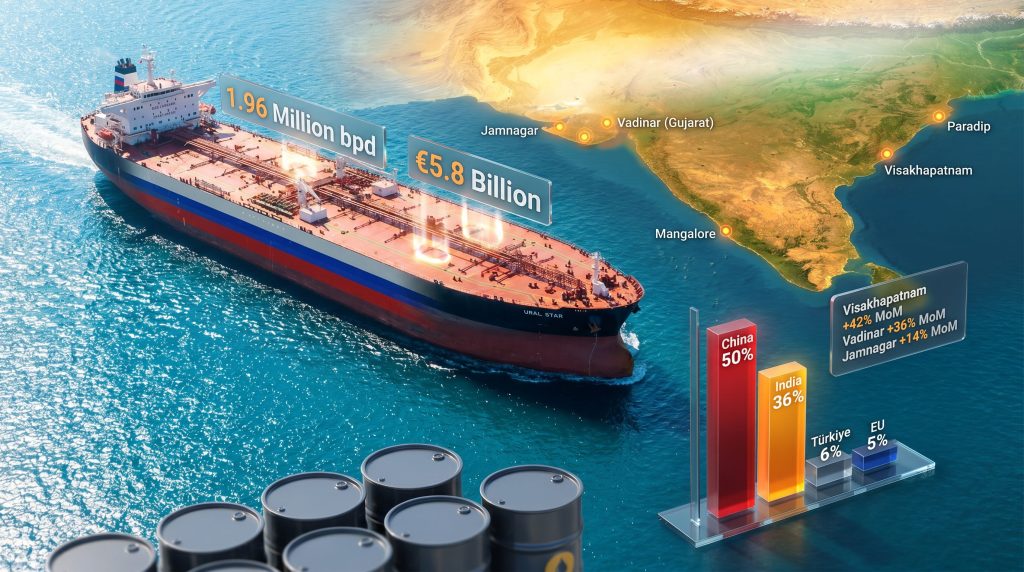
According to data published by the Centre for Research on Energy and Clean Air (CREA) and reported by the Press Trust of India via ET EnergyWorld, India imported an estimated €5.8 billion (approximately USD 6.7 billion) worth of Russian hydrocarbons in May 2026, cementing its position as the world's second-largest buyer of Russian fossil fuels that month. The breakdown of that figure reveals the degree to which crude oil dominates India's Russian energy relationship.
| Import Category | Estimated Value (May 2026) | Share of Total |
|---|---|---|
| Crude Oil | €4.8 billion | ~83% |
| Oil Products | €550 million | ~9.5% |
| Coal | €429 million | ~7.5% |
| Total Russian Hydrocarbons | €5.8 billion | 100% |
The crude oil concentration is analytically important. It indicates that India's Russian energy relationship is fundamentally a refinery feedstock story, not a diversified energy trade. Coal and product imports are secondary considerations. The primary commercial driver is securing competitive crude at below-market rates to feed a refining sector that processes oil for both domestic consumption and export revenue generation.
India's total crude import volumes recorded an 8% month-on-month increase in May 2026. Critically, Russian imports surged by 21% month-on-month during the same period, meaning Russian barrels grew at more than double the rate of overall import growth. The practical implication is clear: Russia's share of India's total crude import basket widened materially during the month, rather than remaining stable or contracting. According to Nikkei Asia, these elevated Russian import levels are likely to remain high well into the coming months.
Understanding the Volume Data: What 1.96 Million Barrels Per Day Actually Means
Volume estimates from cargo tracking sources suggest total Indian Russian crude imports reached approximately 1.96 million barrels per day (bpd) across the full month of May 2026, consistent with a ten-month high. However, the more analytically interesting data point is the early-month figure: tracking data covering the first two weeks of May indicated flows potentially reaching approximately 2.3 million bpd, a rate that moderated through the latter half of the month.
This divergence between front-loaded and full-month figures is not simply a statistical artifact. It reflects a well-documented feature of Indian crude import logistics known as arrival clustering, where multiple cargoes booked under similar voyage schedules arrive within a compressed window, inflating early-month unloading rates before normalising.
Tanker voyage times from Russian Baltic and Black Sea export terminals to Indian west coast ports typically range between 25 and 35 days depending on routing, which means procurement decisions made in April and early May drove the elevated May arrival pattern. Consequently, for analysts and investors tracking Indian crude import trends, the lesson is methodological: weekly or bi-weekly flow estimates can significantly overstate or understate monthly averages, making full-month data from CREA a more reliable baseline than tanker tracking snapshots.
Refinery-Level Breakdown: Where Russian Barrels Are Landing
The May 2026 surge was not concentrated in a single facility. It was distributed across India's refining geography, spanning private-sector giants and state-owned operators, from Gujarat's west coast to Odisha's east coast.
Private Sector Leaders: Vadinar and Jamnagar
The Vadinar refinery in Gujarat recorded one of the sharpest single-facility increases of the month, with unloaded Russian crude volumes rising 36% month-on-month from April levels. Vadinar, operated by Nayara Energy (in which Rosneft holds a significant stake), has a structural commercial incentive to process Russian crude given the ownership alignment between its parent company and Russian export infrastructure.
The Jamnagar refining complex, operated by Reliance Industries and one of the largest single-site refining installations in the world by throughput capacity, recorded a 14% month-on-month increase in Russian crude deliveries. Jamnagar's role extends beyond domestic supply: it is a significant origin point for petroleum product exports to multiple markets, including the United States, a dimension explored in greater detail in the sanctions leakage section below.
State Refinery Restarts: New Mangalore and Visakhapatnam
Perhaps the most analytically significant development in the May data is the behaviour of India's state-owned refinery operators. Both the New Mangalore refinery and the Visakhapatnam refinery had halted Russian crude purchases at the end of November 2025, a pause that lasted approximately four months before both facilities resumed imports in March 2026.
By May 2026, Russian crude deliveries to New Mangalore had risen 13% month-on-month, while Visakhapatnam recorded an even sharper 42% month-on-month jump in Russian crude arrivals. The sequence of halt, restart, and accelerating volume growth suggests the November 2025 pause was driven by short-term operational or diplomatic considerations rather than any durable reorientation of procurement strategy. When commercial logic reasserted itself, both facilities returned to Russian supply with increasing volumes.
East Coast Integration: Paradip's Two-Year High
The Paradip refinery in Odisha, operated by Indian Oil Corporation on India's east coast, processed its highest volume of Russian crude in two years during May 2026. Paradip's east coast location is relevant from a routing perspective: the facility receives crude via the Bay of Bengal, drawing on tanker routes that differ from the west coast delivery pathways serving Vadinar and Jamnagar. The east coast's growing integration into Russia-origin supply chains represents a broadening of the geographic footprint of Indian Russian crude dependence, not merely an intensification at established hubs.
How India Compares Globally: The Buyer Hierarchy for Russian Crude
Russia's post-sanctions crude export architecture has consolidated around a small number of large Asian buyers. In May 2026, the distribution of Russian crude exports was highly concentrated.
| Buyer Country | Share of Russian Crude Exports | Notes |
|---|---|---|
| China | 50% | Dominant anchor buyer; €7.0 billion total fossil fuel imports |
| India | 36% | Second largest; €5.8 billion total hydrocarbon imports |
| Türkiye | 6% | Key processing and re-export intermediary |
| European Union | 5% | Residual flows despite formal import bans |
China's 50% share reflects its role as the load-bearing buyer of sanctioned Russian energy, with crude oil comprising approximately 69% of China's Russian fossil fuel imports in May. China's purchases also include significant volumes of pipeline gas (€618 million), coal (€525 million), LNG (€510 million), and oil products (€479 million), making it a more diversified Russian energy customer than India.
India's 36% share of Russian crude exports, combined with its narrower product mix concentrated in crude oil, positions it as the single most important buyer of Russian seaborne crude barrels globally. Unlike pipeline-dependent China-Russia gas flows, India's purchases are entirely seaborne, meaning they are visible to tanker tracking systems and cargo data providers, but also more logistically complex and subject to shipping market dynamics including tanker availability and shadow fleet routing.
Türkiye's 6% share warrants particular attention given its strategic function as a processing and re-export hub. Turkish refineries, notably the SOCAR-owned STAR refinery and the Tüpraş Izmit facility, process Russian feedstock into refined products that subsequently flow into markets where direct Russian crude imports are restricted. This intermediary role is examined further below.
The Sanctions Leakage Problem: How Russian Crude Reaches Sanctioning Nations Through Refined Products
One of the least publicly understood dimensions of the current Russian energy sanctions architecture is the structural gap created by the distinction between crude oil and refined petroleum products. The sanctions on Russian oil trade restrict direct imports of Russian crude into the EU and other sanctioning nations, but products refined from Russian crude at third-country facilities occupy a considerably murkier regulatory space.
Research from CREA indicates that refineries in India, Türkiye, Brunei, and Georgia collectively exported €641 million worth of oil products to sanctioning countries in May 2026, with approximately €214 million of those products estimated to have been refined directly from Russian crude feedstock. The EU's January 21, 2026 ban on imports of oil products derived from Russian crude has not fully closed this channel: 10 shipments of such products were unloaded at EU ports in May alone.
The destination breakdown reveals the breadth of the leakage:
| Destination | Value of Russian-Origin Refined Products (May 2026) |
|---|---|
| Australia | €275 million |
| European Union | €174 million |
| United States | €147 million |
| New Zealand | €45 million |
| Total | €641 million |
U.S.-bound exports of Russian-origin refined products originated primarily from three facilities: Reliance Industries' Jamnagar refinery in Gujarat, the SOCAR-owned STAR refinery in Türkiye, and the Tüpraş Izmit refinery. CREA's analysis indicates that in the three months prior to May 2026, Russian crude comprised approximately 39% of the STAR refinery's total feedstock and approximately 15% of Jamnagar's feedstock, providing the empirical basis for attributing a proportional share of those facilities' product exports to Russian crude origin.
The policy implication is significant. A sanctioning nation importing petroleum products from a refinery where Russian crude represents 15% to 39% of feedstock is, in economic terms, partially sustaining Russian export revenue despite formal restrictions on direct purchases. The challenge for regulators is that product-level origin attribution requires refinery-level feedstock data that is not always publicly available, and even when available, the legal and trade mechanisms for restricting such imports are complex to enforce without disrupting wider fuel supply chains.
The next major ASX story will hit our subscribers first
Structural Factors Sustaining Indian Demand for Russian Crude
India's deepening reliance on Russian crude is not solely a function of price. Several structural factors embedded in the refining sector and broader energy policy framework reinforce the commercial logic of continued Russian purchases.
-
Refinery configuration adaptation: Over the 2022 to 2026 period, several Indian refineries have adjusted their processing units, blending configurations, and hydroprocessing parameters to optimise throughput of Russian Urals and ESPO blend crudes. These crudes have specific API gravity and sulphur content profiles that differ from Middle Eastern grades. Once a refinery is configured to handle a particular crude blend efficiently, switching back to alternative grades involves costs, technical adjustments, and potentially reduced throughput efficiency.
-
Margin economics and export competitiveness: The discount on Russian crude relative to Middle Eastern benchmarks directly expands refinery gate margins. Those expanded margins support India's status as a major exporter of refined petroleum products, contributing foreign exchange earnings and supporting the domestic energy sector's financial performance.
-
Shadow fleet and tanker logistics: The emergence of a significant shadow tanker fleet operating outside Western insurance and flagging systems has reduced the logistical friction associated with Russian crude trade. Tanker availability, payment mechanisms, and port logistics for Russian cargo have become progressively more established over the 2022 to 2026 window, lowering transaction costs compared to the immediate post-sanction disruption period.
-
Energy security policy calculus: India's official energy policy framework prioritises supply volume security and cost efficiency. Multiple sourcing across geographies is valued, but so is procurement flexibility. Russian crude, available at scale and at discount, fits both objectives in the absence of equivalent volume availability from alternative suppliers at comparable pricing.
Is India Moving Toward Greater Dependency or Managed Diversification?
India officially articulates a diversified crude import strategy, with procurement from the Middle East, West Africa, the Americas, and Russia. However, the May 2026 data challenges the operational reality of that diversification narrative. When Russian import volume growth runs at 21% month-on-month against an 8% overall import growth rate, the mathematical outcome is an expanding Russian share of the import basket, regardless of stated strategic intent.
A reduction in Middle Eastern supply availability earlier in the spring period created a procurement gap. Russian barrels filled that gap at commercially advantageous pricing. That dynamic illustrates a recurring pattern: whenever alternative supply tightens or premiums on non-Russian grades increase, India's refiners naturally gravitate toward the cost advantage offered by Russian crude. In addition, the broader geopolitical trade tensions reshaping energy flows globally have accelerated this tendency, making diversification away from Russian supply progressively more costly in practical terms.
The resumption and acceleration of Russian crude purchases by state-owned refineries at Visakhapatnam and New Mangalore, after a four-month halt, is perhaps the clearest indicator that the November 2025 pause represented a temporary adjustment rather than a strategic reorientation. Commercial imperatives, in the Indian refining sector, consistently reassert themselves over short-term procurement diversification experiments.
Macro Implications: What India's Buying Behaviour Means for Global Oil Markets
India's sustained absorption of Russian crude at scale has measurable consequences for global oil market structure that extend well beyond bilateral trade statistics. Furthermore, the oil price movements linked to these shifting trade flows are influencing benchmark pricing relationships across multiple regions.
For Russian export revenue: India's purchases, combined with China's dominant buying position, have provided a durable alternative revenue base for Russia's energy sector, partially offsetting the intended financial impact of Western sanctions. Russia's ability to maintain export volumes by redirecting barrels eastward has been a stabilising factor for its own fiscal position.
For global price benchmarks: The structural rerouting of Russian crude from Atlantic Basin markets to Asian buyers has contributed to a degree of pricing bifurcation between European reference benchmarks and Asian-facing crude grades. When large volumes of discounted crude are absorbed outside the Brent pricing ecosystem, the relationship between different regional benchmarks becomes less correlated than historical norms would suggest.
For sanctions policy effectiveness: The combination of India's direct crude purchases and the re-export of Russian-origin refined products to sanctioning nations through intermediary hubs creates a complex interdependency. Moreover, the broader trade war impact on oil has further complicated the enforcement perimeter, which relies almost entirely on financial system restrictions and shipping insurance market pressure rather than physical supply chain controls.
For long-term demand forecasting: India's crude import demand is projected to grow substantially through the early 2030s as the domestic economy expands and per-capita energy consumption increases. That demand growth will require large-scale crude supply, and the operational integration of Russian crude into Indian refinery workflows means Russian barrels will likely compete effectively for that incremental demand.
Frequently Asked Questions: India's Russian Oil Imports
How Much Russian Oil Did India Import in May 2026?
India imported approximately €5.8 billion (around USD 6.7 billion) worth of Russian hydrocarbons in May 2026. Volume estimates indicate total Russian crude imports reached approximately 1.96 million barrels per day for the full month, with early-month tracking data suggesting flows may have approached 2.3 million bpd during the first fortnight before moderating.
Why Did India Russian Oil Imports Rise in May 2026?
The increase reflected a convergence of commercial incentives: the persistent price discount on Russian crude relative to alternative supply sources, the resumption of purchases by state-run refineries that had paused imports since late 2025, and reduced Middle Eastern supply availability earlier in the spring creating a procurement gap that Russian barrels filled at attractive pricing.
Which Indian Refineries Saw the Biggest Increases in Russian Crude Intake?
Visakhapatnam recorded the sharpest percentage increase at 42% month-on-month, followed by Vadinar at 36%, Jamnagar at 14%, and New Mangalore at 13%. Paradip processed its highest Russian crude volume in two years. Reuters reporting on prior periods of elevated Indian Russian crude intake confirms this is a recurring pattern tied to competitive pricing dynamics.
Do Western Countries Receive Products Made From Russian Crude Processed in India?
Yes. Refined products derived from Russian crude processed at the Jamnagar complex and other intermediary refining hubs are exported to multiple markets including the United States, the European Union, Australia, and New Zealand. CREA estimated total such exports from all intermediary hubs reached €641 million in May 2026.
How Does India's Position Compare to China in the Russian Crude Market?
China accounted for 50% of Russian crude exports in May 2026 and was the largest buyer of Russian fossil fuels overall at €7.0 billion. India accounted for 36% of Russian crude exports and €5.8 billion in total Russian hydrocarbon imports, making it the second-largest buyer globally.
Is India Reducing Its Reliance on Russian Oil?
The May 2026 data indicates the opposite trajectory. Russian volume growth of 21% month-on-month outpaced overall crude import growth of 8%, implying Russia's share of India's import basket expanded during the period. The restart and acceleration of state refinery purchases reinforces a picture of deepening rather than diminishing integration with Russian supply.
Key Takeaways
- India's status as the world's second-largest buyer of Russian fossil fuels reflects a durable commercial strategy anchored in refinery economics and energy security priorities, not a temporary opportunistic trade.
- The 21% month-on-month surge in Russian imports against 8% overall import growth mathematically expanded Russia's share of India's crude basket in May 2026.
- Refinery-level data shows broad-based engagement with Russian crude across both private operators (Vadinar, Jamnagar) and state-owned facilities (Paradip, Visakhapatnam, New Mangalore).
- The re-export of Russian-origin refined products to sanctioning nations through intermediary hubs including India and Türkiye represents a structural gap in the Western sanctions framework that has not been effectively closed by existing regulatory measures.
- Early-month volume data significantly overstated the full-month average due to arrival clustering, underscoring the importance of using complete monthly figures for trend analysis.
- India's long-term crude demand growth trajectory through the early 2030s means its procurement relationship with Russia will remain a structurally significant variable in global oil market balancing for years ahead.
This article draws on data published by the Centre for Research on Energy and Clean Air (CREA) as reported by the Press Trust of India via ET EnergyWorld. All financial figures are estimates and subject to revision as additional cargo and refinery data becomes available. This article does not constitute financial or investment advice. Readers should conduct independent research before making any decisions related to energy sector investments or commodity market positioning.
Want to Capitalise on the Next Major Resource Discovery Before the Broader Market?
The structural shifts reshaping global energy trade — from redirected Russian crude flows to evolving refinery economics — underscore how rapidly commodity markets can reprice when supply chains are disrupted. Discovery Alert's proprietary Discovery IQ model delivers real-time alerts on significant ASX mineral discoveries, turning complex resource data into actionable investment insights the moment they hit the market — explore historic discovery returns on Discovery Alert's dedicated discoveries page and begin your 14-day free trial to position yourself ahead of the next major market move.