June 14, 2026
The Geology Beneath the Ambition: Understanding Saudi Arabia's $2.5 Trillion Mineral Opportunity
Commodity cycles have a way of reshaping geopolitical hierarchies. In the twentieth century, it was hydrocarbons that restructured global power, redirecting capital flows and redefining which nations held strategic leverage. In the twenty-first century, the same dynamic is unfolding with critical minerals, battery metals, and the raw materials underpinning electrification, food security, and advanced manufacturing. The Saudi Arabia global mining sector is no longer a peripheral consideration — the question is which countries can convert geological endowment into productive, export-oriented supply chains at scale.
Saudi Arabia is making a calculated and deliberate attempt to answer that question on its own terms. Positioned at the intersection of two of the world's most resource-endowed geological zones, the Kingdom is mobilising sovereign capital, regulatory reform, and diplomatic infrastructure to transform itself from an observer in global mining to a central participant. The implications stretch well beyond the Kingdom's borders.
When big ASX news breaks, our subscribers know first
The Arabian Shield: A Geological Foundation Most Investors Underestimate
Understanding Saudi Arabia's mining potential requires starting with the geology itself, because the Arabian Shield is not simply a promising region waiting to be explored. It is one of the most geologically significant exposed Precambrian formations on Earth, sharing ancient structural heritage with the Nubian Shield of northeastern Africa before the opening of the Red Sea separated the two landmasses roughly 30 million years ago.
This geological lineage matters enormously. The same tectonic and hydrothermal processes that have produced world-class gold, copper, and zinc deposits across East Africa operated across the Arabian Shield during the same geological periods. Yet while the East African Rift system has attracted decades of intensive international exploration capital, the Arabian Shield remained comparatively understudied, partly due to restricted access and partly due to the Kingdom's historic prioritisation of hydrocarbons.
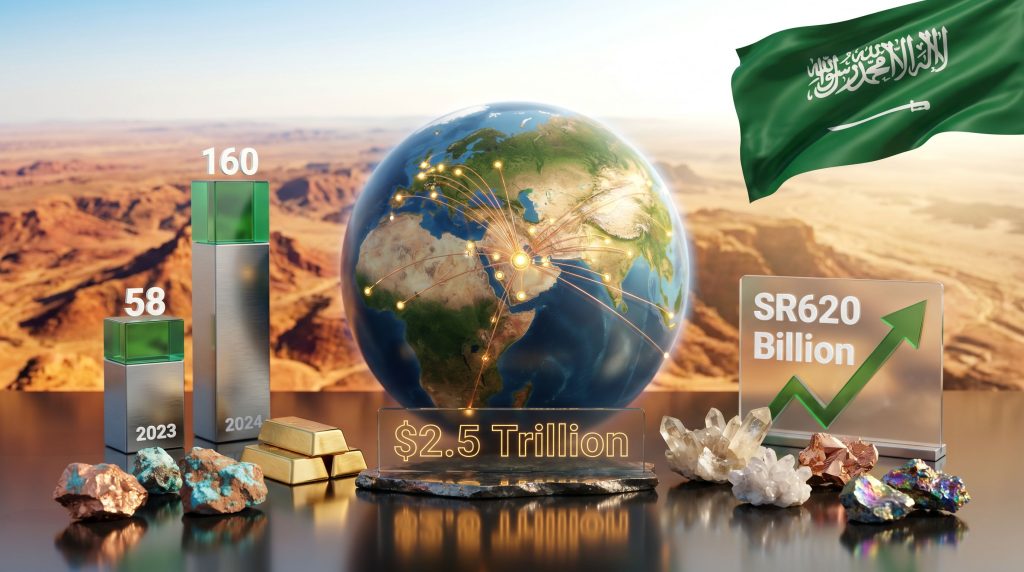
The practical consequence of this underexploration is significant: the $2.5 trillion mineral wealth estimate now attributed to Saudi Arabia's subsurface reflects a roughly 90 percent increase from 2018 assessments, driven almost entirely by intensified geological surveying rather than new geological discoveries in the traditional sense. Furthermore, the Arabian Shield geochemical survey now underway is expected to refine these estimates further. In other words, the minerals were always there — the Kingdom is only now developing the systematic survey coverage to quantify what exists.
This distinction is critical for investors and analysts: the upgrade in Saudi Arabia's mineral resource estimate does not primarily reflect commodity price inflation or speculative rerating. It reflects expanded geological knowledge across previously unsurveyed terrain.
Drilling Activity as a Leading Indicator: From 58 to 160 Active Projects
One of the clearest leading indicators of a mining jurisdiction's trajectory is exploration drilling activity, because exploration spending and drilling programmes consistently precede resource declarations and eventual production by years or even decades. Saudi Arabia's recent drilling data tells a compelling story.
Active drilled projects rose from 58 in 2023 to 160 in 2024, representing a near-tripling within a single calendar year. This is not an incremental uptick. In mining sector terms, this level of acceleration is associated with jurisdictions at an early-stage inflection point, where regulatory conditions have improved sufficiently to convert latent geological prospectivity into active investor commitment.
Several interconnected factors explain the acceleration:
- Regulatory reforms that have streamlined exploration licensing timelines and reduced bureaucratic friction for foreign applicants
- Expanded availability of high-quality geological data through national survey programmes, reducing the technical risk premium that previously deterred international explorers
- Infrastructure development in remote areas of the Arabian Shield, opening terrain that was previously logistically impractical to explore
- Growing strategic urgency among international mining companies to diversify their project pipelines away from jurisdictions facing rising resource nationalism or permitting delays
In addition, Saudi exploration licences have been increasingly sought by international operators, reflecting growing confidence in the Kingdom's reformed regulatory environment. The critical analytical question is whether this surge in drilling activity will convert into commercially viable resource declarations over the coming years. Exploration conversion rates — the percentage of drilled targets that yield economically defined mineral resources — will be the key metric to watch as Saudi Arabia's exploration boom matures.
Mining as the Third Pillar: What This Policy Classification Actually Means
Saudi Arabia has formally designated mining as the third pillar of its national industrial economy, alongside oil and petrochemicals. For observers accustomed to policy language that frequently overpromises, it is worth examining what this classification concretely implies in the Saudi context.
Within Vision 2030's economic architecture, sectoral pillar designation signals long-term budgetary commitment, institutional infrastructure investment, and regulatory prioritisation that persists across political cycles. It is a structural commitment rather than a rhetorical one. The practical manifestations include dedicated financing mechanisms, streamlined permitting pathways, investment in technical education, and the development of downstream processing infrastructure.
Crucially, Saudi policymakers are not targeting raw ore export as the end objective. The strategic vision extends to value chain integration: capturing refining margins, developing processing capacity, and ultimately feeding mineral outputs into domestic advanced manufacturing. This downstream orientation distinguishes Saudi Arabia's mining ambitions from those of many resource-endowed developing economies that have historically exported raw materials at low value-add.
Saudi Arabia's Minister of Industry and Mineral Resources, Bandar Alkhorayef, has emphasised that developing the sector depends not only on mineral resources being present but on building an integrated ecosystem covering infrastructure, advanced technologies, financing mechanisms, and human capabilities. This ecosystem-building orientation reflects a sophisticated understanding of where value actually accumulates in modern mineral supply chains.
The Supply Gap That Defines a Structural Opportunity
Perhaps the most compelling analytical framing for Saudi Arabia's mining ambitions lies in a structural imbalance that most market participants have not fully internalised. Consider the following comparison:
| Region | Share of Global Mineral Reserves | Share of Global Mineral Supply |
|---|---|---|
| Africa, Middle East & Central Asia | ~33% | ~6% |
| Established Western Jurisdictions | Minority share of reserves | Dominant share of supply |
This divergence between geological endowment and productive output represents one of the most significant structural inefficiencies in global commodity markets. The combined regions of Africa, the Middle East, and Central Asia hold approximately one-third of the world's mineral reserves but contribute only around six percent of global supply.
Closing even a modest fraction of this gap would require:
- Substantial capital investment in extraction and processing infrastructure across multiple jurisdictions simultaneously
- Technology transfer from established mining nations to develop local technical capacity
- Export logistics development including rail, port, and road infrastructure connecting mineral-rich interior regions to global shipping lanes
- Governance frameworks credible enough to attract and retain private sector capital through multi-decade project timelines
Saudi Arabia's combination of sovereign financial capacity, geopolitical relationships spanning both Eastern and Western spheres, and a reform-oriented regulatory environment positions it as one of the few actors capable of meaningfully catalysing this transition.
Ma'aden: The Institutional Vehicle Translating Vision Into Operations
No analysis of Saudi Arabia's position in the Saudi Arabia global mining sector is complete without examining Ma'aden, the Saudi Arabian Mining Company that functions as the primary operational vehicle for the Kingdom's mineral ambitions.
Ma'aden's current operational footprint includes 17 active mines and production sites with export relationships spanning 30 countries. Its commodity portfolio covers phosphate fertilizers, aluminum, gold, and copper — a diversification that reflects both near-term revenue generation priorities and longer-term alignment with critical mineral demand trajectories.
Several aspects of Ma'aden's strategic positioning are worth noting for industry observers:
- Phosphate operations feed directly into global fertilizer supply chains, giving Saudi Arabia genuine leverage in food security discussions at a time when global agricultural input security is under increasing scrutiny
- Aluminum production already constitutes a meaningful component of Saudi non-oil exports, demonstrating that downstream value-add processing is not merely aspirational but operationally validated
- Gold production across Arabian Shield deposits provides near-term export revenue that can cross-subsidise exploration and development of less mature mineral categories
- Copper pipeline development aligns with accelerating global electrification demand, where copper intensity per unit of electricity generation capacity continues to rise
The planned development of a dedicated metals exchange within Saudi Arabia would represent a significant maturation of the Kingdom's mining sector infrastructure, potentially enabling transparent price discovery for Saudi-produced commodities and attracting commodity trading activity that currently gravitates toward London, Singapore, and Chicago.
The next major ASX story will hit our subscribers first
The Rare Earth Dimension: An Underappreciated Strategic Layer
Saudi Arabia's participation in the St. Petersburg International Economic Forum panel specifically dedicated to rare earth elements and critical minerals reflects a strategic awareness that is worth examining closely. Rare earth elements occupy a unique position in modern industrial supply chains: they are not rare in geological terms, but economically exploitable concentrations are geographically concentrated, and processing capacity is heavily centralised in China.
The Arabian Shield is known to contain rare earth-bearing mineral systems, though public geological data on grade, tonnage, and economic viability remains limited compared to information available for more mature commodity categories like gold and phosphate. This information asymmetry is itself significant: it suggests that rare earth potential within Saudi Arabia's mineral endowment may be materially underrepresented in current reserve estimates. Furthermore, Saudi critical minerals policy is increasingly oriented towards capturing processing value domestically rather than exporting unrefined material.
The broader geopolitical context amplifies this point. Western governments and manufacturing industries are actively seeking to diversify rare earth supply chains away from single-jurisdiction dependence. Saudi Arabia's geographic positioning, political stability, and existing relationships with both major consuming nations create a potentially compelling alignment of interests.
Bilateral Dimensions: The Saudi-Russian Mining Partnership
Saudi Arabia's ministerial-level participation in discussions on rare and strategic minerals at the St. Petersburg International Economic Forum underscores a deliberate strategy of building mining partnerships across geopolitically diverse relationships rather than aligning exclusively with Western capital markets.
The bilateral meeting between Saudi Minister of Industry Bandar Alkhorayef and Russian Minister of Economic Development Maxim Reshetnikov focused on expanding cooperation across industry and mining sectors. The discussions took place against the backdrop of the centenary of Saudi-Russian diplomatic relations, with bilateral trade currently exceeding $3.28 billion.
For analytical purposes, the Saudi-Russian mining dialogue carries several strategic dimensions worth considering:
- Russia possesses significant technical expertise in large-scale mining operations across challenging terrains, including Arctic and remote desert environments with geological parallels to Arabian Shield conditions
- Joint investment structures could potentially accelerate development timelines for Saudi projects by accessing Russian engineering capabilities and equipment supply chains
- Diversifying Saudi mining partnerships across geopolitical blocs reduces dependence on any single source of capital, technology, or market access
Challenges That Could Constrain the Trajectory
A balanced assessment of Saudi Arabia's mining ambitions requires acknowledging the structural constraints that represent genuine friction rather than easily resolved obstacles.
The Workforce Gap is arguably the most immediate constraint. Mining is an intensely knowledge-dependent industry, and experienced mining professionals — particularly those with underground hard-rock mining expertise — are in global scarcity. Saudi Arabia's domestic pipeline of geologists, mining engineers, and metallurgists remains relatively limited, creating dependence on international expertise that adds cost, complexity, and operational risk to project development.
Infrastructure in Remote Terrain presents a second category of challenge. The portions of the Arabian Shield with the highest mineral prospectivity are frequently in areas with limited existing infrastructure. Developing the power, water, and transport connectivity required for large-scale mining operations extends project lead times and requires capital commitments that must compete with other national development priorities.
ESG Credibility represents a third constraint that is often underestimated. International institutional capital increasingly applies rigorous environmental, social, and governance screening to mining investments. Developing credible ESG frameworks that satisfy global investor expectations requires sustained institutional investment and cultural alignment that cannot be legislated into existence overnight.
Non-Oil Exports as a Measurable Benchmark
Saudi Arabia's non-oil exports reached a record SR620 billion (approximately $165 billion) in the most recently reported period, with mining products, fertilizers, and aluminum forming a significant component of this figure. This data point serves as the most concrete available benchmark for tracking the mining sector's contribution to economic diversification over time.
The significance of this figure extends beyond the headline number. Non-oil export performance is the ultimate empirical test of whether Vision 2030's diversification ambitions are generating measurable economic transformation. The fact that mineral-derived products represent a meaningful share of this record export figure validates the operational foundations upon which more ambitious future targets are being constructed.
However, Saudi mining licences data also suggests that the pipeline of future production is expanding considerably, which should underpin further growth in non-oil export values across the coming decade. For investors and market participants tracking the Saudi Arabia global mining sector, the trajectory of non-oil export composition — specifically the growing share attributable to processed mineral products rather than raw materials — will be the most meaningful indicator of genuine supply chain depth. As one industry analysis notes, the Kingdom's push to become a global mining player is accelerating at a pace few anticipated even five years ago.
Disclaimer: This article is intended for informational purposes only and does not constitute investment advice. Statements regarding mineral resource estimates, export figures, and market projections are based on publicly available information and should not be relied upon as the sole basis for investment decisions. Readers should conduct independent due diligence before making any investment-related judgments.
Want to Track the Next Major Mineral Discovery Before the Broader Market Does?
Discovery Alert's proprietary Discovery IQ model delivers real-time alerts on significant ASX mineral discoveries, transforming complex geological data into actionable investment insights for both short-term traders and long-term investors — explore historic examples of exceptional discovery returns to understand the scale of opportunity, and begin your 14-day free trial at Discovery Alert to position yourself ahead of the market.