June 27, 2026
Critical Mineral Supply Chain Independence and Global Resource Dynamics
The architecture of global industrial power increasingly depends on access to specialized materials that enable technological sovereignty. Nations worldwide grapple with supply chain vulnerabilities that extend far beyond traditional energy dependencies, as control over 17 metallic elements classified as rare earth elements determines competitiveness across renewable energy, defense manufacturing, and consumer electronics sectors.
These elements possess unique magnetic and catalytic properties essential for wind turbine generators, electric vehicle motors, and advanced military systems. Unlike traditional commodities, rare earth elements have no viable substitutes in most applications, creating strategic dependencies that governments and manufacturers are only beginning to understand fully.
When big ASX news breaks, our subscribers know first
Geological Significance of Northwest Botswana's Polymetallic Discovery
Recent exploration activities in Botswana's northwest region have unveiled a comprehensive rare earth element suite within a polymetallic skarn system. The Botswana rare earth minerals discovery at the Gchwihaba project represents more than a typical mineral discovery, containing 15 of the 17 elements classified as critical by the United States Geological Survey alongside valuable co-products including copper, silver, and cobalt.
Resource Scale and Grade Characteristics
The geological formation demonstrates substantial scale potential, with exploration targets indicating 81-97 million tonnes of mineralized material. Grade distributions vary significantly across the deposit, with total rare earth oxide (TREO) concentrations ranging from 0.05% to 1.49% at peak intercepts.
Key Mineralogical Characteristics:
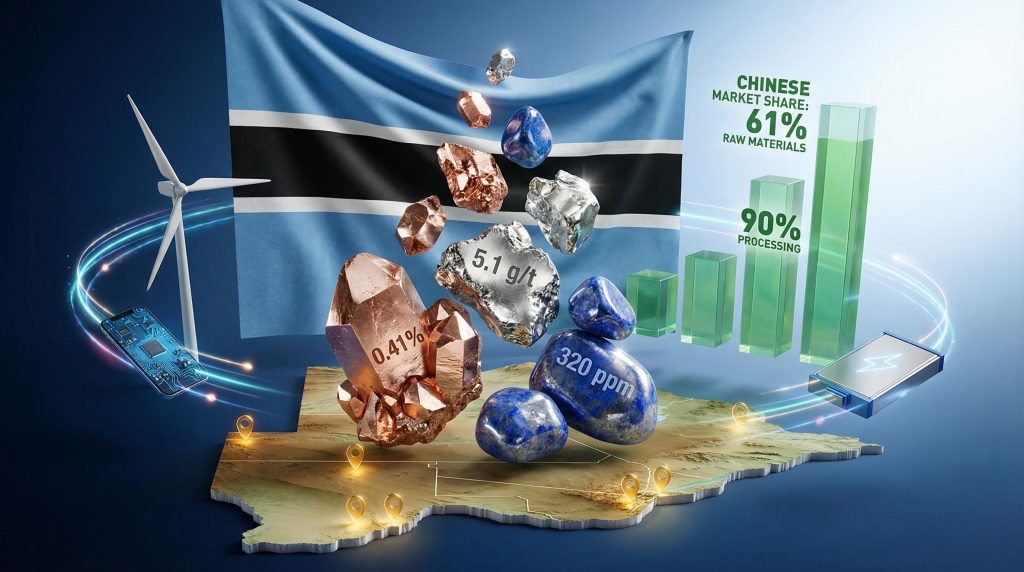
- Peak TREO Grade: 1.49% at drill intercept C27
- Copper Concentrations: Up to 0.41% in C26 skarn zone
- Silver Values: Reaching 5.1 grams per tonne in C27 skarn
- Cobalt Content: 320 parts per million maximum
- Strategic Depth: 20-50 metres below surface
- Polymetallic Suite: Includes vanadium and nickel co-occurrence
Comparative Global Context
When positioned against established rare earth operations worldwide, the Botswana rare earth minerals discovery demonstrates competitive characteristics. Mountain Pass in California operates with 9.5% TREO average grades, producing approximately 12,000 tonnes of rare earth oxides annually. Australia's Mount Weld deposit contains 7% TREO grades supporting Lynas Rare Earths' production of roughly 11,000 tonnes REO per year.
Global Rare Earth Deposit Comparison:
| Deposit Location | Average TREO Grade | Annual Production (tonnes REO) | Operational Status |
|---|---|---|---|
| Bayan Obo (China) | 5-6% | 100,000+ | Active |
| Mountain Pass (USA) | 9.5% | 12,000 | Active |
| Mount Weld (Australia) | 7% | 11,000 | Active |
| Gchwihaba (Botswana) | 0.05-1.49% | Exploration Phase | Development |
The Gchwihaba deposit's shallow mineralization depth provides significant operational advantages. Open-pit extraction methods become economically viable at 20-50 metre depths, reducing capital expenditure requirements compared to underground operations while minimizing energy consumption for material handling.
Advanced Exploration Methodology
Tsodilo Resources employed systematic geophysical techniques to identify and evaluate the mineralized system. Ground magnetic surveys detected subsurface anomalies corresponding to magnetite-rich zones, while gravity measurements delineated density variations associated with garnet-bearing skarn formations.
The company utilized Paradigm GOCAD software for integrated magnetic and gravity geophysical modeling, constraining exploration targets through drilling results and geological interpretation. Furthermore, 3D geological modelling approaches represent industry-standard methodology for rare earth exploration in metamorphic environments.
Supply Chain Vulnerability Assessment and Diversification Imperatives
Current global rare earth supply architecture creates systemic vulnerabilities across technology manufacturing sectors. China maintains approximately 61% of global mining production and 90% of processing capacity, according to International Energy Agency analysis. This concentration level exceeds strategic comfort thresholds for industries dependent on reliable rare earth access.
Historical Disruption Precedents
The 2010 Chinese export quota reduction demonstrated supply chain fragility when dysprosium oxide prices increased 700% and neodymium oxide prices rose 400% within twelve months. Manufacturers across automotive, renewable energy, and defense sectors experienced material shortages that forced strategic sourcing initiatives and alternative technology development programs.
COVID-19 pandemic disruptions further highlighted processing bottlenecks when facility capacity utilization declined 20-30% globally despite maintained Chinese production volumes. Transportation logistics delays and downstream manufacturing constraints created cascading effects through technology supply chains.
Strategic Concentration Risk Analysis
Global Supply Chain Control Points:
| Supply Stage | Chinese Market Share | Alternative Suppliers | Risk Level |
|---|---|---|---|
| Raw Extraction | 61% | 8-12 producers globally | High |
| Chemical Processing | 90% | 2-4 facilities globally | Critical |
| Magnet Manufacturing | 85% | 3-5 producers globally | Critical |
| Component Integration | 45% | 8-10 facilities globally | Moderate |
Processing represents the most acute vulnerability point. Rare earth separation requires sophisticated solvent extraction technology, hydrometallurgical expertise, and environmental waste management systems. Establishing greenfield processing facilities demands $800 million to $1.5 billion capital investment with 4-6 year development timelines.
Geographic and Political Stability Advantages
Botswana presents supply chain diversification through established democratic governance structures, transparent regulatory frameworks, and demonstrated mining sector competence. The country's political stability index ranks among the highest in sub-Saharan Africa, providing institutional predictability for long-term industrial projects.
Transportation infrastructure connects potential Botswana production to global markets through South African port facilities at Richards Bay and Durban, rail networks extending to Indian Ocean shipping routes, and regional road transportation systems supporting processing hub development.
Economic Development Models and Value Chain Integration
Traditional African mineral development follows raw material export models that capture limited value-added processing activities. However, the Botswana rare earth minerals discovery could pursue vertical integration strategies encompassing concentrate production, separation facilities, and downstream manufacturing capabilities.
Capital Investment Framework
Development Phase Investment Requirements:
| Development Phase | Capital Range | Timeline | Expected ROI |
|---|---|---|---|
| Resource Definition | $50-100 million | 2-3 years | N/A |
| Mine Construction | $500M-1.2 billion | 3-5 years | 15-25% |
| Processing Infrastructure | $800M-1.5 billion | 4-6 years | 20-30% |
| Integrated Operations | $2-3 billion | 7-10 years | 25-35% |
Upstream integration opportunities include concentrate production facilities, chemical separation plants, and specialized alloy manufacturing. These activities require technical expertise transfer, skilled workforce development, and environmental management systems meeting international standards.
In addition, downstream potential encompasses permanent magnet production for wind energy applications, electronic component manufacturing for consumer technology sectors, and regional technology hub development leveraging rare earth availability.
Regional Economic Multiplier Effects
Successful rare earth development generates direct employment across skill levels while catalysing supporting industry establishment. Government revenue streams through mineral royalties, corporate taxation, and export earnings provide fiscal resources for infrastructure development and social programmes.
Indirect economic benefits extend to educational institution advancement, research and development capability building, and regional expertise hub formation. These effects compound over project lifecycles, creating sustainable economic transformation beyond mining activities alone.
Renewable Energy Transition and Material Demand Dynamics
Global energy transition acceleration creates unprecedented demand growth for rare earth elements. Wind turbine construction requires 200-600 kilograms of rare earth permanent magnets per 3-megawatt unit, with dysprosium and neodymium essential for motor efficiency and durability specifications.
Electric vehicle deployment generates additional demand through motor magnet requirements and battery technology applications. Furthermore, critical minerals energy security becomes paramount as the International Energy Agency projects 400-600% demand growth for wind energy rare earth consumption by 2040, assuming aggressive renewable energy deployment scenarios.
Technology Sector Implications
Manufacturing cost stability depends increasingly on rare earth price predictability and supply security. Alternative sourcing through the Botswana rare earth minerals discovery could provide long-term contract opportunities for technology manufacturers seeking supply chain resilience while reducing single-source dependencies.
Innovation acceleration becomes possible when manufacturers achieve reliable material access for research and development activities. New technology deployment requires confidence in component availability throughout product lifecycles, particularly for capital-intensive renewable energy projects with 20-25 year operational horizons.
Investment Strategy Considerations and Market Psychology
Rare earth sector investment requires understanding of both geological risk factors and geopolitical dynamics affecting supply security. Direct exposure opportunities include mining company equity positions, commodity futures contracts where available, and infrastructure development partnerships supporting processing facilities.
Risk Assessment Framework
Technical challenges encompass metallurgical processing complexity, environmental management requirements, and skilled workforce development needs. Rare earth separation involves multi-stage chemical processes requiring specialised expertise and significant energy consumption.
Market competition intensifies as established operations benefit from economies of scale, existing customer relationships, and integrated supply chain positions. New entrants must compete against operations with decades of optimisation and cost structure advantages.
Regulatory compliance in Botswana requires adherence to mining legislation, environmental impact assessment procedures, and community engagement protocols. Permitting timelines and stakeholder management represent critical path items affecting project development schedules.
Strategic Investment Positioning
Portfolio diversification through rare earth exposure aligns with energy transition investment themes while providing commodity inflation hedging characteristics. However, individual project risk requires careful due diligence regarding technical feasibility, management capability, and market positioning.
Indirect beneficiary identification includes renewable energy equipment manufacturers, electric vehicle supply chain companies, and battery technology developers. For instance, these sectors benefit from supply security improvements without direct mining operation risks.
Consequently, investment strategy components should account for development timeline uncertainty, capital intensity requirements, and commodity price volatility affecting project economics throughout construction and operational phases.
The next major ASX story will hit our subscribers first
Technical Processing Challenges and Solutions
Extracting 15 rare earth elements from polymetallic ore requires sophisticated separation technology addressing chemical similarity between elements. Solvent extraction processes utilise selective organic compounds to separate individual elements through multi-stage counter-current operations.
Environmental management becomes critical due to processing waste streams containing thorium and other radioactive materials naturally occurring in rare earth ores. Modern facilities require tailings management systems, water treatment capabilities, and atmospheric emission controls meeting international standards.
Energy consumption for rare earth processing averages 10-15 megawatt-hours per tonne of separated oxides, creating operational cost sensitivity to electricity pricing and carbon emission regulations. Renewable energy integration could provide cost advantages while supporting sustainability objectives.
Global Strategic Resource Competition
Nations worldwide recognise rare earth elements as strategic materials requiring domestic supply capabilities or reliable partnership arrangements. European Union initiatives target 25% non-Chinese sourcing by 2030 through extraction projects in Estonia, Poland, and Greenland alongside recycling capacity development for 25% of requirements.
United States policy through the Defense Production Act designates rare earths as critical materials requiring supply chain resilience. Recent legislation provides funding support for domestic processing capability development and strategic reserve establishment.
Moreover, Japan's resource diplomacy focuses on long-term supply agreements with Australia, Vietnam, and potentially African producers to reduce Chinese dependency while securing technology manufacturing inputs for automotive and electronics industries.
The transformation potential extends beyond mineral extraction to encompass technological sovereignty, industrial competitiveness, and economic development acceleration across southern Africa. However, mining industry evolution suggests that whether this potential materialises depends on execution capability, investment attraction, and integration with evolving global supply chain requirements.
The Botswana rare earth minerals discovery occurs within this broader context of strategic competition and supply security initiatives. Additionally, rare earth mineral developments could position the nation as a significant player in global critical mineral supply chains.
Success requires navigating not only technical and economic challenges but also geopolitical dynamics affecting global rare earth trade relationships. Consequently, the transformation potential extends beyond mineral extraction to encompass technological sovereignty, industrial competitiveness, and economic development acceleration across southern Africa.
Disclaimer: This analysis contains forward-looking information involving known and unknown risks, uncertainties, and assumptions. Mineral exploration and development involve significant risk, and readers should conduct independent research before making investment decisions. Resource estimates are preliminary and subject to revision through additional exploration work.
Looking to Capitalise on Critical Mineral Discoveries?
Discovery Alert's proprietary Discovery IQ model delivers immediate notifications on significant ASX mineral discoveries, including rare earth and critical mineral announcements that could reshape global supply chains. Stay ahead of market movements by exploring Discovery Alert's historic discoveries that have delivered exceptional returns, then begin your 14-day free trial to position yourself at the forefront of Australia's next critical mineral breakthrough.