May 23, 2026
What Defines Critical Mineral Supply Chain Vulnerability in 2026?
The modern global economy operates on an intricate web of material dependencies that most decision-makers barely recognise. Strategic planners examining resource security face a sobering reality: approximately 80% of all mined commodities now qualify as essential for national economic stability. This transformation represents a fundamental shift from traditional resource economics, where scarcity drove value, to a new paradigm where technological integration determines criticality.
Understanding supply chain vulnerability requires moving beyond simple availability metrics toward comprehensive risk assessment frameworks. The United States Geological Survey's expanded critical minerals designation now encompasses 60 different materials, reflecting the complex material requirements of contemporary technological systems. This expansion signals a recognition that modern economies depend on an unprecedented diversity of geological resources, each presenting unique supply chain challenges.
Economic Security Metrics and National Dependencies
Import dependency ratios reveal the extent of vulnerability across major economies. Current analysis indicates that over 60% of critical minerals demand is met through global trade, creating substantial exposure to supply disruptions for industrialised nations. This dependency extends far beyond raw material extraction to encompass processing, refining, and specialised manufacturing capabilities.
The economic multiplier effects of supply disruptions compound beyond direct material costs. Defence sector analysis conducted by Govini identified that more than 80,000 parts across 1,900 US weapon systems incorporate just five critical minerals: antimony, gallium, germanium, tungsten, and tellurium. This represents approximately 78% of all US weapons systems dependent on materials where foreign processing dominates global capacity.
Furthermore, recent developments in strategic antimony funding demonstrate government recognition of these vulnerabilities. Such initiatives highlight the growing importance of securing domestic supply capabilities for essential materials.
Strategic stockpile adequacy assessments reveal significant gaps between current reserves and projected consumption under various scenario models. Traditional stockpiling approaches, designed for bulk commodities, prove inadequate for critical minerals used in minute quantities but with transformative technological impact. The challenge lies not in storing large volumes but in maintaining quality specifications and avoiding material degradation over extended periods.
Geopolitical Concentration Risk Matrix
China maintains dominant global producer status across nearly all critical mineral categories, with demonstrated willingness to leverage export controls as geopolitical instruments. The 2025-2026 export restrictions on strategic materials validated concerns about weaponised supply chain dependencies, particularly affecting semiconductor and defence industries.
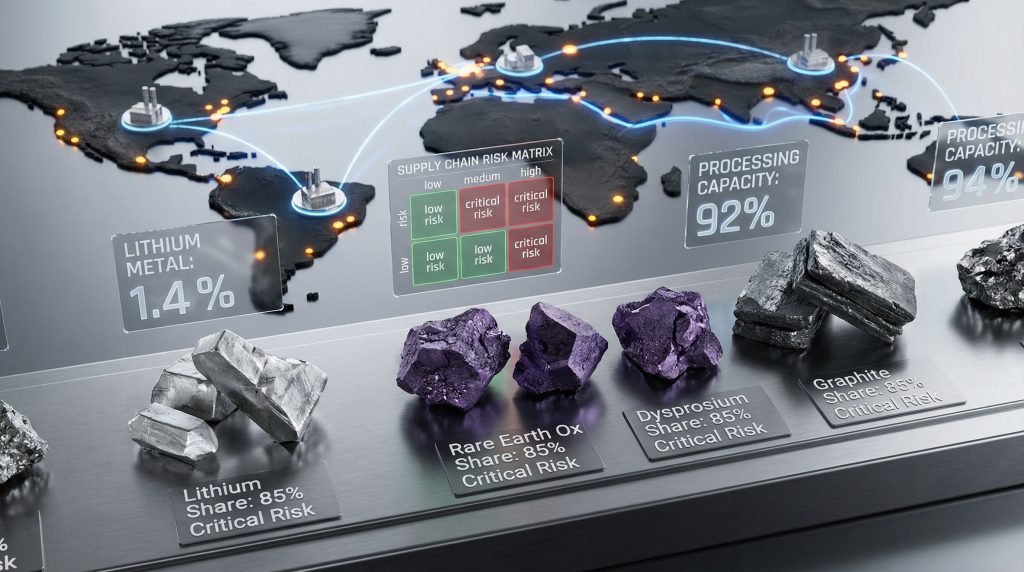
Processing capacity geographic distribution presents even greater concentration risks than raw material extraction. While mining operations can be geographically dispersed, processing and refining facilities require substantial capital investment, technical expertise, and regulatory tolerance for environmental impacts. This concentration creates chokehold vulnerabilities where disrupting a few facilities can affect global supply chains.
However, efforts such as establishing a new European CRM facility aim to address these concentration risks through strategic diversification initiatives.
Transportation chokepoint analysis identifies maritime shipping routes as critical vulnerability points. Major mineral export ports handle concentrated flows of strategic materials, making them potential targets for disruption through geopolitical tensions, natural disasters, or infrastructure failures.
When big ASX news breaks, our subscribers know first
How Do Modern Technologies Drive Critical Mineral Demand Patterns?
The technological revolution driving critical mineral demand operates through three distinct categories of materials. Spice metals like gallium and germanium enable exponential performance improvements when added in microscopic quantities to advanced semiconductors. Power metals including lithium, cobalt, and nickel form the foundation of energy storage systems enabling the clean energy transition. Phoenix metals such as copper and tin have experienced renaissance applications in connecting physical and digital infrastructure.
Semiconductor Industry Mineral Requirements
Silicon substrate technology approaches theoretical performance limits for advanced computing applications. Integration of gallium and germanium enables exponential capacity increases, making these materials essential for next-generation processor development. Advanced chip manufacturing requires complex material combinations including palladium, arsenic, iridium, titanium, copper, and cobalt for plating, wiring, doping, and packaging operations.
Gallium nitride semiconductor technology represents a paradigm shift from traditional silicon-based systems. Defence Advanced Research Projects Agency development of GaN chips enhances radar capability and drone-jamming capacity, creating strategic military applications beyond civilian electronics. The wide-bandgap properties of gallium nitride enable superior electron mobility and thermal conductivity compared to silicon alternatives.
In addition, evolving critical minerals strategy frameworks are increasingly recognising the strategic importance of these materials across defence applications.
Defence application requirements extend across multiple critical minerals simultaneously. Military-grade specifications demand material purity levels and performance characteristics that exceed civilian applications, creating premium demand segments with limited supplier qualification. The integration of critical minerals across weapons systems creates cascading vulnerability where disrupting supply of any single material can compromise entire defence capabilities.
Clean Energy Transition Material Intensity
Battery chemistry evolution demonstrates the dynamic nature of critical mineral demand patterns. Tesla's 2006 Roadster launch catalysed lithium's transformation from niche industrial lubricant applications to battery-centred demand representing over 80% of current lithium consumption. This shift illustrates how technological breakthroughs can rapidly reshape entire commodity markets.
Lithium and metallic cathode ingredients undergo powder formulation into customised battery recipes rather than traditional metalworking processes. This chemistry-based approach enables precise control over energy density, cycle life, and power delivery characteristics. Battery manufacturers develop proprietary formulations combining lithium with cobalt, nickel, and manganese in ratios optimised for specific performance requirements.
Rare earth permanent magnet demand extends throughout renewable infrastructure systems. Electric vehicles require primary traction motors plus 7-10 auxiliary motors for windscreen wipers, seat adjustment, window operation, and other mechanical systems. Each motor incorporates rare earth magnets optimised for specific torque and efficiency requirements, multiplying material demand per vehicle beyond primary propulsion systems.
Grid modernisation material requirements encompass infrastructure development supporting renewable energy integration. Power electronics, energy storage systems, and smart grid technologies each demand specialised critical mineral inputs. The scale of infrastructure transformation required for decarbonisation creates sustained demand growth across multiple mineral categories simultaneously.
Which Supply Chain Bottlenecks Present the Greatest Strategic Risks?
Processing and refining capacity constraints present greater strategic risks than raw material availability across most critical mineral categories. The distinction between mining, beneficiation, smelting, and refining creates multiple chokehold opportunities where disruption can affect global supply chains despite abundant ore deposits.
Processing and Refining Capacity Constraints
| Mineral Category | Dominant Region | Processing Share | Strategic Risk Level |
|---|---|---|---|
| Rare Earth Processing | China | ~85-90% | Critical Risk |
| Lithium Refining | China | ~60% | High Risk |
| Cobalt Processing | China | ~70% | High Risk |
| Graphite Purification | China | >90% | Critical Risk |
| Manganese Processing | China/South Africa | ~65% | Medium-High Risk |
Real-time market conditions in early 2026 demonstrate supply constraint impacts across multiple commodities. Aluminium prices reached $3,000 per ton for the first time since 2022, driven by Chinese smelting capacity caps and European production constraints due to elevated electricity pricing. Global inventory drawdown contributed to supply tightness despite adequate bauxite ore availability.
Copper supply outlook remains characterised as tight with prices at $5.70 per pound, representing the best market performance since 2009. Supply constraints affect processing capacity rather than ore availability, highlighting the critical importance of smelting and refining infrastructure for market balance.
Rare earth processing complexity creates particularly high barriers to entry for alternative suppliers. Rare earth ores typically contain 15-17 different elements with similar chemical properties requiring acid leaching, liquid-liquid extraction, precipitation, and multiple purification cycles. This technical complexity, combined with environmental impact tolerance requirements, justifies concentrated processing capacity despite strategic vulnerability concerns.
Transportation and Logistics Vulnerabilities
Maritime shipping route dependencies create single points of failure for critical mineral supply chains. Major mineral export ports handle concentrated flows of strategic materials, making them vulnerable to disruption through geopolitical tensions, natural disasters, or infrastructure capacity limitations. Port infrastructure requires specialised handling equipment for different mineral forms, creating additional bottlenecks during capacity expansion periods.
Cross-border trade agreement impacts extend beyond tariff structures to encompass regulatory frameworks governing mineral processing and environmental standards. Harmonised technical specifications and mutual recognition agreements affect the feasibility of supply chain diversification efforts across different jurisdictions.
Moreover, new export controls on critical minerals are making supply concentration risks an increasingly urgent reality for global supply chains.
African processing infrastructure development represents strategic supply chain diversification efforts. Ivanhoe Mines commenced copper anode production at a new Democratic Republic of Congo smelter facility with 500,000 tonnes per annum capacity, which will become the largest smelting facility in Africa upon full ramp-up. This development bypasses Chinese processing dependencies while utilising local ore resources.
What Are the Most Effective Supply Chain Resilience Strategies?
Supply chain resilience requires coordinated approaches across extraction, processing, and end-use applications rather than isolated interventions at single points in the value chain. Effective strategies combine geographic diversification, technology development, and policy frameworks supporting domestic capacity building.
Diversification and Partnership Models
Allied nation resource-sharing frameworks enable collective supply security through coordinated stockpiling and processing capacity development. The US-brokered peace deal between Democratic Republic of Congo and Rwanda opens access to copper and cobalt resources previously dominated by Chinese operators. The US International Development Finance Corporation evaluates investment structures with Congo's state miner Gecamines, including right of first refusal arrangements on future supply.
Joint venture structures in mining development facilitate technology transfer and capacity building while sharing investment risks across multiple partners. These partnerships enable access to geological resources, processing expertise, and market channels while reducing single-country dependencies for critical materials.
Technology transfer agreements for processing capabilities represent strategic investments in supply chain resilience. Establishing processing capacity outside dominant supplier regions requires not just capital investment but also technical knowledge transfer, environmental permitting frameworks, and workforce development programmes.
Domestic Production Incentive Mechanisms
Tax policy frameworks supporting mining investment must balance economic incentives with environmental protection requirements. Accelerated depreciation schedules, depletion allowances, and investment tax credits can improve project economics for domestic critical mineral development while maintaining environmental compliance standards.
Environmental permitting streamlining approaches focus on regulatory efficiency rather than relaxed standards. Coordinated review processes across federal, state, and local jurisdictions can reduce project development timelines while maintaining rigorous environmental impact assessments. Clear regulatory pathways encourage private investment in domestic capacity development.
Infrastructure development through public-private partnerships addresses the chicken-and-egg problem of mining project development. Transportation, power, and water infrastructure investments enable multiple mining projects while distributing costs across public and private stakeholders. Strategic infrastructure development can catalyse regional mining cluster development.
How Do Recycling and Circular Economy Models Impact Supply Security?
Secondary production from recycling represents the most significant untapped supply source for critical minerals, with recovery potential sufficient to reduce primary mining dependencies by up to 40% in key material categories. However, current recycling rates vary dramatically across different materials, ranging from less than 1% for rare earths to 70% for platinum group metals.
Recovery Rate Optimisation by Material Type
Current recycling rates for critical minerals range from less than 1% for rare earths to 70% for platinum group metals, representing a massive untapped secondary supply source that could reduce primary mining dependencies by up to 40% in key categories.
Urban mining potential exceeds traditional mining opportunities in many developed economies where electronic waste accumulation provides concentrated sources of critical minerals. Electronic waste streams contain higher concentrations of valuable materials than many primary ore deposits, making recovery economically attractive once collection and processing systems achieve sufficient scale.
Furthermore, advancements in battery recycling process technologies are demonstrating the viability of circular economy approaches to critical mineral supply security.
Tin recycling demonstrates successful circular economy implementation, with more than 50% of current tin consumption dedicated to soldering circuit boards together. This application creates concentrated waste streams amenable to efficient recovery processes, supporting supply chain resilience while reducing environmental impacts.
Battery recycling scalability projections indicate dramatic growth potential as first-generation electric vehicle batteries reach end-of-life periods. Recovery of lithium, cobalt, nickel, and manganese from spent batteries can provide substantial secondary supply while reducing disposal environmental impacts.
Technology Innovation in Material Recovery
Advanced separation techniques for complex electronic waste enable recovery of multiple critical minerals from single waste streams. Hydrometallurgical processes, selective dissolution, and automated disassembly systems improve recovery rates while reducing processing costs compared to traditional methods.
Economic viability thresholds for secondary production depend on material prices, waste stream availability, and processing technology costs. Critical mineral price volatility creates challenges for recycling investment decisions, requiring flexible processing systems capable of optimising recovery across multiple materials based on market conditions.
Material substitution research developments offer longer-term supply security improvements through reduced critical mineral dependencies. Alternative battery chemistries reducing cobalt requirements, synthetic rare earth development programmes, and nanotechnology applications enabling material efficiency gains all contribute to supply chain resilience.
What Investment Implications Emerge from Supply Chain Analysis?
Investment opportunities across the critical minerals value chain reflect supply-demand imbalances, geopolitical risk premiums, and technological transformation requirements. Capital allocation priorities favour processing capacity development, recycling infrastructure, and technology innovation over traditional mining expansion alone.
Mining Sector Capital Allocation Priorities
Exploration budget distributions increasingly favour critical minerals over traditional bulk commodities, reflecting premium valuations and strategic importance. However, discovery-to-production timelines for new mining projects typically span 10-15 years, making near-term supply security dependent on existing operations and capacity expansions.
Infrastructure development investment requirements encompass transportation, processing, and utility systems supporting mining operations. Remote deposit development requires substantial infrastructure investment, creating opportunities for infrastructure-focused investment strategies serving multiple mining projects simultaneously.
Risk-adjusted return profiles for critical mineral projects incorporate geopolitical stability, regulatory frameworks, and market demand sustainability. Projects in politically stable jurisdictions command premium valuations despite potentially higher operating costs compared to operations in higher-risk regions.
In addition, mining industry innovations are creating new investment opportunities across the value chain, from extraction technologies to processing capabilities.
Strategic Metal Inventory Management
Corporate stockpiling strategies across industries balance supply security with inventory carrying costs and material degradation risks. Just-in-time manufacturing approaches prove inadequate for critical minerals subject to supply disruptions, driving strategic inventory accumulation among end-users.
Government reserve optimisation models require balancing material diversity, storage costs, and release mechanisms for market stabilisation. Traditional strategic petroleum reserve concepts require adaptation for critical minerals with different storage requirements and market characteristics.
Price volatility hedging mechanisms for critical minerals remain underdeveloped compared to traditional commodity markets. Limited futures markets and price discovery mechanisms create hedging challenges for companies with significant critical mineral exposure.
The next major ASX story will hit our subscribers first
Which Emerging Technologies Could Reshape Critical Mineral Dependencies?
Material substitution research developments offer the greatest potential for reducing critical mineral dependencies over medium to long-term timeframes. However, substitution success requires not just technical feasibility but also economic competitiveness and manufacturing scalability.
Material Substitution Research Developments
Alternative battery chemistries reducing cobalt requirements include lithium iron phosphate formulations and emerging solid-state battery technologies. These alternatives trade performance characteristics for reduced critical mineral dependencies, creating market segmentation based on application requirements.
Synthetic rare earth development programmes attempt to replicate magnetic properties using more abundant materials or manufactured alternatives. Progress remains limited due to fundamental physical properties of rare earth elements, but incremental improvements in magnetic efficiency can reduce material requirements per application.
Nanotechnology applications enable dramatic material efficiency improvements through optimised structures and enhanced performance per unit of material consumed. However, nanotechnology manufacturing often requires specialised processing equipment and quality control systems, creating new technological dependencies.
Extraction Technology Innovations
Deep-sea mining feasibility assessments evaluate polymetallic nodule and seafloor sulfide deposits as alternative sources for critical minerals. Environmental impact concerns, technical challenges, and regulatory frameworks remain significant barriers to commercial implementation despite resource abundance.
Space-based resource development timelines extend beyond 2030 for any meaningful contribution to terrestrial supply security. Asteroid mining concepts target platinum group metals and rare earth elements but require revolutionary advances in space transportation and processing technology.
Enhanced recovery techniques for low-grade deposits enable economic extraction from previously subeconomic resources. In-situ leaching, bioheap leaching, and selective extraction methods can expand available reserves without new deposit discovery, though environmental impact assessment remains crucial.
How Should Organisations Prepare for Future Supply Chain Disruptions?
Organisational preparedness requires systematic risk assessment, scenario planning, and strategic partnership development rather than reactive responses to supply disruptions. Effective preparation integrates supply chain mapping, early warning systems, and contingency planning across multiple disruption scenarios.
Risk Assessment Framework Implementation
Supply chain mapping methodologies must extend beyond direct suppliers to encompass processing facilities, transportation networks, and raw material sources. Multi-tier mapping reveals hidden dependencies and concentration risks not apparent from first-tier supplier relationships alone.
Scenario planning for geopolitical tensions should incorporate multiple disruption pathways including export controls, transportation blockades, and processing facility shutdowns. Each scenario requires specific response strategies and contingency supply arrangements tailored to disruption characteristics and duration.
Early warning system development combines market intelligence, geopolitical analysis, and supply chain monitoring to provide advance notification of potential disruptions. Automated monitoring systems can track price movements, inventory levels, and geopolitical developments affecting critical minerals supply chain operations.
Strategic Partnership Development
Supplier relationship diversification strategies balance supply security with cost optimisation and quality requirements. Qualifying multiple suppliers across different geographic regions provides resilience against localised disruptions while maintaining competitive procurement options.
Long-term offtake agreement structuring provides supply security for buyers while enabling project financing for suppliers. Contract terms must balance price stability with flexibility to accommodate changing market conditions and technical requirements.
Joint stockpiling consortium participation enables smaller organisations to access strategic inventory management benefits through shared costs and expertise. Industry consortiums can aggregate demand for specialised materials while sharing storage and management expenses.
Frequently Asked Questions About Critical Mineral Supply Chains
What makes a mineral "critical" versus "strategic"?
Critical minerals combine supply vulnerability with economic importance, while strategic materials focus primarily on national security applications. A material becomes critical when supply disruption would significantly impact economic activity, regardless of whether substitutes exist. Strategic designation emphasises defence and security applications, often with stockpiling requirements and trade restrictions.
How long do critical mineral supply disruptions typically last?
Supply disruption duration varies significantly based on cause and material characteristics. Geopolitical export controls can persist for months or years, while transportation disruptions typically resolve within weeks. Processing facility shutdowns require 3-6 months for restart, while new capacity development spans multiple years.
Which industries face the highest supply chain risks?
Semiconductor manufacturing, electric vehicle production, and defence systems face the highest critical mineral supply chain risks due to strict quality requirements, limited supplier qualification, and concentrated processing capacity. Renewable energy infrastructure development also faces significant material supply constraints.
What role do international trade agreements play in supply security?
Trade agreements establish frameworks for supply chain cooperation, intellectual property protection, and dispute resolution mechanisms affecting critical mineral access. Mutual recognition agreements for technical standards and environmental regulations can facilitate supply chain diversification across allied nations.
Finally, ongoing research on critical mineral supply chain sustainability is providing valuable insights into long-term resilience strategies and environmental considerations.
Disclaimer: This analysis incorporates current market data and industry assessments as of January 2026. Critical mineral supply chains remain subject to rapid changes based on technological developments, geopolitical events, and market conditions. Investment decisions should incorporate additional due diligence and professional consultation appropriate to specific circumstances and risk tolerance levels.
Ready to Capitalise on Critical Mineral Supply Chain Opportunities?
Discovery Alert's proprietary Discovery IQ model delivers real-time alerts on significant ASX mineral discoveries, turning complex market dynamics into actionable investment insights for traders and investors navigating the critical minerals landscape. Understanding why historic discoveries can generate substantial returns by exploring our dedicated discoveries page, and begin your 30-day free trial today to position yourself ahead of supply chain disruptions and emerging opportunities.