August 20, 2026
The Architecture of Chokepoint Control: How One Waterway Shapes the World's Energy Pricing
Every few decades, a single geographic feature reasserts its power over global commerce in ways that no diplomatic framework fully anticipates. The Iran Strait of Hormuz transit rules introduced in 2026 represent precisely such a moment — structurally different from previous episodes of Gulf tension. Rather than threats or temporary disruptions, Iran has moved to institutionalise its control over the waterway through a formal administrative body, complete with information demands, authorisation requirements, and reported fee structures that shipping operators are struggling to navigate.
Understanding what this means requires looking beyond the headlines and into the mechanics of how the strait functions, how international maritime law applies, and what the gaps in that law allow.
When big ASX news breaks, our subscribers know first
The Strait of Hormuz: Why This Waterway Holds the World's Energy Markets Hostage
A Chokepoint That Moves Nearly One-Fifth of Global Oil and LNG Supply
The Strait of Hormuz connects the Persian Gulf to the Gulf of Oman and, from there, to the broader Indian Ocean trade network. Its navigable corridor is remarkably narrow relative to the volume of energy it carries, with ships operating through shipping lanes roughly two miles wide in each direction. The physical constraints are compounded by the strategic reality: there is no alternative maritime route that can absorb equivalent export volumes from the Gulf at comparable cost or scale.
The numbers define the stakes clearly. The strait handles close to one-fifth of global oil and liquefied natural gas shipments, making it the single most consequential maritime chokepoint for energy markets worldwide. Furthermore, the global LNG supply dependency on this corridor is profound. The exporting nations whose entire seaborne energy trade depends on unobstructed passage include:
- Saudi Arabia — the world's largest crude oil exporter by volume
- Qatar — one of the world's dominant LNG suppliers
- The United Arab Emirates — a major crude and refined products exporter
- Kuwait and Iraq — significant crude exporters with no viable overland alternative to seaborne routes at scale
Pipeline alternatives exist in limited form, including Saudi Arabia's East-West Pipeline to Yanbu on the Red Sea coast, but these carry far less than the strait's daily throughput and cannot serve LNG exports at all. The strait is, in practical terms, irreplaceable in the near term.
How the Strait Became a Geopolitical Flashpoint
Iran's relationship with the strait as a coercive instrument stretches back decades. During the Iran-Iraq War of the 1980s, the so-called Tanker War saw both sides targeting commercial shipping, drawing in U.S. naval escorts and establishing the precedent of Iranian willingness to weaponise commercial passage. The Islamic Revolutionary Guard Corps Navy has since evolved into the primary enforcement arm for Iranian maritime policy, conducting vessel seizures, harassment operations, and mine-laying exercises as instruments of pressure during periods of diplomatic tension.
What distinguishes the 2026 situation is that Iran is no longer relying solely on these coercive tactics. The establishment of the Persian Gulf Strait Authority represents an attempt to shift from ad hoc enforcement to institutionalised governance — a fundamentally more ambitious and legally consequential move. Indeed, the broader context of geopolitical trade tensions reshaping global commerce makes this development all the more significant.
Key Insight: The Strait of Hormuz is not merely a shipping lane. It functions as a structural pressure valve in global energy geopolitics. Any institutional change to how passage is governed carries immediate pricing and insurance implications far beyond the Gulf region.
What Is the Persian Gulf Strait Authority (PGSA)?
Iran's New Maritime Governance Body: Structure and Declared Mandate
Tehran has formally announced the creation of the Persian Gulf Strait Authority, declaring it to be the legal entity responsible for managing all vessel movement through the Strait of Hormuz. The PGSA has positioned itself as the authoritative body that commercial shipping must engage with before any transit can occur.
A map associated with the authority's announcement, cited by the BBC, indicated that Iranian armed forces claim oversight across more than 22,000 square kilometres of the waterway. This is not a minor administrative zone but an assertion of jurisdiction over the entire operational breadth of one of the world's busiest maritime passages.
What Ships Must Now Do Before Transiting the Strait
The practical requirements imposed by the PGSA are extensive. Shipping companies and vessel operators must now submit more than 40 categories of vessel and cargo information before passage is authorised. These disclosures include:
- Full cargo composition and commodity classification
- Crew nationalities and identity documentation
- Vessel ownership structures, including beneficial ownership
- Final destination ports and intermediate stops
- Authorisation confirmation before passage proceeds
The scope of these requirements goes well beyond standard port entry documentation. Beneficial ownership disclosure in particular is highly sensitive commercially and legally, as it can expose corporate structures that operators typically guard carefully.
Featured Snippet: What are Iran's new Strait of Hormuz transit rules?
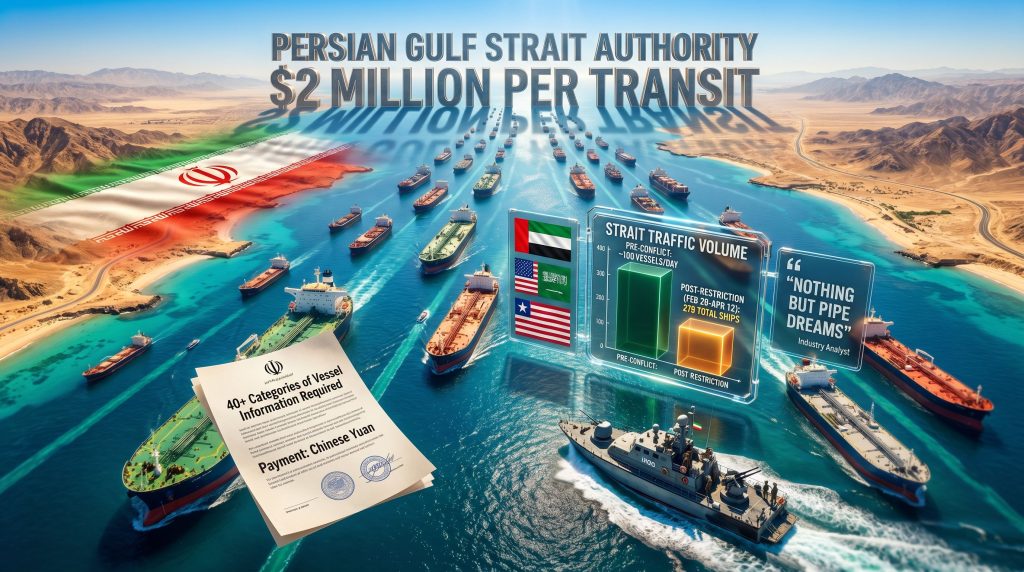
Iran has established the Persian Gulf Strait Authority (PGSA), which requires all commercial vessels to obtain authorisation before transiting the Strait of Hormuz. Ships must submit over 40 categories of information, including cargo details, crew nationalities, and ownership structures, before passage is approved. Reports indicate some vessels have already paid up to $2 million per transit, with payments made in Chinese yuan.
Is There an Official Fee Schedule?
No formally published tariff structure has been released by the PGSA. The reported transit fee of up to $2 million per vessel appears to be applied without a standardised schedule, meaning operators have no transparent framework against which to evaluate or contest charges. This opacity is commercially destabilising in several ways:
- It creates negotiating uncertainty for individual vessel operators
- It makes risk pricing for insurers and freight operators structurally difficult
- It raises questions about whether fee levels are being applied consistently or selectively based on flag state, cargo type, or ownership nationality
- It produces legal ambiguity about the nature of the payment itself — whether it constitutes a toll, a security fee, or a coercive extraction
How Does International Maritime Law Govern the Strait of Hormuz?
The UNCLOS Framework and the Right of Transit Passage
The United Nations Convention on the Law of the Sea establishes the foundational legal framework for international straits used for navigation. Under UNCLOS, the applicable standard for straits like Hormuz is transit passage, a principle that grants ships and aircraft the continuous, expeditious, and unobstructed right to move through without coastal state interference.
Transit passage is deliberately stronger than the alternative standard of innocent passage, which applies in territorial seas and grants coastal states considerably more discretion to regulate and restrict movement. The distinction is legally significant because it was designed precisely to prevent coastal states from using geographic proximity to bottlenecks as leverage over international commerce.
Iran's Legal Position: Why Tehran Rejects Transit Passage
Iran has not ratified UNCLOS. Tehran's longstanding legal position holds that the strait is governed by innocent passage rules, which would give Iranian authorities substantially greater authority to condition, restrict, and control vessel movement. This disagreement between Iran's preferred framework and the UNCLOS standard accepted by most of the international community represents one of the most consequential unresolved disputes in global maritime law.
Legal scholars have noted that Iran's non-ratification creates a genuine enforcement vacuum. Even if UNCLOS reflects customary international law in most of its provisions, the legality of closure and the specific standard of transit passage are contested as customary norms, giving Iran a technical legal foothold for its position, however disputed.
Can a Coastal State Charge Fees for Strait Passage?
| Legal Question | UNCLOS Position | Iran's Position |
|---|---|---|
| Right of transit passage | Guaranteed without impediment | Rejected; not a ratified party |
| Coastal state fee authority | States cannot charge for safe passage through international straits | Fees framed as security coordination costs |
| Innocent passage standard | Lower protection; more coastal state discretion | Iran's preferred legal framework |
| Military vessel passage | Permitted under transit passage | Contested; IRGC enforcement active |
Legal Warning: Under prevailing international maritime law, charging tolls for mere safe passage through an international strait is widely considered unlawful. However, Iran's non-ratification of UNCLOS creates a legal grey zone that makes enforcement of these norms exceptionally difficult in practice.
What Happens When Military Vessels Transit the Strait?
The legal complexity deepens when naval vessels are involved. Even under transit passage rights, vessels are prohibited from threatening or using force against coastal states while transiting. This creates a layered risk environment for naval operations: warships have passage rights under UNCLOS, but exercising those rights while in proximity to IRGC enforcement units carries escalation risk that purely legal analysis cannot resolve. The U.S. Navy's operational posture in the Gulf is directly implicated by the Iran Strait of Hormuz transit rules and their associated jurisdictional claims.
How Has Shipping Traffic Through the Strait Already Changed?
The Dramatic Collapse in Transit Volumes
The scale of disruption to normal shipping patterns is substantial. Ship-tracking data from Kpler reveals a stark contrast between pre-conflict throughput and the post-restriction period:
- Pre-conflict baseline: approximately 100 ships per day transiting the strait
- February 28 to April 12, 2026: only 279 ships recorded in total across this period
- This represents a fraction of what would ordinarily be expected over a roughly six-week window
Vessels That Have Transited Under the New Conditions
Several vessels have navigated the new regime since the fragile ceasefire announced in April 2026. Tracking data and reporting from Reuters and MarineTraffic identified the following transits:
- A Gabon-flagged oil tanker carrying approximately 7,000 tonnes of Emirati fuel oil to India became one of the first non-Iranian vessels through the strait post-ceasefire
- A Liberian-flagged tanker transported approximately 500,000 barrels of UAE naphtha bound for South Korea
- A Liberian-flagged Very Large Crude Carrier carried nearly 2 million barrels of Saudi crude oil destined for Taiwan
Vessels Blocked or Redirected
Not all vessels have passed through without incident. The following cases illustrate the enforcement dimension of the new regime:
- A Botswana-flagged LNG tanker attempting to exit the Persian Gulf was intercepted and forced to reverse course by IRGC naval units
- BBC Verify reported that footage showed what appeared to be a strike on the Liberian-flagged crude oil tanker Barakah, with operators confirming the vessel was struck by unknown projectiles in early May 2026. The Barakah (IMO 9902615), built in 2021, is managed by ADNOC Logistics and Services of the United Arab Emirates.
- The IRGC separately claimed to have coordinated the movement of at least 35 ships within a single 24-hour period, presenting Iranian oversight as an operational service rather than an obstruction
Summary: Strait of Hormuz Traffic Disruption at a Glance
| Metric | Pre-Conflict Average | Post-Restriction Period |
|---|---|---|
| Daily ship transits | ~100 vessels/day | ~279 total (Feb 28 to Apr 12) |
| IRGC-coordinated passages | Not applicable | 35 ships in 24-hour window |
| Reported transit fee | None | Up to $2 million per vessel |
| Payment currency reported | N/A | Chinese yuan |
| Geographic oversight claimed | N/A | 22,000+ sq km |
How Are Regional and Global Powers Responding?
United States: Legal Objection and Naval Posture
Washington has formally challenged the legitimacy of the PGSA, arguing it violates international maritime law and cannot be imposed on vessels with passage rights under established legal frameworks. The U.S. has specifically warned against any attempt to restrict American naval vessel movement through the strait. These objections exist within the broader context of sustained U.S. sanctions pressure on Tehran, where the oil sanctions impact on global supply chains provides a useful parallel for understanding how economic pressure operates through maritime chokepoints.
Gulf States: Outright Rejection of Iranian Authority
The UAE has been the most publicly forceful regional critic of Iran's transit regime. UAE presidential adviser Anwar Gargash stated publicly that Iranian attempts to control the strait amounted to aspirations born of military defeat rather than legitimate governance, characterising the PGSA's claims as having no legal or practical standing.
The fact that ADNOC Logistics and Services, the UAE state energy company, manages vessels directly caught up in enforcement actions — including the Barakah — gives the UAE's rejection particular operational urgency beyond the political dimension. Saudi Arabia, Kuwait, and other Gulf Cooperation Council members share aligned interests in ensuring unimpeded passage and have broadly opposed the PGSA framework.
European Governments: Multilateral Legal Challenge
Multiple European governments have signalled opposition to the new transit regime on UNCLOS grounds. European shipping insurers and freight operators are independently reassessing risk premiums for Gulf transit routes, with elevated war risk surcharges already filtering through to freight cost calculations.
Diplomatic coordination with U.S. and Gulf partners is described as ongoing, though no coordinated enforcement mechanism has been publicly announced.
Geopolitical Context: The timing of the PGSA's establishment following reported military setbacks is significant. It suggests the new transit authority may function at least partly as strategic signalling — an attempt to reassert regional leverage through institutional means when conventional military leverage has been diminished.
The next major ASX story will hit our subscribers first
What Are the Global Energy and Shipping Market Implications?
Oil Price Sensitivity and Supply Chain Vulnerability
With close to one-fifth of global oil and LNG shipments moving through the strait, sustained disruption to transit volumes translates directly into supply-side price shocks. The mechanism is well understood: reduced throughput tightens available spot supply, elevating benchmark crude prices and cascading through to refined product markets globally.
Consequently, the oil price shock dynamics familiar from previous Gulf crises are now resurfacing with renewed structural intensity. Insurance premiums for Gulf-linked voyages have already risen in response to the new enforcement environment, adding a structural cost layer to voyages even when transits are ultimately completed without incident.
Very Large Crude Carrier spot freight rates for Gulf routes are subject to heightened volatility, as operators price in the possibility of delays, interdictions, or fee demands that were not part of the risk calculus twelve months ago.
The Chinese Yuan Payment Dimension
The reported denomination of transit fees in Chinese yuan carries geopolitical weight that extends well beyond the transaction itself. Several layers of significance are worth unpacking:
- It aligns structurally with the bilateral Iran-China energy trade relationship, which has deepened substantially under U.S. sanctions pressure
- Conducting transactions outside the U.S. dollar system insulates the fee mechanism from dollar-denominated sanctions enforcement
- It raises complex secondary sanctions questions for non-Chinese, non-Iranian shipping operators who might comply, as payment in yuan to an Iranian-designated body could itself trigger sanctions exposure under U.S. law
- The arrangement signals a deeper integration of the PGSA framework into the Iran-China strategic partnership, with the yuan serving as the operational currency of a parallel governance structure
Scenario Analysis: Three Possible Trajectories
| Scenario | Description | Market Impact |
|---|---|---|
| Escalation | PGSA enforcement intensifies; major shipping lines reroute or suspend Gulf operations | Significant oil price spike; freight rate surge; insurance market disruption |
| Negotiated Accommodation | Quiet diplomatic channels produce informal passage arrangements | Moderate volatility; selective compliance by non-Western operators |
| Legal Challenge and Multilateral Pushback | U.S., EU, and Gulf states coordinate UNCLOS-based legal challenge; naval escorts deployed | Prolonged legal uncertainty; continued elevated risk premiums |
How Are African-Linked Shipping Operations Affected?
African Flag States and Vessel Exposure
African-registered vessels have been disproportionately visible in the incidents documented since the PGSA's establishment. Gabon, Liberia, and Botswana-flagged ships have all featured in transit and interdiction reports. Liberia's exposure is structurally significant: as one of the world's largest open ship registries by tonnage, a substantial portion of the global commercial fleet sails under the Liberian flag.
The Barakah incident is particularly notable. Despite being Liberian-flagged, the vessel is managed by a UAE state energy company, illustrating how flag state, operating company, cargo origin, and destination can all point in different directions when attribution and legal responsibility are assessed.
Energy Import Cost Pressures on African Economies
For African nations that rely on Gulf crude imports, the implications are indirect but real. Sub-Saharan economies with limited domestic refining capacity face the greatest vulnerability:
- Elevated freight costs for Gulf-origin cargoes translate directly into higher landed costs for crude and refined products
- Countries without significant foreign exchange reserves face intensified import cost pressures if disruptions persist
- The broader context of elevated fuel prices across African markets in 2026 amplifies sensitivity to any additional supply chain disruption
- East African nations importing Gulf LNG face a compounded exposure given that LNG tankers require specialised vessels whose rerouting options are more limited than crude carriers
Frequently Asked Questions: Iran Strait of Hormuz Transit Rules
What is the Strait of Hormuz and why is it strategically important?
The Strait of Hormuz is a narrow maritime passage connecting the Persian Gulf to the Gulf of Oman and the broader Indian Ocean trade network. It serves as the primary seaborne export route for crude oil and LNG from major Gulf producers, handling close to one-fifth of global energy shipments daily. Its geographic bottleneck structure makes it the most consequential maritime chokepoint for energy markets on Earth.
What is the Persian Gulf Strait Authority (PGSA)?
The PGSA is a newly established Iranian body that has declared itself the legal authority governing vessel movement through the Strait of Hormuz. It requires ships to submit detailed information across more than 40 categories and obtain authorisation before transiting. Reports indicate some vessels have paid up to $2 million per passage, with transactions reportedly conducted in Chinese yuan.
Is Iran legally permitted to charge fees or require permits for Strait of Hormuz transit?
Under the UNCLOS framework, coastal states are prohibited from charging fees for safe passage through international straits. However, Iran has not ratified UNCLOS and disputes the applicability of transit passage rights, creating a legally contested environment with no straightforward enforcement pathway available to affected operators. The crude oil geopolitics dimension further complicates any resolution, as competing economic interests shape how nations respond diplomatically.
How has shipping traffic through the strait changed since the new rules were introduced?
Vessel transits have collapsed from a baseline of approximately 100 ships per day to a total of only 279 ships recorded between late February and mid-April 2026, representing a fraction of normal throughput across that period.
Which countries have rejected Iran's new transit authority?
The United States, the United Arab Emirates, and multiple European governments have formally or publicly rejected the PGSA's legitimacy, arguing the new regime violates international maritime law.
What does the use of Chinese yuan for transit payments mean?
The reported use of Chinese yuan aligns with the Iran-China bilateral energy trade relationship and appears designed to structure payment flows outside the reach of U.S. dollar-denominated sanctions enforcement. Shipping operators who comply may face secondary sanctions exposure under U.S. law regardless of the currency used.
Key Takeaways: What the PGSA Means for the Future of Strait of Hormuz Governance
- Iran's establishment of the PGSA represents the most significant institutional assertion of maritime control over the Strait of Hormuz in the modern era, moving from coercive enforcement to formal governance architecture
- The legal dispute between Iran's innocent passage framework and the international community's transit passage standard has no clear near-term resolution pathway
- Shipping operators face a bifurcated compliance environment: paying fees risks secondary sanctions exposure under U.S. law; refusing risks vessel interdiction by IRGC naval units
- Energy markets remain structurally exposed to disruption risk as long as the Iran Strait of Hormuz transit rules remain in force without multilateral resolution
- The yuan-denominated payment structure signals deeper integration of the transit regime into the Iran-China strategic partnership, with implications for how sanctions regimes can be enforced against a non-dollar payment system
- African shipping registries and energy-importing economies face disproportionate secondary exposure relative to their direct operational involvement in Gulf shipping
- The absence of a published tariff schedule is not an administrative oversight but may represent a deliberate strategy to maintain negotiating flexibility and apply selective pressure
Disclaimer: This article contains forward-looking analysis, scenario projections, and assessments of geopolitical risk that are inherently speculative. Readers should not treat this content as legal, financial, or investment advice. The situation described is evolving rapidly, and conditions, legal interpretations, and market impacts may change materially from those described here.
Want to Stay Ahead of the Commodity Opportunities Emerging From Global Energy Disruptions?
When geopolitical flashpoints like the Strait of Hormuz reshape energy supply chains, the ripple effects often surface first in ASX-listed resource and commodity stocks — and Discovery Alert's proprietary Discovery IQ model instantly identifies significant mineral discoveries and actionable opportunities as they are announced, ensuring subscribers are positioned ahead of the broader market. Explore how major discoveries have historically generated exceptional returns on Discovery Alert's discoveries page, and begin a 14-day free trial today to secure a real-time market edge.