
May 23, 2026
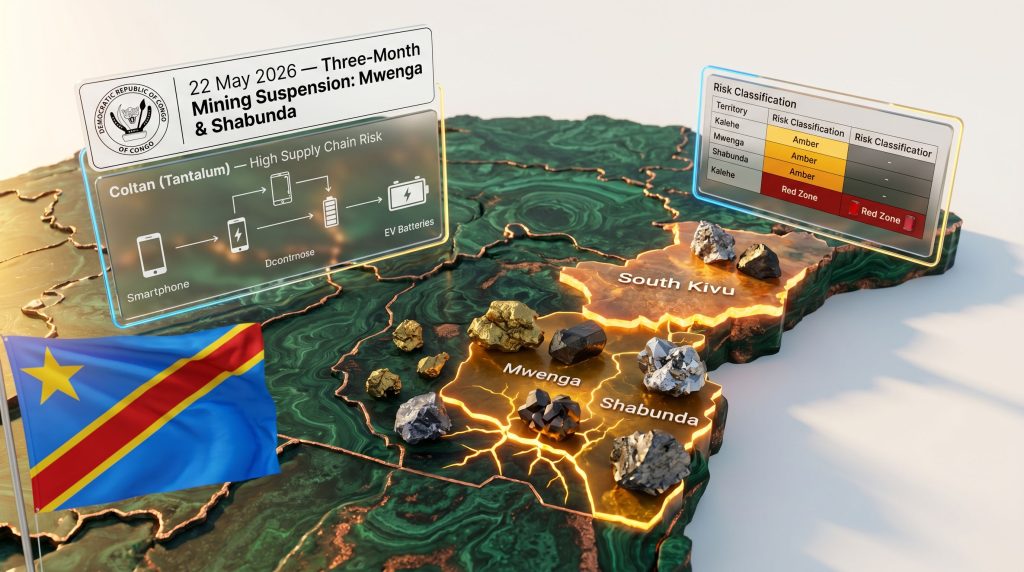
The Mineral Geography That Makes Eastern Congo Irreplaceable
Few corners of the world concentrate so much geological wealth in such a politically fractured landscape as eastern Democratic Republic of Congo. The Kibaran orogenic belt, which underpins much of South Kivu's mineralogy, was formed through tectonic collision events hundreds of millions of years ago, producing the precise metamorphic and hydrothermal conditions required to concentrate gold, coltan, cassiterite, and wolframite in economically exploitable deposits. This geological inheritance is not easily replicated elsewhere on earth, which is precisely why disruptions to extraction in this region carry consequences that ripple far beyond provincial boundaries.
Understanding the DRC mining suspension in South Kivu announced in May 2026 requires situating it within this broader geological and geopolitical context rather than treating it as an isolated enforcement action. What Kinshasa has ordered is, on its surface, a three-month moratorium. Beneath that surface, it represents a fundamental contest over who controls the economic lifeblood of a region whose mineral output shapes supply chains for smartphones, electric vehicles, and defence electronics worldwide. The wider significance of DRC natural resources in global critical mineral strategies makes this contest particularly consequential.
When big ASX news breaks, our subscribers know first
Understanding the Strategic Geography: What Makes South Kivu's Mineral Belt So Critical?
The Mwenga and Shabunda Territories: Eastern Congo's Mineral Heartland
The territories of Mwenga and Shabunda occupy a central position within the broader eastern DRC mineral corridor that stretches from North Kivu through South Kivu toward the Tanganyika province boundary. Both territories sit atop geology that reflects the convergence of multiple mineralising systems, making them unusual even by Congolese standards for the diversity and density of economically significant minerals present within relatively compact geographic areas.
Mwenga is particularly notable for its gold and coltan endowment. The territory hosts a layered extraction ecosystem that includes formally licensed industrial operators, semi-industrial cooperatives operating under mineral trading agreements, and a vast informal artisanal population working deposits that range from alluvial river gravels to hard-rock quartz vein systems.
Shabunda presents a broadly similar profile, with gold and coltan dominant, though its remoteness and historically weaker state presence have made it especially susceptible to the kind of regulatory fragmentation that the May 2026 decree seeks to address.
The practical significance of these territories to global supply chains lies in their position as feeders for regional mineral trading hubs, particularly in Bukavu and across the Rwandan border at Rubavu, through which eastern DRC minerals enter certified smelter networks or, in cases of non-compliant material, informal channels that bypass traceability requirements entirely.
The Scale of Informal and Semi-Formal Mining in Eastern DRC
One of the least appreciated structural features of eastern Congo's mineral economy is the degree to which its output depends not on large formal mining companies but on an extraordinarily complex hierarchy of small-scale and artisanal operators. This layered structure creates enforcement challenges that conventional regulatory tools struggle to address effectively.
At the base of this hierarchy are hundreds of thousands of artisanal diggers, known locally as creuseurs, who work individual pits or alluvial sites with hand tools and minimal capital. Above them sit cooperative structures that aggregate production, provide basic financing, and negotiate with licensed traders. Semi-industrial operators occupy a middle tier, using mechanised equipment but often without the full regulatory compliance profile of major industrial permit holders. At the apex sit industrial licensees, some of whom subcontract extraction to the tiers below.
This structure has a critical implication: enforcement actions directed at the top of the pyramid often fail to disrupt extraction at the base. When a territory-wide suspension is declared, artisanal miners displaced from one area frequently relocate to adjacent zones or simply continue working while shifting the location and methods of production.
The Luhihi gold rush, which preceded the May 2026 decree, illustrates this dynamic vividly. Reports of a newly accessible gold zone drew thousands of unregistered diggers to the area within a short period, overwhelming what little regulatory infrastructure existed and triggering the kind of immediate governmental response that broad suspension orders represent. This pattern of rapid, uncoordinated mineral rushes followed by blunt administrative interventions has repeated itself across eastern DRC for decades.
The following table provides a comparative overview of South Kivu's primary mining territories, their mineral focus, operator composition, and current regulatory risk classification:
| Territory | Primary Minerals | Operator Types | Known Risk Classification |
|---|---|---|---|
| Mwenga | Gold, Coltan | Industrial, Artisanal | Elevated (Suspended May 2026) |
| Shabunda | Gold, Coltan | Semi-industrial, Artisanal | Elevated (Suspended May 2026) |
| Kalehe | Cassiterite, Coltan | Artisanal | Red Zone (Feb 2025) |
| Masisi (N. Kivu) | Coltan, Gold | Mixed | Red Zone (Feb 2025) |
| Luhihi | Gold | Artisanal | Suspended (2026) |
Why Coltan Deserves Special Attention in This Context
Among the minerals affected by the suspension, coltan carries a disproportionate strategic weight. Coltan is the informal name for columbite-tantalite, a mineral that yields tantalum when processed. Tantalum is a refractory metal with exceptional heat resistance and capacitance properties that make it essentially irreplaceable in the manufacture of miniaturised capacitors found in virtually every smartphone, laptop, and advanced electronic device produced globally.
The DRC's share of global tantalum production is substantial and, critically, its artisanal and semi-industrial sectors contribute significantly to that output. Unlike cobalt, where large industrial operations dominate Congolese production, tantalum supply from the DRC is heavily dependent on exactly the kind of small-scale, cooperative, and semi-industrial operators that the May 2026 suspension directly targets. This creates a supply chain vulnerability that downstream electronics manufacturers cannot easily hedge through geographic diversification in the near term.
Furthermore, the DRC export ban on cobalt has already demonstrated how swiftly Kinshasa is prepared to deploy blunt trade instruments when it believes strategic resources are undervalued or misappropriated, adding additional context to the current moratorium.
What Exactly Did the DRC Government Order, and Why Now?
Breaking Down the May 2026 Ministerial Decree
The ministerial decree issued on 22 May 2026 by Minister Louis Kabamba Watum of the Ministry of Mines imposed a complete suspension of all mining activity across gold and coltan-rich zones in Mwenga and Shabunda territories within South Kivu province. The scope of the order is comprehensive: industrial permit holders, semi-industrial operators, artisanal mining cooperatives, independent traders, and any armed personnel present at affected sites are all required to vacate and cease operations for the duration of the three-month moratorium.
Several features of this decree distinguish it from more routine enforcement communications:
- The simultaneous deployment of a special inspection mission led by the General Inspectorate of Mines, rather than relying on existing territorial oversight structures
- An explicit mandate for the inspection team to identify and document individuals and entities involved in illegal extraction networks, signalling an intent to pursue accountability beyond the suspension period
- A clear statement that findings from the inspection mission will directly shape post-moratorium enforcement policy
- The absence of named companies in the decree's text, broadening its application to the full spectrum of operators rather than targeting specific actors
The Regulatory Justification: Security, Traceability, and State Control
Authorities offered a multi-layered justification for the suspension. The primary concerns cited centre on escalating illegal mining activity, widespread mineral fraud, and systematic failures in the enforcement infrastructure that is supposed to govern extraction across both territories. Critically, the government linked uncontrolled mineral revenues to the financing of armed instability in eastern Congo, framing the suspension as a security intervention as much as a regulatory one.
The emphasis on traceability is particularly significant from a global supply chain perspective. The DRC's mineral traceability architecture, which includes the iTSCi (ITRI Tin Supply Chain Initiative) and other certification schemes, depends on consistent tagging and documentation at the point of extraction. When enforcement gaps allow large volumes of untagged material to enter trading chains, it undermines the credibility of certified material originating from the same region, creating compliance complications for international buyers regardless of whether their specific supply source is operating legally.
The broader export suspension impact analysis from earlier interventions demonstrates that these compliance ripple effects can persist long after formal restrictions are lifted, as certification confidence takes time to rebuild.
The May 2026 suspension follows a February 2025 directive that classified mining zones in Masisi (North Kivu) and Kalehe (South Kivu) as formal Red Zones, imposing six-month extraction and sales bans due to documented links between conflict minerals and armed group financing. The 2026 action represents a deliberate escalation of this regulatory posture, not an isolated event.
How Does This Fit Into the DRC's Broader Crackdown on Conflict Minerals?
A Timeline of Escalating Regulatory Interventions in Eastern DRC
The May 2026 decree did not emerge from a regulatory vacuum. It represents the latest point in an accelerating sequence of interventions that reflect Kinshasa's growing determination to assert meaningful control over eastern Congo's mineral corridors:
-
February 2025: The Ministry of Mines formally designates Masisi territory (North Kivu) and Kalehe territory (South Kivu) as Red Zones, imposing six-month bans on both extraction and mineral sales across affected areas.
-
Throughout 2025: Mineral monitoring and tagging systems are progressively suspended across multiple South Kivu territories including Kalehe, Idjwi, Uvira, Kabare, Walungu, and Shabunda, as conflict-related control failures make consistent implementation impossible under prevailing security conditions.
-
May 2026: A three-month comprehensive suspension of all mining activity is imposed across Mwenga and Shabunda, accompanied by the deployment of a special inspection mission from the General Inspectorate of Mines.
-
Post-suspension phase (anticipated): Based on the stated intent to use inspection findings as the basis for future regulatory actions, a tougher enforcement phase is expected once the moratorium concludes.
What Are "Red Zones" and Why Do They Matter?
The Red Zone designation is one of the most consequential tools available to the DRC's Ministry of Mines. When a territory receives this classification, it triggers a cascade of regulatory consequences that extend well beyond the DRC's own legal system:
- Complete extraction and sales bans under Congolese law, enforceable against all operator categories
- Mandatory eligibility for international audit processes under frameworks such as the OECD Due Diligence Guidance for Responsible Supply Chains of Minerals from Conflict-Affected and High-Risk Areas
- Enhanced chain-of-custody requirements for any material that previously originated from the designated zone
- Heightened scrutiny from downstream buyers operating under the EU Conflict Minerals Regulation, which came into full effect for EU-based importers in 2021, and US Dodd-Frank Section 1502, which requires companies listed on US exchanges to disclose whether their products contain conflict minerals sourced from the DRC or adjoining countries
The significance of these international frameworks lies in their extraterritorial reach. A mine suspension in South Kivu affects not only Congolese operators but also procurement decisions made in electronics manufacturing facilities in Asia, Europe, and North America. Companies that cannot demonstrate clean chain-of-custody documentation face regulatory exposure and reputational risk that increasingly influences sourcing strategy at the board level.
Who Is Enforcing the Suspension, and What Powers Do They Have?
The Special Inspection Mission: Mandate and Methodology
The General Inspectorate of Mines is the DRC's primary statutory body for verifying compliance across the mineral extraction sector. Its deployment under a special mission mandate in the context of the May 2026 suspension gives it broader investigative authority than standard operational oversight, including the power to:
- Verify the legal basis for every active or recently active mining operation across affected territories
- Document specific violations in a format that supports subsequent administrative and potentially criminal proceedings
- Identify individuals and corporate entities involved in illegal extraction networks, including financiers and traders who may not be physically present at mining sites
- Recommend both corrective measures (such as revised licensing conditions) and coercive actions (including permit cancellations and referrals for prosecution) under national mining law
The inspection mission operates in coordination with other state agencies, reflecting the multi-dimensional nature of the enforcement challenge. Illegal mining in eastern DRC is rarely a simple matter of unlicensed individuals digging holes. It typically involves complex networks that span extraction, transportation, trading, export, and financing, often with connections to armed actors who provide security or extract taxation from operations at various points in the chain.
Enforcement Challenges on the Ground
The practical difficulty of executing this mandate cannot be understated. South Kivu presents a combination of physical and institutional obstacles that have historically frustrated even well-resourced enforcement efforts:
- Persistent insecurity: Active conflict across multiple zones of South Kivu limits the operational freedom of movement available to civilian inspection teams, who cannot safely access many mining sites without military escort
- Armed actor presence: Non-state armed groups have historically maintained a taxing or control presence at numerous mining sites, creating physical risk for enforcement personnel and complicating the distinction between legal and illegal extraction
- Jurisdictional fragmentation: Multiple agencies with overlapping and sometimes competing authority over mining, environment, security, and fiscal matters have historically undermined coordinated enforcement
- Infrastructure deficits: The absence of reliable road networks across much of Mwenga and Shabunda slows the deployment of inspection teams and makes verification of remote sites genuinely difficult
Monitoring organisations have reported that mineral tagging and traceability systems specifically designed to verify responsible sourcing have been repeatedly suspended across South Kivu territories because security conditions make consistent implementation impossible. The effectiveness of the current inspection mission will depend heavily on whether adequate security guarantees can be established and maintained throughout the moratorium period.
What Are the Global Supply Chain Implications of the South Kivu Suspension?
DRC's Irreplaceable Position in Critical Mineral Supply Chains
The global mineral economy's dependence on the DRC is not evenly distributed across all commodities. For some minerals, the DRC's contribution is significant but substitutable over the medium term. For others, the concentration of supply is so pronounced that disruptions in key production zones create acute near-term vulnerabilities for downstream industries.
The following impact assessment maps each primary mineral affected by the South Kivu suspension to its global relevance and the relative supply chain risk created by the moratorium:
| Mineral | Global Relevance | DRC's Market Position | Supply Chain Risk from South Kivu Disruption |
|---|---|---|---|
| Gold | Jewellery, electronics, central bank reserves | Significant but globally distributed | Moderate, multiple supply alternatives exist |
| Coltan (Tantalum) | Capacitors, smartphones, EVs, defence electronics | Dominant global supplier | High, limited geographic substitution available |
| Cassiterite (Tin) | Soldering, electronics manufacturing | Major top-tier producer | Moderate-High, Indonesia and Malaysia provide alternatives |
| Wolframite (Tungsten) | Cutting tools, electronics, aerospace | Meaningful contributor | Moderate, China dominates global supply |
The Compliance Dimension: What Downstream Buyers Face
For companies sourcing minerals from eastern DRC, the May 2026 suspension creates a specific set of compliance obligations that cannot be managed through passive monitoring. Several practical consequences require active attention from procurement and legal teams:
- Documentation gaps: Suspension periods interrupt the chain-of-custody documentation that traceability schemes depend upon. Material that was legitimately extracted and partially documented before the suspension may have incomplete records that complicate certification for downstream buyers.
- Inventory questions: Traders and processing facilities holding stock from Mwenga and Shabunda need to verify that their inventory was acquired before the decree date and is supported by adequate provenance documentation.
- Ongoing due diligence obligations: The EU Conflict Minerals Regulation and Dodd-Frank Section 1502 do not provide suspension exemptions. Companies with DRC exposure remain obligated to conduct and document their due diligence regardless of whether extraction is formally paused.
- Post-moratorium sourcing reassessment: The inspection mission's findings are expected to result in changes to the operating landscape in both territories. Companies should prepare for a post-suspension environment where the pool of compliant, certifiable suppliers may be materially different from the pre-suspension baseline.
The Tantalum Supply Signal Worth Watching
One supply chain dynamic that receives insufficient attention in mainstream coverage is the structural tightness of the tantalum market relative to other technology metals. Unlike lithium or cobalt, where major mining expansions in Australia, Chile, and elsewhere have provided meaningful supply diversification over the past decade, tantalum's global supply base remains highly concentrated.
The DRC and Rwanda collectively account for a substantial share of globally traded material. Within the DRC's tantalum supply, the artisanal and semi-industrial sectors that dominate South Kivu's coltan production are not easily replaced by large industrial projects, which require years of development and substantial capital investment.
A three-month suspension, while temporary, creates a signal for electronics procurement managers that baseline supply availability from this region is subject to interruption at relatively short notice. For manufacturers with lean inventory strategies, that signal has strategic implications for safety stock calculations and supplier diversification plans. The minerals security partnership framework being developed between the DRC and external partners may, however, introduce new stabilising mechanisms that alter this risk calculus over the medium term.
The next major ASX story will hit our subscribers first
Is the DRC's Formalisation Strategy Working? Structural Barriers to Reform
Why Enforcement Alone Cannot Resolve Eastern Congo's Mining Governance Crisis
The most important limitation of the May 2026 DRC mining suspension in South Kivu, and of the broader pattern of Red Zone designations and moratoriums that preceded it, is that enforcement actions address symptoms rather than root causes. The structural conditions that produce illegal mining in eastern DRC are not created by weak enforcement; they predate and will outlast any particular regulatory intervention.
These structural drivers include:
- Extreme poverty and lack of formal employment: For the majority of artisanal miners in Mwenga and Shabunda, digging is not a choice among multiple options but the only available livelihood. Suspension orders do not create alternative income sources.
- Weak institutional capacity: The DRC state's ability to maintain consistent regulatory presence across remote, insecure territory is fundamentally constrained by fiscal limitations, infrastructure gaps, and security challenges that a mining decree cannot address.
- Active conflict dynamics: So long as armed groups maintain operational presence across eastern Congo, any regulatory architecture built on civilian enforcement will have structural vulnerabilities that non-state actors can exploit.
- Displacement rather than elimination: Research on previous suspension orders in eastern DRC consistently finds that artisanal miners displaced from moratorium zones relocate to adjacent unregulated areas, shifting the geographic footprint of illegal extraction rather than reducing its scale.
The Role of Armed Groups in Eastern DRC's Mineral Economy
The connection between mineral revenues and armed group financing in eastern Congo is among the most extensively documented phenomena in the conflict minerals literature. Groups including the M23 and numerous other non-state actors have historically derived income from mining through direct site control, taxation of miners and traders, and protection rackets imposed on transport routes.
What makes this dynamic particularly resistant to regulatory solutions is that armed groups are not passive beneficiaries of mineral flows. They are active participants in the governance of extraction, often providing the security and dispute resolution functions that formal state institutions cannot reliably deliver. In some cases, miners prefer armed group oversight to that of formal inspectors because it is more consistent and less arbitrary, even when it comes at a financial cost.
International traceability frameworks were explicitly designed to sever this connection by making certified, traceable material more commercially valuable than untraced material. The repeated suspension of those very traceability systems across South Kivu, as occurred throughout 2025, represents a significant setback for this strategy. Consequently, the Congolese supply rivalry between major powers for influence over eastern DRC's mineral corridors further complicates reform efforts, as geopolitical interests do not always align with governance objectives.
What Structural Reform Would Actually Require
A durable improvement in eastern Congo's mining governance would require a combination of interventions that go well beyond ministerial decrees. The core elements of a reform agenda that mining sector experts and development organisations have consistently identified include:
-
Formalisation pathways for artisanal miners: Accessible, low-cost licensing processes, cooperative support structures, and income transition support during formalisation periods that reduce the economic cost of compliance for small-scale operators.
-
Security sector reform: Sustained reduction in armed group presence at and around mining sites, which requires political and security interventions that extend well beyond the Ministry of Mines' mandate.
-
Technology investment in traceability: Mobile-compatible, low-infrastructure tagging and verification systems that can function under the challenging field conditions of remote South Kivu territories, rather than systems designed for more stable operating environments.
-
Sustained international pressure on downstream buyers: Consistent enforcement of responsible sourcing obligations by importing country regulators, creating commercial incentives that reward compliant supply chains and penalise those that cannot demonstrate traceability.
-
Revenue sharing mechanisms: Transparent fiscal arrangements that direct a meaningful share of mineral revenues to producing communities, reducing the economic appeal of informal extraction networks that bypass state systems entirely.
Frequently Asked Questions: DRC Mining Suspension in South Kivu
What territories are affected by the May 2026 DRC mining suspension in South Kivu?
The suspension applies specifically to Mwenga and Shabunda territories within South Kivu province, covering all categories of mining operations across gold and coltan-rich corridors in both areas.
How long will the South Kivu mining suspension last?
The moratorium runs for three months from the date of the ministerial decree, which was issued on 22 May 2026 by Minister Louis Kabamba Watum.
Which minerals are primarily affected by the South Kivu suspension?
Gold and coltan are the primary minerals targeted, though the decree covers all extraction activity across the designated territories regardless of the mineral being mined.
Why did the DRC government suspend mining in South Kivu?
Authorities cited escalating illegal mining activity, mineral fraud, enforcement failures, and concerns that revenues from uncontrolled extraction are being channelled toward financing armed instability in eastern Congo.
What is the General Inspectorate of Mines and what role does it play?
The General Inspectorate of Mines is the DRC's primary statutory mining oversight body. In the context of this suspension, it leads a special control mission with authority to verify operational legality, document violations, identify illegal actors, and recommend enforcement actions that will shape post-moratorium regulatory policy.
How does this suspension affect global mineral supply chains?
South Kivu's production feeds into international electronics and battery material supply chains. The suspension creates traceability documentation gaps and heightened compliance obligations for companies sourcing under the EU Conflict Minerals Regulation and US Dodd-Frank Section 1502.
Has the DRC imposed similar restrictions before?
Yes. In February 2025, the Ministry of Mines classified zones in Masisi (North Kivu) and Kalehe (South Kivu) as Red Zones, imposing six-month extraction and sales bans. Mineral tagging and traceability systems were also suspended across multiple South Kivu territories during 2025 due to ongoing security failures.
Were specific companies named in the suspension decree?
No specific companies were named in the decree. The suspension applies broadly to all industrial, semi-industrial, and artisanal operators across the affected territories.
Key Takeaways: What the South Kivu Suspension Signals for Eastern DRC's Mining Future
The three-month moratorium imposed across Mwenga and Shabunda in May 2026 carries implications that extend far beyond its stated duration and geographic scope. Several conclusions can be drawn for different stakeholder groups:
-
The escalating sequence of Red Zone designations and territory-wide suspensions signals that Kinshasa is moving from ad hoc enforcement responses toward a more structured regulatory reset across eastern Congo's most strategically important mineral corridors.
-
The deployment of the General Inspectorate of Mines under a formal special mission mandate, with an explicit brief to inform post-moratorium policy, suggests that the DRC mining suspension in South Kivu is designed as the beginning of a reform process rather than a standalone intervention.
-
For global supply chain participants with DRC mineral exposure, heightened compliance obligations are now effectively permanent features of the operating landscape rather than temporary disruptions to be managed through short-term inventory adjustments.
-
The tantalum market, in particular, warrants close attention from electronics procurement teams given the DRC's dominant market position and the concentration of artisanal and semi-industrial coltan production in exactly the territories now under suspension.
-
Structural reform, encompassing formalisation, security sector improvement, traceability technology investment, and international buyer compliance enforcement, remains the only pathway to sustainable mineral governance in eastern DRC. Enforcement actions alone, however well-designed, cannot address the underlying conditions that produce illegal extraction in one of the world's most resource-endowed and conflict-affected regions.
This article is intended for informational purposes only and does not constitute financial, legal, or investment advice. Readers with commercial or compliance exposure to DRC mineral supply chains should seek independent professional guidance. Forward-looking assessments reflect analytical interpretation and involve inherent uncertainty.
Want To Stay Ahead of Critical Mineral Discoveries Before the Broader Market?
While eastern DRC's supply disruptions highlight the strategic importance of minerals like tantalum and gold, Discovery Alert's proprietary Discovery IQ model delivers real-time alerts the moment significant ASX mineral discoveries are announced, instantly translating complex geological data into actionable investment insights for traders and long-term investors alike — explore historic discovery returns to understand the scale of opportunity, and begin your 14-day free trial today to position yourself ahead of the market.