June 11, 2026
Global critical mineral supply chains face unprecedented transformation as evolving regulatory frameworks reshape resource extraction paradigms. The convergence of technological advancement, geopolitical tensions, and environmental considerations has created a complex matrix of challenges that traditional mining approaches struggle to address effectively. Recent developments in deep-sea mining permit approval processes highlight the growing urgency to secure alternative resource supplies through innovative extraction methodologies.
Modern industrial economies depend heavily on specialised materials for renewable energy infrastructure, advanced manufacturing, and defence applications. This dependency has intensified scrutiny of extraction methodologies and their long-term sustainability implications across multiple sectors. Furthermore, the critical minerals energy transition requires unprecedented quantities of materials that conventional terrestrial mining may struggle to provide.
Understanding the New Regulatory Framework
The United States has implemented significant changes to its deep-sea mining regulatory structure through amendments to existing legislation. These modifications consolidate previously fragmented permitting processes into streamlined approval mechanisms designed to accelerate project timelines whilst maintaining oversight standards. Additionally, recent mining permits reform initiatives have further transformed the regulatory landscape for resource extraction activities.
Under the revised system, operators can now submit comprehensive applications that address both exploration and commercial recovery phases simultaneously. This represents a departure from traditional two-step approaches that required separate submissions for different operational phases.
Key administrative improvements include:
• Single-point regulatory review eliminating redundant documentation requirements
• Consolidated environmental assessment processes reducing assessment durations
• Integrated technical standards combining exploration and production criteria
• Streamlined inter-agency coordination minimising bureaucratic delays
The National Oceanic and Atmospheric Administration now serves as the primary regulatory coordinator, centralising decision-making authority that was previously distributed across multiple federal agencies. This consolidation aims to reduce permit processing times from several years to approximately twelve months. Consequently, operators seeking to understand this complex regulatory environment may benefit from consulting a comprehensive guide to mining permitting processes.
Timeline Comparison: Old vs. New Process
| Process Stage | Previous Framework | Streamlined Framework | Time Reduction |
|---|---|---|---|
| Initial Review | 6-8 months | 3-4 months | 50% |
| Environmental Assessment | 12-18 months | 6-9 months | 40% |
| Technical Evaluation | 8-12 months | 4-6 months | 50% |
| Final Approval | 24-38 months | 13-19 months | 45% |
The regulatory changes specifically target administrative inefficiencies whilst preserving core environmental and technical review standards. Industry observers note that this approach balances commercial interests with regulatory oversight requirements.
When big ASX news breaks, our subscribers know first
How Will Streamlined Permits Impact U.S. Critical Mineral Independence?
Strategic mineral security has become a cornerstone of national economic policy as supply chain vulnerabilities expose dependencies on foreign sources. The United States currently imports over 80% of its rare earth elements and significant portions of other critical materials from geopolitically sensitive regions.
Deep-sea mining operations could potentially access substantial mineral reserves located in polymetallic nodule fields. These formations contain high concentrations of nickel, copper, cobalt, and manganese essential for battery production, renewable energy systems, and advanced manufacturing processes. However, the evolution of mining industry trends suggests that technological innovation will play a crucial role in making these operations economically viable.
Current U.S. Import Dependencies for Critical Minerals:
• Cobalt: 76% imported (primarily from Democratic Republic of Congo)
• Nickel: 43% imported (primarily from Canada and Russia)
• Copper: 28% imported (primarily from Chile and Peru)
• Manganese: 100% imported (primarily from South Africa and Gabon)
The Clarion-Clipperton Zone, targeted by initial applications, contains an estimated 800 million metric tons of polymetallic nodules. This resource base could potentially supply substantial portions of U.S. critical mineral requirements for decades, assuming successful extraction and processing capabilities.
Economic projections suggest several transformative outcomes:
• Supply chain diversification reducing dependence on single-source suppliers
• Price volatility mitigation through increased supply sources
• Manufacturing sector benefits from secure domestic mineral access
• Strategic reserve enhancement supporting national security objectives
However, realising these benefits requires significant infrastructure investment, including processing facilities, transportation networks, and specialised equipment manufacturing capabilities. The transition from extraction to refined materials suitable for industrial applications represents a complex technical and economic challenge.
Industry analysts project that successful deep-sea mining operations could reduce U.S. import dependence for key battery minerals by 30-40% within a decade, fundamentally altering global supply chain dynamics.
Commercial agreements between extraction companies and major commodity traders suggest growing confidence in the viability of seabed mining operations. These partnerships provide critical market access and financial backing necessary for large-scale commercial development.
What Are the Technical Requirements for Deep-Sea Mining Permit Approval?
Deep-sea mining permit approval requires comprehensive technical documentation addressing extraction methodologies, environmental monitoring, and operational safety protocols. Regulatory standards encompass both exploration phase requirements and commercial-scale production specifications.
Exploration Licence Technical Specifications:
• Coverage area limits: Maximum 150,000 square kilometres per licence
• Operational depth range: 3,000-6,000 metres below sea level
• Survey requirements: Complete bathymetric and geological mapping
• Sample collection: Representative nodule sampling across licence area
• Environmental baseline: Comprehensive ecosystem assessment protocols
Commercial recovery permits impose additional technical standards focusing on extraction efficiency, environmental impact minimisation, and processing capabilities. These requirements ensure operators possess necessary technological capabilities before commencing full-scale operations.
Key Technical Standards Include:
• Collection system efficiency: Minimum 90% nodule recovery rates
• Sediment disturbance limits: Maximum 2-metre seabed penetration depth
• Processing vessel specifications: On-board separation and storage capacity
• Water column protection: Discharge water quality standards
• Equipment monitoring: Real-time operational data transmission requirements
Environmental impact assessment protocols represent the most complex component of permit applications. Operators must demonstrate comprehensive understanding of local ecosystem characteristics and implement monitoring systems capable of detecting operational impacts.
Environmental Assessment Components:
• Baseline biodiversity surveys documenting existing species populations
• Sediment plume modelling predicting disturbance extent and duration
• Noise impact analysis assessing effects on marine wildlife
• Chemical discharge evaluation examining processing waste impacts
• Cumulative impact assessment considering multiple operational effects
Technical review processes evaluate operator capabilities across multiple dimensions, including equipment reliability, operational experience, financial resources, and environmental management systems. This comprehensive assessment approach aims to ensure only qualified operators receive commercial permits.
Which International Waters Fall Under U.S. Jurisdiction?
Jurisdictional authority over deep-sea mining operations presents complex legal and diplomatic challenges, particularly for areas beyond national territorial boundaries. The United States claims regulatory authority over its Exclusive Economic Zone extending 200 nautical miles from coastal baselines.
However, the most promising polymetallic nodule deposits are located in international waters beyond any nation's direct jurisdictional control. The Clarion-Clipperton Zone, spanning approximately 6 million square kilometres between Hawaii and Mexico, falls primarily within international seabed areas.
Clarion-Clipperton Zone Geographic Parameters:
• Northern boundary: 20°N latitude
• Southern boundary: 10°N latitude
• Western boundary: 117°W longitude
• Eastern boundary: 155°W longitude
• Average depth: 4,000-5,500 metres
The legal framework governing these operations derives from the Deep Seabed Hard Mineral Resources Act (DSHMRA), originally enacted in 1980. This legislation asserts U.S. authority to regulate its citizens' activities in international seabed areas, regardless of international treaty obligations.
Critical Legal Considerations:
• UNCLOS non-signatory status: U.S. operates outside international treaty framework
• International Seabed Authority conflicts: Potential jurisdictional disputes with UN-backed organisation
• Unilateral regulatory claims: Precedent-setting for other nations' mining policies
• Diplomatic implications: Potential tensions with treaty signatory nations
The International Seabed Authority, established under the UN Convention on the Law of the Sea, claims regulatory authority over the same areas where U.S. companies seek permits. This jurisdictional overlap creates potential for international legal disputes and diplomatic tensions.
Geopolitical Risk Factors:
• Treaty obligations: Other nations may challenge U.S. regulatory authority
• Commercial conflicts: Competing permit applications from different jurisdictions
• Environmental governance: Conflicting regulatory standards and oversight mechanisms
• Resource allocation: Potential disputes over access to high-value deposit areas
Legal experts suggest that successful U.S. operations could establish precedents encouraging other nations to implement similar unilateral regulatory frameworks, potentially fragmenting international governance systems for seabed mining activities. Moreover, these developments parallel broader discussions about deep‑sea mining concerns that extend beyond national boundaries.
How Do Environmental Safeguards Balance with Expedited Approvals?
Balancing environmental protection with accelerated permitting timelines represents a fundamental challenge in deep-sea mining regulation. Critics argue that compressed review periods may compromise thorough environmental assessment, whilst proponents contend that streamlined processes can maintain protective standards while eliminating bureaucratic inefficiencies.
Environmental Assessment Requirements Under New Framework:
• Baseline ecosystem surveys: 24-month minimum data collection period
• Species impact modelling: Population vulnerability assessments for endemic fauna
• Sediment plume analysis: Three-dimensional dispersion modelling requirements
• Recovery timeline projections: Ecosystem restoration forecasting methodologies
• Cumulative impact evaluation: Regional-scale environmental effect assessments
Scientific understanding of deep-sea ecosystems remains limited, with many species populations and ecological relationships poorly documented. This knowledge gap complicates environmental risk assessment and creates uncertainty regarding potential operational impacts.
Key Environmental Concerns:
• Species endemism: High rates of location-specific fauna vulnerable to extraction activities
• Slow recovery rates: Deep-sea organisms typically exhibit extended reproduction cycles
• Sediment disturbance: Potential for widespread habitat disruption from collection activities
• Noise pollution: Impact of industrial operations on marine wildlife behaviour
• Chemical contamination: Processing discharge effects on water column chemistry
Environmental monitoring protocols require operators to implement comprehensive surveillance systems capable of detecting ecosystem changes during operational phases. These systems must function reliably in extreme deep-sea conditions whilst providing real-time data transmission capabilities.
Recent scientific studies suggest that polymetallic nodule ecosystems may require decades to centuries for recovery from industrial-scale disturbance, raising questions about the reversibility of extraction impacts.
Monitoring Technology Requirements:
| System Component | Technical Specifications | Data Collection Frequency |
|---|---|---|
| Benthic imaging | High-resolution seafloor photography | Continuous during operations |
| Water quality sensors | Multi-parameter chemical analysis | Hourly measurements |
| Acoustic monitoring | Marine mammal detection systems | 24/7 passive listening |
| Sediment tracking | Plume extent measurement | Real-time during collection |
Risk mitigation measures include mandatory operational shutdowns when environmental thresholds are exceeded, requirement for independent scientific oversight, and establishment of reference areas where no mining activities are permitted for comparison purposes.
What Resources Are Targeted in Deep-Sea Mining Operations?
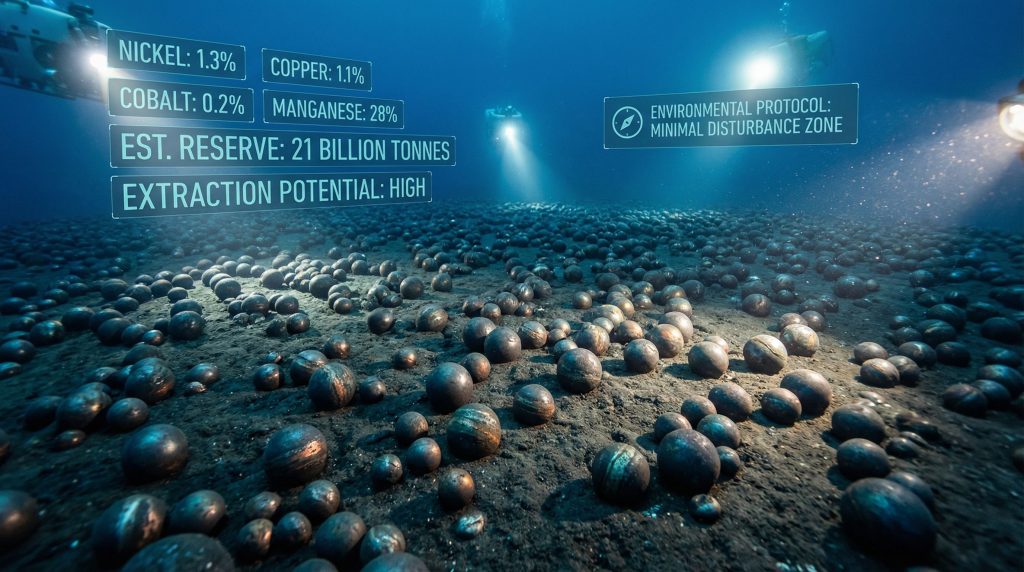
Polymetallic nodules represent the primary target for deep-sea mining operations due to their high concentrations of critical minerals and relatively accessible formation patterns. These potato-shaped formations accumulate on abyssal seafloors over millions of years through complex biogeochemical processes.
Typical Polymetallic Nodule Composition:
• Manganese: 15-35% by weight (primary matrix material)
• Nickel: 1.0-1.5% by weight (key battery component)
• Copper: 1.0-1.4% by weight (electrical applications)
• Cobalt: 0.1-0.5% by weight (high-value battery material)
• Iron: 5-15% by weight (structural applications)
The 800 million metric tons of nodules estimated in targeted zones contain substantially higher mineral concentrations compared to most terrestrial ore deposits. This grade differential potentially offers significant economic advantages despite challenging extraction conditions.
Resource Quality Comparison: Deep-Sea vs. Terrestrial Mining
| Mineral | Nodule Grade (%) | Typical Land-Based Ore (%) | Grade Advantage |
|---|---|---|---|
| Nickel | 1.3 | 0.5-2.0 | Competitive |
| Copper | 1.2 | 0.4-2.0 | Competitive |
| Cobalt | 0.25 | 0.05-0.3 | Superior |
| Manganese | 27 | 25-50 | Competitive |
Nodule formation occurs through precipitation of dissolved metals from seawater around nucleation points such as shark teeth, shell fragments, or rock particles. Growth rates average 2-5 millimetres per million years, making these resources essentially non-renewable on human timescales.
Formation Characteristics:
• Size range: 2-10 centimetres diameter typically
• Density: 2.1-2.3 grams per cubic centimetre
• Distribution pattern: Carpet-like coverage across seafloor areas
• Abundance: 10-70 kilograms per square metre in prime locations
• Depth occurrence: 3,000-6,000 metre water depths predominantly
The Clarion-Clipperton Zone contains the highest-quality nodule deposits globally, with superior metal content and favourable extraction conditions compared to other oceanic regions. This zone's nodules exhibit consistent composition and size characteristics advantageous for commercial processing operations.
Processing and Refinement Challenges:
• Separation technologies: Isolating individual metals from complex mineral matrices
• Energy requirements: High-temperature processing demands for metal extraction
• Waste management: Handling large volumes of processing residues
• Transportation logistics: Moving raw materials from remote ocean locations
• Quality control: Maintaining consistent product specifications from variable feedstock
Economic viability depends heavily on developing efficient processing technologies capable of recovering multiple metals simultaneously whilst minimising energy consumption and waste generation. Current metallurgical research focuses on hydrometallurgical approaches using chemical leaching processes optimised for nodule composition characteristics.
Which Companies Are Positioned for First-Mover Advantage?
The deep-sea mining industry remains in early development stages with limited operational experience and significant technological barriers to commercial success. Several companies have positioned themselves as potential leaders through strategic investments, technological development, and regulatory engagement.
The Metals Company represents the most advanced operator in the U.S. regulatory framework, having submitted the first consolidated deep-seabed mining application under streamlined permitting processes. The company has conducted multiple exploratory expeditions and established commercial agreements with major commodity traders including Glencore.
Strategic Advantages:
• Early regulatory engagement: First-mover status in U.S. permitting process
• Commercial partnerships: Secured off-take agreements with established traders
• Operational experience: Completed multiple deep-sea collection trials
• Technology development: Proprietary collection and processing systems
• Financial backing: International investor support and commodity trader partnerships
Competitive Landscape Factors:
• Technological barriers: Limited proven extraction equipment at commercial scale
• Capital requirements: Estimated $1-3 billion for full-scale operations
• Regulatory uncertainty: Evolving international governance frameworks
• Environmental risks: Potential for operational shutdowns due to ecological concerns
• Market volatility: Commodity price fluctuations affecting project economics
Investment considerations include significant upfront capital requirements, extended development timelines, and regulatory uncertainties that could impact project viability. The industry's nascent state creates both substantial opportunities and considerable risks for early entrants. Indeed, recent regulatory developments suggest that companies are actively positioning themselves to capitalise on expedited approval processes.
Technology Partnership Requirements:
• Collection systems: Specialised seafloor mining equipment development
• Processing vessels: Custom-designed ships with integrated processing capabilities
• Metallurgical facilities: Shore-based refineries optimised for nodule processing
• Transportation logistics: Bulk handling systems for raw material movement
• Environmental monitoring: Advanced sensor networks for ecosystem surveillance
Success in deep-sea mining requires substantial vertical integration across multiple technical disciplines, from marine engineering to metallurgy to environmental science. Companies lacking comprehensive technical capabilities may struggle to achieve commercial viability independently.
The next major ASX story will hit our subscribers first
What Are the Long-Term Supply Chain Implications?
Deep-sea mining success could fundamentally restructure global critical mineral markets by introducing new supply sources outside traditional geographic concentrations. This diversification potential offers strategic advantages whilst creating new competitive dynamics across multiple industrial sectors.
Supply Chain Transformation Scenarios:
Optimistic Case: Successful deep-sea operations could supply 15-25% of global nickel and cobalt demand within 15 years, significantly reducing market concentration and price volatility.
Conservative Case: Deep-sea mining contributes 5-10% of critical mineral supply, providing marginal diversification benefits whilst facing continued technological and regulatory challenges.
Pessimistic Case: Environmental constraints and technical difficulties limit deep-sea mining to pilot-scale operations with minimal market impact.
Market Structure Changes:
• Geographic diversification: Reduced dependence on politically unstable regions
• Price volatility reduction: Additional supply sources moderating market fluctuations
• Strategic reserve opportunities: Government stockpiling of domestically controlled resources
• Manufacturing sector benefits: Improved supply security for battery and electronics industries
• Trade relationship impacts: Altered negotiating positions with traditional mineral exporters
Investment Implications for Mining Sector:
| Investment Category | Traditional Mining | Deep-Sea Mining | Risk-Return Profile |
|---|---|---|---|
| Capital Requirements | $500M-2B | $1B-3B | Higher initial risk |
| Operational Complexity | Moderate | Very High | Technology-dependent |
| Environmental Liability | Significant | Unknown | Potentially severe |
| Market Access | Established | Developing | First-mover advantage |
| Regulatory Certainty | Moderate | Low | Policy-dependent |
The emergence of deep-sea mining capabilities could pressure traditional terrestrial operations to improve environmental performance and reduce costs to maintain competitive positions. This competitive pressure may accelerate innovation in conventional mining technologies and practices.
Industrial Sector Impacts:
• Battery manufacturing: Reduced input cost volatility improving production planning
• Electronics industry: Enhanced supply security for critical components
• Renewable energy: Lower material costs potentially reducing technology deployment costs
• Aerospace/defence: Domestic supply sources supporting national security objectives
• Automotive sector: EV production cost reductions through stable mineral pricing
Long-term success depends on resolving technical challenges, establishing comprehensive environmental management systems, and developing efficient processing infrastructure capable of handling large-volume operations in remote oceanic locations.
How Will International Response Shape Future Regulations?
International reaction to unilateral deep-sea mining regulations could significantly influence the evolution of global governance frameworks for seabed resource extraction. Current multilateral efforts through the International Seabed Authority face substantial challenges in reaching consensus among diverse stakeholder interests.
Diplomatic Response Scenarios:
Cooperative Framework: Nations negotiate bilateral or multilateral agreements recognising parallel regulatory systems whilst establishing coordination mechanisms for overlapping jurisdictions.
Competitive Fragmentation: Multiple nations implement independent regulatory frameworks leading to jurisdictional conflicts and competing permit systems in international waters.
International Opposition: Treaty signatory nations challenge U.S. regulatory authority through international courts or diplomatic pressure campaigns.
Precedent-Setting Implications:
• Regulatory sovereignty: Establishing precedents for unilateral resource governance
• Treaty system impacts: Potential undermining of multilateral governance mechanisms
• Commercial competition: Creating advantages for operators under permissive regulatory frameworks
• Environmental standards: Risk of regulatory race-to-the-bottom in environmental protection
• Resource access rights: Fundamental questions about international commons governance
Several nations including Norway, Japan, and New Zealand are developing independent deep-sea mining regulatory capabilities, suggesting growing acceptance of parallel national frameworks despite existing international treaty structures.
Emerging Regulatory Models:
• National jurisdiction extension: Countries claiming authority over their citizens' activities globally
• Bilateral cooperation agreements: Nations coordinating regulatory standards and oversight
• Regional governance frameworks: Geographic-based management systems for specific ocean areas
• Industry self-regulation: Private sector standards development in absence of international consensus
• Hybrid approaches: Combination of international oversight with national implementation authority
International Seabed Authority Challenges:
The ISA faces fundamental difficulties in developing comprehensive mining regulations due to conflicting interests among member states, environmental organisations, and industry representatives. These challenges include:
• Consensus requirements: Unanimous agreement needed for binding regulations
• Technical complexity: Limited expertise in commercial-scale deep-sea operations
• Environmental uncertainty: Insufficient scientific data for evidence-based policymaking
• Economic pressures: Developing nations seeking resource revenues versus environmental protection
• Enforcement capabilities: Limited mechanisms for monitoring and compliance verification
The success or failure of initial U.S.-permitted operations will likely influence international regulatory development significantly, either validating independent national frameworks or demonstrating the need for coordinated international oversight.
What Does This Mean for Australia's Deep-Sea Mining Strategy?
Australia's approach to deep-sea mining reflects its position as a major mining nation seeking to maintain competitive advantages in emerging resource sectors. The country has developed regulatory frameworks for both territorial waters and international seabed activities whilst maintaining engagement with multilateral governance processes.
Australia's system emphasises environmental assessment rigour and stakeholder consultation processes potentially requiring longer permitting timelines compared to streamlined U.S. approaches. However, Australian operators benefit from established mining expertise and processing infrastructure advantages.
Competitive Positioning Factors:
• Technical expertise: World-leading capabilities in marine geology and offshore operations
• Processing infrastructure: Existing metallurgical facilities adaptable for nodule processing
• Environmental standards: Comprehensive assessment frameworks potentially creating competitive disadvantages
• International engagement: Active participation in ISA processes potentially limiting unilateral action
• Geographic advantages: Proximity to prospective nodule fields in Pacific Ocean regions
Strategic Implications:
• Bilateral cooperation potential: Australia-U.S. agreements on regulatory coordination and technology sharing
• Competitive response: Possible acceleration of Australian permitting processes to match U.S. timelines
• Technology partnerships: Collaboration opportunities in equipment development and operational expertise
• Market positioning: Australian companies potentially serving as technical partners for U.S. operations
• Policy alignment: Coordination of critical mineral security objectives between allied nations
Australia's critical mineral strategy emphasises supply chain resilience and technological leadership, creating natural alignment opportunities with U.S. deep-sea mining development objectives. Bilateral cooperation could enhance both nations' positions in emerging seabed mining markets whilst maintaining environmental standards.
Investment Considerations:
• Regulatory arbitrage: Potential advantages for projects under more permissive frameworks
• Technology transfer: Opportunities for Australian expertise application in U.S. operations
• Market access: Partnership arrangements providing entry to North American mineral markets
• Risk mitigation: Collaborative approaches reducing individual project risks and costs
• Strategic alignment: Enhanced supply chain cooperation supporting allied economic objectives
The evolution of international deep-sea mining governance will significantly influence Australia's strategic options, potentially requiring adaptation of current regulatory approaches to maintain competitive position in global critical mineral markets.
Disclaimer: This analysis involves forecasts and speculation regarding evolving regulatory frameworks, technological developments, and market conditions. Deep-sea mining remains a nascent industry with significant technical, environmental, and economic uncertainties. Investment decisions should consider substantial risks including regulatory changes, environmental challenges, and technological barriers that could impact commercial viability.
Are You Ready to Capitalise on Critical Mineral Discoveries?
The deep-sea mining revolution demonstrates how rapidly resource extraction landscapes can evolve, creating new investment opportunities for those who stay informed about emerging discoveries. Discovery Alert's proprietary Discovery IQ model provides instant notifications when significant mineral discoveries are announced on the ASX, ensuring you never miss the next potential windfall whilst regulatory frameworks continue reshaping global supply chains. Begin your 30-day free trial today to position yourself ahead of transformative market developments.