July 25, 2026
Saskatchewan heavy rare earth expansion represents a critical development as critical mineral supply chains face unprecedented transformation globally. Advanced economies are racing to reduce dependence on concentrated processing capabilities, with this structural shift reflecting decades of accumulated risk from geographic concentration of separation technologies. Western nations are compelled to rebuild domestic processing infrastructure across strategic materials, positioning North America's heartland as a potential counterweight to established supply networks.
The emergence of rare earth processing capabilities in Canadian provinces coincides with evolving regulatory frameworks that prioritise supply chain security over cost optimisation. Defence procurement agencies increasingly mandate domestic or allied-nation sourcing for critical components, fundamentally altering the economics of rare earth separation and metal production. This regulatory evolution creates opportunities for midstream processors operating in jurisdictions with stable governance and established industrial infrastructure.
What Makes Saskatchewan's Heavy Rare Earth Strategy Globally Significant?
North America's Critical Mineral Security Framework
Regulatory momentum toward supply chain localisation accelerates across multiple jurisdictions simultaneously. The United States government has implemented phased restrictions on rare earth element sourcing through the Defence Federal Acquisition Regulation Supplement (DFARS), specifically targeting critical materials procurement for defence applications. These regulations establish minimum domestic content requirements and restrict sourcing from designated countries for military equipment and infrastructure projects.
Canada's Critical Minerals Strategy, published in 2023, explicitly identifies rare earth processing as a priority sector for investment and supply chain security. The framework allocates significant funding toward midstream processing capabilities, recognising that separation and metal production represent the highest value-added segments of the rare earth supply chain. This policy alignment creates favourable conditions for Saskatchewan heavy rare earth expansion projects seeking government support and regulatory certainty.
Strategic positioning within Western supply chain resilience initiatives provides Saskatchewan facilities with access to multiple end markets across defence, automotive, and renewable energy sectors. Furthermore, the province's location enables efficient transportation to both U.S. and Canadian manufacturing centres, while established trade relationships facilitate cross-border movement of processed materials. This geographic advantage becomes particularly valuable as transportation costs and supply chain complexity increase globally.
Heavy REE Market Dynamics and Demand Drivers
Dysprosium and terbium markets exhibit distinct supply-demand characteristics compared to light rare earth elements. Global production capacity for these heavy rare earth oxides remains concentrated, with annual dysprosium oxide production estimated at approximately 500-600 tonnes globally. Saskatchewan's targeted annual capacity of 30 tonnes dysprosium oxide and 15 tonnes terbium oxide represents roughly 5-6% of global dysprosium supply and a smaller but meaningful share of terbium production.
The strategic value of heavy rare earths extends far beyond their production volumes, as these materials enable performance characteristics unattainable through substitution in high-temperature permanent magnet applications.
Defence sector requirements drive consistent demand for heavy rare earth oxides regardless of economic cycles. In addition, military applications including radar systems, guidance equipment, and advanced propulsion systems require materials meeting strict purity and traceability standards. These specifications often command significant price premiums over commercial-grade materials, improving project economics for qualified suppliers.
Price volatility patterns in heavy rare earth markets reflect both supply constraints and demand fluctuations from key consuming industries. Dysprosium oxide prices have ranged from approximately $250-450 per kilogram over the past three years, while terbium oxide has traded between $800-1,200 per kilogram during the same period. This volatility creates both opportunity and risk for Saskatchewan heavy rare earth expansion projects, necessitating flexible offtake structures and cost management strategies.
Long-term contract structures in heavy rare earth markets typically include minimum purchase commitments, pricing mechanisms based on spot market benchmarks, and quality specifications aligned with end-use applications. These agreements provide revenue visibility for project financing while enabling customers to secure supply certainty in volatile markets.
When big ASX news breaks, our subscribers know first
How Does Saskatchewan's Processing Infrastructure Compare to Global Competitors?
Technical Capabilities Assessment
Solvent extraction technology forms the core of heavy rare earth separation processes, utilising organic extractants to selectively isolate dysprosium and terbium from mixed rare earth feeds. The Saskatchewan Research Council's facility employs proprietary solvent extraction systems designed for processing both monazite and bastnaesite concentrates, providing feedstock flexibility that many competing facilities lack.
Production capacity targets position Saskatchewan as a meaningful participant in North American heavy rare earth supply. However, the facility's expansion plans target annual production of:
- Neodymium-Praseodymium (NdPr) metal: 400-600 tonnes
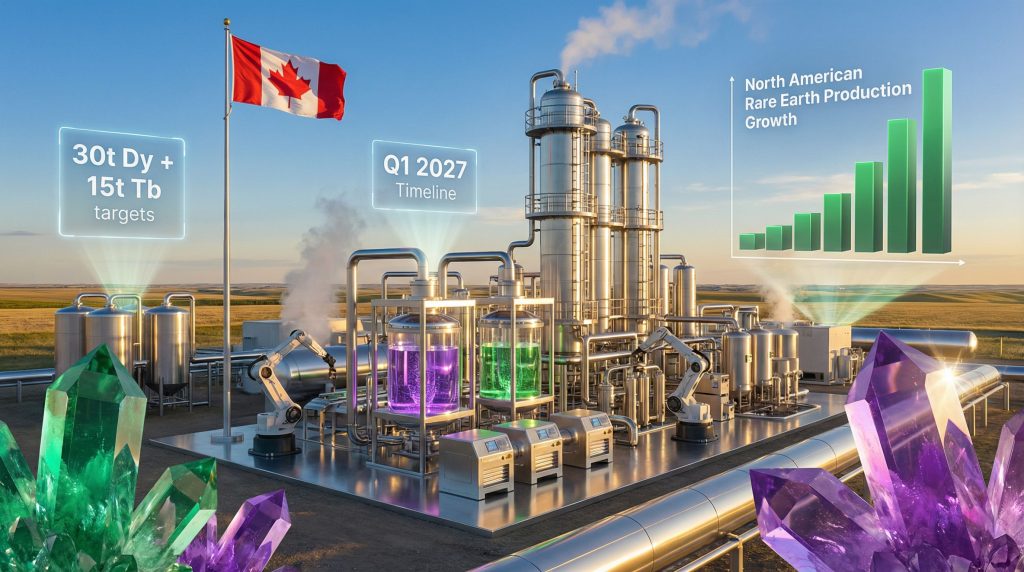
- Dysprosium oxide: 30 tonnes
- Terbium oxide: 15 tonnes
These capacity levels would establish Saskatchewan as the largest heavy rare earth oxide producer in North America, assuming successful commissioning and ramp-up execution by early 2027.
Processing efficiency metrics require optimisation across multiple variables including feed preparation, extraction circuit design, and metal reduction processes. Typical commercial solvent extraction plants achieve dysprosium oxide recovery rates of 85-92% from prepared feed material, while terbium extraction efficiency commonly ranges 80-88%. Saskatchewan's deployment of artificial intelligence optimisation systems targets improvement beyond these industry benchmarks, though specific performance data remains proprietary.
Competitive Landscape Mapping
MP Materials Corporation operates the Mountain Pass rare earth mine in California and continues developing downstream separation capabilities. The company's vertical integration strategy encompasses mining, concentration, separation, and eventual magnet production, representing a comprehensive mine-to-magnet approach. However, MP Materials' heavy rare earth production timeline extends into 2027-2028, providing Saskatchewan with potential first-mover advantages in North American markets.
Lynas Rare Earths Limited maintains separation capacity in Malaysia and has announced plans for U.S. expansion through partnerships with domestic entities. Consequently, the company's Blue Line Corporation joint venture targets separation capacity development in Texas, though regulatory approvals and facility construction timelines remain uncertain. Lynas' established operational experience provides competitive advantages, while geographic concentration in Southeast Asia creates supply chain vulnerabilities that North American facilities can address.
Emerging processing capabilities in Brazil centre around monazite-bearing heavy mineral sands deposits along the country's Atlantic coast. Brazilian rare earth projects remain in early development phases, with no verified commercial heavy rare earth production timelines currently available. Similarly, greenland critical minerals developments face regulatory constraints related to uranium and thorium processing in monazite ores, limiting near-term production prospects.
| Facility | Location | Heavy REE Capacity | Timeline | Integration Level |
|---|---|---|---|---|
| SRC Saskatoon | Canada | 30t Dy, 15t Tb | Q1 2027 | Midstream-focused |
| MP Materials | California | TBD | 2026-2027 | Mine-to-magnet |
| Lynas/Blue Line | Texas | Planned | 2027+ | Separation-focused |
What Are the Investment Implications of Saskatchewan's REalloys Partnership?
Capital Allocation and Funding Structure
Capital expenditure requirements for Saskatchewan heavy rare earth expansion total approximately $21 million USD, representing efficient capital deployment relative to integrated mining and processing projects. This capex allocation focuses on separation circuit expansion, metallurgical equipment installation, and facility modifications necessary to achieve target production capacities.
REalloys partnership structure provides both financial backing and strategic integration across the rare earth value chain. The company brings upstream resource control through the Hoidas Lake project, midstream processing partnerships with Saskatchewan Research Council, and downstream magnet materials operations in Ohio. This vertical integration strategy reduces counterparty risk while enabling margin capture across multiple value chain segments.
Return on investment projections depend heavily on heavy rare earth pricing stability and successful production ramp-up execution. At current market prices, Saskatchewan's targeted dysprosium and terbium oxide production could generate annual revenues of $20-25 million, suggesting attractive returns on the $21 million capex investment, assuming successful commissioning and market access.
Government support mechanisms include federal and provincial funding programs targeting critical minerals strategic reserve development. Canada's Critical Minerals Strategy allocates significant resources toward midstream processing capabilities, while Saskatchewan's economic development incentives provide additional project support. These programs reduce project financing risk and improve overall investment returns.
Feedstock Security and Logistics Analysis
Hoidas Lake resource characteristics provide REalloys with upstream supply control supporting Saskatchewan's processing operations. The deposit contains light rare earth-enriched monazite, though heavy rare earth content requires careful evaluation to ensure adequate dysprosium and terbium recovery rates. Furthermore, monazite typically yields approximately 15-20% heavy rare earths as a percentage of total rare earth content, necessitating substantial feed volumes to achieve target production levels.
Monazite processing advantages include higher heavy rare earth concentrations compared to bastnaesite deposits, improving extraction economics for dysprosium and terbium production. However, monazite processing also requires handling of thorium and uranium byproducts, adding regulatory complexity and disposal costs to operations. Saskatchewan's established nuclear industry infrastructure provides potential advantages in managing these radioactive materials.
Transportation infrastructure connecting northwestern Saskatchewan resource areas to Saskatoon processing facilities requires careful logistics coordination. Road, rail, and potentially air transport options must accommodate both concentrate delivery and finished product shipment to North American customers. Transportation costs represent a meaningful component of total processing economics, particularly for high-value, low-volume heavy rare earth oxides.
Which Market Forces Drive Heavy REE Demand Growth?
Electric Vehicle and Renewable Energy Sectors
Permanent magnet motor requirements in electric vehicles and wind turbines create sustained demand for dysprosium and terbium additives. These materials enable permanent magnets to maintain performance at elevated temperatures, crucial for automotive applications where motor efficiency directly impacts vehicle range and performance. Global EV sales growth targeting 50+ million annual units by 2030 translates into substantial permanent magnet demand growth.
Dysprosium content optimisation in permanent magnet formulations balances performance requirements against material costs. Typical NdFeB magnets for automotive applications contain 2-6% dysprosium by weight, with higher-temperature applications requiring increased dysprosium content. This relationship creates direct correlation between EV market growth and heavy rare earth demand, supporting long-term market expansion prospects.
Wind turbine permanent magnet systems represent another significant demand driver for heavy rare earth oxides. Direct-drive wind turbine generators utilise large permanent magnets containing substantial quantities of dysprosium and terbium to maintain efficiency in variable operating conditions. Global wind power capacity additions exceeding 100 GW annually create consistent demand for these critical materials.
Supply chain localisation trends in clean energy manufacturing drive preference for domestically sourced rare earth materials. Automotive manufacturers increasingly prioritise supply chain security and traceability, creating market opportunities for Saskatchewan heavy rare earth expansion projects that can demonstrate reliable delivery and quality control.
Defence and Aerospace Applications
Critical material requirements for military systems establish consistent demand largely independent of economic cycles. Defence applications including radar systems, electronic warfare equipment, and precision guidance systems require materials meeting stringent purity and traceability standards. These specifications often command premium pricing of 20-50% above commercial-grade materials.
Export control implications affecting rare earth materials create preferences for allied-nation sourcing in defence supply chains. For instance, U.S. defence contractors must navigate International Traffic in Arms Regulations (ITAR) and Export Administration Regulations (EAR) when sourcing critical materials, creating advantages for Canadian suppliers operating under established defence cooperation agreements.
Long-term contract structures in defence procurement typically include multi-year purchase commitments with price escalation mechanisms. These agreements provide revenue predictability that supports project financing and enables suppliers to invest in capacity expansion. Defence customers also often provide technical specifications and quality requirements that create barriers to entry for new suppliers.
What Execution Risks Could Impact Saskatchewan's Timeline?
Technical and Operational Challenges
Artificial intelligence-driven solvent extraction systems represent advanced but unproven technology in commercial rare earth processing applications. While AI optimisation offers potential efficiency improvements, system commissioning and troubleshooting may require extended timelines compared to conventional processing equipment. Backup systems and contingency planning become critical for meeting production commitments.
Scaling from pilot to commercial production volumes often reveals unexpected technical challenges in rare earth processing operations. Feed preparation, extraction circuit optimisation, and product purification systems must demonstrate consistent performance at target production rates. Historical industry experience suggests 6-12 month commissioning periods for complex rare earth processing facilities.
Quality control and metallurgical consistency requirements demand rigorous process control across all production stages. Heavy rare earth customers, particularly in defence applications, require materials meeting exact purity specifications with comprehensive documentation and traceability. Consequently, developing and maintaining these quality systems adds complexity and cost to operations.
Project success depends on managing technical risks through comprehensive testing, experienced operational teams, and flexible contingency planning that accounts for commissioning delays and performance optimisation requirements.
Market and Financial Risk Factors
Heavy rare earth price volatility creates both opportunity and risk for Saskatchewan operations. While current pricing supports attractive project returns, market corrections could significantly impact profitability, particularly during initial production phases when costs remain elevated. Hedging strategies and flexible cost structures become essential risk management tools.
Competition from recycling and alternative materials may constrain long-term demand growth for primary heavy rare earth production. Permanent magnet recycling capabilities continue expanding, while research into alternative magnet chemistries progresses. These developments could alter demand projections and pricing assumptions underlying project economics.
Regulatory changes affecting critical mineral classifications could impact government support programmes and customer preferences. Shifts in trade policy, defence procurement regulations, or environmental standards may create unexpected challenges or opportunities for Saskatchewan heavy rare earth expansion projects.
How Does This Development Reshape North American Critical Mineral Strategy?
Geopolitical Implications
Reduced dependence on concentrated processing capabilities strengthens North American supply chain resilience across multiple critical mineral sectors. Saskatchewan's heavy rare earth processing capacity provides alternatives to established supply networks, reducing systemic risks associated with geographic concentration and improving strategic material security.
Canada-U.S. critical mineral cooperation frameworks facilitate cross-border investment and technology sharing in rare earth processing development. The United States-Mexico-Canada Agreement (USMCA) includes provisions supporting critical mineral trade, while bilateral defence cooperation agreements enable technology transfer and joint development programmes.
Impact on global rare earth trade flows may extend beyond North American markets as other regions evaluate supply chain security strategies. European CRM facility policies increasingly emphasise diversification away from concentrated supply sources, creating potential export opportunities for Saskatchewan heavy rare earth production.
Industry Consolidation Trends
Vertical integration strategies across rare earth supply chains reflect efforts to capture value and reduce counterparty risks. Companies controlling upstream resources, midstream processing, and downstream manufacturing achieve competitive advantages through supply security and margin optimisation. Saskatchewan's position within REalloys' integrated strategy exemplifies this industry trend.
Joint venture structures and strategic partnerships enable risk sharing and capital efficiency in rare earth development projects. Technology licensing agreements, offtake partnerships, and equipment supply relationships distribute project risks while preserving value creation opportunities. These structures become particularly important for complex processing facilities requiring specialised expertise.
Technology licensing and knowledge transfer opportunities emerge as Saskatchewan demonstrates commercial-scale heavy rare earth processing capabilities. However, successful operations may generate intellectual property licensing revenues while supporting capacity expansion at other North American facilities.
The next major ASX story will hit our subscribers first
What Should Investors Monitor for Saskatchewan Heavy REE Success?
Key Performance Indicators
Production ramp-up milestones provide objective measures of project execution progress. Target production rates for dysprosium oxide, terbium oxide, and neodymium-praseodymium metal must be achieved within planned timelines to maintain project economics. Monthly production reporting and capacity utilisation metrics offer transparency into operational performance.
Offtake agreement execution demonstrates commercial viability and market acceptance of Saskatchewan's heavy rare earth production. Contract fulfilment rates, customer satisfaction metrics, and repeat purchase agreements indicate sustainable business operations. Furthermore, diversification across multiple end-use sectors reduces customer concentration risks.
Cost per kilogram metrics compared to global benchmarks determine long-term competitive positioning. Production costs including raw materials, energy, labour, and overhead expenses must remain competitive with alternative supply sources. Regular cost reporting and efficiency improvement programmes support margin optimisation.
Market Development Catalysts
U.S. defence procurement contract awards validate market demand for North American heavy rare earth supply. Multi-year defence contracts provide revenue visibility and support capacity expansion planning. These agreements often include pricing premiums that improve project economics relative to commercial sales.
Electric vehicle manufacturer supply agreements connect Saskatchewan production to rapidly growing automotive markets. Long-term offtake contracts with major OEMs provide demand security while supporting facility expansion financing. Automotive quality certifications and supply chain integration become critical success factors.
Technology licensing deals with other North American facilities create additional revenue streams while expanding market presence. Successful Saskatchewan operations may generate intellectual property licensing opportunities, equipment supply contracts, and consulting services revenue from other rare earth development projects.
What will Saskatchewan's heavy rare earth production reach commercial scale?
Target timeline indicates early 2027 for full dysprosium and terbium oxide production, coinciding with implementation of U.S. defence sourcing regulations favouring allied-nation suppliers.
How does Saskatchewan's approach differ from other Western rare earth projects?
Focus on midstream processing with established technology provides faster path to market and lower capital requirements compared to integrated mining and processing developments.
What makes heavy rare earths strategically important?
Dysprosium and terbium enable high-performance permanent magnets in defence systems, electric vehicles, and renewable energy applications, with limited global supply sources outside of concentrated processing regions.
Conclusion: Saskatchewan's Position in the Global Heavy REE Landscape
Strategic Value Assessment
Integration of processing capability with North American resource base creates synergies supporting long-term industry development. Saskatchewan's midstream focus complements upstream mining industry evolution projects and downstream manufacturing capabilities, building comprehensive supply chain infrastructure. This integrated approach reduces systemic risks while capturing value across multiple segments.
Timing alignment with regulatory and market demand drivers positions Saskatchewan to benefit from structural shifts in critical mineral procurement. Defence sourcing regulations, automotive supply chain localisation, and renewable energy growth create sustained demand for reliable heavy rare earth supply sources.
Risk-adjusted return potential for stakeholders depends on successful execution of technical, operational, and commercial objectives. The project's capital efficiency, market positioning, and government support provide favourable risk-reward characteristics relative to larger integrated development projects.
Long-term Industry Impact
Precedent for government-industry collaboration in critical minerals development demonstrates viable models for public-private partnership structures. Saskatchewan's approach combines research institution expertise, private sector financing, and government policy support to achieve strategic objectives while maintaining commercial viability.
Technology transfer opportunities across North American rare earth processing facilities may accelerate industry development and cost reduction. Additionally, the critical minerals energy transition requires successful Saskatchewan operations that could provide templates for similar facilities in other jurisdictions, expanding processing capacity and supply chain resilience.
Foundation for expanded rare earth processing ecosystem supporting multiple end-use industries and creating economic development opportunities. Saskatchewan heavy rare earth expansion establishes infrastructure and expertise that can support future capacity additions and technology development programmes.
Disclaimers: This analysis contains forward-looking statements and projections based on current market conditions and publicly available information. Actual results may differ materially from projections due to market volatility, technical challenges, regulatory changes, and other factors beyond the control of project participants. Readers should conduct independent research and consult qualified professionals before making investment decisions.
Ready to Capitalise on Critical Minerals Opportunities?
Discovery Alert's proprietary Discovery IQ model delivers real-time alerts on significant ASX mineral discoveries, instantly empowering subscribers to identify actionable opportunities ahead of the broader market. Discover why historic discoveries can generate substantial returns by exploring Discovery Alert's dedicated discoveries page, showcasing exceptional outcomes from major mineral finds.