July 25, 2026
The Geography of Coercion: Why Force Alone Cannot Solve Hormuz
Every major energy disruption in modern history has ultimately been resolved not by the side with the most firepower, but by the side that best understood the physical and political terrain. The Strait of Hormuz presents precisely this kind of challenge, one where conventional military superiority collides with asymmetric geography, producing a strategic stalemate that analysts now widely acknowledge cannot be broken through force alone.
Understanding why military action will not reopen Hormuz requires stepping back from the immediate conflict and examining the structural conditions that make this waterway uniquely resistant to military solutions. The crude oil market dynamics at play here are unlike those of any previous energy crisis.
When big ASX news breaks, our subscribers know first
The Strait of Hormuz: Energy's Most Consequential Bottleneck
The numbers alone convey the stakes. Under normal operating conditions, roughly 20 to 21 percent of global oil consumption moves through the Strait of Hormuz every single day. Qatar, the UAE, and Kuwait depend almost entirely on Hormuz access to export their LNG volumes. When traffic through this 33-kilometre-wide chokepoint falters, the consequences cascade outward almost immediately, hitting Asian refining margins, European spot pricing, and global freight benchmarks in sequence.
What makes Hormuz uniquely dangerous from a strategic standpoint is not just its traffic volume, but its physical structure. The strait's narrow navigable width inherently favours a defender seeking to disrupt rather than an attacker seeking to clear. Iran's extensive coastline on the northern shore provides layered, redundant positions from which asymmetric assets can be deployed, repositioned, and redeployed repeatedly.
This is not a new dynamic. During the so-called Tanker War of the 1980s, sustained naval escort operations by multiple Western powers failed to eliminate attrition risk entirely. Vessels were still struck, insurers still repriced risk, and commercial operators still factored threat probability into their routing decisions. The lesson from that period, which remains directly applicable today, is that even superior naval forces cannot guarantee safe passage when the opposing force has sufficient dispersal and replenishment capacity.
Iran's Asymmetric Toolkit: Why Small Forces Impose Large Costs
A core misconception about the current crisis is that Iran requires large, conventional military formations to deny commercial shipping access through Hormuz. It does not. The cost asymmetry between mounting a disruption and defending against one overwhelmingly favours the aggressor in this specific geography.
Iran's asymmetric capabilities operate across three reinforcing layers:
| Capability Type | Operational Role | Why It Resists Degradation |
|---|---|---|
| Fast Attack Craft | Swarming, harassment, and boarding operations against commercial vessels | Dispersed, easily concealed, rapidly replaceable |
| Anti-Ship Cruise Missiles | Shore-launched strikes capable of reaching targets throughout the strait | Mobile launchers with redundant firing positions |
| Drone Systems | Low-cost, expendable platforms deployable in mass | Volume of deployment offsets individual interception |
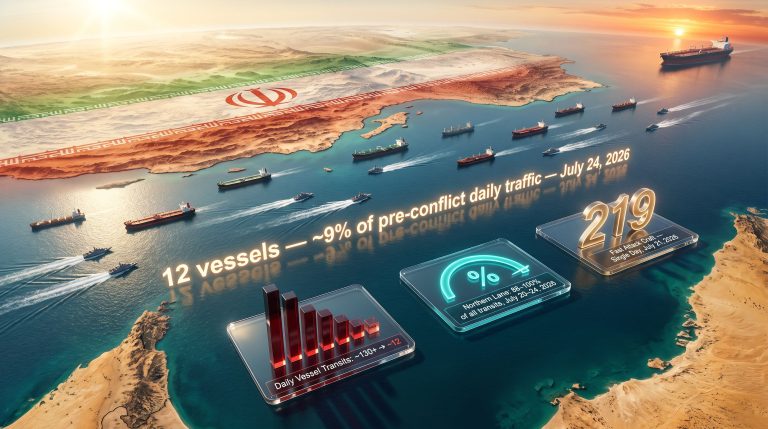
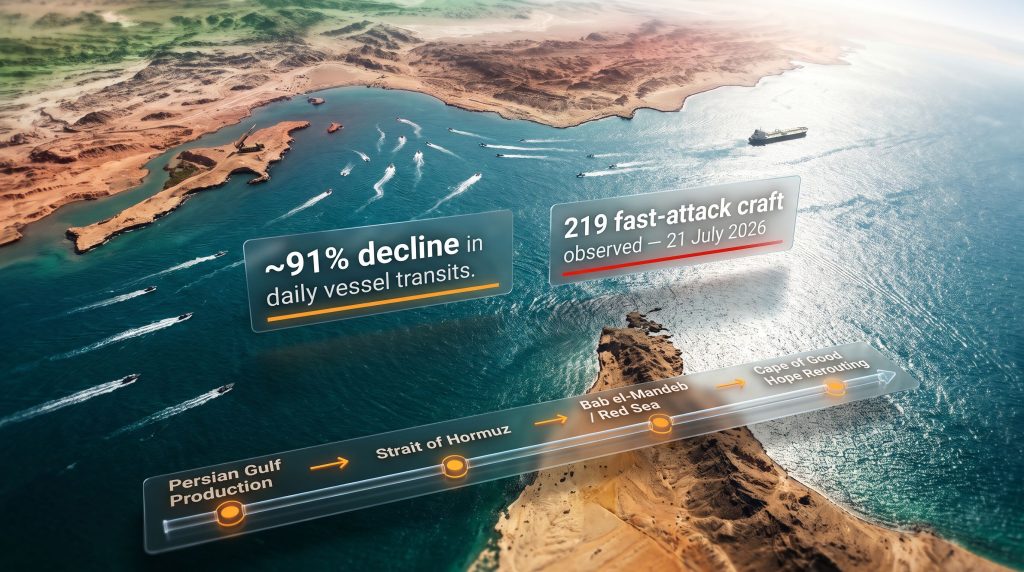
Maritime security tracking recorded 219 fast-attack craft operating within the strait on a single day in late July 2026, the highest single-day count since mid-May 2026. This figure is analytically significant not because it indicates an imminent mass assault, but because it illustrates the scale of the presence Iran can maintain at relatively low operational cost.
The critical threshold to understand here is that Iran does not need to actually sink vessels to achieve its strategic objective. It only needs to maintain a probability of interdiction high enough that commercial insurers, shipowners, and charterers treat the route as unacceptably risky. Independent defence research, including analysis from the Center for Naval Analyses (CNA), a nonprofit research organisation that advises US military forces, has concluded that absent a large-scale ground operation, no military solution exists that removes Iran's capacity to coerce commercial traffic through the strait.
Even a 10 to 15 percent probability of vessel interdiction is sufficient to collapse commercial confidence and trigger mass rerouting. This threshold is far below total capability elimination, which is the only outcome that military strikes could theoretically produce. Furthermore, the geopolitical trade tensions surrounding this crisis add further complexity to any proposed military response.
Four Military Scenarios: Why None Produces Durable Normalisation
Scenario analysis reveals why the range of plausible military options all fall short of restoring commercial shipping flows:
-
Targeted strikes on asymmetric assets: Temporarily reduces specific platforms but leaves Iran's reconstitution capacity intact. Escalation risk to broader regional conflict is significant, and commercial confidence does not recover from temporary degradation.
-
Sustained naval escort operations: Some vessels can transit under protection, but pre-conflict traffic volumes ran at roughly 130 to 140 vessels per day. Escort capacity cannot scale to match this volume, making the operation operationally unsustainable at commercial scale.
-
Massive ground invasion or regime change operation: Theoretically eliminates the threat at source, but the military, humanitarian, and economic costs render this option politically infeasible under any realistic planning horizon.
-
Diplomatic settlement backed by military pressure: Reduces Iran's motivation to disrupt rather than its capability. Historical precedent from contested maritime corridors consistently shows that negotiated frameworks outlast military clearance operations in terms of durability.
Reducing Iran's incentive to disrupt shipping through diplomatic engagement may be structurally easier to achieve than eliminating the physical capability to do so. This distinction shapes every viable policy option currently on the table.
The shipping industry body BIMCO communicated this distinction clearly at the outset of the current conflict, noting that addressing Iran's motivation to attack may prove more tractable than attempting to comprehensively degrade its ability to do so.
Traffic Data: What the Numbers Reveal About Iranian Tactical Success
Vessel traffic statistics from late July 2026 provide a stark quantitative picture of how thoroughly Iran has disrupted commercial shipping without needing to physically intercept every vessel.
| Metric | Pre-War Baseline | Late July 2026 | Change |
|---|---|---|---|
| Daily vessel transits | ~130-140 vessels | ~12 vessels | ~91% decline |
| Northern lane traffic share | ~50% (balanced) | 88-100% | Full concentration |
| Fast attack craft observed (21 July 2026) | Normal baseline | 219 craft | Significant surge |
| Traffic on northern Iranian lane (24 July) | Partial | 100% of transits | Complete lane dominance |
The lane concentration data is particularly revealing. The migration of virtually all remaining commercial traffic to the northern, Iranian-controlled traffic lane is not accidental. It reflects a successful coercion strategy that has pushed operators away from alternative routing options. Vessels choosing the northern lane are implicitly accepting Iranian oversight as the least-bad option available to them, a form of de facto traffic control that does not require physical interdiction to function.
According to vessel tracking data from Windward, all vessels that transited the strait on 24 July 2026 did so exclusively via the northern Iranian-controlled lane, with total daily transits numbering just 12, representing approximately 9 percent of pre-conflict levels.
The Insurance Market as an Early Warning System
War risk insurance premiums function as a leading indicator that often precedes and amplifies physical disruption. When premiums surge, operators begin cancelling voyages before any additional strikes occur, because the economics of transit become untenable. This dynamic acts as a force multiplier for Iran's coercive strategy: the threat itself imposes costs that no additional military action is required to generate.
War risk premiums for both Hormuz and Red Sea transits rose sharply in late July 2026 as insurers reassessed their exposure following renewed regional escalation. This repricing compresses charterer margins, elevates delivered crude costs for Asian refiners, and reinforces the rerouting incentives that are already reshaping global tanker flows. The broader oil market trade war impact has similarly amplified these pricing pressures across multiple regions simultaneously.
The Red Sea Dimension: How Houthi Activity Compounds Hormuz Pressure
The Hormuz crisis does not exist in isolation. Houthi activity in the Red Sea and Bab el-Mandeb strait has created a second pressure point that compounds the disruption emanating from the Persian Gulf, effectively creating a dual-chokepoint constraint on global energy supply chains.
The flow of compounding disruption can be mapped as follows:
- Persian Gulf Production
- → Strait of Hormuz — Iranian Coercion
- → Arabian Sea / Indian Ocean
- → Bab el-Mandeb / Red Sea — Houthi Coercion
- → Suez Canal / Cape of Good Hope Rerouting
- → European and Asian Refining Markets
The practical consequences are already visible in fixture data. South Korea's SK Energy booked the VLCC DHT Stallion to carry Saudi crude from Egypt's Mediterranean coast at Sidi Kerir to South Korea via the Cape of Good Hope, entirely bypassing the Red Sea and Bab el-Mandeb. The lumpsum freight cost was fixed in the range of $17 to $18.5 million, broadly comparable to standard Bab el-Mandeb routing rates, but the Cape route adds approximately 30 days to the voyage and substantially reduces daily vessel earnings.
Meanwhile, divergent national risk assessments are producing varied operator behaviour. Chinese-flagged VLCCs, including the Cosco-owned Cosnew Lake and Xin Long Yang, continued transiting Bab el-Mandeb carrying Saudi crude despite the Houthi ban on Saudi-linked shipping. Other vessels, including the VLCC Sophia and New Explorer, halted AIS transmission or reversed course entirely, reflecting the uncertainty and risk calculus that individual shipowners must navigate in real time.
The next major ASX story will hit our subscribers first
Why Diplomacy Is the Only Durable Pathway, and Why It Is Difficult
The consensus position among defence analysts and maritime security researchers is consistent: military action will not reopen Hormuz on a durable basis. The only pathway to commercial shipping normalisation runs through a negotiated political settlement. OPEC market influence over production decisions will also play a meaningful role in shaping whatever diplomatic framework ultimately emerges.
A viable diplomatic framework would need to incorporate several interlocking elements:
- A verifiable ceasefire mechanism with credible third-party monitoring capacity
- Phased sanctions relief tied to measurable reductions in Iran's maritime threat posture
- Regional security guarantees involving Gulf Cooperation Council member states
- A commercial shipping confidence restoration mechanism that can operate independently of full political normalisation
The structural challenge is that diplomatic processes operate on timelines measured in months to years, while energy markets, freight operators, and insurance underwriters make decisions on timelines measured in days to weeks. This mismatch creates a persistent gap that partial naval escort operations can bridge temporarily, but cannot close permanently.
Iran has historically linked strait access to broader geopolitical concessions, including sanctions relief, security guarantees, and recognition of its regional influence. Any negotiated resolution will need to address these underlying motivations rather than simply seeking tactical compliance. As reported by the Council on Foreign Relations, the unravelling of previous Iran agreements continues to complicate the prospects for near-term diplomatic progress.
Strategic Implications: Freight, Benchmarks, and Long-Term Structural Shifts
The commodity price impacts of a prolonged Hormuz disruption extend well beyond immediate freight rates, reshaping investment decisions across entire sectors of the global economy.
Short-term impacts:
- Sustained upward pressure on freight rates across all vessel classes serving the Persian Gulf
- Widening price differentials for Middle Eastern crude grades as buyers price supply uncertainty into bids
- Compression of Asian refining margins as elevated delivered costs reduce crack spread profitability
Medium-term structural shifts:
- Accelerated drawdowns of strategic petroleum reserves in OECD economies
- Increased term contracting for Atlantic Basin and West African crude as a supply hedge
- Cape of Good Hope routing transitioning from an emergency contingency to a baseline planning assumption for certain trade lanes
Long-term geopolitical consequences:
- The episode reinforces the demonstrated limits of conventional military deterrence against asymmetric maritime coercion
- Import-dependent economies face structural pressure to accelerate energy diversification and domestic production development
- Existing maritime security frameworks for contested waterways face pressure to be redesigned in light of Iran's demonstrated capability and strategic resolve
Frequently Asked Questions: Strait of Hormuz and Military Action
Can military force forcibly reopen the Strait of Hormuz?
Military operations can degrade specific Iranian assets and provide escort protection for individual vessels, but independent defence analysis consistently concludes that no operation short of a large-scale ground invasion can reliably eliminate Iran's capacity to threaten commercial shipping. The dispersed, redundant, and low-cost nature of Iran's asymmetric toolkit makes comprehensive degradation operationally implausible.
How much global oil supply transits Hormuz?
Approximately one-fifth of global daily oil consumption passes through the strait under normal conditions, along with significant LNG volumes. No viable large-scale alternative routing exists for Persian Gulf producers, making this the single most concentrated energy transit point on the planet.
What percentage of normal vessel traffic is currently transiting?
Data from late July 2026 shows daily transits have fallen to approximately 9 percent of pre-conflict levels, with all remaining transits concentrated in the northern, Iranian-controlled traffic lane.
What is Iran's most effective disruption tool?
The combination of fast attack craft, anti-ship cruise missiles, and drone systems provides a low-cost, high-redundancy disruption capability. The minimal force required to impose unacceptable risk on commercial operators constitutes Iran's primary strategic advantage in this theatre.
Is a diplomatic solution realistic?
Analysts broadly agree that a negotiated settlement represents the only pathway to durable normalisation, but the complexity of the required framework — spanning sanctions relief, security guarantees, and regional power dynamics — makes near-term resolution unlikely. Military action will not reopen Hormuz through sheer force alone, and military pressure may generate negotiating leverage, but it cannot substitute for the political process itself.
This article is intended for informational purposes only and does not constitute financial, investment, or trading advice. Forward-looking assessments regarding geopolitical outcomes, freight markets, and energy pricing are inherently uncertain and subject to rapid change. Readers should consult qualified professionals before making decisions based on any market or geopolitical analysis contained herein.
Want to Stay Ahead of the Commodity Market Disruptions Reshaping Global Energy?
When geopolitical crises like the Strait of Hormuz closure send shockwaves through commodity markets, Discovery Alert's proprietary Discovery IQ model delivers real-time alerts on significant ASX mineral discoveries, helping investors identify actionable opportunities before the broader market reacts — explore the historic returns major discoveries have generated and begin your 14-day free trial today to position yourself ahead of the next market-moving event.