July 25, 2026
When Supply Chains Fracture: The New Logic of Pacific Oil Trade
The global energy system is frequently described as interconnected, but that interconnection is not inherently resilient. It is, in many cases, a web of concentrated dependencies that can unravel with alarming speed when geopolitical stress is applied. The Cosmo Oil tanker delivers first Mexican crude to Japan as a direct consequence of precisely this kind of fracture — a crisis-driven recalibration that has forced Asian energy buyers to reopen trade lanes dormant for nearly three years.
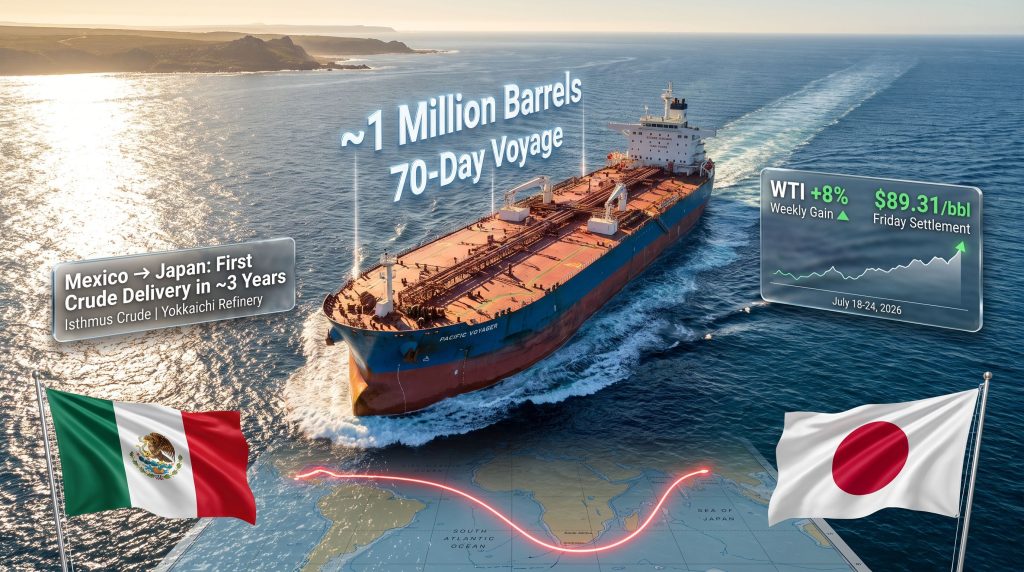
Against this backdrop, the arrival of a Cosmo Oil tanker carrying approximately one million barrels of Mexican Isthmus crude at Japan's Yokkaichi refinery in mid-July 2026 carries significance that extends well beyond the cargo manifest. It represents a deliberate, operationally complex response to a shifting threat environment, one that has forced Japanese energy security planners to act with urgency.
When big ASX news breaks, our subscribers know first
Japan's Hormuz Dependency: A Structural Vulnerability Laid Bare
Japan imports somewhere between 80 and 90 percent of its crude oil from Middle Eastern producers, a concentration that has made it one of the most geopolitically exposed refining economies in the Asia-Pacific region. This dependency is not the product of negligence. It reflects decades of contract structures, refinery configurations optimised for Gulf crude grades, and the historical price competitiveness of Middle Eastern supply.
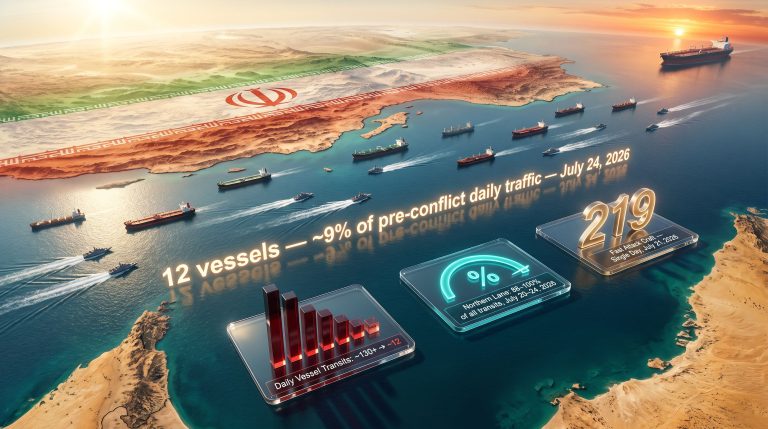
However, the outbreak of US-Israeli military conflict with Iran in late February 2026 introduced a qualitatively different level of risk to this arrangement. The Strait of Hormuz, through which approximately 20 percent of global oil supply transits daily, became a corridor of acute uncertainty. For Japanese refiners bound by long-term supply agreements with Gulf producers and lacking immediate alternative supply infrastructure, the crisis reactivated contingency planning at the highest levels of government.
Japan's Ministry of Economy, Trade and Industry confirmed the strategic significance of the Cosmo Oil shipment, a detail that signals this is not merely a commercial transaction but an energy security event being tracked and encouraged at the policy level.
Why This Crisis Is Different from Previous Hormuz Threats
Japan has navigated Middle Eastern supply disruptions before. The 1973 oil embargo fundamentally reshaped Japanese energy policy, prompting decades of strategic reserve building and efficiency investment. The 2019 Gulf tanker attacks elevated risk premiums but did not materially alter supply flows.
The 2026 Iran conflict is different in character because it involves direct military engagement by two of the region's most significant actors. Furthermore, this creates uncertainty not just about transit safety but about the longer-term viability of Gulf supply contracts themselves. This has accelerated a shift from supply diversification as a strategic aspiration to supply diversification as an operational necessity — a dynamic consistent with broader oil market disruption trends observed across global energy markets in 2025 and 2026.
The Cosmo Oil Shipment: Parameters, Route, and What They Reveal
The mechanics of this particular delivery are as instructive as the fact of its occurrence. Understanding the operational decisions embedded in the shipment illuminates how Asian energy buyers are recalculating risk in real time.
| Shipment Parameter | Detail |
|---|---|
| Cargo Volume | Approximately 1 million barrels |
| Crude Type | Isthmus crude (Mexican medium-sour grade) |
| Origin | Gulf of Mexico |
| Transit Route | Cape of Good Hope, southern Africa |
| Estimated Transit Duration | Approximately 70 days |
| Primary Destination | Yokkaichi Refinery, central Japan |
| Secondary Destination | Chiba Refinery, near Tokyo |
| Confirming Authority | Japan's Ministry of Economy, Trade and Industry |
The routing decision is particularly telling. Rather than using the Suez Canal, which would have involved transit through the Red Sea and proximity to Persian Gulf conflict zones, the vessel navigated around the southern tip of Africa. This added weeks to the journey and meaningfully increased freight costs, yet the decision was made deliberately.
This is the calculus of supply security: absorbing a higher per-barrel logistics cost in exchange for eliminating exposure to maritime chokepoints that have become operationally unpredictable. As this logic spreads across Asian refining markets, it is reshaping global tanker demand patterns and creating sustained support for longer-haul trade routes that were previously considered economically marginal. According to reporting from Reuters, this shipment marks the first Mexican crude cargo Japan has received since the start of the Iran war.
Understanding Isthmus Crude: The Grade Behind the Headline
Not all crude oil is interchangeable, and the selection of Isthmus crude for this shipment carries technical significance. Isthmus is a medium-sour grade, meaning it has a moderate API gravity and a sulphur content that places it above the threshold for classification as sweet crude. Processing medium-sour grades requires refineries equipped with hydrodesulphurisation units and secondary conversion capacity.
Both the Yokkaichi and Chiba refineries operated by Cosmo Oil are configured as complex refining facilities, making them capable of efficiently processing higher-sulphur feedstocks. This refinery-to-crude compatibility is a prerequisite for any sustained trade relationship, not something that can be assumed across the Japanese refining sector broadly. The fact that Cosmo Oil was positioned to receive and process this grade without significant reconfiguration cost is itself a non-trivial piece of supply chain intelligence.
One Million Barrels: Modest in Volume, Significant in Meaning
Taken in isolation, approximately one million barrels represents roughly 0.3 days of Japan's total domestic crude consumption. It would not move the needle on inventory levels or supply adequacy in any material sense. This is where the distinction between volumetric significance and strategic significance becomes essential.
Supply diversification decisions are rarely evaluated on barrel count alone. The re-establishment of a trade lane carries long-term optionality value that is entirely disproportionate to the initial cargo volume.
What this shipment accomplishes beyond its immediate volume:
- Route validation confirms that the Cape of Good Hope transit from the Gulf of Mexico to Japanese ports is operationally feasible at acceptable cost
- Commercial relationship reactivation brings Mexico's state oil company PEMEX back into active engagement with Asia-Pacific buyers after a multi-year absence
- Refinery compatibility confirmation generates performance data on how Isthmus crude processes at Yokkaichi and Chiba under current operational conditions
- Geopolitical signalling publicly demonstrates Japan's capacity to diversify supply sources, communicating supply chain agility to domestic stakeholders and international partners alike
Each of these outcomes has compounding value if sustained trade flows follow. None of them would have been achieved without the initial shipment occurring.
PEMEX's Export Paradox: Revenue Opportunity Constrained by Structure
For Mexico, the arrival of the Cosmo Oil tanker represents an opportunity to re-establish commercial relationships in a high-demand market at a moment when global crude prices are elevated. However, PEMEX's ability to capitalise on this moment is constrained by structural tensions that have been building for years.
Mexico's national oil company operates under a dual mandate that simultaneously prioritises domestic fuel supply and export revenue generation. As the government has expanded domestic refining capacity, most visibly through the Dos Bocas refinery development, the volume of crude available for export has faced compression. More crude processed domestically means fewer barrels available to ship to markets like Japan.
Key structural constraints limiting Mexico's crude export capacity:
- Expanded domestic refining throughput reduces export-available volumes
- Government fuel subsidies create fiscal drag that partially offsets crude revenue gains
- PEMEX's substantial legacy debt burden limits capital available for upstream production growth
- Production volumes have faced sustained pressure, constraining the total export pool
- Asia-Pacific exports have historically been intermittent, reflecting pricing and logistical challenges relative to nearer markets
The Fiscal Arithmetic: Higher Prices, Complicated Benefits
According to analysis by Banamex, if international crude prices average US$80 per barrel across 2026, Mexico could generate an estimated MX$35.2 billion (approximately US$2 billion) in additional fiscal revenue compared to baseline projections. This is a headline figure that requires significant qualification.
The net fiscal transmission is substantially moderated by three intersecting factors: reduced export volumes as domestic refining capacity absorbs more crude, fuel import subsidies that create direct fiscal costs offsetting revenue gains, and tax structure limitations that reduce the effective rate at which windfall crude revenue reaches the federal budget.
Banamex's analysis makes clear that the net fiscal benefit from elevated crude prices in 2026 is materially lower than the headline revenue figure suggests once subsidy obligations and volume reductions are incorporated into the calculation.
This fiscal complexity is not unique to the current cycle. It reflects a structural characteristic of Mexico's oil sector governance that has persisted across multiple administrations and price environments, a pattern familiar to analysts tracking crude oil market dynamics across emerging producer economies.
Brazil vs. Mexico: Two Models for Oil Wealth Capture
Understanding Mexico's position in global crude trade requires examining it against a comparative benchmark. Brazil's approach to oil sector governance offers a directly relevant contrast.
Luis Labardini, Partner at Labardini and Christlieb Energy Experts, has observed that Brazil's royalty-focused market architecture has demonstrably outperformed Mexico's state-monopoly model in capturing subsoil economic rent while simultaneously sustaining long-term energy sector investment. This is not a marginal performance gap; it reflects fundamentally different institutional designs.
| Dimension | Mexico (PEMEX-Dominant Model) | Brazil (Mixed + Royalty System) |
|---|---|---|
| Market Structure | State monopoly with limited private competition | Petrobras plus broad competitive royalty framework |
| Economic Rent Capture | Lower efficiency due to fiscal drag and subsidies | Higher efficiency via transparent royalty architecture |
| Private Sector Participation | Limited; mixed contracts under ongoing pressure | Broad; active upstream competition across basins |
| Export Diversification | Intermittent; Asia-Pacific gaps common | Consistent; growing Atlantic Basin and Asian presence |
| Long-Term Investment Trajectory | Constrained by PEMEX debt obligations | Supported by competitive capital allocation mechanisms |
The implications for Mexico's export future are direct. Without meaningful reform of upstream investment structures or expanded private sector participation frameworks, PEMEX's production capacity and therefore its export optionality will remain constrained. The Cosmo Oil tanker delivers first Mexican crude to Japan as proof of what is possible; the structural environment determines whether it can be sustained at scale.
The next major ASX story will hit our subscribers first
WTI Price Dynamics: The Market Context Behind the Shipment
The week of July 18, 2026 saw West Texas Intermediate crude futures record a cumulative eight percent weekly gain, driven by escalating geopolitical tensions in the Middle East. A three percent single-session pullback on Friday brought WTI to a settlement of $89.31 per barrel, but the weekly trajectory reflected persistent conflict-related supply risk premiums being priced into the market. These movements are consistent with the kinds of oil price shock scenarios that energy executives across the globe have been preparing for.
| WTI Price Metric | Value |
|---|---|
| Weekly Gain | +8% |
| Friday Settlement Price | US$89.31 per barrel |
| Friday Single-Day Movement | -3% |
| Primary Driver | Middle East conflict escalation |
For Mexico, elevated WTI benchmarks nominally improve both PEMEX export receipts and government oil revenue. However, as the Banamex analysis underscores, the structural filters of domestic refining absorption, fuel subsidy costs, and tax architecture mean that a $89 per barrel WTI environment does not translate linearly into fiscal improvement for the Mexican government.
This dynamic creates a situation where Mexico appears to benefit from high oil prices in headlines while the actual budget-level impact is substantially diluted. It is a fiscal irony that has frustrated policymakers and analysts across multiple price cycles.
Modular LNG: Mexico's Parallel Energy Export Frontier
Beyond crude oil, Mexico's energy export landscape is evolving to incorporate liquefied natural gas as a complementary revenue stream with different market dynamics and a different risk profile.
Jose Fernandes, LATAM President and VP/GM Energy and Sustainability Solutions at Honeywell, has highlighted that integrated modular design represents a strategic pathway for mid-scale LNG developers to manage execution risk, compress project timelines, and optimise capital expenditure in a market environment characterised by volatile commodity prices and constrained project financing.
Why integrated modular LNG design matters for mid-scale developers:
- Standardised, pre-engineered components reduce the technical complexity of on-site construction
- Pre-fabrication of modular units shortens the critical path from final investment decision to first cargo
- Capital expenditure optimisation becomes achievable through replication of proven designs across multiple project sites
- Execution risk is fundamentally reduced because novel engineering challenges are minimised
For Mexico specifically, mid-scale LNG development could provide an export channel to Asian markets, including Japan, that operates independently of crude oil price cycles and PEMEX's structural production constraints. An LNG cargo from Mexico to Japan would face different logistical economics than crude but would benefit from Japan's sustained appetite for flexible gas supply as it navigates its long-term energy transition. Furthermore, this complements the role that OPEC market influence continues to play in shaping supply decisions across the region.
The Three Strategic Signals From a Single Tanker Delivery
Synthesising the various dimensions of this development, the Cosmo Oil delivery communicates three macro-level signals for Pacific energy trade that extend well beyond the immediate transaction.
First, Atlantic Basin crude producers, including Mexico, Brazil, and US Gulf Coast exporters, are being repositioned by Asian buyers from opportunistic alternatives to strategic supply pillars. This is a durable reorientation driven by geopolitical risk, not temporary price arbitrage.
Second, long-haul routing via the Cape of Good Hope is transitioning from emergency contingency to accepted operational standard. As this norm solidifies, it will generate sustained demand for VLCC tanker capacity on long-haul routes, restructuring global shipping markets in ways that will persist well beyond any individual conflict episode. Analysis from Supply Chain Brain confirms that Japanese refiners are actively securing alternative crude sources precisely to bypass the Hormuz disruption.
Third, the conditions required for Mexico-Japan crude trade to scale from a single demonstrative shipment into a sustained commercial relationship are defined but not yet met. They require PEMEX production stabilisation, competitive crude pricing that absorbs the freight premium of the longer route, confirmed refinery compatibility at scale, and long-term offtake arrangements that provide both sides with commercial certainty.
Whether this shipment becomes the first in a sustained series or remains a geopolitically motivated one-off will depend less on market conditions and more on whether Mexico's oil sector governance creates the structural conditions for consistent export supply.
The Cosmo Oil tanker's arrival at Yokkaichi is, at its core, a story about what happens when energy security frameworks are stress-tested by real events rather than modelled scenarios. Japan moved quickly to reopen a dormant trade lane. Mexico demonstrated it retains the production and logistics capacity to serve Asian buyers. Consequently, the question now is whether both sides have the institutional infrastructure to convert a crisis-driven transaction into something more durable — and whether a single delivery truly marks the beginning of a reshaped Pacific energy order.
This article contains forward-looking analysis and references to geopolitical scenarios. Readers should be aware that energy market conditions, geopolitical developments, and fiscal projections are subject to rapid change. Nothing in this article constitutes financial or investment advice.
Want to Capitalise on the Next Major Resource Discovery Before the Market Moves?
The geopolitical shifts reshaping Pacific energy trade are a reminder that commodity supply disruptions can create significant investment opportunities — and speed is everything. Discovery Alert's proprietary Discovery IQ model scans ASX announcements in real time, delivering instant alerts on significant mineral discoveries across more than 30 commodities, so subscribers can act on actionable opportunities ahead of the broader market. Explore how historic discoveries have generated substantial returns on Discovery Alert's dedicated discoveries page, and begin your 14-day free trial today to position yourself ahead of the next major find.