July 25, 2026
The Firepower Illusion: Why Kinetic Force Cannot Unlock the World's Most Critical Energy Corridor
Every major geopolitical crisis involving the Strait of Hormuz eventually produces the same instinctive policy reflex: deploy more naval assets, conduct precision strikes, and degrade the adversary's military capacity until commercial traffic flows freely again. It is a logical framework that works well in conventional warfare. However, it fails almost completely when applied to asymmetric maritime coercion in one of the world's most geographically constrained waterways. Understanding why military action will not reopen Hormuz requires stepping back from the headlines and examining the structural mechanics of how Iran has deliberately engineered its position in the strait over several decades.
When big ASX news breaks, our subscribers know first
The Geography of Chokepoint Power
The Strait of Hormuz is not simply a transit route. At its narrowest navigable point, the strait measures approximately 33 kilometres across, channelling roughly 20% of the world's total oil supply and approximately one-third of all globally traded liquefied natural gas through a corridor barely wider than some river estuaries. The nations most exposed to disruption include China, Japan, South Korea, and India, which collectively absorb the overwhelming majority of Persian Gulf crude exports.
What makes this geography so strategically potent is not just its narrowness, but the way Iran's northern coastline dominates the primary shipping lanes. Iran does not need to physically blockade the strait to exert effective control. The combination of shallow water depths, confined navigation corridors, and Iran's extensive coastal infrastructure creates a natural force-multiplier for asymmetric tactics that renders conventional naval superiority largely irrelevant within this specific operational environment.
Furthermore, the crude oil price trends flowing from this disruption are already reshaping global energy economics in ways that extend well beyond simple supply shortfalls.
Iran has spent decades deliberately structuring its military doctrine around the strait's geography, turning a geographical constraint into a persistent geopolitical instrument.
Why Asymmetric Capabilities Cannot Be Bombed Into Irrelevance
The core analytical problem with military-first thinking on Hormuz is what analysts at the Center for Naval Analyses (CNA) describe as a fundamental threshold asymmetry. Iran does not require a large, expensive, or easily targeted military apparatus to achieve its strategic objective of disrupting commercial shipping. The volume of firepower required to meaningfully threaten vessel traffic is remarkably small compared to the firepower required to eliminate that threat entirely.
Iran's toolkit for maritime coercion includes fast attack craft, shore-launched anti-ship cruise missiles, unmanned aerial vehicles, and naval mines. Each of these systems shares a critical characteristic: they are inexpensive relative to the damage they can inflict on global commodity markets, they are highly mobile, and they can be dispersed across dozens of coastal positions, underground facilities, and concealed platforms simultaneously.
Research from the CNA indicates that removing Iran's capacity to threaten commercial shipping entirely would require something approaching a full-scale ground invasion, not airstrikes or naval interdiction operations. This is not a fringe analytical position. It reflects the operational reality that Iran has built a distributed, redundant, and continuously regenerating asymmetric warfare architecture specifically designed to survive conventional military degradation campaigns.
Consequently, understanding the broader oil market disruption context helps explain why even well-resourced military campaigns struggle to translate tactical success into strategic normalisation.
The Dispersal Problem in Practice
| Military Action Type | Likely Effectiveness Against Hormuz Disruption | Key Limitation |
|---|---|---|
| Precision airstrikes on naval infrastructure | Moderate, short-term only | Mobile assets relocate before and after strikes |
| Anti-drone and missile defence systems | Partial interdiction | Cannot intercept all simultaneous threat vectors |
| Naval convoy escort operations | Limited normalisation | Insufficient scale for full commercial traffic volume |
| Mine-clearing operations | Operationally necessary | Mines can be rapidly reseeded after clearance |
| Full-scale ground invasion | Theoretically decisive | Politically and logistically catastrophic at every level |
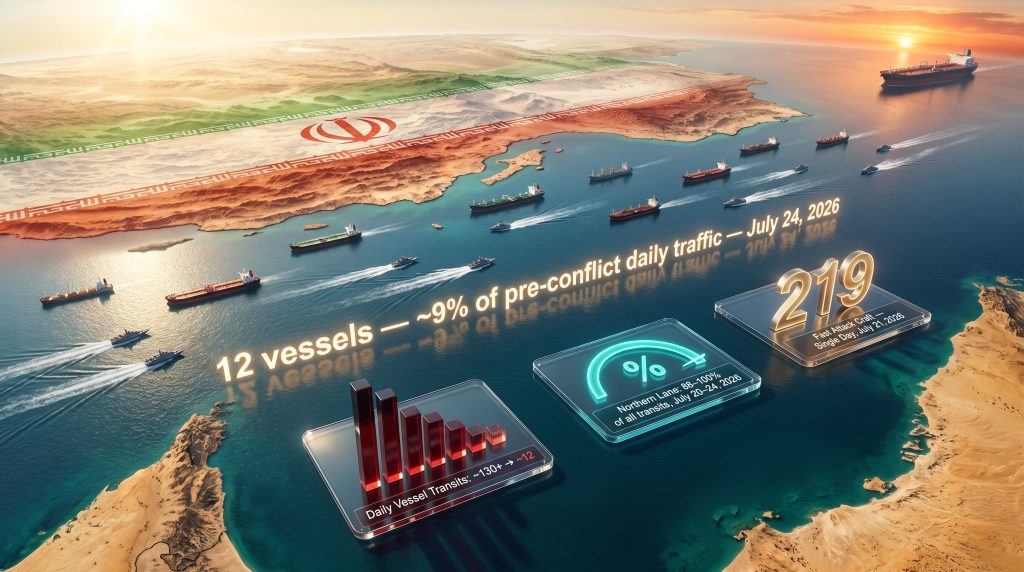
Maritime security tracking data recorded 219 fast attack craft operating within the strait on a single day in late July 2026, the highest single-day count since May of that year. That figure alone illustrates the scale of the operational challenge facing any military campaign aimed at comprehensively neutralising Iran's coercive maritime capacity.
Traffic Data Tells the Real Story
Perhaps the most revealing indicator of Iran's effective strategic success is not the number of weapons it has deployed, but the behaviour of commercial vessel operators in response to those weapons. The 2026 Strait of Hormuz crisis has produced vessel behaviour patterns that speak more clearly than any official statement.
Vessel tracking data compiled by maritime intelligence firm Windward for the period of 20 to 24 July 2026 shows a dramatic and sustained consolidation of Hormuz transit activity into the northern shipping lane, which falls under Iranian operational oversight. On any given day during that window, the northern lane carried between 88% and 100% of all transit traffic through the strait.
On 24 July 2026, every single vessel that transited the Strait of Hormuz did so via the Iranian-controlled northern lane. This represents a complete inversion of pre-conflict routing behaviour, where traffic was distributed across multiple lanes. Commercial operators are, in effect, accepting Iranian operational oversight as the price of passage.
Comparing Pre-Conflict and Current Transit Conditions
| Metric | Pre-Conflict Baseline | Late July 2026 |
|---|---|---|
| Daily vessel transits | ~130+ vessels | ~12 vessels (24 July) |
| Northern lane traffic share | Distributed across lanes | 88-100% (20-24 July) |
| Fast attack craft observed (single day) | Baseline undisclosed | 219 (21 July) |
| Commercial traffic as % of pre-conflict | 100% | ~9% |
Only 12 vessels transited the Strait of Hormuz on 24 July 2026, representing approximately 9% of pre-conflict daily traffic levels. Iran has achieved near-functional closure without issuing a formal blockade.
This data point carries a profound strategic implication. Iran has not needed to physically seal the strait. Through a combination of demonstrated willingness to attack non-compliant vessels and the concentration of remaining traffic into lanes it controls, it has achieved an outcome that is functionally equivalent to closure for the purposes of global energy supply.
The Insurance Market as a Chokepoint Within a Chokepoint
One dimension of the Hormuz crisis that receives insufficient attention in conventional military analysis is the role of war risk insurance markets in defining what it actually means for the strait to be "open." Even if a military operation were to temporarily suppress Iranian attacks, commercial shipping cannot resume at scale until war risk insurance premiums return to commercially viable levels.
Insurance underwriters do not price risk based solely on current military posture. They assess probability distributions across extended time horizons, factoring in political stability, escalation risk, and the credibility of security guarantees. Additional war risk premiums for vessels transiting both the Strait of Hormuz and the Red Sea rose sharply on 23 July 2026 as insurers reassessed their exposure following renewed regional escalation, demonstrating precisely how quickly insurance markets transmit geopolitical signals into shipping economics.
A temporary military suppression of Iranian fast attack craft activity, without a credible diplomatic framework underpinning it, would not be sufficient to move insurance market assessments. Underwriters would correctly reason that Iran retains the capacity to reactivate disruption at any point, and premiums would remain elevated accordingly. This creates a structural barrier to commercial normalisation that military force simply cannot overcome.
The Dual Chokepoint Problem: Hormuz and the Red Sea Simultaneously
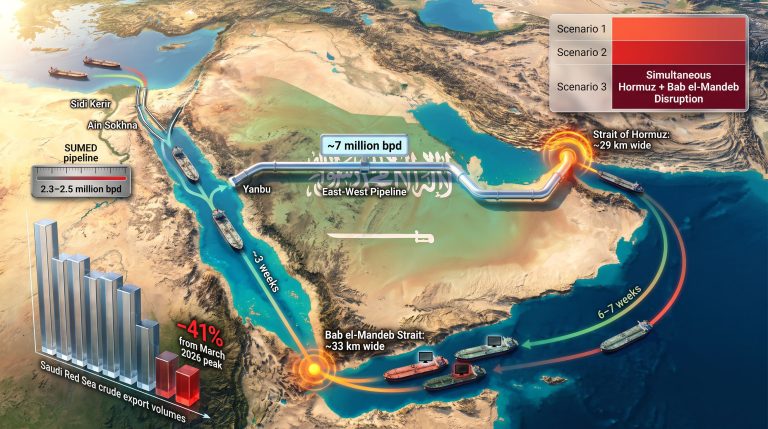
The Hormuz disruption is compounding with simultaneous pressure on a second critical energy corridor. Houthi threats against Saudi-linked shipping through the Bab el-Mandeb strait at the southern end of the Red Sea have forced tanker operators to choose between accepting elevated war risk exposure or absorbing the significant additional costs of rerouting around the Cape of Good Hope.
South Korea's SK Energy recently booked a very large crude carrier (VLCC) at a lump-sum fixture of $17 million to $18.5 million to carry Saudi crude from Egypt's Mediterranean coast to South Korea via the Cape route, bypassing both the Red Sea and Hormuz risk corridors entirely. The Cape route adds approximately 30 additional days to the voyage, substantially eroding refining margins for Asian buyers who are already absorbing elevated crude acquisition costs.
The operational responses from commercial operators reflect the severity of the dual chokepoint problem:
- Route diversification: Major charterers are booking Cape of Good Hope transits to avoid both risk corridors simultaneously
- AIS signal suppression: Multiple tankers have ceased broadcasting their location data when approaching high-risk zones, complicating traffic monitoring and creating additional uncertainty for insurers
- Cargo repricing: Yanbu-origin VLCC rates surged sharply as war risk insurance premiums were incorporated into spot market deal structures
- Lane concentration: Vessels still transiting Hormuz are consolidating entirely into the Iranian-controlled northern lane, accepting a form of de facto Iranian oversight as the least-bad available option
The next major ASX story will hit our subscribers first
What a Partial Military Solution Actually Produces
It is worth constructing a concrete scenario to illustrate why even a militarily successful campaign against Iranian naval assets falls well short of restoring commercial normalisation. Analysis from the Washington Institute reinforces this assessment, highlighting the significant limitations of kinetic options in the strait.
Assume a sustained and highly effective US naval air campaign successfully destroys 60 to 70% of Iran's identified fast attack craft, coastal missile batteries, and drone launch facilities. The likely sequence of events would unfold as follows:
- Iran redeploys surviving mobile assets to alternative coastal positions within days of initial strikes
- Naval mines previously laid throughout the strait remain active, requiring dedicated mine-clearing operations lasting weeks
- Insurance markets maintain elevated premiums because Iran retains demonstrated capacity to regenerate its threat posture
- Commercial shipping operators wait for sustained evidence of safety before resuming anything approaching normal transit volumes
- Iran retains the political leverage and physical capability to reactivate disruption at any moment of its choosing, preventing full normalisation
The conclusion is unavoidable: even an operationally successful military campaign produces only a temporary and partial suppression of disruption, not a functional restoration of pre-conflict commercial transit conditions. This assessment aligns with analysis of the current crude oil market, where suppressed Hormuz throughput is already feeding through to sustained price pressure globally.
The Case for Addressing Motivation Rather Than Capability
Shipping industry bodies including BIMCO have noted that reducing Iran's political motivation to attack commercial shipping may prove substantially more achievable than eliminating its physical capacity to do so. This framing reorients the entire strategic problem from a military engineering challenge to a diplomatic one.
Iran's asymmetric capabilities are deeply embedded across multiple redundant platforms, continuously regenerating through domestic production and procurement networks, and specifically designed to impose costs that exceed the benefits of military intervention. The strategic architecture is not a bug in Iran's military posture. It is the central feature of a doctrine built around deterring a conventional military adversary through unconventional means.
What military operations can realistically achieve in this environment:
- Temporary suppression of specific identified threat vectors during active engagement periods
- Reduction in the frequency of attacks while military operations are ongoing
- Establishment of limited protected transit corridors for the highest-priority cargo categories
What military operations cannot achieve under any realistic scenario:
- Restoration of shipper and insurer confidence at the scale required for commercial normalisation
- Permanent elimination of Iran's capacity to regenerate asymmetric naval capabilities
- Normalisation of commercial traffic volumes without an underlying political and diplomatic framework
- Long-term deterrence without maintaining a permanent and operationally unsustainable forward military presence
Supply Chain Implications and the Structural Case for Diversification
The current disruption is accelerating a strategic conversation that energy-importing nations, particularly across Asia, have been reluctant to confront directly: the structural vulnerability of energy supply chains that depend on single chokepoint transit routes. In addition, the LNG supply outlook for the region is increasingly uncertain as operators reconsider long-term routing assumptions that were built on stable Hormuz access.
Pipeline alternatives offer partial relief. The Abu Dhabi Crude Oil Pipeline (ADCOP), with a capacity of approximately 1.5 million barrels per day, provides a bypass route to the UAE's Fujairah terminal on the Gulf of Oman, circumventing Hormuz entirely for a portion of Abu Dhabi's crude exports. However, this capacity represents a fraction of normal Hormuz throughput and cannot absorb the full volume of Gulf crude that would otherwise transit the strait under normal conditions.
For crude oil markets, the combination of Hormuz volume suppression at approximately 9% of pre-conflict levels and the Red Sea disruption is removing a substantial volume of Gulf crude from accessible global supply chains, creating structural upward price pressure particularly acute for Asian refiners. These refiners face a compounding cost squeeze: elevated crude acquisition prices, sharply higher freight costs, and eroding refining margins on delivered product. Furthermore, the role of OPEC market influence in managing this supply shock will be critical to whether price stability can be partially restored in the months ahead.
FAQ: Hormuz, Military Force, and the Path to Normalisation
Can the US Navy physically force the Strait of Hormuz open?
The US Navy maintains overwhelming conventional superiority in the Persian Gulf region. However, Iran's asymmetric threat architecture, built around dispersed, low-cost, and rapidly regenerating systems, means that conventional naval dominance does not translate into the ability to guarantee safe commercial transit. Eliminating Iran's capacity to threaten shipping would require operations that extend far beyond anything achievable through naval and air power alone.
Has Iran formally closed the Strait of Hormuz before?
Iran has not fully closed the strait in the modern era, but has repeatedly demonstrated both the willingness and the capability to severely suppress commercial transit. The current situation represents a functional near-closure achieved through volume suppression and route concentration rather than a formal declared blockade, a strategically more sophisticated approach that is harder to respond to militarily.
What would a diplomatic resolution actually require?
A credible negotiated framework would need to engage Iran's core security and economic concerns, including sanctions relief, verifiable security commitments, and recognition of its regional interests, in exchange for binding commitments to cease attacks on commercial shipping. Historical precedent across comparable regional conflicts suggests such frameworks require sustained multilateral engagement rather than bilateral negotiations alone.
What does the disruption mean for global oil prices?
With commercial transit running at approximately 9% of pre-conflict daily levels, the sustained suppression of Hormuz throughput is removing significant volumes of Gulf crude from the accessible global supply pool. This creates sustained upward price pressure, particularly for Asian refiners whose entire business model depends on reliable access to Persian Gulf crude grades. The dual disruption of Hormuz and the Red Sea simultaneously amplifies this effect across both crude and refined product markets.
The Political Problem Requires a Political Answer
The convergence of operational military analysis, real-time vessel tracking data, and insurance market behaviour all point toward the same structural conclusion. Military action will not reopen Hormuz in any meaningful, durable sense. Iran's asymmetric doctrine is precisely calibrated to impose costs that exceed the benefits of kinetic intervention, and it has demonstrated its effectiveness against the most capable conventional naval force on earth.
The only pathway to restoring the Strait of Hormuz as a functioning global energy corridor is a diplomatic settlement that resolves the underlying political conflict driving Iran's behaviour. Every day that military escalation crowds out diplomatic engagement is another day that global energy markets absorb costs that are, ultimately, the product of an unresolved geopolitical dispute rather than an unavoidable force of nature.
Reopening Hormuz is a political problem. It requires a political solution. The application of additional military force, without a credible diplomatic framework alongside it, does not shorten the path to normalisation. It extends it.
This article contains forward-looking analysis and scenario projections based on available data and expert assessments as of late July 2026. Geopolitical situations evolve rapidly, and readers should not interpret this analysis as investment advice or a prediction of specific market outcomes. All figures cited reflect publicly available data from maritime intelligence firm Windward and reporting by Argus Media.
Want to Stay Ahead of Commodity Market Shifts Driven by Geopolitical Disruption?
When energy corridor crises reshape global commodity markets overnight, Discovery Alert's proprietary Discovery IQ model instantly identifies significant ASX mineral discoveries that may benefit from supply chain disruptions and shifting commodity dynamics — explore historic discovery returns to understand the opportunity scale, then begin your 14-day free trial at Discovery Alert to position yourself ahead of the broader market.