July 25, 2026
When the Backup Plan Has a Backup Problem
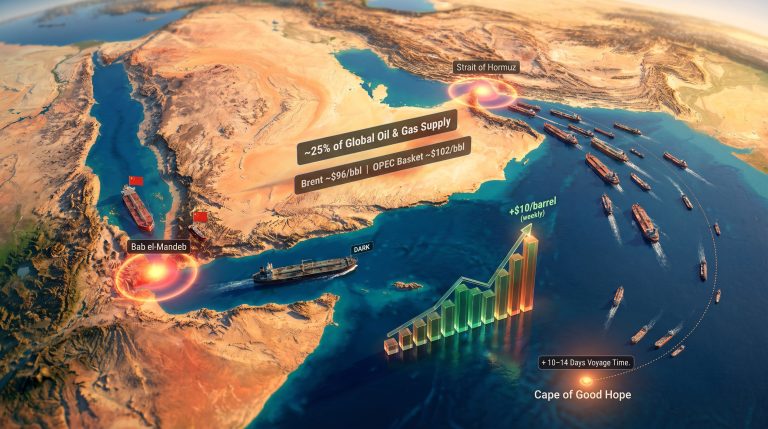
Global energy markets have spent decades pricing geopolitical risk through a single lens: can the oil get out of the Gulf? The Strait of Hormuz has long dominated strategic conversations about Middle Eastern supply security, and with good reason. At its narrowest point, roughly 33 kilometres wide, it handles a disproportionate share of the world's seaborne crude. However, a quieter, less-discussed vulnerability has been building in parallel, one that current events are now forcing into full view.
The Saudi Arabia Red Sea oil bottleneck represents something genuinely new in the architecture of global energy risk: a situation where the backup to the primary chokepoint has itself become compromised. Understanding why this matters requires looking not just at what is happening, but at the physical and logistical constraints that determine what can realistically replace what. Furthermore, crude oil price trends are increasingly shaped by these compounding vulnerabilities in ways that markets are only beginning to price.
When big ASX news breaks, our subscribers know first
The East-West Pipeline: Extraordinary Asset, Incomplete Solution
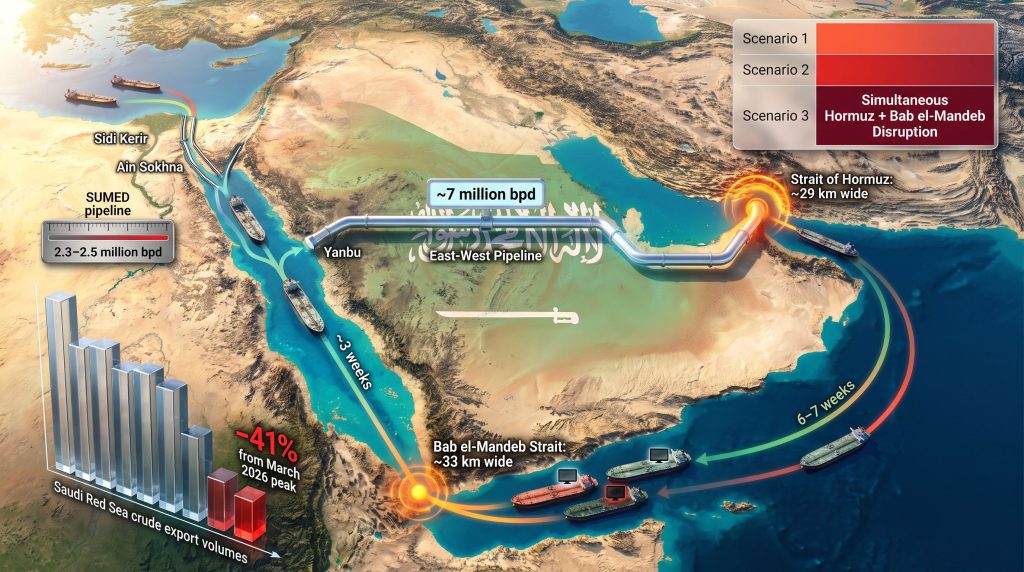
Saudi Arabia's East-West Pipeline is, by any measure, an engineering achievement. With a nameplate capacity of approximately 7 million barrels per day (bpd), it represents one of the largest overland crude transport systems on the planet. Constructed specifically to give the Kingdom an alternative export corridor that bypasses the Strait of Hormuz entirely, it routes crude from the eastern oil fields westward across the Arabian Peninsula to the Red Sea port of Yanbu.
For decades, this pipeline's existence was treated as a near-definitive answer to Hormuz disruption scenarios. Energy analysts and financial markets incorporated it into their risk frameworks as evidence that Saudi export capacity could be preserved even in the event of a Gulf closure. That reassurance, however, always contained a hidden assumption: that the Red Sea itself would remain open.
The reality of the pipeline's practical export ceiling is also less impressive than the headline figure suggests. A meaningful share of the 7 million bpd nameplate capacity feeds domestic refineries and petrochemical complexes positioned along Saudi Arabia's western industrial corridor. Analysts following Saudi export logistics have estimated the practical Yanbu export ceiling at closer to 4 million bpd during periods of elevated Gulf routing risk — still a substantial volume, but considerably below the number that reassured markets for years.
The deeper issue is structural. The East-West Pipeline resolves the production access problem by moving crude to a different coast. It cannot, however, resolve the maritime delivery problem once that crude arrives at Yanbu. With the Bab el-Mandeb Strait now subject to sustained Houthi interdiction operations, every barrel that reaches Yanbu still faces the fundamental question of how it exits the Red Sea. These oil logistics risks are now central to how the global supply chain functions under pressure.
What the Bab el-Mandeb Chokepoint Actually Means for Global Supply
The Bab el-Mandeb Strait sits at the southern end of the Red Sea, connecting it to the Gulf of Aden and the broader Indian Ocean. At its narrowest, the strait measures approximately 29 kilometres wide, making it only marginally more spacious than Hormuz. Its strategic function is straightforward: every cargo loaded at Yanbu and destined for Asian or African markets must pass through this corridor.
The operational impact of current Houthi interdiction activity on Saudi Red Sea crude exports has been substantial. Data tracking Yanbu loadings indicates that Saudi Red Sea crude exports have declined by approximately 41% from their March 2026 peak — a figure that quantifies the practical effect of the security environment on actual commercial shipping behaviour. Beyond export volume declines, tanker operators have been documented switching off Automatic Identification System (AIS) transponders to attempt undetected passage through the strait, a behaviour that signals acute risk perception among commercial shipping interests.
In addition, the oil price market impact of these interdiction operations extends well beyond Saudi Arabia's borders, rippling through freight markets, insurance pricing, and downstream fuel costs across multiple continents. As the EIA notes, these strategic waterways represent some of the most consequential vulnerabilities in the entire global energy system.
Comparing Saudi Arabia's Two Critical Export Chokepoints
| Chokepoint | Location | Approximate Width | Primary Threat | Alternative Routing |
|---|---|---|---|---|
| Strait of Hormuz | Persian Gulf exit | ~33 km | Iranian military activity | East-West Pipeline to Yanbu |
| Bab el-Mandeb | Red Sea southern exit | ~29 km | Houthi interdiction operations | Suez Canal / SUMED (partial) |
The asymmetry in this comparison is critical. For Hormuz, the alternative is a major overland pipeline delivering crude directly to a different sea. For Bab el-Mandeb, the alternative is a different route through the same general maritime system, with hard physical capacity ceilings that the original routing was never subject to.
The SUMED Capacity Ceiling: Where the Alternative Route Breaks Down
When analysts and policymakers consider routing Saudi exports northward through the Suez Canal rather than south through Bab el-Mandeb, the conversation inevitably arrives at Egypt's SUMED pipeline. This twin pipeline system runs from the Ain Sokhna terminal on the Red Sea to Sidi Kerir on the Mediterranean coast, spanning the Sinai Peninsula. It exists precisely to allow crude that cannot transit the Suez Canal at full draft to bypass the canal constraint.
The draft restriction issue is not incidental. Saudi crude export logistics depend heavily on Very Large Crude Carriers (VLCCs), vessels capable of carrying approximately 2 million barrels per cargo. VLCCs provide the lowest per-barrel transportation cost over long distances, which is why they became the backbone of Saudi export logistics to Asian buyers. A fully laden VLCC, however, draws too much water to transit the Suez Canal, even after the canal's repeated expansion programmes over the past decade. The SUMED partial-discharge and reload process is the only mechanism that allows these vessels to effectively use the northern route.
The problem is SUMED's capacity ceiling. Under normal commercial conditions, the system moves approximately 2.3 to 2.5 million bpd. This is adequate for its existing commercial commitments, which already include flows from other regional producers. The spare capacity available for emergency Saudi diversion is materially smaller than the headline throughput figure suggests.
Estimating the Yanbu export requirement during a sustained Bab el-Mandeb closure suggests the demand on SUMED could approach roughly double its available throughput. Consequently, SUMED transforms from a strategic bypass mechanism into the primary binding constraint on Saudi oil delivery to Asia.
The SUMED Bottleneck in Numbers
| Metric | Figure |
|---|---|
| SUMED effective throughput capacity | ~2.3 to 2.5 million bpd |
| Estimated Yanbu export requirement under full Bab el-Mandeb closure | Potentially approaching double SUMED capacity |
| VLCC cargo capacity | ~2 million barrels per vessel |
| Suez Canal draft limitation | Prevents full-load VLCC transit |
Terminal Congestion and the Compounding Delay Effect
The mechanics of congestion at Ain Sokhna and Sidi Kerir are worth examining in detail because they illustrate how individual constraints interact to produce outcomes far worse than their simple sum.
Each VLCC requiring partial discharge before Suez Canal transit occupies berth infrastructure, storage tank capacity, pumping systems, and loading equipment for extended periods. Under high-diversion scenarios, vessel queues begin forming at Ain Sokhna before the SUMED capacity ceiling is even reached. Demurrage costs — the charges accumulated when vessels wait beyond contracted loading or discharge windows — escalate rapidly in congested terminal environments.
The same dynamic repeats at Sidi Kerir on the Mediterranean side, where partial VLCC cargoes must be reloaded before the vessel can continue its voyage. What was previously a direct export chain from Yanbu to an Asian refinery now involves two additional terminal operations, each introducing delay, cost, and complexity.
The Suez Canal itself operates under its own set of practical constraints. It handles container ships, LNG carriers, bulk vessels, naval traffic, cruise ships, and tankers in carefully managed convoy sequences. Every additional crude carrier and product tanker entering the canal system competes for pilot assignments, tug support, convoy slots, and anchorage positions. Suez Canal Authority security procedures have also historically become more stringent during periods of elevated regional risk, adding further time to the transit process.
Refined Products: The Faster-Moving Crisis Within the Crisis
While crude oil disruptions attract the most attention, Saudi Arabia's Yanbu export profile includes substantial volumes of refined petroleum products: diesel, gasoline, jet fuel, naphtha, fuel oil, and liquefied petroleum gas. These products move on Medium Range and Long Range product tankers rather than VLCCs, and these vessel classes can transit the Suez Canal without SUMED dependency. This might suggest they face fewer constraints than crude exports.
The reality is more nuanced. Product tankers compete for exactly the same Suez Canal convoy slots, pilot availability, anchorage capacity, and terminal access as crude carriers. More importantly, refined product supply chains operate with significantly smaller inventory buffers than upstream crude systems. Where a crude oil disruption might take weeks to translate into visible market tightness, a refined product delivery delay can drive wholesale price increases within days.
For Asian fuel distributors and downstream industrial users, this speed differential matters enormously. The Saudi Arabia Red Sea oil bottleneck is not just an upstream story. Its downstream consequences move faster and hit consumers more directly than equivalent disruptions to raw crude supply. Monitoring current crude oil prices has consequently become critical for any business exposed to energy input costs across the Asia-Pacific region.
The next major ASX story will hit our subscribers first
Asian Buyers: Mapping the Demand-Side Exposure
China, India, Japan, and South Korea collectively account for the dominant share of Saudi crude export volumes, making the Red Sea bottleneck fundamentally an Asian energy security problem. Under a sustained Bab el-Mandeb closure with Suez Canal rerouting, cargoes bound for Asia must travel north through the entire Red Sea, transit the Suez Canal, cross the Mediterranean, and then sail the full Cape of Good Hope route before heading eastward toward their destination.
This routing adds thousands of nautical miles per voyage and extends transit times from approximately 3 weeks to 6 or 7 weeks. Each additional week at sea represents higher bunker fuel consumption, elevated working capital requirements for both exporters and importers, and reduced vessel availability for other trade routes.
The tanker fleet absorption effect is a particularly underappreciated dimension of this problem. Longer voyages do not destroy tanker capacity — they absorb it. A VLCC committed to a Cape of Good Hope routing effectively disappears from available fleet inventory for the additional transit period. This tightening of VLCC availability increases demand for Suezmax and Aframax tanker classes, particularly on Mediterranean and European trade routes, spreading the disruption well beyond the directly affected Saudi export chain.
How Major Asian Buyers Are Responding
-
India has been actively sourcing alternative crude from Angola and Venezuela as Middle Eastern supply reliability deteriorates, while also pulling back from Iraqi crude given the compounding Hormuz risk exposure.
-
China has been accelerating purchases of Russian crude to reduce dependency on Middle Eastern supply chains. Chinese-operated tankers have been documented attempting direct Bab el-Mandeb passage despite interdiction threats, accepting elevated risk in exchange for shorter routing.
-
Japan and South Korea face structurally elevated import costs with limited near-term diversification options, given that their refinery configurations are optimised for specific Middle Eastern crude grades that cannot be easily substituted with alternative origins.
Scenario Modelling: Three Disruption Pathways and Their Market Implications
Scenario 1: Partial Disruption (Current Environment)
Bab el-Mandeb remains technically accessible but subject to elevated risk premiums. Tanker operators implement AIS-dark transit tactics and absorb war risk insurance surcharges. Saudi Red Sea exports from Yanbu run at materially below theoretical maximum, with the 41% decline from the March 2026 peak representing the quantified impact of this environment. Market consequences include moderate crude price premiums, manageable supply tightness, and elevated tanker freight rates.
Scenario 2: Full Bab el-Mandeb Closure with Suez Rerouting
All Yanbu exports are forced through the Suez Canal and SUMED system. The 2.3 to 2.5 million bpd SUMED capacity ceiling becomes the binding constraint. Terminal congestion at Ain Sokhna and Sidi Kerir generates multi-week delays. Effective Saudi crude export capacity to Asian markets declines by an estimated 30 to 50% versus normal operations. Refined product shortages in Asian markets emerge faster than crude supply tightness. Global tanker effective capacity contracts significantly.
Scenario 3: Simultaneous Hormuz and Bab el-Mandeb Disruption
Saudi Arabia loses both its primary Gulf export corridor and its Red Sea alternative simultaneously. The combined Suez Canal and SUMED system cannot absorb full Saudi export volumes under any realistic operational scenario. This pathway represents a global oil supply shock without a modern precedent outside the 1970s Arab oil embargo. As analysis of new Houthi threats confirms, potential consequences include sustained crude prices well above $100 per barrel, severe downstream fuel shortages across Asia and Europe, and emergency drawdowns of strategic petroleum reserves across International Energy Agency member nations.
Disclaimer: The scenario projections above represent analytical frameworks based on available infrastructure data and should not be interpreted as forecasts or investment advice. Energy market outcomes are subject to geopolitical, operational, and diplomatic variables that cannot be modelled with certainty.
The Infrastructure Investment Gap That Created This Vulnerability
The Saudi Arabia Red Sea oil bottleneck did not emerge suddenly. It reflects decades of investment prioritisation that favoured upstream production capacity over maritime logistics resilience. The energy industry poured capital into drilling, reservoir development, pipeline construction, and export terminal capacity. The maritime corridors connecting those terminals to consuming markets received comparatively little strategic attention.
Specific gaps in the Red Sea logistics infrastructure include:
-
No significant expansion of SUMED pipeline throughput capacity beyond its current ceiling in recent decades
-
Limited development of alternative Red Sea export terminals capable of handling VLCC traffic without SUMED dependency
-
Insufficient strategic petroleum reserve positioning in major Asian importing nations to buffer extended routing disruptions of the scale now being contemplated
-
No alternative overland pipeline route connecting Saudi production to a non-Red Sea, non-Gulf export point
The measurement framework for energy security itself contributed to this gap. Security has historically been assessed in terms of production capacity and reserve volumes: how many barrels can be produced, how quickly, and for how long. The question of whether those barrels can actually reach consumers on schedule — via specific vessel classes, through specific maritime corridors — was treated as a commercial logistics matter rather than a strategic security question. Furthermore, OPEC market influence over production decisions has historically overshadowed the equally important question of delivery infrastructure resilience.
The next phase of energy security thinking must shift from measuring security in barrels produced to measuring it in barrels reliably delivered. These are fundamentally different infrastructure investment problems requiring different capital allocation frameworks.
Key Reference Metrics for the Saudi Red Sea Oil Bottleneck
| Metric | Figure | Strategic Significance |
|---|---|---|
| East-West Pipeline nameplate capacity | ~7 million bpd | Maximum theoretical crude movement to Yanbu |
| Practical Yanbu export ceiling | ~4 million bpd | Real-world ceiling after domestic refinery feed |
| Saudi Red Sea export decline from March 2026 peak | ~41% | Quantified current disruption impact |
| SUMED throughput capacity | ~2.3 to 2.5 million bpd | Hard ceiling on Suez rerouting option |
| VLCC cargo capacity | ~2 million barrels per vessel | Explains draft restriction consequences |
| Normal Asia transit time via Red Sea | ~3 weeks | Baseline for disruption cost comparison |
| Rerouted Asia transit time via Cape of Good Hope | ~6 to 7 weeks | Additional cost, time, and fleet absorption impact |
| Bab el-Mandeb width at narrowest point | ~29 km | Geographic constraint on all Red Sea exit traffic |
Frequently Asked Questions: Saudi Arabia Red Sea Oil Bottleneck
What makes the Bab el-Mandeb Strait so critical to Saudi oil exports?
The Bab el-Mandeb Strait is the only maritime exit point from the southern Red Sea. Every cargo loaded at Yanbu destined for Asian or African markets must physically pass through this corridor before reaching the Gulf of Aden and the broader Indian Ocean. There is no overland alternative to this transit. Its disruption therefore directly constrains the value of the entire East-West Pipeline strategy.
Why can't SUMED simply be expanded to handle more volume?
SUMED capacity expansion would require significant engineering assessment, capital investment, and construction time measured in years, not months. The pipeline infrastructure, pumping stations, terminal facilities at both Ain Sokhna and Sidi Kerir, and associated storage systems would all require upgrades. This is a multi-billion dollar undertaking with a timeline incompatible with responding to current disruptions.
How does tanker AIS dark passage indicate market stress?
When tanker operators disable AIS transponders, they sacrifice navigational safety and regulatory compliance in exchange for reduced detectability. This behaviour reflects a calculation that the risk of being tracked and targeted exceeds the risk of operating without the standard positioning broadcast. It is an extreme measure that signals acute commercial and physical risk perception, not routine operational practice.
What does the Cape of Good Hope rerouting cost per cargo?
While exact figures vary by vessel size, charter rate, and bunker fuel price, the additional 3 to 4 weeks of transit time for an Asia-bound VLCC translates directly into substantially higher bunker consumption costs, extended working capital lock-up for both exporter and importer, higher vessel hire costs, and delayed delivery to refineries operating on lean inventory schedules. Collectively, these factors represent a significant per-barrel cost increase that eventually flows through to refined product prices paid by end consumers.
Is there any diplomatic pathway to restoring Bab el-Mandeb security?
Restoration of navigational security in the strait would require either a sustained multilateral naval interdiction effort capable of neutralising Houthi maritime strike capabilities, or a diplomatic resolution to the broader Yemen conflict that removes the motivation for commercial shipping targeting. Both pathways involve significant geopolitical complexity and timelines that energy markets cannot rely upon for near-term planning purposes.
The Decisive Variable Has Shifted
Energy markets are in the early stages of recalibrating a foundational assumption: that oil supply security is primarily a production question. The Saudi Arabia Red Sea oil bottleneck makes clear that the decisive variable has shifted. It is no longer sufficient to ask whether Saudi Arabia can produce and pipeline crude to a coast. The critical question is whether the maritime infrastructure connecting that coast to Asian refineries can physically handle the volume, under the current security environment, within commercially viable timeframes.
The East-West Pipeline remains a genuine and significant strategic asset. Its value, however, is entirely conditional on what happens after crude arrives at Yanbu. With Bab el-Mandeb under sustained threat, SUMED at its capacity ceiling, and Asian buyers facing potential transit times that double standard voyage lengths, the logistical resilience of the global oil system is being tested in ways that decades of production-focused investment never anticipated.
For energy markets, infrastructure investors, and supply chain strategists, the lesson is structural rather than episodic. Maritime corridor resilience must be elevated to the same priority level as production capacity expansion. The gap between those two investment categories — accumulated over decades — is now visible in real-time crude export data, tanker positioning behaviour, and the price premiums being demanded by the markets that depend on reliable delivery.
Want to Know When Energy Market Disruptions Create ASX Mineral Discovery Opportunities?
Discovery Alert's proprietary Discovery IQ model scans ASX announcements in real time, instantly identifying significant mineral discoveries — including those tied to commodities reshaping global supply chains under geopolitical pressure — and delivering actionable insights to subscribers ahead of the broader market. Explore historic discovery returns on Discovery Alert's dedicated discoveries page and begin your 14-day free trial to position yourself at the forefront of the next major find.