July 25, 2026
When Geography Becomes Destiny: Understanding the World's Most Dangerous Maritime Bottlenecks
Energy security analysts have long warned that the global oil system carries a structural flaw hiding in plain sight. Unlike most critical infrastructure, which can be replicated, rerouted, or redundantly engineered, the world's hydrocarbon trade depends on a handful of geographic pinch points that cannot be duplicated. No amount of capital spending, policy coordination, or technological innovation can build a second Strait of Hormuz. This fundamental reality is now playing out in real time, and the consequences are reverberating across every major economy on the planet.
The Hormuz and Bab el-Mandeb oil disruption unfolding through mid-2026 is not a temporary logistical inconvenience. It represents the simultaneous activation of two of the most consequential geographic vulnerabilities in the architecture of global energy trade, and markets are only beginning to price in the full implications.
When big ASX news breaks, our subscribers know first
The Numbers That Explain Why This Crisis Is Different
To understand the scale of what is happening, the arithmetic of chokepoint dependency must be confronted directly. The Strait of Hormuz, the narrow passage between the Persian Gulf and the Gulf of Oman, handles approximately 20% of all globally traded oil and natural gas under normal operating conditions. Every major Persian Gulf producer, including Saudi Arabia, Iraq, Kuwait, the UAE, and Qatar, relies on this passage as the primary exit point for seaborne crude and LNG exports.
The Bab el-Mandeb strait, positioned at the southern tip of the Red Sea where it meets the Arabian Sea, carries an estimated 10% of global oil supply in transit at any given time. Vessels moving between Asian and European markets, or heading toward the Suez Canal, must pass through this 29-kilometre-wide corridor. Furthermore, understanding crude oil price volatility is essential context for grasping why these geographic constraints carry such outsized market consequences.
The critical insight that most analysis misses is the interaction effect between these two passages. Consider the following:
- Saudi Arabia's East-West Pipeline, which can partially bypass Hormuz, terminates at Red Sea export terminals
- Those Red Sea terminals are themselves dependent on Bab el-Mandeb clearance for onward delivery to Asian buyers
- A simultaneous disruption to both passages therefore eliminates the primary bypass workaround for the primary chokepoint
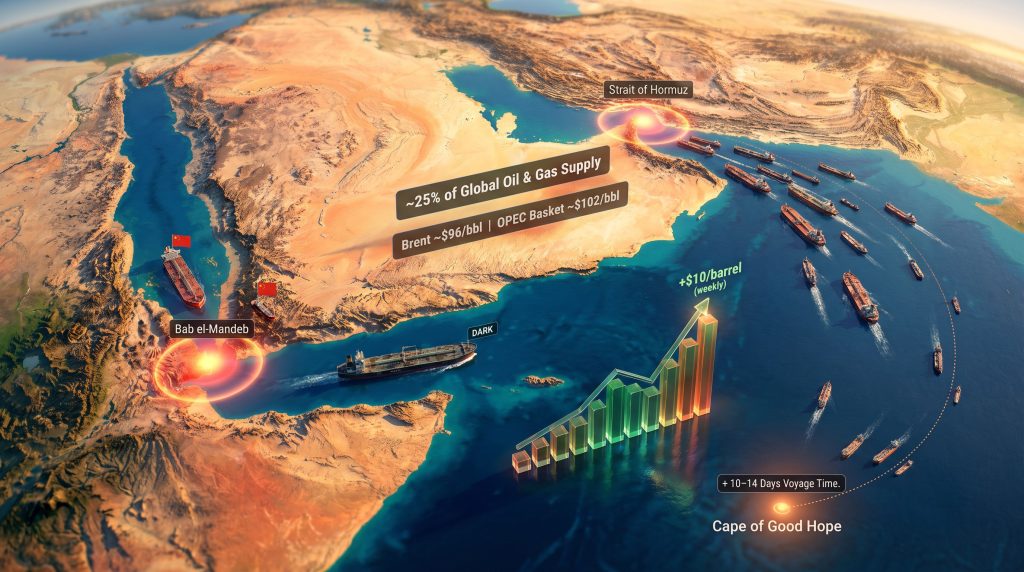
In combination, analysts estimate that severe concurrent disruption to both corridors could threaten roughly 25% of the world's oil and gas supply moving through normal distribution channels. No pipeline network, no strategic reserve release program, and no alternative routing can absorb that volume quickly.
Tanker Traffic Collapse: What the Data Reveals About Hormuz
Hormuz tanker crossings have fallen to their lowest recorded levels since May 2026, driven by escalating war-risk insurance premiums and the direct threat environment created by ongoing U.S.-Iran military exchanges. The confrontation, which had entered its 12th consecutive night of strikes as of late July 2026, has fundamentally altered the risk calculations of commercial shipping operators, many of whom are declining Hormuz transits entirely rather than expose vessels to conflict zone liability.
The physical evidence of this withdrawal is already appearing in downstream data. U.S. crude oil inventories have begun building as normal resupply flows from Gulf producers are interrupted. More dramatically, a Kuwaiti tanker was struck inside the Strait of Hormuz itself, triggering an immediate oil price response above $90 per barrel as markets processed the signal that the waterway was no longer a safe commercial corridor.
The critical distinction between this disruption and previous Hormuz tension episodes is duration and simultaneity. Past crises involved elevated threat rhetoric without sustained physical interdiction. The current situation combines active military strikes, confirmed tanker attacks, and a parallel Red Sea closure into a single, compounding supply shock.
According to reporting on the Bab el-Mandeb blockade, analysts have noted that the scale of maritime withdrawal from these corridors is unprecedented in the modern era of commercial shipping.
Houthi Operations in the Red Sea: From Harassment to Systematic Interdiction
While Hormuz captures the most attention, the Bab el-Mandeb dimension of this crisis may ultimately prove more strategically significant. Yemen's Houthi forces have demonstrated a meaningful expansion in their operational capabilities, claiming missile strikes against two Saudi crude tankers, the Encelia and the Layla, in the Red Sea, damaging both vessels. The attacks signal that Houthi forces can now reliably threaten commercial vessels carrying crude from one of the world's largest exporters.
The threat escalated further when Houthi leadership declared its intention to impose a full Red Sea blockade, a declaration that produced an immediate 4% single-session oil price spike as markets absorbed the implications. The practical response from commercial shipping has been rapid and decisive: shipowners are diverting vessels around the Cape of Good Hope, adding approximately 10 to 14 days to voyage times and generating proportional increases in fuel, freight, and insurance costs.
Perhaps the most revealing data point about the severity of the threat environment came when a Saudi crude tanker was observed operating with its AIS transponder disabled, effectively going dark as it attempted to transit the Bab el-Mandeb undetected. Automatic Identification System (AIS) transponders are mandatory under international maritime law for vessels of a certain size. Disabling them is typically only done when operators judge that being tracked presents a greater risk than violating the legal requirement, a judgement that communicates more about conditions on the water than any official statement. CNBC's analysis of these chokepoints similarly highlights how insurance and compliance frameworks are being stress-tested far beyond their original design parameters.
The Chinese Tanker Exception: An Asymmetric Geopolitical Advantage
One of the least widely understood dimensions of the current Red Sea crisis is the differential treatment of vessels by flag and beneficial ownership. Two Chinese-flagged tankers, the Xin Long Yang and the Cosnew Lake, transited the Bab el-Mandeb carrying Saudi crude despite active Houthi threat declarations against the region.
This passage appears to reflect an informal accommodation between Beijing and Houthi leadership, granting Chinese-flagged vessels preferential transit rights through the contested corridor. The strategic implications extend well beyond shipping logistics:
- China can maintain supply continuity from Middle Eastern producers while competitors face interdiction risk
- Beijing's separate diplomatic engagement with Houthi forces operates independently of the Western-aligned naval response framework
- Chinese refiners gain a structural cost advantage over Japanese, Korean, and European peers who must absorb Cape of Good Hope rerouting costs or war-risk premium surcharges
- The arrangement creates a geopolitical asymmetry in crude procurement that could persist even if Western naval operations succeed in deterring Houthi attacks on other nations' vessels
Separately, the U.S. has reported that China has reduced its purchases of Iranian crude by approximately 40%, suggesting Beijing is managing its exposure to Iranian supply chains while simultaneously preserving its Red Sea access rights through the Houthi accommodation.
Oil Price Mechanics: Where Markets Stand and Where They Are Heading
The price response to the dual chokepoint crisis has been swift and substantial. Both ICE Brent and WTI added $10 per barrel over a single week, representing one of the sharpest short-duration price movements in recent years outside of the initial COVID-19 supply collapse. Tracking current crude oil prices provides essential context for understanding how dramatically conditions have shifted.
| Benchmark | Recent Price Level | Weekly Movement |
|---|---|---|
| ICE Brent Crude | ~$96 per barrel | +$10 (weekly) |
| WTI Crude | ~$88-90 per barrel | +$10 (weekly) |
| Murban Crude | ~$97 per barrel | Significant intraday volatility |
| OPEC Basket | ~$102 per barrel | +$8.23 (daily) |
| Indian Basket | ~$103 per barrel | +$10.14 (daily) |
Market consensus is consolidating around a $100+ per barrel scenario as oil-deprived refiners globally compete for diminishing available supply. The mechanism driving this is not speculative positioning alone. Physical buyers, particularly Asian refiners unable to source Hormuz-transiting barrels, are bidding aggressively for Atlantic Basin and non-Gulf alternative supply, creating genuine spot market tightness.
QatarEnergy's decision to extend force majeure declarations on LNG deliveries to Asian buyers through at least October 2026, while simultaneously leasing out LNG carriers, signals that the supply disruption is expected to persist well beyond any near-term diplomatic resolution. Force majeure in LNG contracts is not a routine commercial tool. Its activation and extension reflects a genuine operational inability to deliver contracted volumes, and its persistence through Q3 2026 is pricing into forward markets accordingly.
A proposed 20% Hormuz transit toll floated by the Trump administration would, if implemented, add an entirely new structural cost layer to all Gulf crude exports, independent of the physical security situation.
The Regional Exposure Map: Who Bears the Greatest Risk
The distributional consequences of the Hormuz and Bab el-Mandeb oil disruption are far from uniform. Asian importers carry the greatest structural exposure by a considerable margin, given their near-total dependence on Middle Eastern crude delivered through these precise corridors.
India presents the most acute case. Having pulled back from Iraqi crude purchases as Hormuz transit risk became operationally unacceptable, India is now actively sourcing replacement barrels from Angola and Venezuela, geographically distant alternatives that are Hormuz-independent but carry their own logistical and geopolitical complexity. India also became the world's largest long-term LNG buyer in 2025 according to GIIGNL data, which means QatarEnergy's force majeure extension hits the country with compounding force across both crude and gas supply chains. The IMF has formally identified elevated oil prices as a key downside risk to India's GDP growth trajectory.
Japan is experiencing power prices at their highest level in 3.5 years, with the surge in import costs directly attributable to Middle East supply disruption feeding through to electricity generation fuel costs. Japan's import bill has reached unprecedented levels as a direct consequence of the price spike.
Pakistan has taken the notable step of shifting to daily market-based fuel price adjustments, abandoning the periodic administrative pricing model in favour of real-time pass-through of international price movements. Having already spent approximately $500 million on fuel subsidies in 2026 to date, Pakistan's fiscal room to absorb further oil price escalation is extremely limited. The country is actively seeking alternative supply corridors as Hormuz and Red Sea risks mount.
China, as noted above, is simultaneously accelerating purchases of Russian crude as a Hormuz-independent supply hedge while maintaining Red Sea passage rights through its Houthi accommodation, executing a dual-track supply security strategy unavailable to other major importers.
Europe's Compounding Winter Vulnerability
Europe enters the 2026 winter season with its weakest natural gas storage cushion in 15 years, a structural vulnerability that is being compounded by Middle East LNG supply disruption from precisely the point in the calendar when storage adequacy is most consequential. LNG importers across the continent are seeking revised pricing from Qatar and UAE counterparties as war-related supply uncertainty reshapes existing contract structures.
A secondary logistics crisis is also developing. The Rhine River, which functions as a critical inland artery for fuel and chemical distribution across Central Europe, faces water levels potentially as low as 30 centimetres in early August, threatening to halt barge navigation entirely. A maritime supply shock and an inland logistics failure occurring simultaneously would represent an unprecedented compound stress test for European energy infrastructure.
The EU has progressed its 21st sanctions package against Russia, including a 12-month extension of the Russian oil price cap and a modified provision allowing Russian LNG transshipment to third countries. This architecture is being maintained even as Europe faces its most acute energy supply exposure in over a decade, reflecting the political complexity of simultaneously managing energy security and sanctions policy.
The next major ASX story will hit our subscribers first
Producer Responses and the OPEC+ Paradox
The supply-side response to the Hormuz and Bab el-Mandeb oil disruption involves a notable paradox. OPEC+ is expected to raise September output targets by a further 188,000 barrels per day at its August 2 meeting, continuing the unwinding of 1.65 million b/d in voluntary cuts implemented since 2023. However, OPEC's market influence is being tested in ways that formal output decisions alone cannot resolve when physical delivery infrastructure is under active threat.
The strategic logic for OPEC+ is straightforward: higher prices create an incentive to maximise revenue from available production capacity. The paradox lies in the physical delivery problem. Several OPEC+ members face documented capacity constraints that prevent them from matching their formal output targets regardless of what the group decides formally. And even where production capacity exists, the maritime infrastructure required to export those barrels is precisely what is under threat.
ADNOC's commercial response has been instructive. The Abu Dhabi National Oil Company has issued its seventh crude tender since June, a deliberate signal of supply continuity intent despite the surrounding risk environment. This commercial posture reflects the UAE's strategic interest in preserving buyer relationships and market share, communicating to Asian and European customers that Abu Dhabi remains a reliable supplier even under elevated geopolitical pressure.
The U.S.-Saudi civilian nuclear cooperation agreement, which enables American firms to participate in Saudi Arabia's nuclear energy development program, carries a long-term supply-side implication. Reducing Saudi Arabia's domestic crude consumption in power generation by substituting nuclear capacity would free additional barrels for export, representing a structural rather than cyclical supply response to the current crisis.
Corporate Earnings: The Windfall Dimension
While the humanitarian and macroeconomic consequences of the supply disruption are severe for importing nations, the earnings implications for upstream producers and refiners have been dramatic. TotalEnergies reported a 68% profit surge as elevated oil prices fed directly into upstream earnings. Equinor posted a 93% profit increase driven by the oil and gas price spike. U.S. refinery utilisation has reached 96.2%, near maximum operational capacity, as domestic refiners race to process available feedstock.
The transmission of maritime supply disruption into aviation sector economics is illustrated by Ryanair's 36% profit decline, attributed to unhedged jet fuel costs doubling as Middle East supply chains fractured. This single data point captures how the consequences of a shipping crisis in the Persian Gulf propagate through to consumer-facing industries thousands of kilometres away.
Industrial metals have also responded to the geopolitical stress. Copper prices climbed to a one-month high of $13,835 per tonne, supported by Chinese inventory tightness and diminishing expectations for a near-term Iran ceasefire. Glencore is preparing to withdraw approximately 30,000 metric tonnes of lead from LME warehouses, a move that arrested a price decline and pushed the three-month lead contract to $1,900 per tonne.
Three Scenarios for the Path Forward
The resolution trajectory of the dual chokepoint crisis remains genuinely uncertain. Consequently, three distinct scenarios bracket the plausible outcome space, each carrying significantly different implications for energy markets globally.
Scenario 1: Partial Disruption Persists (Base Case)
- Hormuz traffic remains suppressed but not fully closed
- Bab el-Mandeb sees intermittent Houthi attacks without a sustained full blockade
- Oil prices stabilise in the $90 to $100 per barrel range
- Cape of Good Hope rerouting becomes the operational norm for non-Chinese tankers
- Asian importers accelerate diversification toward Atlantic Basin and Russian supply sources
Scenario 2: Full Dual Closure (Tail Risk)
- Both straits effectively closed simultaneously for a sustained period
- Approximately 25% of global oil and gas supply removed from normal distribution
- Oil prices spike decisively above $100 per barrel, potentially reaching $120 to $130 under sustained closure
- Emergency strategic petroleum reserve releases activated across IEA member nations
- Global recession risk escalates materially as energy costs propagate through industrial and consumer price indices
Scenario 3: Diplomatic De-escalation (Upside Case)
- A U.S.-Iran ceasefire framework is reinstated and holds
- Houthi attacks on Red Sea shipping cease under a negotiated arrangement
- Hormuz tanker traffic recovers toward normal levels over four to six weeks
- Oil prices retrace toward the $75 to $85 per barrel range as supply anxiety recedes
- OPEC+ output increases absorb demand as the supply shock premium unwinds
Disclaimer: The scenario projections above are analytical frameworks based on current market conditions and publicly available information. They do not constitute investment advice. Oil markets are subject to rapid, unpredictable change driven by geopolitical, meteorological, and macroeconomic factors beyond any model's capacity to fully anticipate. Investors and energy market participants should conduct independent due diligence and consult qualified financial advisors before making decisions based on energy price forecasts.
The Structural Question Markets Are Underpricing
The most important insight embedded in the current crisis may be the one that persists after any ceasefire or diplomatic resolution. The geographic vulnerabilities that created this crisis have not changed and cannot change. What has changed is the demonstrated willingness of multiple actors, state and non-state alike, to exploit those vulnerabilities simultaneously.
The combination of U.S.-Iran military exchanges, Houthi Red Sea operations, Chinese tanker accommodation arrangements, and a fracturing global sanctions architecture represents a new baseline of geopolitical risk for maritime energy trade. In addition, the scale of this oil market disruption reflects compounding pressures that extend well beyond any single bilateral confrontation. Even in the optimistic de-escalation scenario, the structural chokepoint dependency that made this crisis possible remains fully intact.
Furthermore, the US-China oil price impact layered on top of the maritime disruption creates an additional dimension of uncertainty that markets, insurers, and energy planners must now incorporate into their baseline assumptions. Those who treat the current episode as a temporary aberration rather than a preview of recurring vulnerability may find themselves inadequately prepared for the next activation of the same geographic fault lines.
The arithmetic of global energy geography has not changed. What has changed is the world's willingness to test it.
Want to Know Which ASX Miners Are Positioned to Benefit From Rising Oil and Commodity Prices?
Discovery Alert's proprietary Discovery IQ model delivers real-time alerts on significant ASX mineral discoveries — instantly cutting through market noise to surface actionable opportunities as energy and commodity prices surge. Explore how historic discoveries have generated extraordinary returns on Discovery Alert's dedicated discoveries page, and begin your 14-day free trial today to position yourself ahead of the next major market move.