July 25, 2026
The Minerals Are There. The Industrial Economy Is Not.
Every major technology transition of the past two centuries has required nations to control not just the raw materials underpinning it, but the processes that transform those materials into economic output. The steel age rewarded countries that built furnaces, not just those that owned iron ore fields. The semiconductor era enriched nations that mastered fabrication, not just those sitting atop silicon deposits.
Today's clean energy and digital economy transition is following the same pattern, and Africa finds itself, once again, holding extraordinary geological wealth while remaining structurally excluded from the industrial value it generates.
This is the central challenge the U.S. alternative to China's critical minerals model in Africa is designed to address, and understanding why that gap exists requires looking beyond resource economics into the architecture of global supply chains themselves.
When big ASX news breaks, our subscribers know first
Africa's Geological Advantage Versus Its Industrial Reality
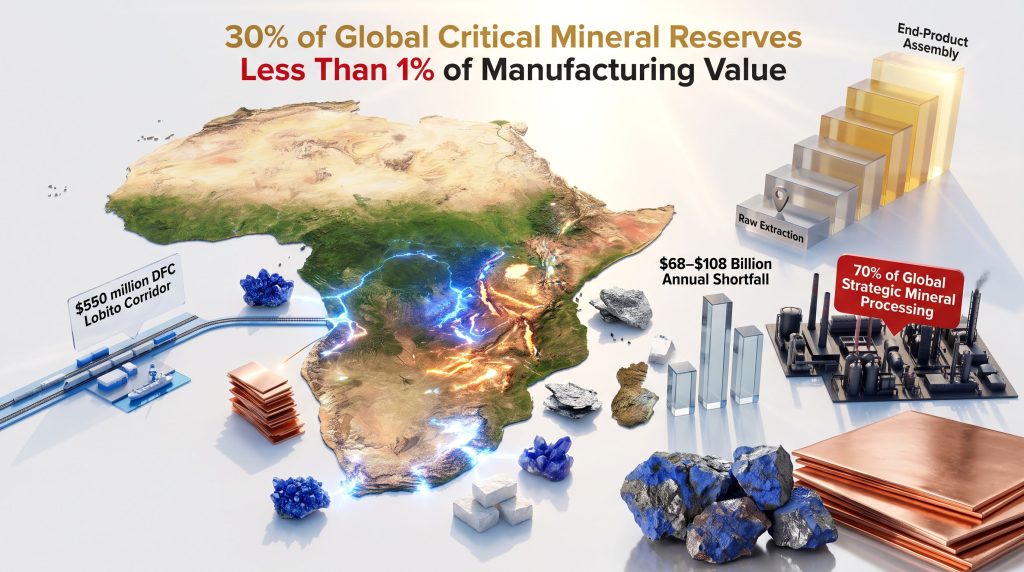
Africa holds roughly 30% of the world's critical mineral reserves, encompassing cobalt, copper, lithium, manganese, bauxite, graphite, and rare earth elements. These are precisely the materials that electric vehicle batteries, grid-scale storage systems, semiconductors, and clean power infrastructure cannot be built without. The critical minerals demand for all of them is accelerating, driven by the global energy transition and the digitisation of industrial economies.
Yet despite this endowment, Africa captures less than 1% of the manufacturing value generated globally from energy technologies. The explanation for this paradox is not geological. It is structural.
The table below illustrates where value is actually created across the mineral supply chain, and where Africa currently sits within it:
| Value Chain Stage | Economic Value Generated | Africa's Current Participation |
|---|---|---|
| Raw ore extraction | Low margin, high environmental cost | Primary role |
| Ore concentration and processing | Moderate value-add | Minimal |
| Refining and smelting | High value-add | Very limited |
| Component manufacturing | Very high value-add | Near-absent |
| End-product assembly | Highest margin | Essentially zero |
The pattern is unambiguous. Each step away from raw extraction generates more economic return, more skilled employment, and more tax revenue, and Africa is systematically absent from every stage beyond the first.
How China Built Dominance Through Downstream Control
China's position in global critical mineral supply chains was not accidental. Over several decades, Beijing deployed state-directed financing to secure upstream extraction rights across Africa while simultaneously building out domestic refining, processing, and manufacturing capacity on an industrial scale. The result is a supply chain architecture where raw materials extracted in Africa frequently pass through Chinese processing facilities before reaching any global end market.
Today, China controls approximately 70% of global strategic mineral refining capacity, according to figures cited by U.S. Treasury Department officials. This includes cobalt, lithium, and rare earth element processing. Furthermore, the strategic implications of this concentration are significant:
- Any geopolitical disruption, export restriction, or policy shift within China can immediately destabilise supply chains for electric vehicles, defence systems, and consumer electronics worldwide
- African producing nations have limited pricing power even during periods of surging commodity demand, because value capture occurs at refining stages they do not control
- The more Africa remains locked in raw export roles, the more structurally dependent it becomes on Chinese processing networks, progressively weakening its negotiating position
China's engagement model in Africa typically bundles resource extraction with transport infrastructure, creating export-optimised corridors that move raw materials out efficiently but generate limited local industrial development. State-owned enterprises frequently retain operational control over both mines and logistics, constraining technology transfer and workforce advancement.
The concentration of refining capacity in a single geography creates a single point of failure for the global clean energy transition. Supply chain resilience requires distributing that processing capacity across multiple regions, with Africa as a logical and resource-rich candidate.
The U.S. Alternative Framework: Architecture and Priorities
The U.S. alternative to China's critical minerals model in Africa was articulated at a ministerial level during the African Development Bank's Ministerial Forum on Critical Minerals, Value Chains and Beneficiation, held in Abidjan in July 2025. Jeremy Wiggins, the U.S. Treasury Department's Deputy Assistant Secretary for Investment, Energy and Infrastructure, outlined Washington's approach as a fundamentally different structural proposition, centred not on state ownership of assets but on financial de-risking, regulatory improvement, and partnership-based industrialisation.
The framework rests on five structural pillars:
-
Development finance as a catalyst, not a controller – The U.S. International Development Finance Corporation and the U.S. Trade and Development Agency provide financial guarantees, equity co-investment, and technical assistance to reduce project risk for private investors without seeking operational control over mining assets. A $550 million DFC loan commitment to the Lobito rail corridor connecting the DRC and Zambia's Copperbelt to Angola's port of Lobito demonstrates this infrastructure-first logic.
-
Offtake agreements over ownership – Rather than deploying large-scale U.S. mining operations in politically complex environments, Washington favours long-term offtake arrangements that secure supply for U.S.-aligned buyers while leaving operational management with local or multinational partners, reducing political exposure while anchoring supply chain diversification.
-
In-country value addition as an explicit goal – The framework actively supports African nations developing their own refining and processing capacity, positioning them as midstream participants rather than upstream-only raw material exporters. This directly challenges the offshore processing dynamic that has historically transferred value to Chinese refiners.
-
Strategic infrastructure investment – Rail corridors, port upgrades, and energy systems are treated as prerequisites for processing-scale industrialisation. The Millennium Challenge Corporation's $300 million regional energy compact in Côte d'Ivoire reflects this logic, recognising that industrial processing is impossible without reliable, affordable power.
-
Governance quality as an investment enabler – The U.S. framework positions regulatory transparency, contract enforceability, and anti-corruption standards not as burdensome conditions but as the foundations of sustainable long-term capital deployment. Governance quality determines the risk premium attached to any project, and lower risk premiums mean lower cost of capital and more competitive processing economics.
U.S. vs. China Critical Minerals Model in Africa: A Structural Comparison
| Dimension | China-Style Model | U.S. Alternative Framework |
|---|---|---|
| Primary financing mechanism | State-backed sovereign lending | Development finance plus private capital |
| Operational control | Often retained by Chinese SOEs | Local or multinational operators |
| Supply chain integration | Tied to Chinese refining networks | Diversified, non-Chinese value chains |
| Infrastructure purpose | Export-optimised corridors | Broad industrial enablement |
| Value retention in Africa | Limited – processing offshore | Explicit in-country value addition goal |
| Deal structure | Resource-backed, government-to-government | Offtakes, blended finance, partnerships |
| ESG standards | Frequently criticised as weak | Positioned as core investment criteria |
Energy Access: The Non-Negotiable Prerequisite That Is Rarely Acknowledged
One of the least-discussed barriers to African mineral industrialisation is not regulatory or financial. It is physical. Mineral processing at industrial scale requires continuous, reliable, and affordable electricity. Copper cathode production, cobalt hydroxide refining, and lithium hydroxide conversion are all energy-intensive processes. Without consistent industrial-grade power, no processing facility can operate competitively against established refining hubs in China, South Korea, or Finland.
The U.S. position on this issue is explicitly pragmatic. Washington's view, as expressed at the Abidjan forum, is that energy sources should be evaluated on their ability to serve local industrial needs rather than filtered through external climate financing targets. Natural gas, hydropower, geothermal, and solar all have legitimate roles depending on the geography and economic context of the country in question.
This position also reflects a broader institutional shift. The World Bank's decision to move away from a fixed 45% climate-financing allocation toward country-driven growth priorities signals that development institutions are increasingly recognising the tension between climate-first financing rules and industrial development realities in resource-rich but energy-poor economies. In addition, the energy transition minerals debate is further complicated by these infrastructure realities on the ground.
No economy in recorded history has industrialised without first securing access to abundant, reliable, and affordable energy. Africa's processing ambitions are directly constrained by energy deficits, and any minerals strategy that ignores this reality is structurally incomplete.
Africa's annual infrastructure financing shortfall is estimated by the African Development Bank at between $68 billion and $108 billion. This gap is not a secondary concern. It is the primary structural barrier preventing mineral-rich nations from developing the processing facilities, power systems, and transport networks required to move up the value chain.
The African Development Bank's NAFAD Framework and the Bankability Problem
At the Abidjan forum, AfDB President Sidi Ould Tah framed the institution's role as mobilising African capital for African industrial development, rather than simply facilitating foreign extraction deals. Under the New African Financial Architecture for Development (NAFAD), the bank committed to:
- Strengthening financial guarantee instruments to reduce perceived investment risk
- Mobilising domestic African institutional capital, including pension funds and sovereign wealth funds, for mineral sector projects
- Supporting the preparation of bankable project pipelines that meet international investor standards
- Expanding multilateral and bilateral partnerships to accelerate deal flow
The concept of project bankability is underappreciated in public discussions of African mineral investment. Many viable African mineral projects fail to attract institutional capital not because of geological shortcomings, but because of project preparation gaps. These include incomplete feasibility studies, ambiguous environmental and social impact assessments, and unclear regulatory pathways. Definitive feasibility studies represent a particularly critical bottleneck in moving projects from concept to investment-ready status.
Institutional investors, particularly pension funds and infrastructure funds operating with fiduciary obligations, require a specific standard of documentation and risk assessment before committing capital. When that documentation is absent or substandard, projects simply do not clear investment committee review, regardless of their underlying merit.
Development finance institutions fill this gap by funding pre-feasibility work, building government technical capacity, and structuring projects to meet international standards. This is less visible than a large loan announcement, but arguably more important for long-term capital mobilisation.
The next major ASX story will hit our subscribers first
Turning Geopolitical Competition Into Industrial Leverage
A lesser-discussed but strategically critical dynamic is the bargaining power that U.S.-China competition is generating for African governments. Nations that previously negotiated resource deals from a position of limited alternatives now find themselves approached by multiple major powers, each offering different combinations of financing, infrastructure, market access, and technology transfer.
The strategic question is not which partner to select, but how to structure engagement with multiple partners to maximise in-country value retention. As highlighted in analysis of how the US and China compete for Africa's resources, three broad scenarios define the range of possible outcomes:
Scenario 1: Passive recipient (status quo risk)
African governments continue accepting raw-export deals without meaningful processing requirements attached. Foreign partners capture the majority of value chain returns. Africa remains structurally excluded from manufacturing income despite rising global demand for its minerals.
Scenario 2: Selective beneficiation push
Governments implement progressive export restrictions on unprocessed ores, incentivising foreign partners to establish in-country refining capacity to maintain access. Multiple competing investors improve local employment, fiscal returns, and technology transfer. Outcomes depend heavily on regulatory consistency and energy availability.
Scenario 3: Integrated industrial partnership
African nations leverage multilateral frameworks, including the African Continental Free Trade Area and NAFAD, to negotiate comprehensive packages covering processing infrastructure, technology transfer, workforce development, and guaranteed offtake arrangements. Both U.S. and Chinese capital are deployed under African-designed deal architectures rather than foreign-designed structures.
Africa's greatest leverage in this environment is not simply its mineral reserves. It is the timing advantage created by simultaneous demand from multiple competing powers during a period of acute global supply chain anxiety. That window will not remain open indefinitely.
The Barriers That Remain Underaddressed
Understanding the path forward requires honest accounting of what still stands in the way. The barriers to African mineral industrialisation are multiple and interconnected. Furthermore, the critical minerals supply chains that underpin the entire global clean energy transition are directly affected by each of these gaps.
Regulatory and policy constraints:
- Inconsistent mining codes and the risk of retroactive changes reduce investor confidence and raise the cost of capital
- Weak harmonisation of standards across African jurisdictions limits the development of regional value chains under the AfCFTA framework
- Local content requirements are frequently unenforced, reducing the actual impact of beneficiation policies
Energy and infrastructure deficits:
- Industrial-grade, continuous power is unavailable in many mineral-rich regions
- Energy unreliability adds operating cost premiums that erode the competitive economics of African processing against established offshore hubs
Financial and capital access constraints:
- Political risk perceptions inflate the cost of capital for African projects beyond economically viable levels
- The domestic institutional investor base, including pension funds, remains underdeveloped relative to the scale of infrastructure investment required
- Project preparation gaps prevent bankable project pipelines from forming at the pace needed
Human capital and technology transfer:
- Skilled workforce shortages in metallurgy, chemical engineering, and project management constrain processing capacity expansion
- Technology transfer provisions in foreign investment agreements are frequently absent or too weak to enforce meaningfully
The Three-Part Equation Washington Believes Africa Needs
The clearest distillation of Washington's perspective on African mineral industrialisation came in a formulation offered by Wiggins at the Abidjan forum. His argument was that what Africa requires is not aid or charity, but three specific economic ingredients: capital, kilowatts, and customers.
Each element addresses a different layer of the structural problem:
-
Capital must be patient, long-term, and diversified across domestic, multilateral, and private foreign sources. Short-term extractive financing that generates limited local fiscal return perpetuates the value chain gap rather than closing it.
-
Kilowatts refers to the reliable, affordable industrial-grade energy without which processing plants cannot operate competitively. This requires pragmatic choices about energy mix based on local resource endowments and industrial requirements, not external financing conditions.
-
Customers means guaranteed demand through long-term offtake agreements with buyers in U.S.-aligned markets, providing the revenue certainty that justifies large-scale processing infrastructure investment in the first place.
| Stakeholder | Strategic Priority | Immediate Action |
|---|---|---|
| African Governments | Maximise value retention | Harmonise mining codes; enforce processing requirements |
| U.S. Development Finance | De-risk processing investment | Expand DFC guarantees; accelerate project preparation |
| Private Investors | Secure long-term supply | Engage early; support ESG compliance frameworks |
| Multilateral Institutions | Bridge the bankability gap | Fund pre-feasibility work; build government capacity |
| African Development Bank | Mobilise African capital | Scale NAFAD instruments; expand guarantee programmes |
Consequently, African mining finance structures are evolving rapidly to meet these new demands, with blended finance instruments gaining traction as a practical bridge between development objectives and commercial returns.
The structural transformation Washington is advocating will not happen within a single political cycle or through any single financing transaction. It requires simultaneous progress on energy access, regulatory predictability, project preparation, workforce development, and market connectivity. However, as Brookings Institution research on U.S.-Africa critical minerals investment strategy makes clear, the geopolitical conditions to make that transformation possible, with multiple major powers competing for African mineral partnerships, may never again be as favourable as they are right now. The U.S. alternative to China's critical minerals model in Africa, if implemented with consistency and scale, offers a genuinely different pathway, one where Africa moves from geological wealth to industrial prosperity.
This article is analytical and informational in nature. It does not constitute financial or investment advice. Statements regarding forecasts, development timelines, and policy outcomes involve inherent uncertainty and should not be relied upon as predictions of actual results. Readers should consult qualified advisors before making investment or policy decisions based on the information presented here.
Want To Track the ASX Mineral Discoveries Fuelling the Clean Energy Transition?
Discovery Alert's proprietary Discovery IQ model delivers real-time alerts on significant ASX mineral discoveries, instantly translating complex data across 30-plus commodities into actionable insights for investors at every level. Explore how historic discoveries have generated substantial returns on Discovery Alert's dedicated discoveries page, and begin your 14-day free trial today to position yourself ahead of the market.