June 18, 2026
How Critical Minerals Drive Modern Mining's AI Revolution
The global economy stands at a pivotal intersection where traditional industrial extraction must accelerate its transformation to support renewable energy infrastructure while simultaneously reducing its own environmental footprint. Modern mining operations now handle what industry experts characterise as "the 3Ms": mining complexity, mineral variability, and metals processing challenges that require unprecedented coordination across linear value chains. These data-driven operations are becoming increasingly sophisticated.
This transformation has positioned humans empowered by AI behind the automated mine as the dominant operational model, where machine intelligence amplifies human decision-making capacity rather than replacing strategic oversight. Mining companies are discovering that successful automation requires sophisticated integration of sensing technologies, advanced process control, and human expertise to navigate the sector's inherent complexities.
The industry's contribution of 11% to global carbon emissions creates a paradox where mining must both reduce its environmental impact and scale production of strategic minerals essential for renewable energy transition. This dual mandate drives the adoption of AI-powered optimization systems that can manage extreme energy loads whilst maintaining safety standards across remote operations.
When big ASX news breaks, our subscribers know first
Evolution of Workforce Capabilities Through AI Integration
Redefining Human Roles in Automated Systems
Mining operations traditionally relied on reactive maintenance schedules and manual quality control processes that limited operational efficiency. Furthermore, these industry evolution trends demonstrate how modern AI integration creates hybrid workflows where predictive maintenance scheduling replaces reactive repairs, enabling operators to address equipment issues before they impact production.
The transformation extends beyond maintenance optimisation to encompass real-time production monitoring. Workers equipped with AI-powered dashboards can now monitor multiple processes simultaneously, receiving alerts and recommendations that expand their operational oversight capacity. This augmentation model preserves human judgment whilst providing enhanced information processing capabilities.
The Linear Value Chain Challenge
Mining follows a distinctly linear progression from exploration through geology, planning, extraction, processing, and transport. Unlike manufacturing operations with multiple input-output configurations, this sequential structure requires orchestrated optimisation across each stage to maximise overall efficiency.
Advanced AI systems now coordinate this linear workflow by processing vast datasets to identify bottlenecks and optimise throughput. The technology manages what industry professionals call "the inherent complexity of the 3Ms whilst keeping the linear value chain moving harmoniously." This approach directly supports mining decarbonization transformation initiatives.
Machine Learning Applications in Process Control
Neural Networks Managing Non-Linear Behaviours
Traditional process control systems relied on linear mathematical models that struggled with the variable characteristics of mineral processing. Machine learning algorithms now identify pattern anomalies in ore characteristics, equipment performance, and environmental conditions that would be invisible to conventional monitoring systems.
These neural networks adapt to non-linear behaviours in mineral processing circuits, learning from historical performance data to optimise parameters continuously. The technology has been embedded in control applications for over five years, making adaptive process management a standard feature of modern mining operations.
Advanced Sensing and Data Processing
The automation framework consists of three critical components: sensing, controlling, and commanding. Current limitations exist primarily in sensing capabilities, where new technologies are needed to measure variables in raw materials that were previously invisible.
Modern operations process billions of data points simultaneously through neural networks that can:
- Detect equipment anomalies before failure occurs
- Optimise energy distribution across processing circuits
- Adjust parameters based on ore grade variations
- Coordinate fleet operations for maximum productivity
Generative AI Supporting Analytical Functions
Beyond process control, generative AI assists mining professionals in data analysis, report generation, and scenario planning. These systems learn from experienced operators, effectively digitising expertise to support training and decision-making across operations.
The technology reduces time spent on routine documentation whilst enabling deeper focus on strategic planning and operational improvements. Mining companies report significant efficiency gains in analytical workflows through AI-assisted reporting and trend analysis. This is complemented by AI mill drive optimization technologies.
Strategic Implementation Framework for Maximum ROI
Three-Pillar Integration Approach
Successful AI deployment requires synchronised advancement across people, processes, and technology. Mining companies must first identify structural bottlenecks before implementing digital solutions, ensuring automation enhances rather than complicates existing workflows.
The implementation sequence follows a proven methodology:
- Process Optimisation: Identifying and resolving physical constraints
- Technology Integration: Deploying AI tools aligned with operational needs
- Workforce Development: Training personnel for augmented operational roles
Bottleneck Analysis as Foundation
Automation cannot fix a poorly designed process. Operations lacking sufficient crushing capacity or conveyor throughput cannot achieve optimisation through software solutions alone. Comprehensive assessment must precede technology implementation to ensure physical infrastructure supports digital transformation objectives.
This consultative approach begins with deep evaluation of current technology deployment across various processes. Mining companies benefit from strategic roadmaps that may involve targeted automation projects for immediate operational gaps or comprehensive five-year digital transformation plans.
Operating Model Customisation
Every mining company defines its own strategy for technology depth, human-machine capability combinations, and operational preferences. Two copper mines in different countries may require entirely different operating models, demanding flexible technology platforms that support diverse strategic choices.
This customisation imperative explains why standardised implementations often fail. Successful AI integration adapts to specific pain points, regional constraints, and company-specific operational philosophies rather than imposing uniform solutions.
Autonomous Fleet Management and Coordination
Mission-Based Vehicle Operations
Modern mining deploys autonomous vehicle fleets that coordinate mission completion without continuous human oversight. Operators provide high-level objectives whilst AI systems manage route optimisation, load distribution, and equipment coordination across complex terrains.
The autonomous fleet model demonstrates advanced AI capabilities:
Operational Benefits:
- 24/7 operation capability without fatigue-related risks
- Predictive route adjustment based on environmental conditions
- Coordinated fleet behaviour optimising overall productivity
- Reduced exposure to hazardous operational environments
Real-Time Adaptation Capabilities
Autonomous systems adjust to changing conditions during operations. If routes become compromised or vehicles experience performance limitations, the system adjusts autonomously to meet production goals without human intervention, maintaining mission completion targets through dynamic resource reallocation. This capability significantly improves enhanced haulage safety outcomes.
Integration with Process Control
Fleet coordination extends beyond transportation to encompass integration with processing facilities. AI systems coordinate vehicle schedules with plant capacity, ensuring optimal material flow rates that maximise throughput whilst preventing bottlenecks at processing stages.
Addressing Industry Challenges Through AI Innovation
Talent Gap Mitigation and Knowledge Transfer
The mining industry faces significant expertise loss as experienced professionals retire without sufficient knowledge transfer to younger personnel. AI systems now capture and digitise veteran operator expertise, creating intelligent assistance tools for complex operational decisions.
Knowledge Preservation Methods:
- Pattern recognition from expert operator behaviours
- Decision tree modelling based on historical choices
- Automated recommendation systems for complex scenarios
- Virtual mentoring through AI-powered guidance systems
Geographic and Generational Challenges
Capacity constraints emerge because fewer young professionals accept remote mine site relocations. Whilst Integrated Operation Centres in urban areas have made process control roles more attractive, physical assets still require on-site personnel for maintenance and oversight.
AI addresses this challenge by enabling remote monitoring capabilities and augmented decision support that reduces the need for specialised expertise at every location. Systems can provide real-time guidance to local personnel whilst connecting them with remote experts through digital communication platforms.
Safety Enhancement Through Predictive Analytics
AI applications in mining safety focus on preventing incidents rather than responding to them. Computer vision systems monitor worker behaviour and environmental conditions, providing real-time alerts for potential hazards before they develop into dangerous situations.
This predictive approach represents a fundamental shift from reactive safety protocols to proactive risk management, where humans empowered by AI behind the automated mine continuously assess multiple variables to maintain safe operating conditions.
The next major ASX story will hit our subscribers first
Long-Term Vision: The Autonomous Plant Concept
Mission-Based Autonomous Operations
The mining industry progresses toward autonomous plant concepts where entire processing facilities operate with minimal human intervention. These systems adapt to changing ore characteristics, market conditions, and operational constraints whilst maintaining production targets.
Autonomous Operation Characteristics:
- Mission-based operation with high-level human oversight
- Self-adjusting processes responding to material variations
- Predictive maintenance scheduling minimising downtime
- Adaptive production planning based on market signals
Time Horizon Management
True autonomy operates within specific timeframes based on equipment reliability and maintenance requirements. Plants may operate autonomously for two months, knowing that human intervention becomes necessary for major maintenance activities that exceed current robotic capabilities.
The vision extends these autonomous windows progressively, allowing companies to fulfil production missions over longer periods with minimal human interference whilst maintaining safety and quality standards.
Industry 5.0: Human-Centric Technology Integration
The evolution toward Industry 5.0 places human judgment at the centre of AI-augmented operations. Rather than replacing human decision-making, advanced systems provide enhanced information and recommendations whilst preserving human oversight for complex strategic choices.
This approach recognises that AI still lacks judgment and the philosophical ability to decide between complex options based on long-term strategic vision. Humans manage industrial processes supported by virtual AI agents that provide augmented analytical capabilities.
Implementation Strategies and Partnership Models
Consultative Assessment Framework
Successful AI deployment begins with comprehensive operational assessments that identify specific pain points and improvement opportunities. This consultative methodology ensures technology investments align with business objectives and operational realities.
Assessment Framework:
- Current state technology evaluation
- Bottleneck identification and prioritisation
- Strategic roadmap development
- Risk-adjusted implementation planning
Long-Term Strategic Partnerships
Mining companies increasingly adopt strategic partnership approaches with technology providers, moving beyond transactional relationships toward collaborative development models. These partnerships enable continuous innovation and adaptation as technology capabilities evolve.
A notable example includes 20-year joint ventures that have endured radical technological shifts. When such partnerships began decades ago, modern AI concepts did not exist, smartphones were in their infancy, and high-speed fibre optic networks were not yet global standards.
Risk and Reward Sharing Models
Maintaining long-term partnerships rather than series of one-off projects allows mining companies and technology providers to share risks and rewards of technological adoption. This collaborative framework supports digital transformation roadmaps that evolve alongside company growth and market changes.
Performance Metrics and Success Indicators
Operational Performance Benchmarks
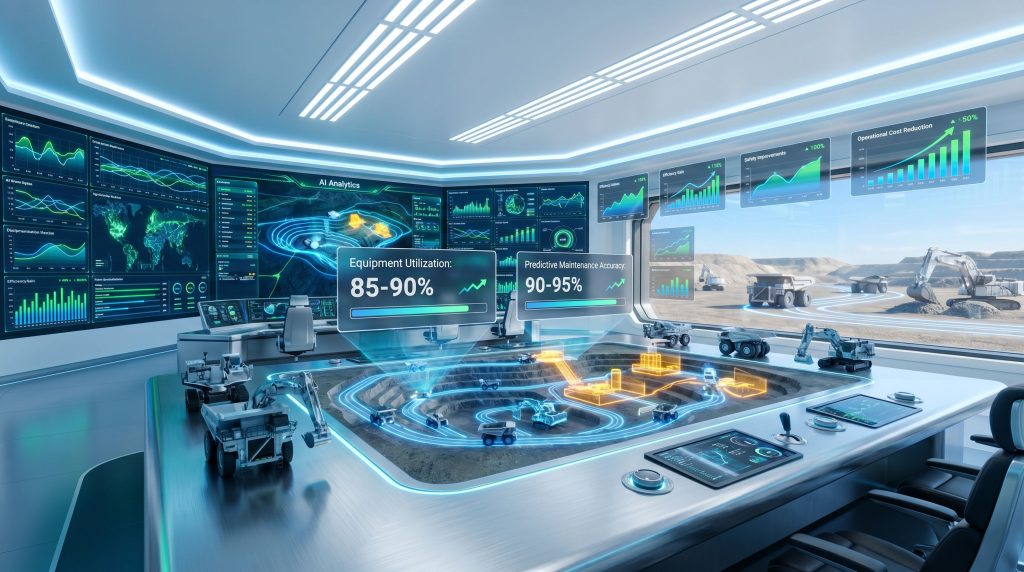
AI implementation success in mining is measured through specific operational improvements including increased throughput, reduced energy consumption, enhanced safety performance, and improved asset utilisation rates.
| Metric Category | Traditional Baseline | AI-Enhanced Target |
|---|---|---|
| Equipment Utilisation | 75-80% | 85-90% |
| Predictive Maintenance Accuracy | 60-70% | 90-95% |
| Safety Incident Reduction | Baseline | 20-30% decrease |
| Energy Efficiency Improvement | Baseline | 10-15% reduction |
Return on Investment Through Operational Excellence
Mining companies evaluate AI investments based on tangible improvements in production efficiency, cost reduction, and risk mitigation. Successful implementations demonstrate clear value creation through enhanced operational capabilities that justify significant capital expenditures.
Continuous Improvement Requirements
No problem is solved entirely during initial technology introduction. AI systems require continuous improvement processes, software evolution, and performance optimisation to maintain value generation throughout their operational lifecycle.
Future Technology Developments and Industry Evolution
Emerging Sensor Technologies
The next generation of mining AI applications will be enabled by advanced sensing technologies that measure previously undetectable variables in raw materials and processing environments. These capabilities will expand the scope of AI-assisted decision-making beyond current limitations.
Critical sensing requirements include:
- Real-time ore grade analysis
- Mineral composition identification
- Equipment condition monitoring
- Environmental parameter tracking
Integration of Physical and Digital Models
Future mining operations will seamlessly blend physical assets with digital twins, enabling real-time simulation and optimisation of complex processes. This integration will further enhance human operators' ability to manage large-scale operations effectively.
Digital twin technology allows operators to test scenarios, predict outcomes, and optimise parameters in virtual environments before implementing changes in physical systems, reducing risks and improving decision-making accuracy. This represents the future of automated mining operations.
Global Connectivity and Remote Operations
High-speed fibre optic networks now enable global standard connectivity that supports remote operation centres and international expertise sharing. Mining companies can leverage specialised knowledge regardless of geographic constraints through advanced communication systems.
This connectivity foundation enables Global Centres of Excellence that provide remote support worldwide at the speed of light, whilst maintaining local presence for cultural and operational requirements.
Adaptive Technology Evolution
The mining industry's future will be shaped by technology platforms that evolve alongside changing market demands and operational requirements. Rather than static implementations, successful AI systems will adapt continuously to new challenges and opportunities.
This adaptability requirement explains the industry's movement toward strategic partnerships rather than transactional technology purchases. Maintaining a strategic partnership allows companies to share risks and rewards whilst ensuring technology evolution supports long-term operational objectives.
However, the concept of humans empowered by AI behind the automated mine remains central to successful implementations, where strategic human oversight guides sophisticated automated systems toward optimal performance outcomes.
Disclaimer: This analysis contains forward-looking statements and industry projections based on current technology trends and expert opinions. Mining operations involve significant risks including commodity price volatility, regulatory changes, and operational challenges. Technology implementation outcomes may vary based on site-specific conditions, company capabilities, and market factors. Readers should conduct independent due diligence before making technology investment decisions.
Ready to Capitalise on AI-Driven Mining Opportunities?
Discovery Alert's proprietary Discovery IQ model delivers instant notifications when ASX mining companies announce significant technological breakthroughs and operational improvements, including AI-powered mining innovations. Explore Discovery Alert's discoveries page to understand why major mining technology advances can lead to substantial market returns, then start your 14-day free trial to position yourself ahead of the market.