August 20, 2026
The Hidden Fragility Inside America's Most Critical Industrial Chains
Consider a scenario where a single geopolitical disruption cuts off access to refined lithium hydroxide, processed cobalt sulfate, or battery-grade synthetic graphite. Within months, electric vehicle production stalls, grid storage deployment freezes, and defence procurement faces cascading shortages. This is not a hypothetical threat confined to academic risk models. It reflects the structural reality of how U.S. industrial supply chains are currently configured, with the vast majority of midstream mineral processing concentrated in foreign jurisdictions that operate outside American regulatory or strategic control.
The DOE $500 million critical mineral and battery supply chains initiative announced on August 20, 2026 represents the federal government's most targeted response yet to this vulnerability. However, understanding why this programme matters requires looking beyond the headline figure and examining the deeper architecture of the problem it is designed to solve.
When big ASX news breaks, our subscribers know first
Why Processing Capacity Is the Real Bottleneck, Not Mining
A common misconception in public debate around critical minerals demand is that domestic mining solves the supply chain problem. It does not. The extraction of raw ore is only the first step in a multi-stage industrial process. Raw lithium spodumene concentrate, for example, must be chemically converted into battery-grade lithium hydroxide or lithium carbonate before it can enter a cell manufacturing line.
Cobalt must be refined into cobalt sulfate. Graphite must be purified and shaped into anode material. Each of these conversion steps requires specialised industrial infrastructure, technical expertise, and significant capital expenditure. Over the past three decades, this midstream processing capacity was systematically offshored as global cost arbitrage made foreign refining economically dominant. The result is a processing capacity gap that cannot be closed by exploration drilling or new mine permits alone.
Key distinctions that define this gap include:
- Raw ore extraction produces a concentrate that is commercially unusable without further processing
- Hydrometallurgical and pyrometallurgical refining converts concentrates into battery-ready precursor materials
- Precursor chemical manufacturing transforms refined metals into cathode active materials and anode materials
- Cell component manufacturing integrates these processed inputs into functional battery components
Each stage represents a separate industrial capability that must exist domestically for true supply chain sovereignty. The DOE's programme directly targets the midstream and downstream layers where U.S. capacity is weakest.
What the DOE's $500 Million Initiative Actually Funds
Programme Architecture and the Three Investment Pillars
The $500 million allocation is the third funding round under the Battery Materials Processing and Battery Manufacturing and Recycling programmes operated by the DOE's Office of Critical Minerals and Energy Innovation (CMEI). This multi-cycle structure is significant. It signals a sustained, institutionalised commitment to rebuilding domestic capacity rather than a one-time political allocation.
Seven projects were selected through a competitive evaluation process. Letters of intent closed March 27, 2026, with full applications due April 24, 2026, indicating a rigorous multi-stage review rather than a discretionary grant process. Furthermore, the energy security minerals dimension of this investment cannot be overstated, given the strategic dependencies at stake.
The programme operates across three distinct but interdependent investment pillars:
| Investment Pillar | Core Focus Area | Facility Scale Targeted |
|---|---|---|
| Pillar 1 | Critical mineral processing from domestic raw feedstocks | Demonstration to commercial-scale |
| Pillar 2 | Battery material recycling infrastructure | Commercial-scale facilities |
| Pillar 3 | Battery materials and component manufacturing | New construction, retrofit, and retooling |
Which Minerals Are in Scope?
The programme targets the full battery cell chemistry stack rather than any single material. Primary focus minerals include lithium, nickel, cobalt, and graphite, which map directly onto cathode chemistries (NMC, NCA, LFP) and anode materials. Secondary targets include copper and aluminium, which serve dual roles as battery current collectors and broader industrial infrastructure materials.
This mineral selection reflects an understanding that battery supply chain vulnerability is not reducible to a single chokepoint. The entire electrochemical stack from anode to cathode to current collector relies on processed materials that currently flow predominantly through foreign industrial systems.
The Executive Order Framework and Policy Reorientation
From Climate Framing to Industrial Sovereignty
The $500 million programme operates under the authority of President Trump's Unleashing American Energy Executive Order. This policy foundation matters because it represents a deliberate reframing of critical minerals investment. Rather than positioning battery supply chain development as a climate or clean energy initiative, the programme is explicitly framed around domestic industrial capacity, supply chain sovereignty, and national security doctrine.
Secretary of Energy Chris Wright articulated the administration's position by characterising decades of foreign mineral dependency as a strategic vulnerability that U.S. policy is now actively reversing. The emphasis is on bringing critical materials production and processing back within American borders, not merely diversifying import sources.
Assistant Secretary Audrey Robertson reinforced this framing by positioning the initiative as decisive action to secure the supply chains that underpin national power. This language — treating mineral processing infrastructure as equivalent in strategic importance to energy grid infrastructure or defence industrial base capacity — represents a meaningful shift in how federal energy policy discourse is constructed.
CMEI as the Operational Execution Arm
The Office of Critical Minerals and Energy Innovation sits within DOE's organisational architecture as the dedicated execution vehicle for this mandate. CMEI coordinates across DOE programme offices, national laboratories, and private industry partners to move capital from policy intent to physical facility construction. The selection of seven projects from a competitive applicant pool reflects CMEI's role as a technical evaluator, not merely a grant administrator. For further context, the U.S. Department of Energy's announcement outlines the full scope of this commitment.
Quantifying the Domestic Capacity Shift
The 15% Reduction Target and What It Means
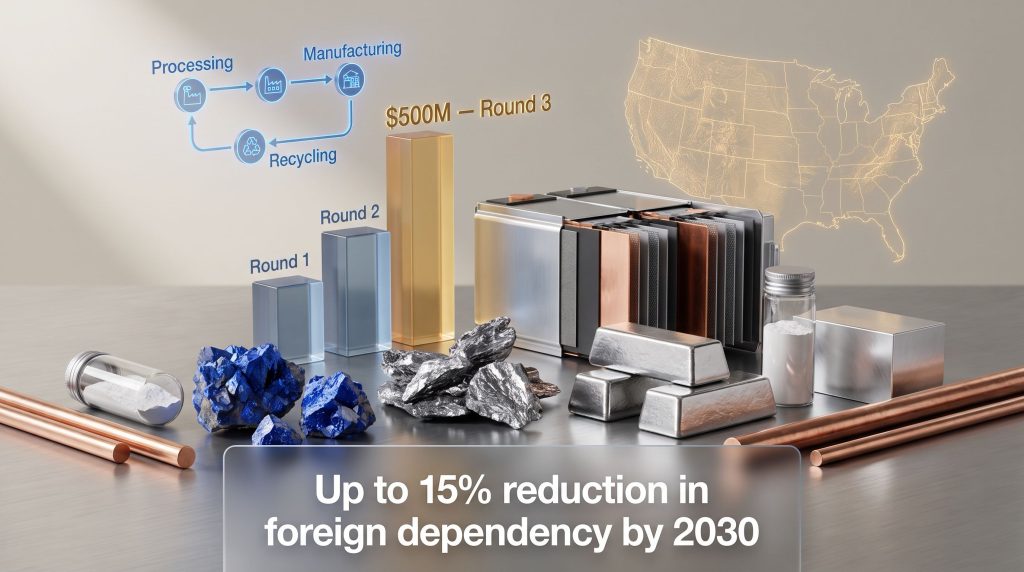
Programme modelling projects a reduction in foreign supply chain reliance of up to 15% by 2030 for key battery materials and components. At first glance, this figure may appear modest. In context, however, it represents a structurally significant inflection point.
U.S. battery demand is scaling rapidly across three converging sectors: electric vehicle manufacturing, grid-scale energy storage deployment, and defence system modernisation. A 15% domestic capacity increase applied against that volume of demand translates to substantial physical quantities of material that no longer require foreign processing, foreign logistics chains, or foreign political cooperation.
The multiplier effect compounds this impact:
- Domestic processing facilities create upstream demand for domestic mining operations, improving the commercial viability of U.S. mineral extraction projects
- Downstream, domestic processed materials feed domestic cell and component manufacturers, reducing import dependency at multiple supply chain nodes simultaneously
- Commercial-scale recycling operations recover domestically processed material at end-of-life, preventing it from re-entering foreign-controlled material flows
Comparing Funding Rounds: The Progression of Federal Commitment
| Funding Round | Programme Focus | Key Outcome Objective |
|---|---|---|
| Round 1 | Early processing and manufacturing pilots | Proof-of-concept validation |
| Round 2 | Scaling selected technologies | Transition to demonstration scale |
| Round 3 (Current, $500M) | Seven projects selected | Commercial-scale capacity and recycling integration |
This progression is not accidental. Federal capital deployed at commercial scale targets the point of maximum market de-risking, where private capital faces the highest barriers due to technology uncertainty and offtake risk. By absorbing a portion of that risk, the programme is designed to catalyse private co-investment beyond the $500 million federal allocation.
Battery Recycling as a Supply Chain Security Mechanism
Why Recycling Is Not an Environmental Story
One of the less widely understood dimensions of this initiative is its treatment of the battery recycling process as a supply chain security instrument rather than an environmental compliance measure. The logic is straightforward: every kilogram of lithium, cobalt, or nickel recovered from a spent battery within the United States is a kilogram that does not need to be imported, refined abroad, or sourced from a geopolitically exposed supply chain.
At commercial scale, this creates a domestic secondary materials market that progressively reduces the volumetric demand placed on primary import channels. The economic equation is also evolving. As battery deployment volumes accumulate and end-of-life material flows increase, the feedstock availability for recycling operations improves, moving cost parity with primary processing closer to realisation.
The Infrastructure Stack for Commercial Recycling
Achieving commercial-scale recycling requires a sequential infrastructure stack that is often underappreciated in policy discussions:
- Collection and logistics networks to aggregate spent batteries from diverse end-use applications
- Pre-processing facilities for safe dismantling, module separation, and mechanical shredding to produce black mass
- Hydrometallurgical recovery plants that chemically dissolve black mass and selectively precipitate target metals
- Refining and purification stages that bring recovered materials to battery-grade specification
- Reintegration into the supply chain as refined precursor inputs for new cell production
The DOE's explicit emphasis on commercial-scale facilities rather than pilot programmes is critical here. Pilot-scale recycling has been technically demonstrated. What the market lacks is the capital and offtake certainty to justify full-scale facility construction. Federal co-investment addresses precisely this barrier.
The next major ASX story will hit our subscribers first
Geopolitical Context: How U.S. Strategy Compares Internationally
The Global Race for Mineral Processing Sovereignty
The United States is not operating in isolation. Peer economies and allied nations have each developed their own strategic responses to the same processing capacity gap. Understanding these parallel frameworks provides important context for evaluating the scale and ambition of the U.S. approach. In addition, innovations such as direct lithium extraction are increasingly shaping how allied nations approach upstream supply chain efficiency.
| Jurisdiction | Policy Mechanism | Investment Scale | Primary Focus |
|---|---|---|---|
| United States | DOE CMEI grants and Executive Order mandate | $500M (Round 3) | Processing, manufacturing, and recycling |
| European Union | Critical Raw Materials Act | Multi-billion EUR | Diversified sourcing and processing |
| Australia | Critical Minerals Strategy | AUD billions | Upstream mining and early processing |
| Canada | Critical Minerals Strategy | CAD billions | Extraction and allied nation supply |
A concept gaining traction across these allied frameworks is friend-shoring — the alignment of mineral supply chains preferentially with geopolitically stable trading partners. Friend-shoring can reduce exposure to adversarial leverage points without requiring fully domestic supply chains. However, it does not eliminate the core vulnerability: without domestic processing capacity, even materials sourced from allied nations must transit foreign industrial systems before reaching U.S. manufacturers.
Domestic processing capacity therefore remains the non-negotiable foundation within any friend-shoring strategy. Allied sourcing diversifies the upstream; domestic processing secures the midstream. Consequently, frameworks addressing critical raw materials across allied jurisdictions remain essential to understanding the broader strategic landscape. The USSC analysis on supply chain resilience further reinforces why physical processing capacity remains central to any durable strategy.
"The concentration of synthetic graphite production, lithium hydroxide refining, and cobalt sulfate processing in a small number of foreign jurisdictions creates structural leverage points that no amount of diplomatic relationship management fully neutralises. Physical industrial capacity within U.S. borders is the only durable solution."
Frequently Asked Questions: DOE $500 Million Critical Mineral and Battery Supply Chain Funding
What does the $500 million cover?
The allocation funds three operational domains: processing of critical minerals from domestic raw feedstocks, commercial-scale battery material recycling infrastructure, and battery materials and component manufacturing through new construction, facility retrofitting, and equipment retooling.
Which minerals are targeted?
The programme focuses on lithium, nickel, cobalt, graphite, copper, and aluminium. These materials span the full electrochemical architecture of battery cells and extend into broader energy infrastructure applications.
What project scale does the DOE support?
The programme explicitly targets demonstration-scale and commercial-scale projects, distinguishing it from early-stage research funding. Eligible categories include new facility construction, retrofitting of existing industrial sites, and retooling of manufacturing operations.
Is this a one-time allocation?
No. This is the third funding round under the Battery Materials Processing and Battery Manufacturing and Recycling programmes, confirming a structured multi-cycle federal investment approach with demonstrated continuity across administrations.
What is the application process?
The competitive process required letters of intent by March 27, 2026, and full applications by April 24, 2026. Seven projects were selected by CMEI from the applicant pool following multi-stage technical evaluation.
Key Takeaways for Industry and Investors
The DOE $500 million critical mineral and battery supply chains initiative carries implications that extend well beyond the seven selected projects:
- The shift to commercial-scale funding signals federal intent to permanently alter the domestic industrial baseline, not fund temporary demonstration programmes that expire without lasting capacity
- Battery recycling integration within the same framework reflects a full supply chain lifecycle approach that closes the materials loop and reduces perpetual import dependency
- The projected 15% reduction in foreign dependency by 2030, while incremental as a percentage, establishes a measurable benchmark against which programme success can be independently evaluated
- The multi-round programme structure reduces policy discontinuity risk for private investors, providing a more durable co-investment framework than single-cycle appropriations
- For mining and materials companies operating in the U.S. or in allied jurisdictions, the growth of domestic processing capacity creates new downstream offtake pathways that did not previously exist at commercial scale
This article is intended for informational purposes only and does not constitute financial or investment advice. Projections referenced, including the 15% reduction in foreign supply chain dependency by 2030, are based on programme modelling and are subject to change. Readers should conduct independent research before making investment decisions.
Want to Identify the Next Major Mineral Discovery Before the Market Does?
As the U.S. accelerates its push for critical mineral supply chain sovereignty, the race to secure lithium, cobalt, graphite, and nickel is creating significant opportunities on the ASX — and Discovery Alert's proprietary Discovery IQ model delivers real-time alerts the moment a significant mineral discovery is announced, ensuring subscribers are positioned ahead of the broader market. Explore historic discoveries and their exceptional returns on Discovery Alert's dedicated discoveries page, and begin your 14-day free trial today to gain an immediate market-leading edge.