June 11, 2026
The Mineral Foundations of a Low-Carbon World
Every solar panel, every electric vehicle battery, and every wind turbine generator tells a story that begins not in a factory, but deep within the earth. The accelerating global push toward clean energy is fundamentally a story about minerals, and the nations that hold those minerals in abundance are rapidly discovering that geological fortune can translate into extraordinary geopolitical leverage. Understanding this reality requires stepping back from the headlines about climate targets and carbon neutrality to examine the physical supply chains that make decarbonisation physically possible.
This mineral-first perspective reframes how the world should view Brazil. Long regarded primarily as an agricultural powerhouse and emerging consumer market, Brazil is increasingly recognised by governments, institutional investors, and industrial strategists as one of the most consequential mineral territories on earth. The country's extraordinary endowment of minerais críticos no Brasil positions it at the intersection of the clean energy transition, geopolitical supply chain restructuring, and a generational opportunity for domestic industrial development.
When big ASX news breaks, our subscribers know first
What Are Critical Minerals and Why Does the Classification Matter?
The term "critical mineral" carries specific technical and policy weight that extends well beyond common usage. In the Brazilian regulatory context, a mineral earns this classification when it meets two conditions simultaneously: it is essential for economic, industrial, or defence applications, and it faces meaningful supply disruption risk due to geographic concentration, geopolitical fragility, or import dependency.
Brazil's official list, first formalised by the federal government in 2021, encompasses ten minerals that satisfy these criteria:
- Cobalt (cobalto)
- Copper (cobre)
- Graphite (grafita)
- Lithium (lítio)
- Niobium (nióbio)
- Nickel (níquel)
- Rare earth elements (terras raras)
- Titanium (titânio)
- Uranium (urânio)
- Vanadium (vanádio)
A technical distinction worth noting is that Brazilian regulatory architecture separates "critical minerals" from "strategic minerals," with the latter category carrying additional national security considerations and a distinct governance framework. This nuance is often lost in international discussions that treat the two terms as interchangeable. For further context on how these definitions compare globally, this overview from Agência Brasil provides a clear breakdown of the distinctions between rare earths and strategic minerals in the Brazilian context.
How Different Regulatory Frameworks Define Criticality
The global race to secure mineral supply chains has produced multiple, sometimes overlapping frameworks for identifying which resources demand policy priority:
| Framework | Jurisdiction | Primary Criteria | Key Focus |
|---|---|---|---|
| Inflation Reduction Act (IRA) | United States | Supply chain security, domestic processing | Battery minerals, defence applications |
| Critical Raw Materials Act (CRMA) | European Union | Strategic autonomy, economic importance | Clean tech, digital technologies |
| National Strategic Minerals List | Brazil | Economic essentiality, supply risk | Energy transition, industrial competitiveness |
| Critical Minerals Strategy | Australia | Export diversification, processing investment | Mining-to-processing value chain |
The urgency behind all of these frameworks intensified sharply between 2020 and 2026, as pandemic-era supply chain fractures exposed the vulnerability of concentrating mineral processing in a single geographic region. The recognition that China controls dominant shares of rare earth processing, graphite refining, and lithium chemical production catalysed competing nations into accelerated efforts to diversify sourcing and build alternative supply networks. Furthermore, rare earth supply chains have become a central battleground in the broader contest for clean energy industrial leadership.
Brazil's True Mineral Potential in Global Clean Technology Supply Chains
The Geography of Strategic Reserves
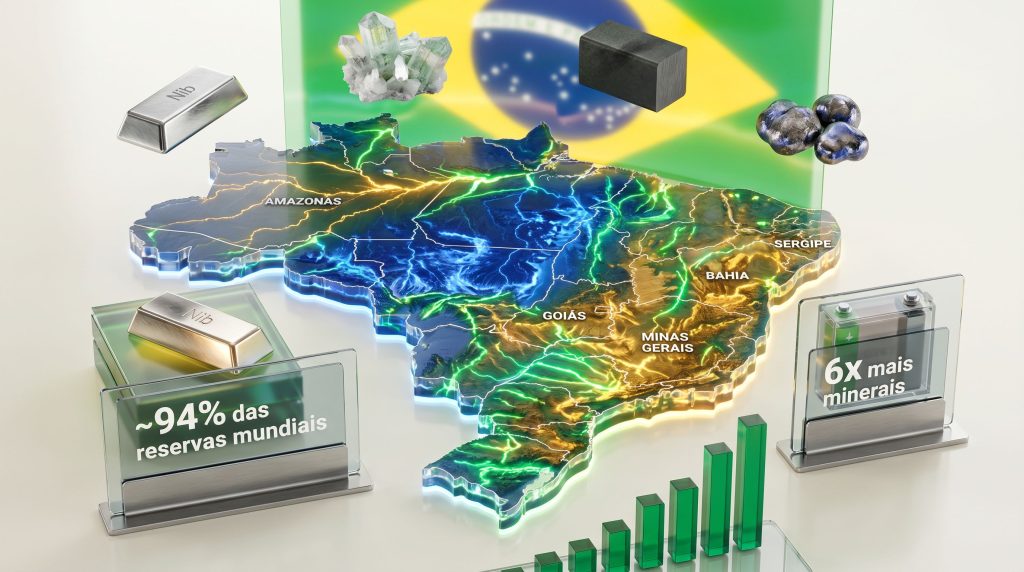
Brazil's mineral endowment is remarkable not only for its volume but for its diversity. The country holds a near-monopoly position in niobium, controlling approximately 94% of global known reserves, a concentration that is almost without parallel in the critical minerals world. This extraordinary dominance in a mineral essential for high-strength steels, superconductors, and advanced alloys gives Brazil a degree of pricing power and strategic leverage that few nations possess over any resource of industrial importance.
Beyond niobium, the Brazilian Geological Service (SGB) has identified significant rare earth element potential across five distinct states: Minas Gerais, Goiás, Amazonas, Bahia, and Sergipe. These provinces vary in their geological character, with some hosted in lateritic weathering profiles within the Amazon region and others associated with alkaline complexes in southeastern Brazil, meaning the composition and processing requirements differ meaningfully between deposits.
Lithium potential has expanded considerably with discoveries in pegmatite formations, particularly in Minas Gerais and Bahia. In addition, nickel and cobalt occurrences frequently associate with lateritic and sulfidic deposits in Pará and Goiás. Graphite resources position Brazil competitively in the supply of anode materials for battery manufacturing, an application whose demand trajectory is directly linked to electric vehicle adoption rates.
| Mineral | Brazil's Global Position | Primary Applications | Key States |
|---|---|---|---|
| Niobium | ~94% of world reserves | High-strength steel, superconductors | Minas Gerais |
| Rare Earths | Significant provinces identified | Electric motors, permanent magnets | MG, GO, AM, BA, SE |
| Lithium | Expanding reserve base | Li-ion batteries | MG, BA |
| Graphite | Competitive global position | Battery anodes | Multiple states |
| Nickel | Substantial lateritic deposits | Batteries, stainless steel | PA, GO |
| Cobalt | Associated with nickel occurrences | Batteries, aerospace | PA, GO |
From Resource to Value Chain: The Aggregation Challenge
Possessing reserves is categorically different from capturing value from them. Brazil has historically operated as a raw material exporter, shipping minerals with minimal processing and capturing a relatively small share of the total value created across the supply chain. This pattern represents what economists describe as "commodity trap" dynamics, where resource-rich nations remain price-takers rather than price-setters in the markets their resources ultimately serve.
Pablo Cesário, president of IBRAM, the Brazilian Mining Institute, articulated a clear vision for transcending this trap at the International Seminar on Critical and Strategic Minerals held on 9 June 2026 in Brasília. Cesário argued that Brazil's mineral future depends on combining resource abundance with knowledge creation, scientific development, and genuine innovation capacity, advocating for a model where critical mineral exploitation is inseparable from value addition and deeper participation in global production chains.
International precedents offer instructive lessons. Australia has progressively expanded its lithium value chain from spodumene concentrate exports toward downstream hydroxide processing, despite significant capital intensity requirements. Chile has leveraged its copper dominance to attract smelting and refining investment, while Canada's rare earth and battery mineral sectors benefit from strong government-industry alignment on processing investment. Each of these trajectories required sustained policy commitment and patient capital deployment over decades.
Brazil's institutions supporting this transition include the Mineral Technology Center (CETEM), universities with strong materials science and metallurgy programmes, and research funding bodies including FINEP, BNDES, and CNPq. The scientific infrastructure exists; however, the challenge lies in connecting it more systematically to commercial mineral processing development and scaling those capabilities to industrial relevance.
The competitive advantage available to Brazil is not simply the volume of what lies underground. It is the combination of geological abundance, qualified researchers, established scientific institutions, and commercial partnerships that together create something rare: a resource-rich nation with the intellectual capital to move beyond extraction.
How Brazil's Regulatory Framework Is Evolving
Project Law 2780/2024 and the Construction of a National Policy
The legislative landmark defining Brazil's current regulatory trajectory is Project Law 2780/2024, which proposes establishing an integrated National Policy for Critical and Strategic Minerals. This legislation passed the Chamber of Deputies with notable cross-partisan consensus and is currently advancing through the Senate Federal in 2026.
The political significance of this consensus was explicitly highlighted at the June 2026 IBRAM seminar. Deputy Arnaldo Jardim, who served as rapporteur for the bill in the Chamber, emphasised the alignment between the Executive and Legislative branches in constructing a durable state policy rather than a transient government initiative. Jardim expressed confidence that the Senate was unlikely to substantially alter the legislation's direction, suggesting the bill represented genuine cross-institutional commitment rather than partisan positioning.
This distinction between a "state policy" and a "government policy" carries significant practical implications for investors. State policies tend to persist across election cycles and government changes, providing the regulatory stability that long-duration capital projects in mining require. A policy that depends on a single administration's priorities provides fundamentally weaker investment assurance than one embedded in durable legislative architecture.
Regulatory Timeline: Key Milestones in Brazil's Mineral Policy Evolution
| Year | Regulatory Development | Significance |
|---|---|---|
| 2021 | Federal government publishes official strategic minerals list | Formal scope definition for policy priority |
| 2024 | PL 2780/2024 presented to legislature | First integrated national policy framework proposed |
| 2025 | Chamber of Deputies approval | Broad political consensus achieved |
| 2026 | Senate consideration underway | Legislative consolidation anticipated |
The Institutional Architecture Supporting Implementation
Effective mineral policy requires more than legislation; it demands institutional capacity to implement, monitor, and adapt regulatory frameworks. Brazil's key institutions in this space include:
- ANM (National Mining Agency): Responsible for licensing, oversight, and maintaining registers of areas with critical mineral potential
- SGB (Brazilian Geological Service): Conducting geological mapping and maintaining inventories of strategic resources
- IBRAM (Brazilian Mining Institute): Bridging private sector interests with government policy and international sustainability standards
- MME (Ministry of Mines and Energy): Coordinating integrated energy and mineral policy at the national level
Ana Paula Bittencourt, Secretary of National Geology, Mining, and Mineral Transformation, representing Minister Alexandre Silveira at the IBRAM seminar, noted that mining has entered a distinctive moment where it has gained recognition as a strategic state sector. Consequently, it has moved beyond being a concern exclusively for mineral-producing countries, given the breadth of global demand for critical and strategic minerals and Brazil's potential to become a major supplier.
The Connection Between Critical Minerals and the Global Energy Transition
Sustainable Energy Cannot Exist Without Mining
A persistent and consequential misconception in public discourse about decarbonisation is that clean energy technologies represent a departure from resource extraction. In reality, the energy transition is exceptionally mineral-intensive. According to the International Energy Agency, demand for minerals critical to clean energy technologies could grow by up to six times by 2040 under scenarios consistent with Paris Agreement targets. Indeed, critical minerals demand is increasingly recognised as one of the defining supply chain challenges of the coming decade.
The scale of mineral dependency varies by technology:
- Electric vehicles require approximately six times more minerals than conventional combustion engine vehicles, drawing heavily on lithium, cobalt, nickel, graphite, and manganese
- Offshore wind turbines utilise up to nine times more mineral resources per unit of installed capacity than natural gas power plants, with particular reliance on rare earth elements for permanent magnet generators and high-strength steel (incorporating niobium) for structural components
- Solar photovoltaic panels depend on silicon, silver, tellurium, and indium, with demand scaling directly with deployment rates
- Nuclear energy infrastructure requires uranium, zirconium, and hafnium at various stages of the fuel cycle
The implications for minerais críticos no Brasil are direct. The country's niobium monopoly positions it as an indispensable supplier for the high-strength steel that goes into renewable energy infrastructure. Its rare earth potential connects to the permanent magnet motors in electric vehicles and wind generators. Its lithium and graphite resources link directly to battery supply chains, while its nickel deposits contribute to the cathode materials increasingly favoured in next-generation battery chemistries.
A Demand Multiplier That Few Have Fully Priced In
What is less widely appreciated is the mineral demand multiplier effect emerging from the digital economy. Cesário made this connection explicit at the June 2026 seminar, noting that growing energy demands to support artificial intelligence infrastructure, data centre expansion, and broad digitalisation reinforce the strategic importance of mining. This creates demand pressures on the energy system that flow directly back to mineral requirements, producing a second-order demand dynamic where the energy needed to power AI and digital services drives additional clean energy deployment, which in turn drives additional mineral demand beyond the direct automotive and grid storage markets typically modelled in commodity forecasts.
How Brazil Can Become a Reliable and Competitive Global Supplier
The Four Pillars of a National Critical Minerals Strategy
Pillar 1: Governance and Regulatory Predictability
Long-duration capital projects, which mining projects inherently are, require regulatory stability as a prerequisite for investment. Brazil's environmental licensing process has historically presented challenges in terms of timeline predictability, creating uncertainty that increases financing costs and deters risk-averse capital. The challenge for policymakers is designing processes that maintain rigorous socio-environmental standards while delivering the timeline predictability that makes Brazil competitive with peer jurisdictions. ESG compliance has additionally transitioned from a reputational consideration to a market access requirement, with European and Japanese buyers increasingly demanding certifiable provenance and environmental performance standards.
Pillar 2: International Cooperation and Bilateral Agreements
Brazil's engagement with the Minerals Security Partnership signals its recognition that integration into Western-aligned supply chains requires active diplomacy as well as geological advantage. The May 2026 announcement of a port construction initiative involving Japan, India, the United States, and Australia investing in critical minerals infrastructure directly addresses Brazil's logistical limitations. Bilateral partnerships with technology-rich nations offer Brazil access to processing know-how it currently lacks domestically, while long-term offtake agreements provide the revenue predictability that reduces financing costs for capital-intensive projects.
The Viridis and Solvay partnership announced in June 2026, focused on processing rare earths from the Colossus project within Brazil, illustrates precisely this model: international technology expertise combined with domestic resource advantage to develop in-country processing capabilities. Furthermore, critical minerals and energy security considerations are driving governments across Europe, North America, and the Asia-Pacific to actively pursue supply agreements with resource-endowed nations like Brazil.
Pillar 3: Innovation, Science, and Technological Development
Cesário's articulation of a "mining plus knowledge" vision represents more than aspiration; it describes a specific strategic pathway. The model requires sustained investment in applied research for mineral beneficiation and refining, development of human capital in mining engineering, geology, metallurgy, and materials science, and systematic linkages between academic institutions and commercial mineral developers. Funding bodies including FINEP, BNDES, and CNPq provide mechanisms for financing this innovation chain, though the scale and coordination of their deployment will determine whether they generate transformative industrial capabilities or remain fragmented research activities.
Technological innovation is also reshaping processing methods. For instance, direct lithium extraction techniques are emerging as a potentially transformative approach to reducing water usage and improving recovery rates in lithium projects, an area where Brazil could benefit significantly given its growing lithium resource base.
Pillar 4: Territorial Development and Shared Prosperity
Cesário was direct at the June 2026 seminar on the social dimension of this strategic opportunity: the fundamental challenge for Brazil is transforming its mineral wealth into durable opportunities for workers, communities, entrepreneurs, and investors, creating what he described as a sustainable and lasting cycle for everyone rather than merely generating short-lived commodity booms. This framing connects mineral policy to royalty structures, local participation requirements, community engagement processes, and mechanisms for ensuring indigenous and traditional communities maintain meaningful voice in decisions affecting their territories.
The next major ASX story will hit our subscribers first
Key Challenges That Could Limit Brazil's Ambitions
Structural Bottlenecks and Risks the Sector Must Address
Brazil's mineral ambitions face several structural constraints that are well understood within the industry but often underweighted in optimistic narratives about the country's potential:
- Infrastructure deficit: The distance between mineral deposits and export ports creates logistics costs that directly affect Brazil's price competitiveness against closer-to-market alternatives in Australia or southern Africa
- Market concentration risk: Dependence on a limited number of buyers creates vulnerability to geopolitical shifts, bilateral trade disputes, or demand-side policy changes in key consuming markets
- Capital cycle challenges: Mining projects typically require a decade or more from discovery to production, demanding patient capital that can withstand commodity price cycles, regulatory delays, and technical setbacks
- Environmental and social liabilities: Brazil carries historical legacies of environmental damage from extractive industries that create reputational headwinds in markets where ESG provenance is increasingly scrutinised
- Processing technology gap: Domestic refining capacity for several critical minerals, particularly rare earth elements, remains limited compared to global leaders, meaning the value-addition ambition requires substantial technological investment before it can be commercially realised
The industry publication Brasil Mineral reported in May 2026 that while capital is arriving in the Brazilian mining sector, the industry is demanding greater regulatory predictability as a condition for sustained investment commitment, a signal that investor confidence remains conditional on policy improvements rather than already secured.
Three Scenarios for Brazil's Critical Mineral Future
| Scenario | Enabling Conditions | Projected Outcome by 2035 |
|---|---|---|
| Optimistic | Consolidated regulatory framework, active international partnerships, scaled R&D investment | Brazil among the top three global suppliers of processed critical minerals |
| Base Case | PL 2780 enacted, moderate foreign investment, continued dominance of raw material exports | Revenue growth from mineral exports without significant value-added capture |
| Pessimistic | Regulatory instability, licensing bottlenecks, loss of competitiveness to peer jurisdictions | Structural underperformance; other nations capture clean energy transition demand |
How Global Investors Are Evaluating the Brazilian Mineral Sector
Capital Flows, Requirements, and Competitive Positioning
The composition of sponsors at the June 2026 IBRAM International Seminar provides a telling indicator of investor interest. BHP and Vale Base Metals participated as Master-level sponsors, with Norsk Hydro and Lundin Mining at the Diamond tier, alongside Brazilian entities including Borborema Recursos Estratégicos and Taboca S.A. This mix of global mining majors, European industrial companies, and domestic specialists reflects the breadth of international capital now actively engaged with Brazil's critical minerals opportunity.
What institutional capital requires before committing to Brazilian mineral projects is reasonably well understood from patterns across comparable jurisdictions:
- Regulatory clarity and timeline certainty for environmental licensing and permitting
- Demonstrated ESG performance including community relations and environmental management
- Infrastructure access or credible infrastructure development plans connecting deposits to export logistics
- Political stability and evidence that policy frameworks will persist across government transitions
- Offtake visibility in the form of letters of intent, binding contracts, or credible market access pathways
For long-horizon investors willing to absorb regulatory risk in exchange for early positioning in strategic assets, Brazil's current period of legislative consolidation represents a characteristic window. The combination of substantial geological endowment with policy frameworks still crystallising creates conditions where patient capital can establish positions at valuations that may not persist once regulatory clarity is fully achieved.
Disclaimer: The above represents a general analytical observation about investment timing dynamics and does not constitute financial advice. Investors should conduct independent due diligence and consult qualified financial advisers before making investment decisions.
A comparison with peer jurisdictions illustrates Brazil's relative positioning. Moreover, Brazil's critical minerals trade strategy will prove decisive in determining whether the country captures a disproportionate share of growing global demand or cedes ground to more aggressively positioned competitors:
| Country | Geological Endowment | Regulatory Stability | Processing Capability | ESG Standards Compliance |
|---|---|---|---|---|
| Australia | High | High | Growing | High |
| Chile | High (lithium, copper) | Moderate | Moderate | Moderate-High |
| Brazil | Very High (diversified) | Developing | Limited | Developing |
| DRC | High (cobalt) | Low | Low | Low |
FAQ: Critical Minerals in Brazil
What are critical minerals in Brazil?
Critical minerals are those considered essential for the economy, defence industry, and energy transition, with potential supply disruption risk. Brazil's official list includes cobalt, copper, graphite, lithium, niobium, nickel, rare earth elements, titanium, uranium, and vanadium. The IBRAM report on critical and strategic minerals in Brazil provides comprehensive data on reserves, policy frameworks, and sector development.
Which critical mineral does Brazil dominate globally?
Brazil holds approximately 94% of known global niobium reserves, conferring an unparalleled leadership position in this mineral essential for high-strength steels and advanced industrial applications.
Where are Brazil's main rare earth reserves located?
The Brazilian Geological Service has identified significant rare earth potential in Minas Gerais, Goiás, Amazonas, Bahia, and Sergipe, with varying geological profiles across each province.
What is Project Law 2780/2024?
PL 2780/2024 is the legislation proposing to establish Brazil's National Policy for Critical and Strategic Minerals. Approved in the Chamber of Deputies with broad political consensus, it is currently advancing through the Senate Federal in 2026.
Why are critical minerals essential for the energy transition?
Clean energy technologies are intensively mineral-dependent. Electric vehicles require approximately six times more minerals than conventional vehicles, while offshore wind installations use up to nine times more mineral resources per installed capacity unit than gas-fired power plants. Without adequate mineral supply, the energy transition cannot proceed at the pace required to meet global climate commitments.
Does Brazil currently export processed critical minerals or raw ore?
Brazil predominantly exports raw ore or minimally processed mineral products. Developing domestic processing and refining capacity is a central objective of the minerais críticos no Brasil policy under construction, representing the shift from comparative to competitive advantage.
What is the "mining plus knowledge" concept?
This framework, articulated by IBRAM leadership, describes a development model where mineral exploitation is systematically linked to scientific research, technological innovation, and industrial value addition, enabling Brazil to participate in global supply chains as a value-added producer rather than purely as a raw material source.
Brazil at a Generational Crossroads
From Geological Fortune to Industrial Leadership
The alignment of forces currently converging around Brazil's mineral sector is historically unusual. Global supply chains are being deliberately restructured away from single-point concentration risk. Clean energy technology deployment is accelerating demand for the specific minerals Brazil holds in abundance. A legislative framework with cross-partisan support is establishing durable policy architecture. And international capital, including major global mining companies, is actively engaging with the Brazilian opportunity.
What remains to be resolved is whether Brazil can make the transition from comparative advantage — possessing resources that others want — to competitive advantage, having the processing capability, regulatory environment, and commercial infrastructure to serve demanding global markets reliably. That transition requires sustained policy commitment across election cycles, patient capital deployment, technological investment, and genuine partnership with the communities whose lands contain these resources.
Cesário's framing at the June 2026 seminar captures the stakes precisely: the objective is not another commodity boom that concentrates wealth briefly before dissipating, but a sustainable and lasting cycle that creates durable opportunity across Brazilian society. Whether this aspiration becomes reality will depend on the quality of decisions made in the coming five to ten years, a period during which the foundations of the global clean energy supply chain are being set in ways that will likely persist for decades.
The window is open for minerais críticos no Brasil to drive a genuine industrial transformation. However, how long it remains so will depend on how quickly Brazil's institutional actors, private investors, scientific community, and local stakeholders can align around a shared vision for what responsible, value-adding mineral development actually looks like in practice.
This article is intended for informational purposes only and does not constitute financial, legal, or investment advice. Projections and scenario analyses reflect analytical frameworks and are inherently uncertain. Readers should conduct independent research and seek professional guidance before making investment or business decisions related to the mining sector.
Want to Track the Next Major Mineral Discovery Before the Broader Market Does?
Discovery Alert's proprietary Discovery IQ model delivers real-time alerts on significant ASX mineral discoveries — instantly translating complex geological data into actionable investment insights across critical commodities including lithium, nickel, rare earths, and more. Explore how historic mineral discoveries have generated substantial returns and begin your 14-day free trial today to position yourself ahead of the market.