
June 10, 2026
When a Single Unit Fails, an Entire Region Feels It
Refinery systems are among the most interconnected industrial architectures ever built. Unlike a factory that produces discrete units, a large-scale refining complex operates as a continuous, interdependent flow of chemical conversions — where the output of one unit feeds the input of the next. This interdependency is precisely why a failure in one process train can compress total output far beyond what the size of that individual unit would suggest.
This dynamic sits at the heart of the Dangote refinery petrol unit cut that has unfolded across mid-2026. What began as a feedstock mismatch in May has evolved into a more serious process containment failure, and the downstream effects on gasoline export volumes have been dramatic. Understanding why requires a closer look at the specific unit at the centre of the disruption — and what its role means for Africa's most significant refining asset.
When big ASX news breaks, our subscribers know first
The Unit That Drives Gasoline Yield: How the RFCCU Works
The Conversion Engine Inside a Modern Refinery
When crude oil is first processed through an atmospheric distillation column, the lighter fractions — naphtha, kerosene, gas oil — separate relatively easily. What remains at the bottom is a dense, heavy residue that has limited commercial value in its raw form. The Residual Fluid Catalytic Cracking Unit, or RFCCU, exists specifically to unlock value from this residue.
The process works by exposing heavy residual oils to a fluidised bed of catalyst particles at high temperatures, typically between 500 and 550 degrees Celsius. This catalytic environment breaks apart large hydrocarbon chains into smaller, lighter molecules — the building blocks of gasoline, diesel, and liquefied petroleum gas. The catalyst itself is continuously circulated between a reactor vessel and a regenerator, where carbon deposits are burned off before the catalyst returns to active duty.
This circulation loop is the unit's critical vulnerability. Any breach in the system — whether through a mechanical valve fault or a physical catalyst leak — forces an immediate shutdown, because continued operation risks contaminating downstream process streams and causing progressive mechanical damage to the unit's internal structure.
Why Output Losses Are Non-Linear
The RFCCU typically contributes a disproportionately large share of a refinery's total gasoline-range yield. In a complex conversion refinery like Dangote's, the unit may account for 40 to 60 percent of total motor gasoline production capacity, depending on crude slate and operating configuration. This means a 34% reduction in the unit's operating rate does not translate to a 34% reduction in overall gasoline output — the actual impact on exportable volumes is considerably larger, as confirmed by the export data that followed.
A catalyst leak in an RFCCU is categorically more serious than a valve fault. It requires physical inspection of reactor internals, catalyst inventory management, and in many cases, the replacement of refractory linings or cyclone separators — work that cannot be safely rushed without risking further damage to the unit's core structure.
Two Disruptions, Two Different Failure Modes
Phase One: Feedstock Mismatch and Valve Fault (May 2026)
The first phase of the Dangote refinery petrol unit cut began on 21 May 2026, when operating rates at the RFCCU were reduced by 34%. The initial driver was a feedstock availability problem rather than a mechanical failure. Lighter crude grades being processed through the refinery produced insufficient residual feed for the RFCCU to operate at design capacity — a phenomenon known in refinery operations as crude slate mismatch.
By late May, industry monitor IIR Energy identified a secondary complication: a fault in the flue gas slide gate valve, a critical flow-control component in the unit's regeneration circuit. IIR Energy indicated at the time that repair work was near completion, with a return to full operating rates projected for mid-June 2026.
Phase Two: Catalyst Leak and Emergency Shutdown (August 2026)
The more significant disruption occurred on 29 August 2026, when the petrol unit was taken offline following a catalyst leak. Dangote Refinery had previously indicated no scheduled maintenance shutdown was planned for the unit, confirming this as an unplanned operational event rather than a routine turnaround.
IIR Energy subsequently assessed that major repairs and potential equipment replacement could extend the outage to two to three months beyond the initial restart target of 20 September 2026 — meaning a realistic recommissioning timeline of late October to November 2026. Furthermore, according to reporting from CNBC Africa, the gasoline unit could remain shut for two to three months, underlining the severity of the containment breach.
| Event | Date | Failure Type | Estimated Resolution |
|---|---|---|---|
| RFCCU rate reduction | 21 May 2026 | Feed availability + valve fault | Mid-June 2026 (initial estimate) |
| Catalyst leak shutdown | 29 August 2026 | Process containment breach | 20 Sep 2026 target; 2–3 month risk |
The distinction between these two events matters considerably from an operational planning perspective. A valve fault is a discrete component failure with predictable repair pathways. A catalyst leak, however, involves the breach of a closed-loop process system, with contamination risks, structural inspection requirements, and catalyst inventory implications that make repair timelines far less predictable.
| Failure Type | Flue Gas Valve (May) | Catalyst Leak (August) |
|---|---|---|
| Nature | Mechanical component fault | Process containment breach |
| Repair complexity | Moderate | High |
| Downtime risk | Days to weeks | Weeks to months |
| Output impact | Partial rate reduction | Full unit shutdown |
| Planning status | Partially anticipated | Unplanned / emergency |
Export Volume Collapse: The Numbers Behind the Dangote Refinery Petrol Unit Cut
A Quantified Supply Shock
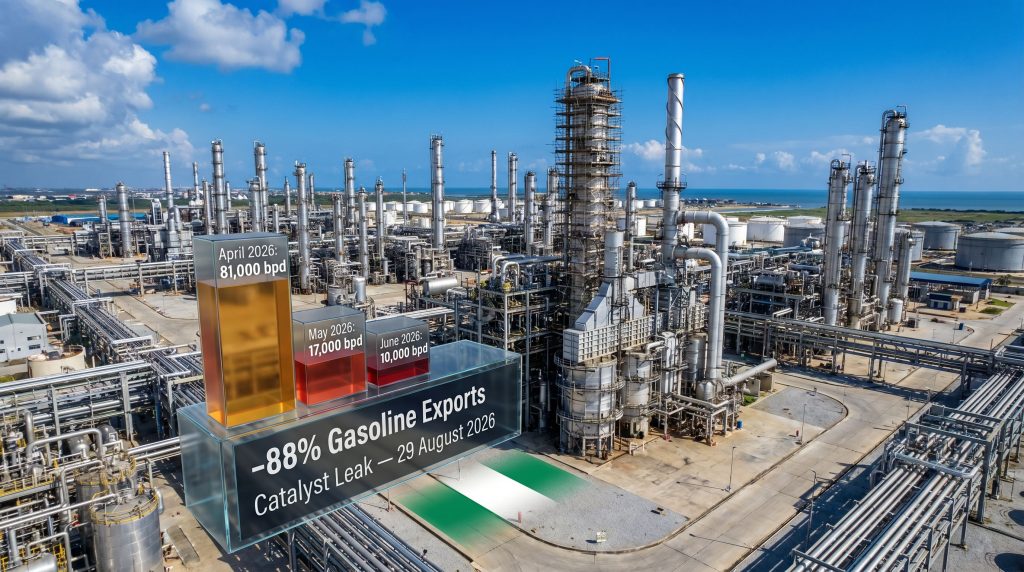
The practical consequences of the Dangote refinery petrol unit cut are most visible in the gasoline export data tracked by commodities analytics platform Kpler, which monitors real-time shipping and cargo flow intelligence used by energy traders globally.
| Month | Gasoline Exports (bpd) | Change vs. April |
|---|---|---|
| April 2026 | 81,000 | Baseline |
| May 2026 | 17,000 | -79% |
| June 2026 (avg.) | 10,000 | -88% |
The scale of this decline is striking. A facility that was exporting 81,000 barrels per day of gasoline in April had, by June, reduced that figure to just 10,000 barrels per day — an 88% reduction in export volume within the space of two months. The August catalyst leak shutdown is expected to suppress these figures further until a full recommissioning is completed.
What This Means for West African Fuel Markets
West African fuel markets had begun structurally adjusting their supply sourcing around Dangote output. Importers across Nigeria's neighbouring markets that had shifted purchasing patterns away from European-origin cargoes now face renewed supply uncertainty. The practical consequences include:
- Fuel marketers re-engaging European and Mediterranean refinery export programmes
- Increased spot cargo demand from Atlantic Basin traders, which tightens regional pricing
- Higher landed costs for fuel in markets that lack domestic refining capacity
- Renewed pressure on foreign exchange reserves in countries running import-dependent fuel supply chains
The speed at which a single unit failure translated into an 88% export volume decline reflects the refinery's current operational architecture. Until redundant RFCCU capacity or alternative gasoline-producing units are added, the facility's export reliability remains sensitive to the performance of this single process train.
Africa's Largest Refinery: Scale, Significance, and Strategic Weight
A Facility That Rewired Regional Trade Flows
To appreciate the significance of the Dangote refinery petrol unit cut, it helps to understand the structural transformation the facility has already delivered. With a nameplate capacity of 700,000 barrels per day, the refinery holds the distinction of being both Africa's largest refining facility and the world's largest single-train refinery by throughput capacity.
Prior to its commissioning, Nigeria occupied a paradoxical position in the global energy landscape: Africa's largest crude oil producer, yet almost entirely dependent on imported refined petroleum products. The country spent billions of dollars annually on petrol, diesel, and kerosene imports, with the associated foreign exchange outflow representing a persistent structural drain on the economy.
Since reaching full operational status in early 2026, the refinery has progressively displaced this import dependency, reshaping regional trade flows that had historically been anchored to European refining hubs and Mediterranean product terminals. This transformation has been rapid enough that the facility's operational status now functions as a primary supply signal for fuel marketers, logistics operators, and procurement agencies across West Africa.
The Post-Commissioning Vulnerability Window
There is a well-documented pattern in large-scale greenfield refinery operations: the first two to three years following commissioning tend to carry an elevated frequency of unplanned outages. Equipment that operates within design specifications during commissioning testing may perform differently under continuous full-load operation. Catalyst systems, heat exchangers, and flue gas circuits are particularly susceptible to issues that only manifest under sustained operational conditions.
The back-to-back disruptions at Dangote's RFCCU — first a valve fault, then a catalyst leak within the same three-month window — are consistent with this pattern. This does not diminish the significance of the disruptions, but it does provide useful context for assessing the refinery's longer-term operational trajectory. As equipment bedding-in issues are identified and resolved, and as maintenance contractor networks develop refinery-specific expertise, unplanned outage frequency typically declines substantially.
Market Implications: Domestic, Regional, and Global Dimensions
Nigeria's Domestic Fuel Price Sensitivity
Nigerian consumers and fuel marketers operate in an environment where pump prices are acutely sensitive to two compounding variables: international crude oil benchmarks and naira/USD exchange rate movements. A sustained reduction in domestic refining output increases the probability that import volumes must be increased to compensate — and given current exchange rate dynamics, this translates directly into upward pump price pressure.
The macroeconomic stakes extend further. One of the refinery's most significant contributions to Nigeria's economy has been the reduction of foreign exchange outflow associated with petroleum product imports. A two-to-three-month outage at the RFCCU would partially reverse these gains, increasing dollar demand for fuel imports at a time when forex reserve management remains a priority for Nigerian monetary authorities. Furthermore, Australia's energy export challenges demonstrate how such supply disruptions carry ripple effects well beyond a single domestic market.
Two Scenarios for the Months Ahead
Scenario A: Restart by Late September 2026
- Export volumes recover progressively toward the 40,000–60,000 bpd range within four to six weeks of recommissioning
- Regional supply disruption remains manageable; European cargo substitution is limited and temporary
- Domestic fuel prices experience a brief period of upward pressure before stabilising
- The incident is absorbed as a post-commissioning operational event, with limited lasting market impact
Scenario B: Extended Outage Through November 2026
- Export volumes remain suppressed for an additional two months beyond the September target
- West African importers formally reactivate European and Asian supply contracts
- Nigeria's fuel import bill increases materially, placing renewed pressure on foreign exchange reserves
- Atlantic Basin gasoline market tightening intensifies, with price implications for traders across the region
The Global Oil Market Backdrop
The timing of the Dangote refinery petrol unit cut adds a layer of complexity to an already pressured global energy environment. Rising oil prices have amplified concerns about fuel cost inflation globally, and crude oil price volatility has sharpened further in response to geopolitical tensions in the Middle East. For a refinery that sources crude internationally and exports refined products into a price-sensitive regional market, the combination of reduced throughput and elevated crude input costs creates a dual margin compression dynamic.
Furthermore, crude oil price volatility adds another dimension of uncertainty for market participants attempting to model forward supply economics. Energy security analysts broadly agree that the timing of the outage amplifies its significance beyond what the raw production numbers alone would indicate. A 10,000 bpd export rate, against a backdrop of rising crude prices and tightening Atlantic Basin supply, creates conditions in which even modest supply shortfalls can generate outsized price responses in downstream markets.
In addition, OPEC's market influence on global output decisions remains a critical variable — any production adjustments from OPEC member states during this period could further tighten the supply picture for Atlantic Basin gasoline traders. Consequently, the global crude steel outlook also bears watching, as infrastructure demand signals from steel markets often correlate with broader energy consumption trends.
The next major ASX story will hit our subscribers first
Frequently Asked Questions: Dangote Refinery Petrol Unit Cut
What caused the Dangote refinery petrol unit cut?
The disruption unfolded in two distinct phases. In May 2026, a combination of crude slate mismatch and a flue gas slide gate valve fault reduced RFCCU operating rates by 34%. A more serious catalyst leak in August 2026 then forced a complete unit shutdown, with IIR Energy warning that major repairs could extend the outage to two to three months.
How far have gasoline exports fallen?
According to Kpler data, gasoline exports declined from 81,000 barrels per day in April 2026 to approximately 10,000 barrels per day by June 2026 — a reduction of roughly 88% over two months. The August catalyst leak shutdown is expected to suppress volumes further until the unit is recommissioned.
When could the unit restart?
The initial restart target following the August 2026 catalyst leak was 20 September 2026. IIR Energy has cautioned that the actual timeline could extend to late October or November 2026 if major equipment replacement is required.
Is this shutdown planned or unplanned?
The August 2026 shutdown is an unplanned operational disruption. Dangote Refinery had previously confirmed it had no scheduled maintenance shutdown planned for the petrol unit, distinguishing the current situation from a routine turnaround event.
Will Nigerian fuel prices be affected?
A prolonged outage increases the risk of renewed import dependency. Given naira/USD exchange rate pressures, this could translate into higher domestic pump prices. The severity of any impact depends on the outage duration and the speed at which alternative supply arrangements can be activated.
Operational Resilience as the Next Strategic Frontier
Building Redundancy Into Africa's Most Important Refinery
The events of mid-2026 highlight an important structural reality: the Dangote refinery's current configuration places significant dependence on the continuous operation of its RFCCU for gasoline yield and export capacity. The speed at which a single process containment failure translated into a near-complete collapse of export volumes underscores the need for operational redundancy planning as the facility matures.
Several strategic priorities emerge from this analysis:
- Spare parts pre-positioning for critical RFCCU components, including catalyst inventory buffers and key valve assemblies
- Turnaround contractor network development to reduce mobilisation time when unplanned outages occur
- Crude slate diversification to reduce the risk of feedstock-driven RFCCU rate reductions
- Contingency supply protocols at the regional level, enabling West African importers to activate alternative cargo sources rapidly when Dangote operational disruptions are detected
A New Kind of Energy Security Indicator
The refinery's emergence as a regional supply anchor means its operational status now carries implications that extend far beyond any single country's energy balance. Monitoring agencies, fuel procurement bodies, and government energy planners across West Africa are increasingly treating Dangote's production metrics as a first-order input into their supply security assessments.
This represents a significant shift from the pre-2026 paradigm, when West African fuel supply was determined primarily by European refinery run rates, Mediterranean spot market dynamics, and shipping economics from distant supply hubs. The concentration of regional supply significance in a single facility creates efficiency gains during normal operations — but amplifies vulnerability when that facility experiences unplanned disruptions.
As the refinery progresses through its post-commissioning phase and accumulates the operational experience necessary to reduce unplanned outage frequency, its resilience profile should improve materially. The current period, however, represents a window of elevated supply chain risk for the markets that have come to depend on it.
Disclaimer: This article contains forward-looking scenario analysis and market projections based on publicly available data and third-party industry assessments. These scenarios involve inherent uncertainty and should not be construed as financial advice. Readers making supply, investment, or procurement decisions based on refinery operational data are advised to consult current market intelligence sources independently.
Want to Stay Ahead of the Next Major Commodity Supply Shock?
When refinery disruptions of this scale ripple across regional fuel markets, investors who receive real-time intelligence on commodity-linked ASX discoveries gain a decisive edge — Discovery Alert's proprietary Discovery IQ model scans ASX announcements the moment they land, translating complex market signals across 30+ commodities into clear, actionable opportunities. Explore historic examples of major mineral discoveries and their market returns, then begin your 14-day free trial at Discovery Alert to position yourself ahead of the broader market.