June 10, 2026
The Quiet Transformation of LME Aluminum Into a Geopolitically Stranded Market
Global commodity exchanges were never designed to absorb the fallout of geopolitical fragmentation. Yet the London Metal Exchange's aluminum warehouse system has become precisely that: an inadvertent holding bay for metal that the broader market structurally prefers to avoid. Understanding why Russian aluminum's share of LME stocks rebounds to 93% in May 2026 requires looking past the headline figure toward the underlying mechanics of trader behaviour, sanctions architecture, and the increasingly tactical role that Indian-origin aluminum plays in shaping exchange inventory composition.
When big ASX news breaks, our subscribers know first
How LME Warehouse Stocks Work and Why Origin Composition Matters
The LME operates a global network of registered warehouses where physical metal can be deposited and held against exchange contracts. Aluminum held in this system on an active warrant is referred to as on-warrant or available stock, meaning it is eligible for delivery against LME futures positions.
When a warrant is cancelled, the metal is effectively earmarked for physical withdrawal and exits the available pool. The remaining warehouse composition then shifts, sometimes dramatically, based purely on which origins are being drawn down versus which are accumulating.
Origin composition within LME warehouses has evolved from a technical footnote into a frontline signal for geopolitical trade flows, sanctions compliance behaviour, and physical market appetite.
There are important limitations to interpreting this data. LME origin figures reflect declared provenance at the point of registration rather than the ultimate end-user destination. A single large warrant cancellation from one country can produce outsized percentage swings that overstate the magnitude of underlying market shifts. Month-to-month movements therefore require contextual interpretation rather than face-value reading.
Furthermore, LME trading volumes across base metals have grown considerably in recent years, making accurate origin-level interpretation increasingly consequential for market participants.
Breaking Down the May 2026 Aluminum Data
The Numbers Behind the 93% Figure
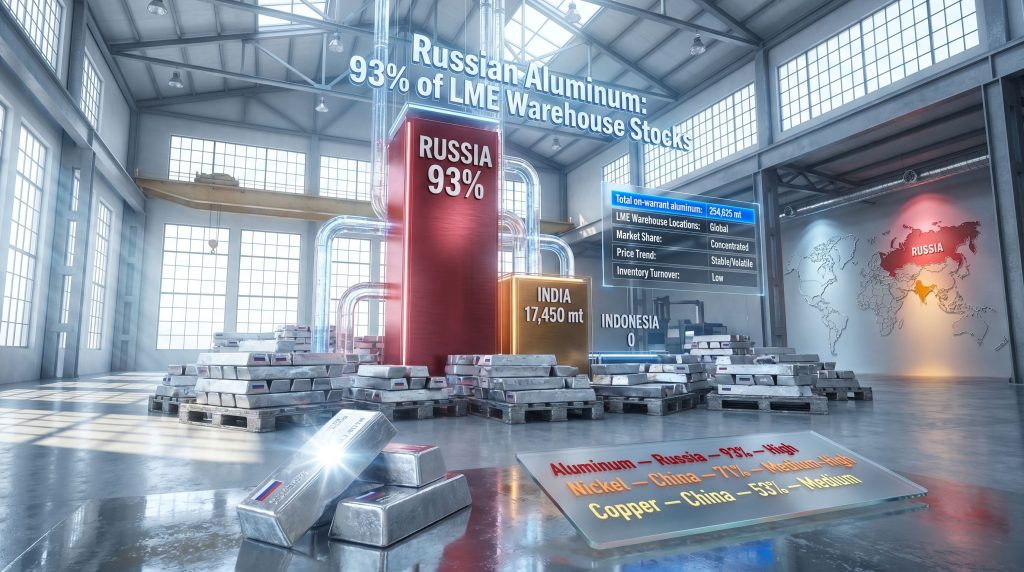
The May 2026 LME warehouse data presents what looks like a dramatic surge in Russian aluminum dominance. In practice, the mechanics are considerably more nuanced.
| Metric | April 2026 | May 2026 | Change |
|---|---|---|---|
| Russian-origin share (%) | 72% | 93% | +21 percentage points |
| Total on-warrant aluminum (mt) | ~330,000 | 254,625 | -23% |
| Russian-origin aluminum (mt) | ~241,125 | 237,175 | -3,950 mt |
| Indian-origin aluminum (mt) | ~89,200 | 17,450 | -71,750 mt |
| Indonesian-origin aluminum (mt) | 2,275 | 0 | Fully withdrawn |
The critical insight here is that Russian aluminum volumes actually declined by approximately 3,950 metric tons over the month. Its share jumped from 72% to 93% not because Russian supply flooded into warehouses, but because Indian-origin aluminum was withdrawn at a volume nearly eighteen times larger.
Passive Concentration: A Structural Concept Often Misunderstood
This phenomenon, where a dominant origin's proportional share rises through the exit of competing origins rather than through its own inflows, is best described as passive concentration. It is a fundamentally different dynamic from an active supply surge, and misreading it can lead to incorrect conclusions about Russian aluminum production trends or LME delivery intentions.
The withdrawal of 71,750 metric tons of Indian aluminum in a single month, combined with the complete exit of all 2,275 metric tons of Indonesian-origin material, left Russian metal as the near-exclusive available stock. This is not a story about Russian supply expanding. It is a story about every other origin being actively preferred for physical off-take.
Total Inventory Decline Signals Genuine Physical Tightness
Beyond composition, the aggregate figures carry their own significance. Total on-warrant aluminum stocks fell 23% in May to 254,625 metric tons, with current levels at 250,525 metric tons representing the lowest reading since May 2025. Production and logistical pressures across Middle East smelting operations have contributed to tightening global availability, reducing the overall pool of exchange-deliverable metal independent of the origin question.
According to recent Reuters reporting, this shift in warehouse composition has attracted significant attention from traders and analysts monitoring physical delivery dynamics across global aluminium markets.
Why Traders Systematically Avoid Russian Aluminum
The April 13, 2024 Sanctions Boundary
A decisive regulatory threshold sits at the centre of the Russian aluminum situation. Aluminum produced in Russia before April 13, 2024, retains eligibility for LME trading and physical delivery. Metal produced after that date was excluded from the LME warehousing system as part of compliance with Western sanctions frameworks.
This creates what is effectively a two-tranche Russian supply pool:
- A legacy tranche of pre-sanctions metal that remains technically eligible but faces voluntary market avoidance
- A sanctioned tranche of post-April 2024 production that is entirely excluded from LME warehousing
The legacy tranche is finite and gradually depleting, as eligible pre-sanctions Russian aluminum is consumed or degraded from the available pool over time. This structural shrinkage has implications for how long Russian metal can continue to dominate LME composition, even in passive concentration terms.
The Stranded Asset Dynamic
Even technically eligible Russian aluminum faces formidable commercial barriers that prevent it from circulating freely through physical markets:
- Reputational and ESG exposure: Many institutional end-users and manufacturers, particularly in Europe and North America, operate internal procurement policies that restrict or prohibit Russian-origin material regardless of its technical LME eligibility.
- Trade finance constraints: A meaningful segment of banks and commodity finance providers decline to fund transactions involving Russian metal, restricting the availability of credit for would-be buyers.
- Downstream resale friction: Even if a trader acquires Russian-origin LME aluminum, reselling it into end-user markets carries buyer resistance that erodes margin and increases holding periods.
- Structural illiquidity: The combined effect of these constraints means Russian metal enters the LME warehouse system and largely remains there, cycling slowly if at all through physical delivery.
This is not a temporary dislocation. It represents a durable reconfiguration of trade flows around a geopolitical fault line, with the LME warehouse system absorbing the metal that the rest of the market declines to handle. Indeed, the broader aluminium sector restructuring underway globally is compounding these already complex dynamics.
Indian Aluminum: The Decisive Swing Variable
Why Indian Metal Moves in and Out of LME Warehouses Tactically
One of the most underappreciated dynamics in LME aluminum composition is the tactical warranting behaviour of Indian-origin metal. The monthly data reveals a recurring cycle that is far more informative than any single month's reading in isolation.
| Period | Russian Share of LME Aluminum Stocks | Key Driver |
|---|---|---|
| Pre-2022 | Below 10% | Diversified global supply mix |
| December 2023 | ~90% | Post-sanctions accumulation |
| January-February 2026 | 58%-60% | Indian warrants increasing |
| March 2026 | ~92% | Indian metal temporarily withdrawn |
| April 2026 | 72% | Indian aluminum re-warranted in volume |
| May 2026 | 93% | Indian and Indonesian metal withdrawn again |
This oscillating pattern reflects the economics of LME warrant arbitrage. Indian producers, primarily large integrated operations including Hindalco and Vedanta, appear to warrant material into the LME system when exchange premiums and contango structures make storage economically attractive, then withdraw it when physical delivery premiums or direct industrial demand offer superior returns.
Russian metal, by contrast, shows remarkably low turnover. It enters the warehouse and remains, reflecting the absence of willing physical off-takers rather than any deliberate warehousing strategy.
What Indian Warrant Activity Signals About Physical Demand
When Indian aluminum is withdrawn rapidly, as occurred in May 2026 with the removal of nearly 72,000 metric tons in a single month, it signals that physical industrial demand is being actively satisfied through LME delivery channels. This is a substantively different signal from passive Russian accumulation and carries more direct implications for supply-demand balances in real-world manufacturing markets.
For market participants tracking aluminium pricing dynamics, monthly Indian warrant activity is arguably the single most important variable to monitor in LME aluminum composition data. Moreover, data from Alcircle confirms this pattern of Russian aluminium dominance has been building for some time, with shares previously surging to 90% before the brief dilution through Indian warrant inflows.
Origin Concentration Across Multiple LME Base Metals
The aluminum situation does not exist in isolation. Across LME base metals, a broader pattern of national origin concentration has emerged that raises structural questions about the exchange's role in price discovery.
| Metal | Dominant Origin | Share of Available LME Stocks (May 2026) | Geopolitical Risk Level |
|---|---|---|---|
| Aluminum | Russia | 93% | High (sanctions exposure) |
| Nickel | China | 71% | Medium-High |
| Copper | China | 53% | Medium |
Chinese Copper: A Mirror of the Aluminum Dynamic
In LME copper markets, Chinese-origin material held 53% of available stocks in May 2026, up from 51% in April, even as the absolute volume of Chinese copper fell by 36,425 metric tons to 141,025 metric tons. Total available copper stocks contracted by 79,375 metric tons to 266,875 metric tons over the same period.
The mechanism mirrors the aluminum situation precisely: other origins withdrew at a faster pace than Chinese-origin copper, elevating China's proportional share despite an absolute volume decline. Elevated Chinese copper exports into LME warehouses may also reflect domestic demand fluctuations and export arbitrage dynamics, where Chinese smelters access international pricing when domestic premiums compress.
Chinese Nickel: A Stable Dominance
Chinese-origin nickel maintained a 71% share of available LME nickel stocks through May 2026, with the stability of this figure suggesting that Chinese nickel has effectively become the structural floor of LME nickel inventory rather than a temporary concentration event.
When a single national origin accounts for 70% to 93% of available LME stocks in any given metal, the exchange's price discovery mechanism becomes inherently sensitive to that country's domestic trade conditions, production decisions, and policy environment. This represents a systemic concentration risk that did not feature in historical LME market design assumptions.
The next major ASX story will hit our subscribers first
Market Implications: Pricing, Premiums, and a Two-Tier Aluminum Market
The LME Benchmark Divergence Problem
When Russian aluminum constitutes 93% of available LME stocks, a significant divergence can develop between the LME benchmark price, which reflects the cost of the dominant warehouse stock, and the physical market premium required to source origin-certified, sanctions-clean aluminum.
This premium spread is not merely a financial abstraction. For industrial buyers with:
- Regulatory compliance obligations under sanctions frameworks
- ESG supply chain requirements imposed by shareholders or customers
- Downstream customer specifications excluding Russian-origin input material
…the effective cost of aluminum procurement materially exceeds the LME headline price. The LME benchmark increasingly prices Russian metal while physical market participants pay a separate premium to access non-Russian supply. Consequently, understanding the pressures on aluminum and alumina markets has never been more critical for procurement decision-makers.
Supply Chain and Procurement Implications
Procurement teams at European and North American manufacturers face compounding complexity as the pool of non-Russian LME-eligible aluminum contracts:
- Origin specification requirements must now be embedded into purchasing contracts as a standard practice rather than an exception.
- Premium budgeting for non-Russian material must account for the potential widening of the LME-to-physical spread during periods of low Indian or Indonesian warrant activity.
- Alternative source development, including material from UAE and Bahrain-based smelters and expanded Indian production capacity, is becoming a strategic procurement priority rather than a contingency.
However, US aluminium tariffs are adding a further layer of complexity to sourcing decisions, particularly for North American manufacturers seeking to diversify away from Russian-origin exchange metal.
Key Variables for Investors and Traders to Monitor
For those tracking LME aluminum markets, the following data points carry the highest signal value:
- Monthly Indian warrant activity: The entry and exit of Indian aluminum from LME warehouses is the primary driver of Russian share fluctuations and should be the first figure reviewed in each monthly LME origin report.
- Physical premium spreads: The divergence between LME aluminum cash prices and delivered premiums for non-Russian origin material in Rotterdam or Midwest US markets reflects the real cost of origin preference in physical markets.
- Middle East production developments: Capacity expansions or logistical disruptions at major Gulf smelters affect the global availability of sanctions-neutral aluminum that can substitute for Russian-origin exchange stocks.
- Sanctions boundary developments: Any modification to the April 13, 2024 eligibility threshold would directly alter the volume of LME-eligible Russian stock and reshape the entire composition landscape.
- Total on-warrant inventory trends: Declining overall LME stocks, now at multi-year lows, independently signal physical tightness that may eventually force buyers to engage with Russian metal or pay escalating premiums for alternatives.
Frequently Asked Questions
What does a 93% Russian share actually mean in global context?
It is important not to conflate LME warehouse stocks with global aluminum supply. LME on-warrant inventories represent a relatively small fraction of total global aluminum inventory. The 93% figure reflects the composition of exchange-held metal specifically, not the broader market. Its significance lies in what it signals about trader behaviour and physical demand patterns rather than as a measure of Russian market share in global production.
Is Russian aluminum still legally tradeable on the LME?
Yes, subject to the production date condition. Russian aluminum produced before April 13, 2024 retains full LME eligibility. The critical constraint is not legal but commercial: financing barriers, buyer resistance, and compliance policies mean that technically eligible metal is functionally difficult to move through normal trade channels. This is the essence of the stranded asset dynamic driving passive concentration. In addition, top aluminium producers outside Russia are increasingly positioned to fill any supply gaps that emerge as physical buyers seek alternatives.
Why did Russian aluminum's share drop to 72% in April before rebounding?
A substantial volume of Indian-origin aluminum, approximately 89,200 metric tons, was re-warranted into the LME system in April, diluting Russian metal's proportional share to 72%. The subsequent May withdrawal of roughly 71,750 metric tons of that Indian material, along with the complete exit of Indonesian aluminum, returned Russian metal's share to 93% despite a slight decline in Russian absolute volumes. The April-to-May swing is entirely explained by Indian warrant behaviour.
Does this concentration affect LME aluminum prices?
Indirectly and meaningfully. The LME benchmark price reflects deliverable exchange stocks, which are now overwhelmingly Russian-origin. Physical premiums for non-Russian origin material trade above this benchmark, creating a two-tier pricing structure. The spread between these tiers tends to widen when Indian warrant activity is low and narrows when non-Russian metal is actively entering the system, making Indian warrant data a leading indicator for physical premium dynamics.
What the May 2026 Data Tells Us About the Evolving LME
The convergence of structural trends visible in the May 2026 LME data points toward a market undergoing a fundamental identity shift. What was historically a diversified, liquid exchange inventory is becoming, across multiple metals, a repository for geopolitically constrained material that broader physical markets decline to absorb at pace.
The Russian aluminum's share of LME stocks rebounds to 93% in May is best understood not as a supply event but as a market structure event. It reflects the cumulative weight of sanctions architecture, ESG-driven procurement policies, trade finance conservatism, and the tactical flexibility of non-Russian producers in choosing when to engage with exchange-based pricing versus direct physical delivery.
For market participants, the practical takeaway is clear: the LME origin composition report has become a required monthly input for aluminum procurement strategy, price premium analysis, and supply chain risk assessment. Indian warrant activity is the variable that determines whether the headline share figure reads 72% or 93%, and understanding the economics driving those decisions is now central to navigating LME aluminum markets effectively.
This article is intended for informational purposes only and does not constitute financial, investment, or procurement advice. Commodity markets involve significant risk, and past trends in warehouse composition or pricing do not guarantee future outcomes. Readers should consult qualified professionals before making investment or supply chain decisions based on LME data.
Want to Stay Ahead of Major ASX Mineral Discoveries Before the Broader Market?
Discovery Alert's proprietary Discovery IQ model delivers real-time alerts on significant ASX mineral discoveries, transforming complex commodity data into actionable investment insights for both short-term traders and long-term investors — explore historic examples of exceptional discovery returns to understand the magnitude of opportunity at stake, then begin your 14-day free trial at Discovery Alert to position yourself ahead of the market.