August 21, 2026
The Geography of Scarcity: Why the DRC Sits at the Centre of the Energy Transition
Every rechargeable battery in every electric vehicle rolling off a production line today carries within it a geopolitical story. The minerals enabling the clean energy transition are not evenly distributed across the planet's crust. They are concentrated in specific geological formations, in specific nations, and in some cases, overwhelmingly in one. When it comes to critical minerals mining in DRC, that concentration reaches a level of strategic significance that no other country on Earth currently matches.
The Democratic Republic of Congo is not simply a major supplier of battery-critical materials. It is, for several key minerals, the only supplier at scale that exists. Understanding what that means, both as an opportunity and as a systemic risk, requires moving well beyond headline statistics and into the structural mechanics of how mineral wealth translates, or fails to translate, into lasting economic and industrial development.
When big ASX news breaks, our subscribers know first
What Makes DRC's Mineral Endowment Structurally Irreplaceable
The DRC's geological profile is the product of ancient tectonic processes that created the Central African Copperbelt, one of the most mineralised corridors on the planet. This formation, straddling the DRC and Zambia, hosts copper and cobalt deposits of a quality and scale that consistently rank among the most economically significant on Earth.
What makes the DRC's position particularly extraordinary is not the presence of any single mineral but the co-occurrence of multiple strategically critical materials within accessible, commercially viable formations. This is not coincidence. It reflects a specific geological history involving sedimentary basins, hydrothermal systems, and metamorphic processes that concentrated minerals in ways that are exceptionally rare globally.
The following table summarises the DRC's current position across key critical mineral categories:
| Mineral | DRC's Estimated Global Share | Primary Application |
|---|---|---|
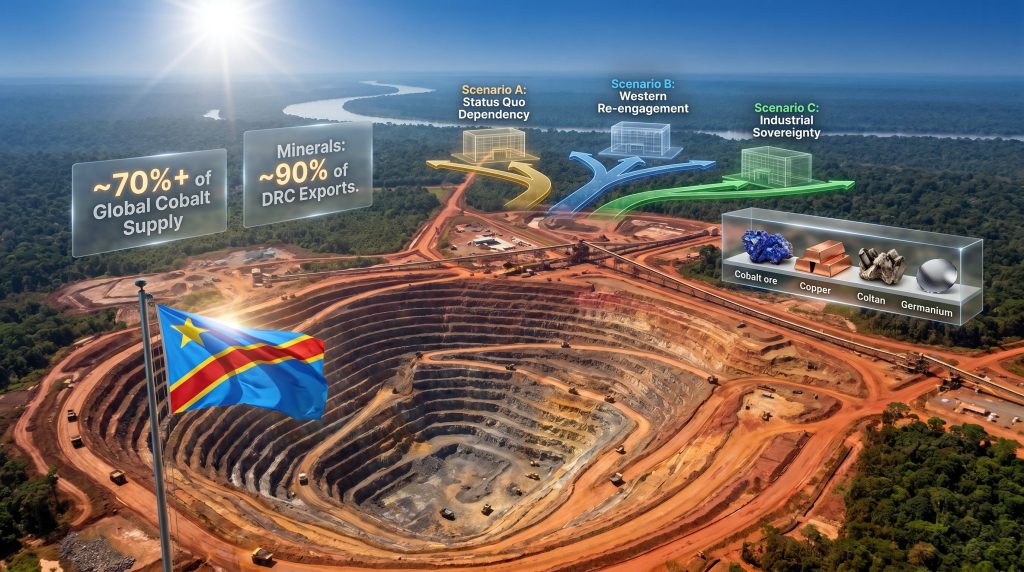
| Cobalt | ~70%+ of global supply | EV batteries, energy storage |
| Copper | Major Copperbelt contributor | Power infrastructure, electronics |
| Tantalum | Significant producer | Semiconductors, aerospace systems |
| Germanium | Notable reserves | Fiber optics, defence electronics |
| Coltan | Major global source | Consumer electronics, capacitors |
| Lithium | Emerging frontier (Manono) | Battery anodes, grid storage |
The DRC natural resources collectively account for an estimated 90% of total DRC exports and approximately 40% of national GDP. This degree of commodity concentration is both a source of enormous leverage and a macroeconomic vulnerability. When cobalt prices collapsed between 2018 and 2020, losing more than 70% of their peak value, the economic consequences inside the DRC were immediate and severe. A diversified industrial base would absorb such shocks. A raw material export economy amplifies them.
Critical framing: The distinction investors and policymakers must draw is between geological abundance and investment-grade project readiness. The DRC has an extraordinary quantity of the former and a persistent shortage of the latter.
The Cobalt Concentration Problem: Leverage, Dependency, and Market Fragility
No other commodity in the current critical minerals landscape exhibits geographic supply concentration quite like cobalt. With the DRC controlling an estimated 70% or more of global cobalt output, the exposure for battery manufacturers and electric vehicle producers is systemic rather than manageable through simple procurement diversification.
This level of single-source dependency is genuinely unprecedented in modern commodity markets. For context, Saudi Arabia's share of global oil production, often cited as the defining example of resource concentration, has historically been closer to 10 to 12 percent. The DRC's cobalt position is categorically different in its implications for supply chain resilience.
Furthermore, the DRC cobalt export ban has added another layer of complexity to an already strained supply landscape. Complicating the picture further is the role of artisanal and small-scale mining, or ASM, which accounts for an estimated 15 to 30% of total DRC cobalt production. This segment operates largely outside formal regulatory oversight, creating significant challenges around:
- Child and forced labour traceability under international due diligence frameworks
- Environmental impact assessment and remediation obligations
- Mineral provenance certification for supply chain compliance
- Integration with formal corporate governance and ESG reporting requirements
Battery manufacturers sourcing from the DRC are increasingly required under frameworks such as the OECD Due Diligence Guidance for Responsible Supply Chains to demonstrate provenance across their upstream mineral inputs. The ASM sector's opacity is not merely a reputational issue for individual companies. It is a systemic traceability problem that affects the entire downstream supply chain from cell manufacturers to vehicle producers to end consumers. According to the Panzi Foundation, conflict minerals in the DRC are also deeply linked to patterns of sexual violence, underscoring the human cost of unregulated mining activity.
Who Controls Critical Minerals Mining in the DRC: The Geopolitical Ownership Structure
China's Structural Dominance in DRC Mining Assets
Development finance analysis consistently points to Chinese-linked entities owning or operating an estimated 80% of critical mineral production in the DRC. This positioning was not accidental. It reflects two decades of sustained, strategically coordinated investment by Chinese state-linked enterprises at a time when Western capital remained largely absent from DRC mining due to governance concerns and political risk perceptions.
The implications extend beyond asset ownership. Much of what the DRC produces in cobalt and copper concentrate flows directly into Chinese refining and processing infrastructure before re-entering global supply chains as refined battery-grade materials. This means that even non-Chinese manufacturers purchasing DRC-origin minerals frequently encounter Chinese-controlled processing as an unavoidable node in their supply chains.
This is the processing dependency that Western governments and manufacturers are now urgently attempting to address. Owning mining assets without controlling refining capacity means the DRC, and its international partners, capture only the lowest-margin segment of the value chain.
Western Re-engagement and the Competing Access Race
The escalation of US-China cobalt rivalry has elevated the DRC from a regional development challenge to a front-line theatre for minerals diplomacy. Western policy frameworks, including the EU Critical Raw Materials Act and the U.S. critical minerals strategies under successive administrations, have identified DRC-origin cobalt and copper as materials warranting strategic attention.
The Lobito Corridor, connecting the Angolan Atlantic port of Lobito through the DRC's Copperbelt mining heartland to Zambia, has emerged as the most tangible expression of infrastructure-as-geopolitical-strategy in Central Africa. International investment in this transport corridor is driven less by conventional logistics economics than by the recognition that controlling the route through which minerals exit the continent confers meaningful strategic leverage.
Emerging East African trade links are also reshaping the DRC's export architecture, offering alternative routing options that could reduce dependence on historically congested southern corridors and provide additional negotiating leverage for the DRC in infrastructure investment discussions.
Three Scenarios for DRC Mineral Sovereignty Through 2030
Scenario A: Entrenched Dependency Chinese processing dominance persists. The DRC captures raw material export rents but remains structurally excluded from the higher-margin segments of battery material value chains. Governance improvements are incremental.
Scenario B: Dual-Track Market Emergence U.S. and EU investment creates a parallel supply chain for responsibly sourced DRC minerals. ESG premiums emerge for certified cobalt and copper, creating differentiated pricing that rewards compliance investment.
Scenario C: Domestic Industrialisation Stabilised energy infrastructure, anchored by Congo River hydropower development, enables viable in-country beneficiation. Battery material processing capacity begins onshore, capturing a larger share of end-product value domestically.
Each scenario carries distinct implications for investors, policymakers, and project developers. The probability-weighted outcome for the period through 2030 most likely involves elements of all three operating simultaneously across different sub-sectors and mineral types.
The Infrastructure Variable: Why Power, Transport, and Water Determine Project Viability
In the DRC context, infrastructure is not a background consideration for project developers. It is the decisive variable separating a mineralised asset that exists on paper from one that is genuinely investable. Extensive domain expertise within the sector consistently identifies power availability, transport access, and water supply management as the three foundational conditions that determine mine viability before geological or engineering factors are even considered.
The Congo River basin holds the largest untapped hydroelectric potential of any river system on the African continent. The Inga hydropower site alone has been estimated to hold theoretical generation capacity exceeding 100,000 megawatts, compared to the Three Gorges Dam's installed capacity of approximately 22,500 megawatts. The gap between that potential and the DRC's current installed generation capacity represents both the country's most acute infrastructure constraint and its most compelling long-term development opportunity.
Mine operators are increasingly moving beyond waiting for national grid improvements. The integration of mine-site renewable energy solutions, including solar generation, battery storage, and direct hydropower offtake agreements from smaller-scale run-of-river facilities, is becoming a standard element of bankable feasibility studies in the DRC context. The DRC-Zambia energy cooperation framework represents a complementary regional approach to power integration across the broader mining corridor.
Transport economics also impose a meaningful discount on DRC project bankability. Landlocked mine sites face logistics cost structures that directly affect the financial modelling of projects, particularly for bulk commodities. The distance from production point to export port, combined with road quality and border crossing efficiency, creates a variable cost burden that must be explicitly modelled in project economic assessments.
Translating Geological Potential into Bankable Projects: The Technical Requirements
The single most underappreciated constraint on DRC mining investment is not geology, politics, or infrastructure in isolation. It is the gap between an exploration asset with compelling in-ground resource potential and the documented, independently verified, technically rigorous project definition that institutional capital requires before committing.
Compliance with international mineral reporting codes, specifically JORC (Joint Ore Reserves Committee, the Australian standard), NI 43-101 (the Canadian standard), and SAMREC (the South African standard), is a prerequisite for unlocking financing from most institutional investors, development finance institutions, and major commercial banks. Many DRC exploration assets have not yet been brought into alignment with these standards, representing both a gap and an opportunity.
The multidisciplinary scope of work required to convert an exploration asset into a bankable project is substantially broader than many junior explorer management teams initially anticipate. A properly structured bankable feasibility study in the DRC context requires integrated input across:
- Geological modelling and resource estimation to applicable reporting code standards
- Geotechnical and hydrogeological assessment of mine site conditions
- Metallurgical testwork characterising ore processing behaviour
- Mine planning and scheduling optimisation
- Environmental and social impact assessment, including baseline studies
- Community engagement and social licence to operate documentation
- Water resource management planning
- Infrastructure and energy supply analysis
- Economic modelling incorporating realistic capital and operating cost estimates
The complexity and cost of this process is one reason why the pathway from grassroots exploration to investment decision in the DRC can extend well beyond typical timelines for comparable jurisdictions with more developed technical services ecosystems.
The next major ASX story will hit our subscribers first
ESG Compliance, Governance Risk, and the Investment Premium
International supply chain compliance requirements are fundamentally reshaping which DRC projects attract institutional financing and which do not. ESG performance has moved from a voluntary disclosure exercise to a market access condition, particularly for projects seeking offtake agreements with European battery manufacturers or American automotive original equipment manufacturers operating under their own supply chain due diligence obligations.
The cobalt export ban impacts on global pricing and investor sentiment have reinforced how rapidly regulatory decisions in Kinshasa can ripple through international supply chains. Armed conflict in eastern DRC provinces creates a persistent security risk discount on investment valuations across the broader country. This discount is not uniformly applied. Projects located in the Katanga copper belt, centred on Lubumbashi in the south, are assessed differently from exploration assets closer to the conflict-affected eastern provinces.
Sophisticated investors perform sub-national risk analysis rather than applying a blanket country risk premium. The DRC's mining code has undergone significant evolution, with the 2018 revision introducing higher royalty rates and a new strategic minerals classification for cobalt that increased state participation in revenues. Further regulatory clarity around fiscal stability clauses and the terms of state-owned enterprise participation in new projects would materially improve the investment environment. As noted by The Conversation, the DRC government's deployment of military forces to guard critical mineral sites reflects the growing security pressures that investors must factor into their risk assessments.
The Beneficiation Imperative and the Industrial Transformation Pathway
Exporting unprocessed or partially processed ore and concentrate represents a structural ceiling on the economic value the DRC can extract from its mineral endowment. The comparison with other resource-rich nations pursuing downstream processing strategies is instructive:
- Indonesia imposed export restrictions on unprocessed nickel ore in 2020, forcing the development of domestic nickel processing capacity and positioning the country as a producer of battery-grade nickel intermediates rather than raw ore
- Chile has debated similar approaches for lithium, exploring how state participation in lithium chemistry can capture more of the value chain upstream of battery cell manufacturing
- Morocco has developed phosphate processing capacity that captures fertiliser and chemical manufacturing margins rather than simply exporting raw phosphate rock
The DRC's industrial transformation pathway requires the convergence of five systemic conditions:
- Stabilised and expanded energy infrastructure, anchored by hydropower development at scale
- Transport corridor investment connecting mining regions to regional and Atlantic export markets
- Regulatory clarity and fiscal frameworks designed to attract patient, long-term institutional capital
- Accelerated human capital development in engineering, geology, and ESG disciplines
- International reporting code alignment to convert exploration inventories into financeable project definitions
The stabilisation of power supply has been identified across the industry as the single most transformative lever available. A reliable energy environment would open the door not only to expanded conventional mining operations but to beneficiation of battery materials, potential downstream recycling facilities, and the broader industrial activity that follows reliable, affordable electricity.
Building Human Capital as a Long-Term Structural Investment
Engineering and geoscience skills shortages function as a persistent bottleneck in DRC project delivery timelines that receives considerably less analytical attention than infrastructure or governance. The demand for professionals capable of delivering projects to international technical standards consistently exceeds the supply of locally trained practitioners.
The most effective models for addressing this gap involve deliberate international-local knowledge transfer, where global technical methodologies developed across mining jurisdictions including South Africa, Australia, Canada, the United Kingdom, and China are embedded within locally grounded professional teams through structured mentorship and on-project exposure. This is meaningfully different from simply deploying international consultants to deliver technical work. The distinction matters because the former builds lasting domestic capability while the latter perpetuates dependency.
Local professionals who develop exposure to integrated project thinking, spanning geology, resource estimation, ESG compliance, environmental impact assessment, water studies, and mine planning, become the human infrastructure upon which a self-sustaining sector of critical minerals mining in DRC can eventually be built. The US-Congo mining partnership framework further signals that long-term investment in human capital and institutional capacity is increasingly recognised as a geopolitical priority, not merely a development aspiration. That investment in domestic capability is arguably as important to the country's mineral future as any single infrastructure project.
Key Metrics: DRC Critical Minerals at a Glance
| Indicator | Estimated Figure | Strategic Significance |
|---|---|---|
| Cobalt global supply share | ~70%+ | Highest single-country concentration globally |
| Artisanal cobalt production share | 15-30% | Traceability and ESG compliance risk factor |
| Chinese ownership of DRC mineral production | ~80% | Geopolitical supply chain concentration |
| Minerals as share of DRC exports | ~90% | Economic dependency and diversification imperative |
| Minerals as share of DRC GDP | ~40% | Macroeconomic exposure to commodity cycles |
| Manono lithium deposit | Among world's largest known | Battery minerals diversification beyond cobalt-copper |
| Congo River hydropower potential | Estimated 100,000+ MW theoretical | Largest untapped hydro resource on the continent |
Frequently Asked Questions: Critical Minerals Mining in the DRC
What critical minerals does the DRC produce?
The DRC is the world's leading producer of cobalt and a major source of copper, tantalum, tin, gold, diamonds, manganese, zinc, germanium, and niobium. The Manono deposit in Tanganyika province also positions the country as a significant emerging lithium producer, making the DRC one of the most mineral-diverse nations on Earth.
Why does China dominate DRC mineral production?
Chinese entities made sustained, large-scale investments in DRC mining assets during a period of two decades when Western institutional capital largely avoided the country due to governance and political risk concerns. This first-mover positioning secured ownership or operational control over an estimated 80% of critical mineral production, integrated into Chinese downstream refining and processing capacity.
What is the Lobito Corridor and why does it matter for mining?
The Lobito Corridor connects Angola's Atlantic port of Lobito through the DRC's Copperbelt mining region to Zambia. It is attracting significant international investment as a strategic logistics artery that could reduce the DRC's export dependence on longer, higher-cost alternative routes while also functioning as a geopolitical instrument in the competition for mineral access.
What is the Manono lithium project?
Located in the DRC's Tanganyika province, the Manono deposit is considered one of the largest known lithium resources globally. It signals the country's capacity to expand its critical minerals portfolio beyond the established cobalt-copper axis into broader battery materials, including lithium used in lithium-ion cell chemistries.
What are the biggest investment risks in DRC mining?
Key risk factors include armed conflict in eastern provinces, power and transport infrastructure deficits, governance and fiscal regulatory uncertainty, artisanal mining traceability challenges, and evolving ESG compliance requirements from international investors and supply chain partners.
How does the DRC's mining code affect foreign investment?
The 2018 revision of the DRC Mining Code introduced higher royalty rates and created a strategic minerals classification that increased state revenue participation from cobalt production. Further regulatory evolution around fiscal stability mechanisms and state enterprise partnership terms remains a variable that active investors in critical minerals mining in DRC monitor closely.
Disclaimer: This article is intended for informational purposes only and does not constitute financial or investment advice. All statistics and projections referenced involve uncertainty and should be independently verified before being relied upon in any investment or commercial decision-making context. Commodity market conditions, regulatory frameworks, and geopolitical dynamics in the DRC are subject to rapid change.
Want to Track the Next Major Mineral Discovery Before the Market Reacts?
Discovery Alert's proprietary Discovery IQ model delivers real-time alerts on significant ASX mineral discoveries — instantly translating complex resource data into actionable investment insights for both short-term traders and long-term investors. Explore historic examples of major mineral discoveries and their market returns, then begin your 14-day free trial at Discovery Alert to position yourself ahead of the broader market.