June 10, 2026
The Hidden Cost Multiplier Reshaping Indonesia's Nickel Dominance
When a commodity market shifts, the most consequential changes rarely announce themselves through headline price moves. They accumulate quietly inside the geology, inside the ore bodies being worked progressively harder for diminishing returns. The global nickel market is currently experiencing exactly this kind of slow-motion structural adjustment, and its epicentre is the world's largest nickel-producing nation. Indonesia nickel ore grades decline has been underway for several years, but the pace of deterioration observed between 2024 and 2025 has elevated this from a background concern to an active variable reshaping supply economics across the entire global nickel complex.
When big ASX news breaks, our subscribers know first
Understanding the Ore Grade Crisis: What the Numbers Actually Reveal
From 1.8–1.9% to 1.52%: Mapping the Trajectory of Indonesian Grade Deterioration
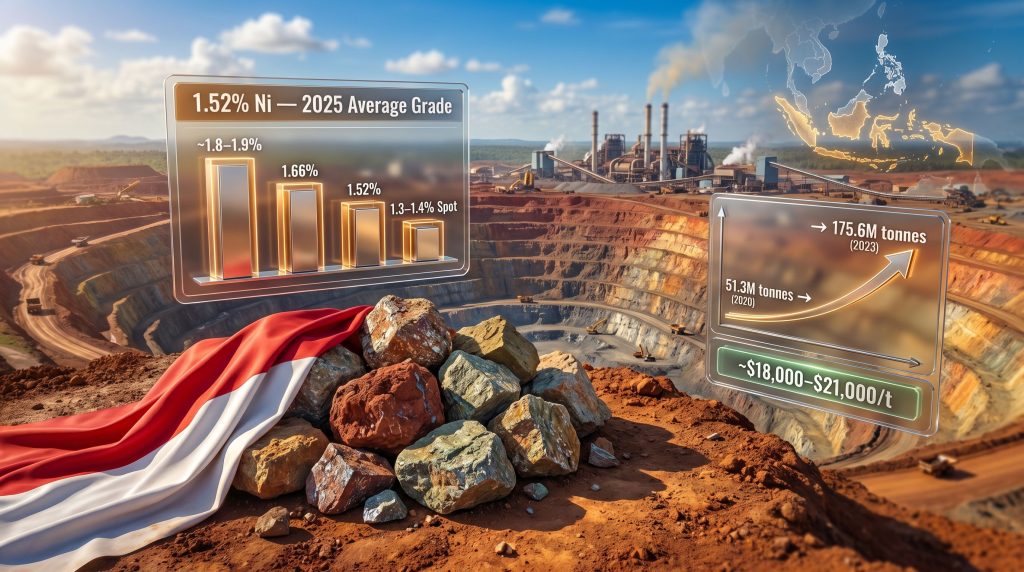
The compression in Indonesian nickel ore quality follows a clear downward trajectory that accelerated meaningfully in 2025. Ore grades fell from approximately 1.66% nickel in 2024 to around 1.52% in 2025, representing a year-on-year decline of roughly 8 to 10%. What makes this figure particularly significant is not just the average grade, but where commercially traded material actually sits in the spot market: predominantly in the 1.3 to 1.4% range. Finding volumes of ore trading at grades above 1.4% has, furthermore, become genuinely difficult in current market conditions.
| Year/Period | Average Nickel Ore Grade | Key Observation |
|---|---|---|
| Historical baseline | ~1.8–1.9% Ni | Peak saprolite quality era |
| 2024 | ~1.66% Ni | Measurable decline underway |
| 2025 | ~1.52% Ni | ~8–10% year-on-year drop |
| Spot market (current) | 1.3–1.4% Ni | Commercially traded material |
Why Saprolite Quality Matters More Than Headline Output Volumes
Saprolite ore is the primary feedstock for Rotary Kiln Electric Furnace (RKEF) smelters, the dominant processing technology underpinning Indonesia's nickel pig iron and NPI-to-matte conversion chain. When saprolite grades compress, the consequences are not linear; they compound across multiple cost centres simultaneously.
- As grade falls, furnace productivity per tonne of ore processed declines directly, inflating unit operating costs
- Higher impurity concentrations in lower-grade material impose additional downstream processing burdens on top of the primary efficiency loss
- Energy consumption per unit of contained nickel rises as more ore must be moved, crushed, and thermally processed to achieve the same output
- The spot market reality, where traded volumes are now concentrated in the 1.3 to 1.4% range, indicates that premium-grade saprolite is no longer reliably available at commercial scale
Key Insight: Grade deterioration is not a future risk scenario. It is an active, measurable constraint already visible in spot market pricing and processing economics across Indonesia's entire nickel complex.
How Indonesia's Nickel Reserves Reached This Point
The Extraction Acceleration That Depleted High-Grade Zones
To understand the current grade crisis, the trajectory of Indonesian production expansion is essential context. Indonesia's nickel ore output surged from 51.3 million tonnes in 2020 to 175.6 million tonnes in 2023, a more than three-fold increase in just three years. This extraordinary ramp-up was driven by aggressive development of the Indonesian Processing and Purification (HPAL) and RKEF smelting complex, largely backed by Chinese capital and technology. The Indonesia nickel industry challenges that have emerged from this breakneck expansion are now becoming impossible to ignore.
The extractive logic underlying that expansion followed a well-established mining industry pattern: go for the best ore first. The systematic prioritisation of the highest-grade saprolite zones delivered strong early economics but progressively depleted the most attractive ore bodies. Industry analysts have characterised the current situation as miners confronting the natural ceiling of high-grading without proportional investment in new reserve replenishment. At current extraction rates, industry estimates suggest high-grade saprolite reserves could be substantially exhausted within approximately six years.
The Processing Capacity Overhang Problem
Indonesia's smelting and refining infrastructure expanded faster than the ore supply could sustainably support at high grades. Since late 2023, a structural shortage of quality nickel ore feedstock has been developing beneath the surface of otherwise robust headline production statistics. The mismatch between installed processing capacity and available high-grade material creates a systemic inefficiency, as smelters compete for declining volumes of premium feedstock, accelerating the depletion of what remains.
This dynamic introduces a self-reinforcing feedback loop: capacity pressure incentivises mining lower-grade material to maintain throughput, which in turn pulls average grades down faster and pushes unit costs higher across the processing chain. Consequently, Indonesia's nickel mining giants are under increasing pressure to adapt their operational strategies.
What Grade Decline Means for Global Nickel Supply Economics
Translating Lower Grades Into Real Cost Inflation
The economic mechanics of ore grade decline are straightforward but their cumulative effect is often underestimated. Every percentage point reduction in ore grade requires proportionally more tonnes of material to be mined, transported, and processed to produce the same quantity of contained nickel. At the RKEF smelter level specifically, this translates into:
- Reduced furnace throughput efficiency and higher energy consumption per unit of nickel output
- Increased reagent and flux consumption as impurity profiles worsen in lower-grade feedstock
- Higher logistics costs as more raw material must be moved per unit of recoverable nickel
- Compressing operating margins even when nickel prices are stable, because the cost per tonne of production is rising independently of price movements
The combined effect is a structural upward shift in the cost curve for Indonesian nickel production. Crucially, this cost inflation cannot be resolved by simply mining more volume; increasing volume at lower grades only accelerates the reserve depletion problem while spreading fixed costs more thinly. Understanding Indonesian nickel price trends is therefore increasingly tied to understanding these underlying cost dynamics.
The Philippines Competitiveness Reversal
One of the more consequential, and less widely appreciated, consequences of Indonesian grade deterioration is the competitive repositioning of the Philippines as a nickel ore supplier. Historically, Philippine ore was considered a secondary, lower-quality alternative to Indonesian saprolite, priced at a discount to reflect its quality limitations.
As Indonesian spot market grades have compressed into the 1.3 to 1.4% range, however, Philippine ore has become increasingly price-competitive on a per-unit-of-nickel basis. Chinese processors, who are the primary end consumers of laterite nickel ore in the region, are responding rationally. Rising Philippine export volumes to Chinese processing facilities are already visible in trade data, representing a meaningful redistribution of market share within the global laterite ore trade that few analysts anticipated happening this quickly.
Indonesia's Policy Response: Quota Management and Sovereign Oversight
How the Government Is Using Supply Controls as a Price Mechanism
Indonesia's regulatory approach to its nickel sector has evolved well beyond passive resource governance. The quota allocation system functions as an active supply management instrument, with consequences that are already apparent at the individual company level. Mining firms are assigned annual extraction quotas; once those allocations are exhausted, operations must cease regardless of market conditions or contractual obligations.
The practical impact has been direct. Weda Bay, one of the significant nickel operations within Indonesia's processing complex, suspended mining after exhausting its allocated quota. Reinstatement has been linked to the settlement of outstanding regulatory fines running into the tens of millions of dollars, illustrating how the quota mechanism functions simultaneously as a supply control tool and a fiscal enforcement instrument. According to reporting on Indonesia's output cuts, the government is actively navigating these dynamics with a clear strategic intent.
Based on observable quota management behaviour, Indonesian authorities appear to be targeting a nickel price range of approximately $18,000 to $21,000 per tonne over a projected one to two year horizon. This band is managed primarily through supply allocation controls rather than direct market intervention. The strategic logic is coherent: Indonesia has sufficient dominance in global nickel supply to influence prices through volume management without exposing itself to the legal and diplomatic risks of overt price-fixing. Once comfortable with market share stability, authorities may allow prices to move above the current managed ceiling.
The Sovereign Transaction Entity: Fiscal Transparency or Market Risk?
Indonesia has established a government-linked sovereign entity to route transactions across nickel and other key commodities. The stated objective centres on fiscal enforcement, specifically ensuring that tax revenues owed by offshore operators, with particular focus on Chinese-affiliated processing companies operating within Indonesia's industrial complex, are actually remitted to the Indonesian government rather than managed through offshore structures that obscure the tax base.
| Dimension | Detail |
|---|---|
| Structure | Government-linked sovereign entity routing commodity transactions |
| Stated objective | Ensuring tax compliance, particularly from offshore operators |
| Primary target | Chinese-affiliated processing companies operating within Indonesia |
| Market concern | Additional government intermediation in commercial transactions |
| Investor implication | Elevated regulatory risk layer for foreign-linked participants |
Analytical Note: The sovereign oversight mechanism is primarily a fiscal enforcement tool rather than a direct price control instrument, but its existence adds a material layer of regulatory complexity for non-Indonesian participants in the supply chain, and market participants are still assessing the full scope of its operational implications.
Is Indonesia's Dominance in Global Nickel at Risk?
Structural Vulnerabilities Beneath the Production Supremacy Narrative
Indonesia commands the largest share of global nickel mine supply by a considerable margin, but several converging pressures are challenging the durability of that position in ways that headline output statistics do not yet fully reflect.
- Ore grade deterioration is reducing quality-adjusted effective supply even as volumetric output remains elevated
- Processing capacity overhang intensifies competition for high-grade feedstock, accelerating depletion of the best remaining ore bodies
- Quota-driven supply management introduces artificial constraints that can disrupt downstream processing chains with limited advance notice
- Regulatory and fiscal complexity through the sovereign transaction entity increases the operational risk premium for international capital
- The six-year high-grade reserve horizon (per industry estimates) implies a structural inflection point is approaching faster than conventional reserve disclosures suggest
How This Reshapes the Global Nickel Cost Curve
As Indonesian production costs rise due to grade compression, the marginal cost of producing global nickel supply increases. This shifts the entire industry cost curve upward, which has significant implications for the competitive positioning of nickel projects outside Indonesia. High-grade sulphide deposits in Canada, Australia, and parts of Africa that were previously considered economically marginal relative to low-cost Indonesian laterite production begin to look considerably more attractive as the Indonesian cost advantage narrows.
Projects with structurally lower processing costs, more favourable metallurgy, or higher contained-nickel grades become relatively better positioned as Indonesian cost inflation persists. In addition, nickel price momentum in 2025 has increasingly reflected these structural shifts, creating a gradual but meaningful rebalancing of investment incentive across the global nickel project landscape.
The next major ASX story will hit our subscribers first
M&A Activity: Why Capital Is Moving Into the Nickel Sector Now
The Valuation Reset That Created Acquisition Opportunities
Several years of depressed nickel prices compressed junior mining valuations to levels that strategic acquirers, particularly from Asia, are now actively moving to exploit. High-grade nickel deposits that required decades of exploration and technical development to advance are in some cases trading at significant discounts to their replacement cost, creating a window of opportunity for well-capitalised strategic buyers.
Lifezone Metals, which controls a high-grade nickel deposit with origins in exploration work conducted in the 1980s and has been advancing it toward a construction decision, is reportedly the subject of acquisition interest from a Hong Kong-based group. Activity has also been noted in Madagascar and other East African jurisdictions, reflecting a broad geographic search for quality assets outside of Indonesia as domestic grade quality continues to decline.
The strategic rationale for Asian buyers is clear: securing feedstock diversity as Indonesian ore quality deteriorates reduces exposure to a single-source supply risk that is becoming increasingly apparent in processing economics. Furthermore, the role of Indonesian nickel in energy transition supply chains adds an additional layer of strategic urgency to these acquisition decisions.
Geopolitical Risk as an M&A Variable: The Sanctions Dimension
Not all M&A activity in the nickel sector is straightforward. Sherritt International, a Canadian mining company with significant operations in Cuba, has attracted acquisition interest from a U.S.-linked private equity group seeking a 45 to 50% stake. Sherritt's situation illustrates a dimension of asset-level risk that investors in the nickel sector must increasingly incorporate into their analysis.
The Helms-Burton Act creates specific and material constraints on ownership structures, financing arrangements, and operational continuity for assets with Cuban exposure. Any ownership change involving U.S.-linked capital must navigate the intersection of sanctions law, political relationships, and regulatory compliance in ways that standard mining due diligence frameworks are not always equipped to handle. The Sherritt situation is a useful case study in how geopolitical risk can transform a fundamentally sound mining asset into a structurally complex investment.
Emerging Technologies: Geological Hydrogen and Awaruite Processing
A New Value Dimension for Nickel-Bearing Geology
Two technology-related developments are attracting meaningful attention as potential long-term value drivers for ultramafic nickel deposits, though they sit at very different stages of technical maturity.
Geological Hydrogen Production
Canada Nickel, through a partnership with GeoRedox, an MIT-affiliated research group, has announced a pilot project to test geological hydrogen production at its Timmins property in Ontario, Canada. The process involves injecting water into subsurface ultramafic rock formations under specific pressure and temperature conditions to stimulate natural hydrogen generation through a process known as serpentinisation.
The environmental differentiation cited for this approach is the absence of chemical catalysts, which distinguishes it from conventional hydrogen production methods that typically rely on fossil fuel reforming or energy-intensive electrolysis. For nickel deposits hosted in ultramafic geology, this creates a potential secondary value stream that could improve overall project economics without requiring additional surface disturbance.
Awaruite-Focused Nickel Processing
Awaruite is a naturally occurring nickel-iron alloy found in ultramafic rocks. Its processing characteristics differ substantially from conventional sulphide or laterite nickel ores, and recovering economic quantities of nickel from awaruite-bearing deposits requires a thorough understanding of mineral particle size distribution, liberation characteristics, and concentrate producibility.
This distinction is critically important for investors evaluating companies in this space. The technical risk profile of an awaruite project where detailed metallurgical characterisation has been completed is fundamentally different from one where the geological narrative is advanced but the metallurgical work remains unpublished. Market valuations do not always reflect this gap. First Atlantic Nickel has attracted significant share price attention for its awaruite and hydrogen-related narrative, yet as of the time of this analysis, it has been noted that First Atlantic has been trading at a higher implied value than FPX Nickel, despite FPX having completed extensive metallurgical work that First Atlantic has yet to publish.
Investor Caution: In the junior nickel space, share price momentum driven by geological hydrogen or awaruite narratives should be evaluated rigorously against the completeness of underlying metallurgical and resource definition work. The gap between narrative value and technical substance is one of the most consequential risk factors for investors in this segment.
What the Indonesia Nickel Ore Grade Decline Means for Battery Metal Supply Chains
The EV and Energy Storage Demand Context
Nickel remains a critical input for high-energy-density lithium-ion battery chemistries, particularly NMC (nickel-manganese-cobalt) formulations favoured in longer-range electric vehicles. Battery-grade nickel requires Class 1 refined product rather than the nickel pig iron that dominates Indonesian output, but the cost and supply dynamics of Indonesia nickel ore grades decline influence the entire nickel price complex, including Class 1 pricing.
Battery manufacturers and automotive OEMs are increasingly incorporating Indonesian grade risk into their medium-term supply chain planning. Diversification strategies that prioritise supply security over pure cost optimisation are gaining traction, which favours assets in stable jurisdictions with credible development timelines. Analysis of the nickel sector's supply pressures further underscores how falling ore grades are reshaping the EV supply chain calculus.
Implications for Ex-Indonesia Nickel Project Development
| Factor | Impact on Non-Indonesian Projects |
|---|---|
| Rising Indonesian production costs | Narrows cost disadvantage of sulphide projects |
| Grade-driven supply constraints | Strengthens long-term supply security argument |
| Quota and regulatory uncertainty | Increases strategic value of stable-jurisdiction assets |
| Six-year high-grade reserve horizon | Accelerates timeline for alternative supply development |
| Philippines competitiveness reversal | Demonstrates how rapidly supply source preferences can shift |
Frequently Asked Questions: Indonesia Nickel Ore Grade Decline
What caused Indonesian nickel ore grades to fall so sharply?
The primary driver is systematic high-grading, the industry practice of extracting the highest-quality ore first. Indonesia's rapid production expansion from 51.3 million tonnes in 2020 to 175.6 million tonnes in 2023 accelerated the depletion of premium saprolite zones. The result is a structural shift toward lower-grade material as the most accessible high-grade ore bodies are progressively exhausted.
How does ore grade decline affect nickel processing costs?
Lower ore grades require more material to be mined and processed per tonne of contained nickel. This increases energy consumption, reagent usage, and logistics costs on a per-unit basis. For RKEF smelters, which dominate Indonesian processing infrastructure, reduced feedstock quality also lowers furnace productivity, compounding the cost impact across the entire production chain.
What is Indonesia's target nickel price range under current policy settings?
Based on observable quota management behaviour, Indonesian authorities appear to be targeting a price range of approximately $18,000 to $21,000 per tonne over a one to two year period. This range is managed primarily through quota allocation controls rather than direct market intervention, with the potential for prices to move higher once the government is comfortable that market share is secure.
How long before Indonesia's high-grade nickel reserves are depleted?
Industry estimates suggest that at current extraction rates, high-grade saprolite reserves could be substantially depleted within approximately six years. This timeline is subject to change based on production rates, exploration success in discovering new high-grade zones, and the adoption of processing technologies capable of economically handling lower-grade feedstock.
Does Indonesia's ore grade decline benefit nickel producers in other countries?
Yes, indirectly. As Indonesian production costs rise due to grade compression, the global nickel cost curve shifts upward, improving the relative economics of projects in other jurisdictions, particularly high-grade sulphide deposits in Canada, Australia, and parts of Africa, that were previously considered uncompetitive against low-cost Indonesian supply.
What is the sovereign commodity entity Indonesia established, and why does it matter?
Indonesia established a government-linked entity to route nickel and other commodity transactions primarily to enforce tax compliance from offshore operators, particularly Chinese-affiliated companies within the Indonesian processing complex. While its stated purpose is fiscal, its existence introduces an additional layer of regulatory oversight that increases operational complexity for foreign participants and represents a risk factor that the market is still assessing.
Want To Capitalise On The Structural Shifts Reshaping Global Nickel Supply?
Discovery Alert's proprietary Discovery IQ model delivers real-time alerts on significant ASX mineral discoveries, instantly translating complex commodity dynamics — like the grade deterioration now undermining Indonesia's nickel dominance — into actionable investment insights for both traders and long-term investors. Explore how major mineral discoveries have historically generated substantial returns on Discovery Alert's dedicated discoveries page, and begin your 14-day free trial today to position yourself ahead of the next significant ASX opportunity.