May 10, 2026
The Structural Logic Behind Critical Minerals Consolidation in 2026
The rare earth and battery metals sector has spent the better part of a decade caught between two competing realities: the strategic urgency of building Western supply chains and the chronic inability of junior explorers to attract the capital needed to actually build them. That tension is now generating a wave of corporate restructuring that goes beyond opportunistic dealmaking. The European Lithium Critical Metals deal, announced in late April 2026, is one of the most instructive examples of this dynamic in action.
Understanding what this transaction actually represents requires stepping back from the immediate headlines and examining the architecture of critical minerals demand financing that has made consolidation not just attractive but increasingly necessary.
When big ASX news breaks, our subscribers know first
Why the Capital Gap Is Forcing Junior Miners to Consolidate
Hard-rock lithium and rare earth projects share a common commercial problem: they are capital-intensive, technically complex, and operate on development timelines that stretch years beyond what many retail-dominated markets are willing to fund. The ASX has long served as a natural home for junior critical minerals explorers, offering accessible listing standards and a retail investor base comfortable with high-risk, long-duration resource plays.
However, as projects mature toward development, the funding requirements shift dramatically. Pre-feasibility studies, pilot metallurgical plants, environmental permitting, and ultimately construction financing demand institutional capital at a scale that ASX-listed juniors rarely attract independently. The result is a structural bottleneck: assets of genuine strategic significance remain stranded at the pre-production stage not because the geology fails to support development, but because the financing architecture around the company is insufficient.
This is the precise problem the European Lithium Critical Metals deal is designed to solve. By consolidating key critical minerals interests under a single Nasdaq-listed vehicle, the transaction is a direct response to the capital market mismatch that has constrained both companies' development timelines.
The Nasdaq pathway is not simply a change of address. It represents access to a fundamentally different pool of institutional capital, one where fund managers are mandated to hold positions in listed critical minerals companies as part of broader energy transition and strategic resources mandates.
How the Transaction Is Structured
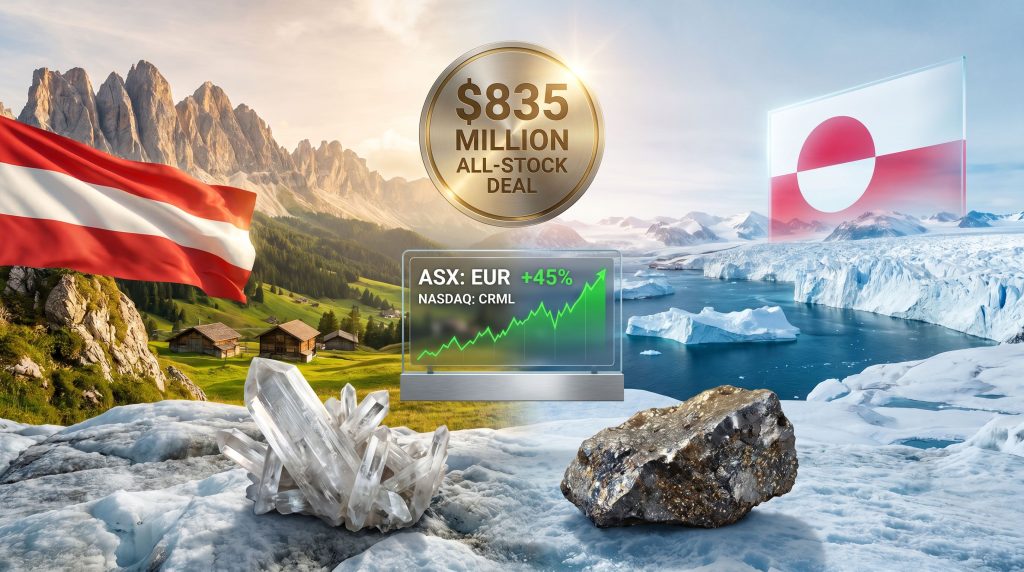
The proposed acquisition of European Lithium Ltd (ASX: EUR, OTCQB: EULIF) by Critical Metals Corp (NASDAQ: CRML) is structured as an all-stock transaction via a court-approved Scheme of Arrangement, with an implied deal value of approximately $835 million at announcement.
Under the exchange terms, EUR shareholders would receive 0.035 new CRML shares for every European Lithium share held. Holders of listed European Lithium options (ASX: EUROC) are accommodated through a parallel option scheme, with CRML shares issued based on the cashless in-the-money value of those options at the time of implementation.
Key Transaction Parameters at a Glance
| Parameter | Detail |
|---|---|
| Acquirer | Critical Metals Corp (NASDAQ: CRML) |
| Target | European Lithium Ltd (ASX: EUR / OTCQB: EULIF) |
| Implied Deal Value | ~$835 million |
| Exchange Ratio | 0.035 CRML shares per EUR share |
| Transaction Type | All-stock Scheme of Arrangement |
| Due Diligence Status | Completed (as of early May 2026) |
| Binding SID | Under finalisation |
| Shareholder Vote | Anticipated Q3 2026 |
| Completion Target | Second half of 2026 |
A Scheme of Arrangement is a court-supervised corporate restructuring mechanism under Australian law, governed by the Corporations Act 2001 (Cth). Unlike a conventional takeover bid, it requires approval from both a majority of voting shareholders by headcount and at least 75% by value at a shareholder meeting. This higher approval threshold means schemes are generally only pursued when there is broad shareholder alignment, which itself is a signal of deal confidence.
The exclusivity period between the two parties was extended in May 2026, with both companies confirming that mutual due diligence had been completed. The extension reflected the time needed to finalise the binding Scheme Implementation Deed (SID) rather than any change to the commercial terms of the transaction, which remained consistent with those outlined in the original April 2026 announcement.
The Asset Logic: What Is Actually Being Consolidated
The strategic rationale for the European Lithium Critical Metals deal becomes clearer when the underlying asset base is examined in detail.
Wolfsberg: Austria's Most Advanced Hard-Rock Lithium Project
The Wolfsberg lithium project is located in the Austrian state of Carinthia, where its spodumene-bearing pegmatite geology has been subject to exploration and development work across multiple eras of activity. Hard-rock lithium deposits of this type yield lithium from spodumene crystals hosted within granitic pegmatite intrusions, a fundamentally different extraction pathway from the brine-based lithium that dominates South American production.
Spodumene lithium extraction from hard-rock sources has historically commanded processing premiums and supply chain preference from battery manufacturers seeking consistency of product quality. Wolfsberg's fully permitted status within a European Union member state jurisdiction also positions it favourably relative to projects still navigating environmental or planning approvals in less stable regulatory environments.
The EU Critical Raw Materials Act, which establishes a framework for reducing European dependency on third-country mineral supply, sets targets for domestic sourcing and processing of strategic minerals. Furthermore, Wolfsberg's location and development-ready status make it one of the few European lithium assets with a realistic pathway to contributing to domestic battery supply chains within the decade.
Tanbreez: Greenland's Rare Earth Deposit and Its Western Supply Chain Significance
The Tanbreez rare earth project in Greenland is a distinct and arguably more strategically significant asset within the consolidated portfolio. The deposit is hosted in a nepheline syenite intrusive complex, a geological setting associated with large-tonnage rare earth mineralisation. Greenland's basement geology hosts several such intrusive bodies, but Tanbreez is distinguished by its scale and the breadth of its rare earth element inventory.
Rare earth elements are not homogeneous in their commercial value. The industry distinguishes between light rare earth elements (LREEs) such as lanthanum and cerium, which occur in greater abundance but command lower prices, and heavy rare earth elements (HREEs) such as dysprosium, terbium, and neodymium, which are present in smaller quantities but are critical inputs for high-performance permanent magnets used in EV motors, wind turbine generators, and defence electronics.
Projects that can demonstrate meaningful HREE content alongside bulk tonnage are considerably more valuable from a supply chain perspective than those dominated by low-value LREEs. The composition of a rare earth deposit, not just its size, determines its strategic utility.
CRML moved to consolidate full ownership of Tanbreez by acquiring the remaining interest previously held by Rimbal Pty Ltd. Consequently, CRML's chairman publicly described this as a pivotal moment for both the company and the broader objective of building rare earth supply chains outside Chinese-controlled production networks. First ore production from Tanbreez is targeted for Q4 2028 or Q1 2029.
The Circular Ownership Problem and Why It Matters
One of the less-discussed but structurally important aspects of the European Lithium Critical Metals deal is the circular ownership dynamic it resolves. European Lithium holds approximately 34% of CRML's outstanding shares, a position valued at roughly $540 million at announcement prices.
This creates an unusual situation: a significant portion of CRML's market capitalisation is effectively held by a company that CRML is simultaneously proposing to acquire. Circular shareholding structures of this kind suppress the acquirer's public float, reduce institutional tradability, and complicate how the market values both entities. Eliminating this circularity through the scheme delivers three simultaneous benefits:
- It expands CRML's freely tradeable public float on Nasdaq
- It simplifies the corporate structure for institutional investors conducting due diligence
- It removes the valuation distortion created when a major shareholder is also a controlled or related entity
Market Response and What the Price Action Tells Investors
The immediate market reaction to the April 2026 announcement provided a clear signal about how each company's shareholders perceived the value proposition. European Lithium shares surged approximately 45% on the day of announcement, while CRML recorded a more modest 5% gain.
This divergence is textbook M&A price behaviour in scrip-based transactions. When an acquirer offers its own shares as consideration, the target typically re-rates toward the implied transaction value if the market believes the deal will complete. The magnitude of the EUR re-rating suggests investors considered the stock materially undervalued relative to the exchange ratio prior to the announcement.
The more restrained CRML response reflects a combination of factors. As the acquirer in an all-stock deal, CRML faces dilution from issuing new shares, even if the strategic logic of the acquisition is sound. The acquirer's share price movement in scrip deals is frequently a function of how the market weighs the long-term value creation from the combined entity against the near-term dilution impact.
What the Exclusivity Extension Signals to the Market
Investors unfamiliar with scheme transaction mechanics sometimes interpret an exclusivity extension as a sign of deal stress. In practice, however, the opposite is typically the case. Extensions in the SID finalisation phase generally reflect the complexity of documentation in cross-border, multi-asset corporate transactions rather than any deterioration in deal terms or commercial alignment.
Both parties confirmed the transaction terms remained unchanged following the exclusivity extension, which is a meaningful signal that neither side has sought to renegotiate the exchange ratio or impose new conditions.
Scenario Pathways: Three Ways This Deal Could Unfold
Investors tracking the European Lithium Critical Metals deal should consider three plausible outcomes and what each would mean for their position.
Scenario 1: On-Schedule Completion (Base Case)
The SID is finalised in mid-2026, a shareholder meeting is convened in Q3 2026, and the transaction closes in H2 2026. CRML emerges as a Nasdaq-listed critical minerals company with full ownership of Wolfsberg and Tanbreez. EUR shareholders receive CRML shares and gain exposure to a better-capitalised, more liquid vehicle with a consolidated critical minerals portfolio spanning lithium and rare earths.
Scenario 2: Delayed but Intact (Moderate Risk)
Documentation complexity or regulatory review pushes the timeline into early 2027. Deal terms remain unchanged but EUR shares trade at a modest discount to the implied scheme value during the extended period, creating a potential entry opportunity for investors willing to accept timeline risk. In addition, critical minerals price movements during the delay period represent the primary variable that could prompt either party to revisit terms.
Scenario 3: Deal Termination (Tail Risk)
Failure to execute a binding SID results in deal collapse. EUR reverts to its standalone ASX listing, with its CRML shareholding as its primary asset. CRML retains full Tanbreez ownership but carries the ongoing burden of the circular shareholding structure. This scenario is the least probable given that mutual due diligence has been completed and both parties have confirmed unchanged terms, but it cannot be excluded given the inherent complexity of cross-border scheme transactions.
The next major ASX story will hit our subscribers first
The Broader Industry Signal: What This Deal Means for Critical Minerals M&A
The European Lithium Critical Metals deal reflects a maturing pattern within the critical minerals sector. All-stock consolidation structures are becoming the dominant mechanism through which ASX-listed juniors with globally significant assets attempt to access the deeper institutional capital pools available on major North American exchanges.
Furthermore, several structural forces are driving this pattern simultaneously. The various lithium extraction methods and processing technologies being developed alongside these consolidations are also shaping investment decisions:
- Western policy frameworks have elevated the strategic profile of rare earth and battery metal projects, increasing investor interest from institutional funds with ESG and supply chain resilience mandates
- The cost of developing a major critical minerals project from advanced exploration to first production has escalated significantly, making standalone development financing increasingly difficult for smaller listed vehicles
- Nasdaq's deeper liquidity and broader institutional investor base create more efficient price discovery for assets with global strategic relevance
- All-stock deal structures preserve corporate cash for project development rather than distributing it to selling shareholders, aligning incentives between both sets of shareholders throughout the development phase
The 2026 to 2028 window is likely to see further consolidation plays of this type, particularly as the gap between projected rare earth demand from EV and defence manufacturing and current non-Chinese production capacity becomes increasingly apparent to institutional investors. According to analysis of the transaction's value implications, the deal could deliver a significant premium to European Lithium shareholders, underscoring the scale of value unlock that well-structured consolidation can generate.
Key Milestones to Monitor
| Date / Period | Milestone |
|---|---|
| April 27, 2026 | Non-binding indicative offer and exclusivity announced |
| May 2026 | Exclusivity extended; mutual due diligence confirmed complete |
| Mid-2026 (est.) | Binding SID expected to be finalised |
| Q3 2026 | Shareholder vote anticipated |
| H2 2026 | Expected transaction completion |
| Q4 2028 / Q1 2029 | Tanbreez first ore production target |
This article is intended for informational purposes only and does not constitute financial advice. The European Lithium Critical Metals deal involves forward-looking statements, indicative timelines, and transaction terms that remain subject to change pending finalisation of a binding Scheme Implementation Deed. Investors should conduct their own due diligence and seek independent financial advice before making investment decisions. Deal values, share price movements, and stated timelines are based on publicly disclosed information from company announcements and may not reflect current market conditions.
Want to Catch the Next Major Critical Minerals Discovery Before the Market Does?
Discovery Alert's proprietary Discovery IQ model scans ASX announcements in real time, instantly identifying significant mineral discoveries across lithium, rare earths, and over 30 other commodities — turning complex data into clear, actionable opportunities for investors at every level. Explore how historic mineral discoveries have generated substantial returns and begin your 14-day free trial at Discovery Alert to position yourself ahead of the next major consolidation play.