July 11, 2026
When Weapons Systems Became the Demand Driver: Critical Minerals Enter a New Era
The global mining industry has navigated countless commodity cycles driven by industrial expansion, infrastructure booms, and energy transitions. Yet the force reshaping capital allocation in 2026 operates on an entirely different logic. Defence-driven demand for critical minerals has introduced a buyer that does not respond to price signals the way commercial markets do. Governments procuring materials for weapons systems, radar arrays, and missile guidance do not negotiate on spot price. They negotiate on availability, reliability, and allied-nation origin. That distinction is rewriting the investment playbook across the entire extractive sector.
Understanding why this matters requires stepping back from individual company announcements and examining the structural transformation underneath. What was once framed as a supply diversification challenge is now being treated as a military readiness imperative. Furthermore, that reclassification carries profound consequences for where capital flows, which companies attract strategic partners, and how entire national economies prioritise resource development.
When big ASX news breaks, our subscribers know first
The Reclassification That Changed Everything
For most of the past century, minerals were evaluated through an industrial lens. Price, volume, grade, and logistics determined their strategic importance. The shift occurring now is categorical rather than incremental. Certain minerals are no longer assessed purely by their commercial utility but by their role in sustaining weapons platforms, electronic warfare systems, and next-generation munitions.
This reclassification gained momentum as Western defence planners began stress-testing supply chains against plausible conflict scenarios. What they found was alarming. For a range of materials considered routine industrial inputs, the processing and refining capacity was concentrated almost entirely within a single geopolitical competitor. The vulnerability was not in the ground. It was in the furnaces, reactors, and separation plants that transform raw ore into defence-grade material.
The key insight driving current policy is that access to raw mineral deposits is a necessary but insufficient condition for supply security. Processing sovereignty — the ability to take ore through to finished material meeting military specifications — is the true chokepoint. Governments across the Western alliance have absorbed this lesson and are now acting on it with urgency.
The Eleven Most Defence-Sensitive Minerals
The Pentagon and allied defence establishments have identified a core group of materials where supply chain concentration poses unacceptable risk. These are not obscure laboratory curiosities. They are embedded in the systems that define modern military capability.
| Mineral | Key Military Application | Primary Supply Risk |
|---|---|---|
| Rare Earth Elements | Radar, sonar, laser guidance, propulsion magnets | China-dominant processing (~90% of global capacity) |
| Tungsten | Armour-piercing rounds, missile components | Chinese export restrictions since 2025 |
| Antimony | Munitions, flame retardants, military optics | Chinese export controls since August 2024 |
| Gallium | Semiconductors, radar, electronic warfare | Chinese export restrictions |
| Germanium | Infrared optics, fibre-optic military communications | Chinese export controls |
| Cobalt | High-performance batteries, jet engine superalloys | DRC export risk |
| Lithium | UAV batteries, satellite power systems | Supply concentration risk |
| Scandium | Aerospace alloys, solid oxide fuel cells | Limited global production |
| Tantalum | Electronic components, missile guidance | Geopolitical supply fragility |
| Silicon | Navigation semiconductors, communications systems | Processing concentration |
| Platinum Group Metals | Sensors, catalytic systems, fuel cells | South Africa and Russia concentration |
What Military Systems Actually Consume
Defence planners thinking about mineral security are not concerned with the same specifications as a consumer electronics manufacturer or an electric vehicle producer. Military applications impose requirements that commercial supply chains were never designed to meet.
Rare earth supply chains used in advanced weapons systems require purification to exceptionally high standards. The permanent magnets found in radar systems, sonar arrays, and precision guidance systems depend specifically on dysprosium and terbium to maintain magnetic performance at elevated operating temperatures. These properties cannot be replicated by substituting alternative materials without compromising system performance, and no commercially scalable alternative currently exists.
Tungsten presents a similarly uncompromising picture. Its exceptional density, roughly 1.7 times that of lead, makes it the preferred material for kinetic energy penetrators used in armour-piercing ammunition. The US military's annual demand for tungsten is estimated at between 2,000 and 3,000 metric tons annually, representing a significant and inflexible procurement requirement. The irony of the current situation is that US refining infrastructure, originally constructed in the 1950s for incandescent light bulb filaments, theoretically holds production capacity of approximately 18,000 metric tons, yet is operating far below that level due to constrained feedstock supply following China's 2025 tungsten export ban.
Antimony in defence occupies a less visible but equally critical role. Its applications in military munitions, particularly in tracer rounds and incendiary compositions, alongside its use in flame retardants for military equipment and specialist optical systems, made China's August 2024 export restrictions an immediate national security concern rather than merely a market disruption.
Gallium and germanium, both subject to Chinese export controls, underpin the semiconductor systems that enable electronic warfare and advanced communications. Gallium arsenide semiconductors used in military radar systems require purity levels measured in parts per billion, a specification that demands specialised crystal growth techniques concentrated almost entirely within Chinese industrial facilities.
China's Export Controls as a Capital Market Catalyst
The sequence of Chinese export restrictions between 2024 and 2025 functioned as a series of accelerating shocks to Western defence procurement assumptions. Each restriction demonstrated not only that supply could be interrupted, but that the interruption could be maintained indefinitely with minimal economic cost to China while imposing substantial military readiness costs on adversaries.
China's August 2024 restrictions on antimony supply risks tightened global supply of a mineral that had already been heavily concentrated in Chinese processing facilities. Prior to these controls, China processed approximately 85% of the world's antimony, making the restriction effectively a near-total cutoff for Western defence supply chains dependent on Chinese-origin material.
The November 2025 development introduced a revealing distinction. China issued a one-year suspension of its export restrictions on antimony, gallium, and germanium to the United States, easing commercial supply pressures. However, restrictions on military end-users remained firmly in place. This created a situation where civilian industrial buyers regained access to materials while the Pentagon remained excluded. The implication for defence planners was unambiguous: diplomatic easing cannot be relied upon as a strategic supply solution when military-use restrictions can be maintained independently of commercial policy.
The critical distinction in China's November 2025 partial suspension was not the easing itself, but what it revealed about the architecture of Chinese export controls. Commercial and military channels were explicitly separated, demonstrating that strategic mineral supply can be weaponised selectively without triggering the broader economic consequences of a complete trade restriction.
Cobalt added a separate dimension to the supply picture. Restrictions on cobalt exports from the Democratic Republic of Congo introduced a secondary chokepoint that is geographically distinct from Chinese processing dominance but equally concerning for defence applications requiring high-performance battery systems and jet engine superalloys.
The US Listings Wave: Scale, Composition, and Strategic Intent
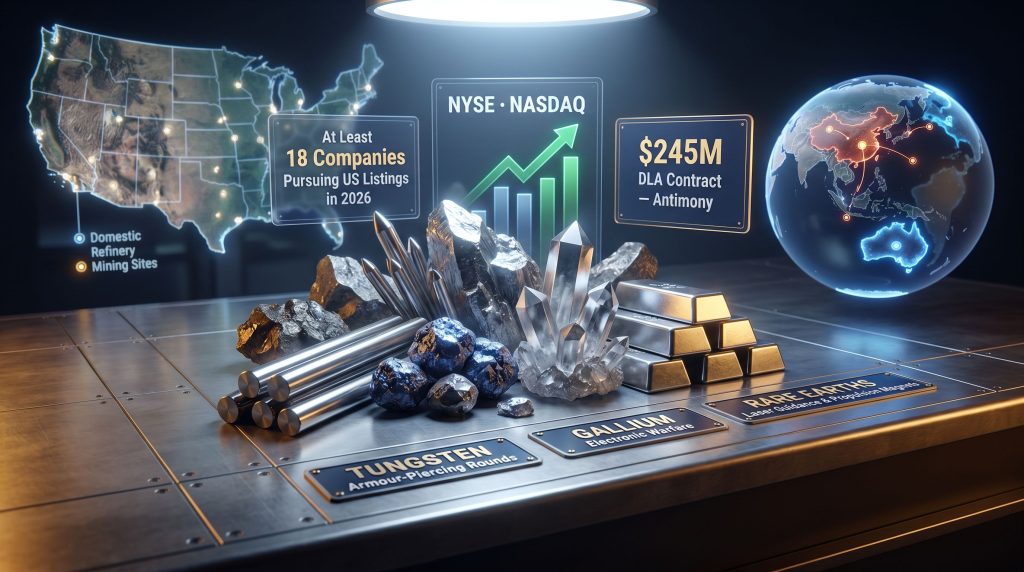
The capital market response to this accumulation of supply chain shocks has been rapid and structurally significant. At least 18 companies have completed or are actively pursuing US exchange listings in 2026, compared with just three in all of 2025. This is not a marginal acceleration. It represents a sixfold increase in the pace of strategic listings within a single calendar year.
The companies involved span a value range from approximately $25 million to $7.5 billion, reflecting the breadth of the strategic minerals universe rather than a concentration in any single commodity. Notably, the composition is predominantly Canadian and Australian firms, with a smaller cohort of US startups. This geographic pattern reflects the reality that most Western-aligned mineral deposits of commercial significance are located outside the continental United States, while the financial mechanisms and government procurement relationships that give these listings their strategic value are concentrated in Washington.
| Company | US Exchange | Previous/Concurrent Listing | Date |
|---|---|---|---|
| Atlas Critical Minerals | Nasdaq: ATCX | OTCQB (Jupiter Gold) | Jan. 13 |
| Blue Moon Metals | Nasdaq: BMMT | TSXV, Frankfurt, OTCQX | Jan. 26 |
| Santacruz Silver | Nasdaq | TSX-V | Jan. 21 |
| Mayfair Gold | NYSE American / NYSE | TSX-V to TSX | Jan. 27 |
| Aris Mining | NYSE: ARMN | TSX | Feb. 19 |
| Versamet Royalties | Nasdaq | TSXV / private | Mar. 6 |
| Highlander Silver | NYSE American: HSLV | CSE / TSXV | Mar. 11 |
| U.S. Antimony Corp | NYSE (uplist) | NYSE American | Mar. 11 |
| Guardian Metal Resources | NYSE American | LSE | Mar. 20 |
| OceanaGold | NYSE: OGC | TSX, ASX | Apr. 7 |
| The Metals Royalty | Nasdaq: TMCR | TSX-V | Apr. 8 |
| Nicola Mining | Nasdaq ADSs: NICM | TSX-V | Apr. 13 |
Capital Raised by Select Companies
| Company | Capital Raised (USD) | Key Commodity | Defence Angle |
|---|---|---|---|
| Guardian Metal Resources | $68.3 million + Pentagon funding | Tungsten | Armour-piercing ammunition supply |
| Rare Earth Americas | $63.3 million | Rare Earths (Dy, Tb) | Advanced weapons system magnets |
| Atlas Critical Minerals | ~$11 million | Critical Minerals | Strategic supply diversification |
| U.S. Antimony Corp | $245M DLA contract | Antimony | Defence stockpile supply |
The IPO Language Transformation
The linguistic shift in public filings accompanying these listings deserves specific attention because it signals something deeper than marketing strategy. Traditional mining prospectuses position projects against commodity price cycles, reserve life estimates, and cost curves. The 2026 cohort is doing something categorically different, framing projects in terms of weapons system dependencies, defence stockpile requirements, and military-grade material specifications.
Guardian Metal Resources explicitly stated its objective as covering direct defence demand for tungsten. REalloy Inc highlighted the dysprosium and terbium content of its project specifically in the context of magnets used in advanced weapons systems. Rare Earth Americas, backed by Australian mining figure Gina Rinehart, structured its NYSE IPO narrative partly around defence applications rather than leading with conventional supply-demand fundamentals.
This is not incidental. A US exchange listing opens eligibility for Pentagon-linked financing mechanisms, Export-Import Bank programmes, and government equity participation that are structurally inaccessible to companies listed exclusively on foreign exchanges. The listing itself is part of the strategic positioning, not merely a mechanism for accessing retail investor capital.
The Pipeline for H2 2026
| Company | Planned US Venue | Timeline |
|---|---|---|
| Resolution Minerals | Nasdaq | TBC |
| American Rare Earths | Nasdaq | H2 2026 |
| Sunshine Silver | NYSE (SSMR) | TBC |
| McEwen Copper | IPO | Q4 2026 |
| Jindalee / USE | Nasdaq SPAC | H2 2026 |
| Barrick / NA Barrick | NYSE/TSX vehicle | TBC |
How Washington Is Rebuilding Domestic Mineral Supply Chains
The US critical minerals strategy has evolved from passive policy support and grant funding toward direct operational and financial involvement at a scale without modern precedent. Several distinct mechanisms are operating simultaneously.
President Trump's February 2026 launch of Project Vault, a $12 billion strategic minerals stockpile initiative primarily backed by the US Export-Import Bank, represents the largest single commitment to mineral security financing in recent US history. The initiative is designed to accumulate physical stockpiles of defence-critical minerals as a buffer against supply disruption, while simultaneously providing demand certainty that incentivises new domestic and allied-nation production.
Direct Pentagon equity stakes in mining and processing companies mark an even more significant departure from conventional procurement practice. Companies including MP Materials, USA Rare Earth, and Korea Zinc have received government equity participation as part of Washington's push to secure strategic mineral supply chains. This approach effectively converts supply chain risk from a commercial problem into a shared government-industry undertaking, with the Pentagon becoming a co-investor rather than merely a buyer.
By December 2025, the US military had moved beyond funding private sector projects to operating its own small-scale mineral refineries, a development that signals how completely the strategic calculus has shifted. The transition from passive buyer to active processor represents the most direct form of supply chain intervention and reflects an assessment that market mechanisms alone cannot deliver the required supply security within the necessary timeframe.
JPMorgan's October announcement that it could invest up to $10 billion in sectors tied to national economic security, including critical minerals demand, demonstrates that private capital is increasingly aligning its deployment with the policy architecture rather than waiting for traditional commodity price signals.
The next major ASX story will hit our subscribers first
What Government Equity Participation Means for Mining Investors
For investors evaluating defence-linked mining opportunities, the significance of Pentagon equity participation extends well beyond the capital itself. Companies that have secured government equity stakes gain several forms of value that conventional mining investors rarely encounter.
- Contract access: Government equity relationships typically create pathways to long-term offtake arrangements with defence procurement agencies, providing revenue certainty that commodity-linked contracts cannot match.
- Subsidy eligibility: Companies within the government investment ecosystem gain preferential access to grant programmes, loan guarantees, and processing facility subsidies that are unavailable to purely commercially positioned firms.
- Policy protection: Government co-investors have structural incentives to protect their portfolio companies from adverse regulatory changes, creating a form of political risk insurance that has tangible value in volatile policy environments.
- Cyclicality buffering: Commodity price cycles have historically been the dominant source of mining investment risk. Strategic government financing that is determined by defence requirements rather than spot prices introduces a demand floor that partially decouples project economics from commodity market volatility.
However, the importance of rigorous due diligence cannot be overstated. Rick Werner, co-chair of the capital markets and securities practice at law firm Haynes Boone, has noted that while a substantial volume of capital is flowing into defence-driven exploration, a significant portion of this activity remains highly speculative. Werner has observed that breaking China's processing dominance is achievable in principle, given access to the underlying resources, but will require substantial time and sustained financial commitment. For further context, the SFA Oxford analysis on critical minerals in defence provides a useful independent perspective on these dynamics.
The distinction investors must make is between companies with confirmed government contracts, active Pentagon equity relationships, and operational milestones, versus those that have adopted defence-oriented language in their marketing materials without any corresponding contractual or financial relationship with defence agencies. These two categories carry fundamentally different risk profiles despite often appearing similar in promotional materials.
A Due Diligence Framework for Defence-Linked Mining Claims
- Confirmed contracts: Does the company hold a signed offtake agreement or supply contract with a defence agency, such as the Defense Logistics Agency, rather than merely expressing intent?
- Government equity: Has the Pentagon or a related agency taken an actual equity stake, or is the company referencing government interest without a binding commitment?
- Processing capability: Does the company have demonstrated capacity to produce defence-grade material meeting military specifications, or does it hold only upstream mining assets?
- Timeline realism: Are development timelines consistent with the geological, regulatory, and infrastructure complexity of the project, or are they compressed to align with investor sentiment?
- Revenue visibility: Are there contracted revenue streams that provide financial foundation independent of commodity price movements?
The Geopolitical Architecture Behind Long-Term Demand
The forces driving defence-driven demand for critical minerals are not temporary responses to a single supply disruption. They reflect structural geopolitical realities that will shape mineral markets for at least the next decade and likely considerably longer. The IEA's critical minerals overview further underscores how deeply these materials are embedded in both energy and security frameworks globally.
Western nations are competing simultaneously on two fronts for the same underlying supply chains. The energy transition requires massive volumes of lithium, cobalt, rare earth elements, and other minerals for battery systems, wind turbines, and electric vehicles. Defence modernisation requires many of the same materials for weapons systems, electronic warfare, and next-generation platforms. This dual demand creates competition between civilian and military applications for constrained supply, with governments increasingly prioritising defence requirements when allocation decisions must be made.
Australia, Canada, and the United Kingdom are emerging as the primary allied-nation contributors to US mineral security strategy. Their geological endowments, political reliability, and existing financial relationships with US markets make them natural partners for a supply diversification effort that cannot be achieved through domestic US production alone.
The timeline challenge is sobering. Even under optimistic assumptions about permitting, financing, and construction, rebuilding meaningful Western-aligned processing capacity for rare earths, tungsten, and antimony is a decade-long project at minimum. The stockpiling initiatives, allied sourcing agreements, and government equity programmes currently being deployed are bridge strategies designed to manage vulnerability during the build-out period, not permanent solutions. Investors who understand this distinction will be better positioned to evaluate which companies are providing near-term strategic value versus which are building the longer-term infrastructure that will define the sector's mature architecture.
The fundamental question for capital markets is whether the convergence of defence spending urgency, government financing commitment, and genuine geological opportunity can sustain investment returns through the extended development cycles that characterise the mining sector. The answer will not be uniform across all companies that have adopted defence-oriented positioning. It will depend on the quality of individual projects, the depth of government relationships, and the ability to translate strategic narrative into contracted, operational reality.
This article contains forward-looking statements and analysis based on publicly available information as of May 2026. Mineral markets, government policy frameworks, and company-specific circumstances are subject to change. Nothing in this article constitutes financial or investment advice. Investors should conduct independent due diligence and consult qualified financial advisers before making investment decisions.
Want to Stay Ahead of the Next Major Critical Minerals Discovery on the ASX?
Discovery Alert's proprietary Discovery IQ model delivers real-time alerts the moment significant ASX mineral discoveries are announced, instantly translating complex data across 30+ commodities into clear, actionable insights — including the critical and defence-linked minerals reshaping global capital markets. Explore historic examples of extraordinary discovery returns and begin your 14-day free trial today to position yourself ahead of the broader market.