
August 23, 2026
The global rare earth market stands at a crossroads where technological advancement intersects with geopolitical strategy. As nations increasingly recognize the importance of critical minerals energy security for everything from renewable energy infrastructure to advanced defence systems, supply chain vulnerabilities have emerged as national security concerns. This intersection of technology dependence and resource concentration has created unprecedented opportunities for strategic repositioning in the global materials economy.
Modern economies rely heavily on seventeen specialised elements that enable cutting-edge technologies, yet production and processing capabilities remain concentrated in a handful of nations. The result is a complex web of dependencies that governments worldwide are now actively working to restructure through substantial public and private investments in domestic capabilities.
Federal Investment Architecture in Critical Materials
The landscape of government involvement in strategic mineral development has evolved significantly over the past decade. Traditional mining subsidies and tax incentives have given way to more sophisticated public-private partnership models that blend federal funding mechanisms with equity participation and technology development initiatives.
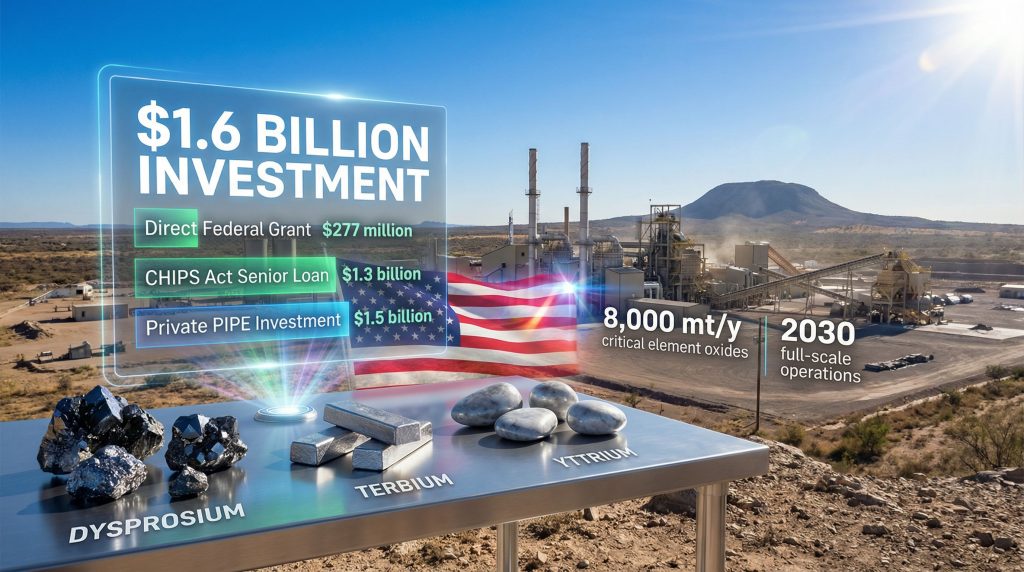
The USA Rare Earth U.S. Government investment represents a fundamental shift in how federal agencies approach critical mineral security. Rather than simply providing grants or loan guarantees, this structure combines multiple funding streams to create a comprehensive capitalisation framework totalling $4.3 billion across public and private sources.
Investment Structure Breakdown
| Component | Amount | Mechanism | Risk Profile |
|---|---|---|---|
| Federal Grant | $277 million | Direct appropriation | Government bears full risk |
| CHIPS Act Loan | $1.3 billion | Senior secured debt | Secured by project assets |
| Private PIPE | $1.5 billion | Equity investment | Market-driven returns |
| Government Equity | 10% ownership | Shares + warrants | Performance-linked upside |
This financing architecture represents a significant departure from traditional government mining support. The Department of Commerce, through its CHIPS Programme, serves as the primary funding administrator, while the Department of Energy contributes technical expertise through its National Energy Technology Laboratory.
Commerce Secretary Howard Lutnick characterised the initiative as fundamental to economic autonomy, stating that "the investment ensures supply chains become resilient and no longer reliant on foreign nations." Similarly, Energy Secretary Chris Wright emphasised the dual objectives of domestic job creation and national security enhancement through expanded mining and processing capabilities.
Furthermore, the non-binding Letter of Intent structure indicates these commitments remain conditional pending final documentation and regulatory approval processes. This framework allows for due diligence completion while signalling strong government commitment to the project's strategic objectives.
When big ASX news breaks, our subscribers know first
Production Capabilities and Technical Specifications
The scope of planned production capabilities extends across the entire rare earth value chain, from raw material extraction through finished component manufacturing. This vertical integration approach addresses current gaps in American industrial capacity while establishing competitive advantages in high-value applications.
Primary Extraction Operations
The Round Top deposit in Texas serves as the foundation for this integrated operation, targeting 40,000 metric tons daily of rare earth and critical mineral feedstock extraction. This represents a substantial operation by industry standards, with commercial production scheduled to commence in 2028 and full-scale operations by 2030.
Processing and Separation Capacity
Advanced processing facilities will handle 8,000 metric tons annually of combined monazite rare earth concentrate and heavy rare earth elements. The specific elements targeted for separation include:
• Strategic Heavy Rare Earths: Dysprosium, terbium, yttrium, gadolinium
• High-Tech Applications: Hafnium, erbium, thulium, lutetium, ytterbium, holmium
• Industrial Materials: Gallium, zirconium for semiconductor and aerospace applications
These elements are largely unavailable through domestic production currently, requiring imports for applications in semiconductor manufacturing, aerospace systems, defence equipment, and renewable energy infrastructure.
Manufacturing and Value-Added Production
The integration extends into finished component manufacturing through several key capabilities:
Metal and Alloy Production: 10,000 metric tons annually of heavy rare earth element metal and alloy-making capacity will be established through the Less Common Metals Ltd. subsidiary. These capabilities do not currently exist within the United States, representing a complete capability gap that the project aims to fill.
Magnet Manufacturing: 10,000 metric tons annually of neodymium-iron-boron (NdFeB) magnet production capacity targets high-performance applications in electric vehicles, wind turbines, industrial motors, and defence systems.
Recycling Operations: 2,000 metric tons annually of magnet swarf processing creates a secondary materials recovery stream, incorporating circular economy principles into the overall production framework.
In addition, the Department of Energy partnership specifically focuses on developing digital twin technologies for rare earth element separation processes. This computational approach to optimisation represents an advanced methodology for improving extraction efficiency and reducing processing costs.
Market Positioning and Strategic Impact
Current market dynamics reflect significant concentration risks in rare earth processing, with approximately 80% of global processing capacity controlled by Chinese operations. This concentration creates supply chain vulnerabilities for industries dependent on these materials for critical applications.
The projected annual processing capacity of 8,000 metric tons of heavy rare earth elements could potentially reduce American import dependencies by 15-20% based on current consumption patterns. While substantial, this level of production represents a foundation for broader supply chain diversification rather than complete independence.
Geographic Distribution and Infrastructure
The project spans multiple states to leverage specific advantages in each location:
Texas Operations: The Round Top deposit provides the geological foundation for extraction operations, taking advantage of existing mining infrastructure and regulatory frameworks supportive of resource development.
Colorado Technology Centre: The Wheat Ridge facility serves as the research and development hub for separation technology advancement, working in partnership with the Department of Energy to develop and optimise processing techniques.
This geographic distribution creates regional economic development opportunities while building specialised expertise in different aspects of the rare earth value chain.
End-Use Applications and Market Demand
The materials produced will support critical applications across multiple sectors:
• Defence Systems: Fighter jets, nuclear submarines, satellites, drones
• Commercial Technology: Semiconductors, robotics, electric vehicles
• Industrial Equipment: High-performance motors, renewable energy systems
• Advanced Manufacturing: Precision instruments, medical devices
CEO Barbara Humpton described the collaboration as transformative for establishing a resilient, independent domestic value chain essential to national security, economic competitiveness, and future technology development.
What Are the Regulatory Framework and Policy Integration?
The USA Rare Earth U.S. Government investment operates within an evolving regulatory environment that prioritises critical mineral security through multiple legislative mechanisms. The CHIPS and Science Act provides the primary funding authority, expanding beyond its original semiconductor focus to include raw materials essential for technology manufacturing.
Legislative Foundation
CHIPS Act Integration: The $1.3 billion senior secured loan represents one of the largest commitments under the expanded CHIPS Programme authority. This demonstrates congressional support for extending semiconductor supply chain security to include upstream raw materials.
Interagency Coordination: The involvement of both Commerce and Energy departments reflects a coordinated approach to industrial policy, combining funding mechanisms (Commerce) with technical development capabilities (Energy).
Expedited Approval Process: The timeline from announcement to planned commercial production suggests streamlined regulatory review processes for projects deemed critical to national security.
Implementation Timeline and Milestones
The aggressive 24-month timeline to commercial production represents a significant acceleration compared to typical mining project development cycles, which historically require 5-7 years from permitting to production. This compressed schedule introduces execution risks but also demonstrates priority treatment within federal approval processes.
Key milestones include:
- 2026: Final documentation and regulatory approval completion
- 2027: Infrastructure development and equipment installation
- 2028: Commercial production commencement
- 2030: Full-scale operations across all product lines
How Are Risks Assessed and Mitigated?
Large-scale mining and processing projects inherently involve multiple categories of risk that require comprehensive mitigation strategies. The USA Rare Earth investment structure incorporates several mechanisms to address these challenges.
Technical and Operational Risks
Geological Uncertainties: While the Round Top deposit has undergone extensive evaluation, extraction at commercial scale may reveal challenges not apparent in smaller-scale testing. The 40,000 metric tons daily extraction target requires consistent ore quality and processing efficiency.
Processing Technology Scalability: The planned 8,000 metric tons annually of heavy rare earth processing relies on separation technologies that must perform reliably at industrial scale. The Department of Energy partnership in digital twin development helps address these scaling challenges.
Quality Control Requirements: Defence and aerospace applications require materials meeting stringent specifications. Achieving consistent quality at high production volumes presents ongoing operational challenges.
Financial Risk Factors
Cost Escalation Potential: Mining projects frequently experience cost overruns due to equipment delays, labour shortages, or regulatory changes. The $4.3 billion total capitalisation provides some buffer for unexpected expenses.
Market Price Volatility: Rare earth prices can fluctuate significantly based on Chinese production decisions and global demand patterns. The senior secured loan structure provides some downside protection through asset collateral.
Competing Technology Development: Research into alternative materials that could reduce rare earth requirements poses long-term demand risks for some applications.
Structural Risk Mitigation
Government Equity Participation: The 10% ownership stake aligns public and private interests while providing oversight capabilities for strategic decisions affecting national security objectives.
Diversified Funding Sources: The combination of federal grants, secured debt, and private equity reduces dependence on any single funding mechanism.
Vertical Integration Strategy: Controlling the entire value chain from extraction through finished components reduces exposure to supply chain disruptions and captures value-added processing margins.
Competitive Landscape and Global Context
The initiative occurs within a rapidly evolving global competitive environment where multiple nations are pursuing critical mineral security through domestic production and strategic partnerships. Moreover, detailed rare earth reserves analysis reveals the global distribution challenges that drive such investments.
International Response Patterns
Chinese Policy Adjustments: Anticipated responses may include export controls on processing equipment or preferential pricing for domestic consumers to maintain competitive advantages.
Allied Nation Coordination: Australia, Canada, and European Union members are implementing similar strategies to diversify supply sources and reduce dependencies. For instance, the Australia critical minerals reserve initiative demonstrates comparable strategic thinking.
Technology Competition: Advanced processing techniques developed through this project may provide competitive advantages that other nations will seek to match or exceed.
Private Sector Investment Trends
The announcement has generated increased investor interest in North American rare earth projects, with mining company valuations reflecting optimism about sustained government support for domestic production capabilities.
Environmental, social, and governance (ESG) considerations are driving technology adoption focused on cleaner extraction and processing methods. The digital twin development partnership with the Department of Energy specifically targets process optimisation that could reduce environmental impacts while improving efficiency.
The next major ASX story will hit our subscribers first
What Are the Long-Term Strategic Implications?
The USA Rare Earth U.S. Government investment represents more than a single mining project; it establishes a foundation for broader transformation of American critical mineral capabilities. Success in this initiative could catalyse additional investments across the rare earth value chain and related strategic materials.
Technology Leadership Development
The digital twin technology development through the Department of Energy partnership could establish American leadership in advanced rare earth processing techniques. These capabilities have potential export value to allied nations pursuing similar supply chain diversification strategies.
However, this initiative also highlights broader concerns about the defence-critical minerals supply chain, which extends beyond rare earths to include other strategic elements.
Economic Ecosystem Development
Domestic rare earth production capabilities are likely to attract downstream manufacturers seeking secure supply sources. This clustering effect could create regional economic development opportunities in Texas and Colorado while reducing transportation costs and supply chain complexity.
Future Investment Framework
The public-private partnership model developed for this project establishes precedents for future critical mineral investments. The combination of federal funding, secured debt, and equity participation provides a framework that other strategic material projects may adapt.
Investment Outlook and Performance Monitoring
Success measurement for this initiative extends beyond traditional financial metrics to include strategic objectives related to supply chain security and technological capability development.
Key Performance Indicators
Production Metrics: Meeting the 2028 commercial production timeline and achieving 8,000 metric tons annually processing capacity by 2030 represent critical operational benchmarks.
Market Impact Measures: Tracking the percentage of domestic rare earth consumption supplied through USA Rare Earth production provides insight into supply chain diversification success.
Technology Development: Patent applications, process improvements, and separation efficiency gains indicate progress toward advanced processing capabilities.
Financial Performance: Return on government investment, debt service coverage, and project cash flow generation demonstrate economic viability alongside strategic value.
Sector Investment Implications
The landmark nature of this government commitment signals sustained federal support for critical mineral independence initiatives. This policy consistency creates investment confidence for additional private capital deployment across North American rare earth projects and related supply chain infrastructure.
Consequently, investors monitoring this sector should track production milestone achievements, cost competitiveness versus international benchmarks, and technology development progress as indicators of broader sector viability and growth potential.
Furthermore, the project's success could influence other strategic initiatives, including Greenland critical minerals development, as nations seek to diversify their supply sources beyond traditional suppliers.
Recent market developments, including concerns about rare earth price supports, highlight the importance of establishing cost-competitive domestic production capabilities that can withstand market volatility.
Disclaimer: This analysis is based on publicly available information and projections that may change based on technical, regulatory, or market developments. Investment decisions should incorporate comprehensive due diligence and risk assessment beyond the scope of this overview.
Ready to Invest in the Next Major Mineral Discovery?
Discovery Alert instantly alerts investors to significant ASX mineral discoveries using its proprietary Discovery IQ model, turning complex mineral data into actionable insights. Understand why historic discoveries can generate substantial returns by visiting Discovery Alert's dedicated discoveries page, showcasing historic examples of exceptional outcomes.