August 22, 2026
The Race to Build a Western Rare Earth Supply Chain Has a New Contender
For decades, the global rare earth industry has operated under a single, uncomfortable truth: one country controls the overwhelming majority of output, processing capacity, and pricing power. The search for credible alternatives has intensified considerably as clean energy transitions accelerate critical minerals demand for magnet rare earth elements (REEs) used in electric vehicles, wind turbines, and industrial motors. This is precisely where Minas Gerais rare earth demand supply dynamics are beginning to attract serious international attention.
Within this landscape, Brazil's Minas Gerais state is emerging as one of the most geologically compelling, yet industrially underutilised, rare earth provinces on the planet. The question is no longer whether Minas Gerais has the resources. The question is whether Brazil can build the institutional and industrial machinery to convert those resources into sovereign supply chain influence before the window of opportunity narrows.
When big ASX news breaks, our subscribers know first
Brazil's Rare Earth Reserve Base: Size, Structure, and Significance
How Large Is the National Resource Position?
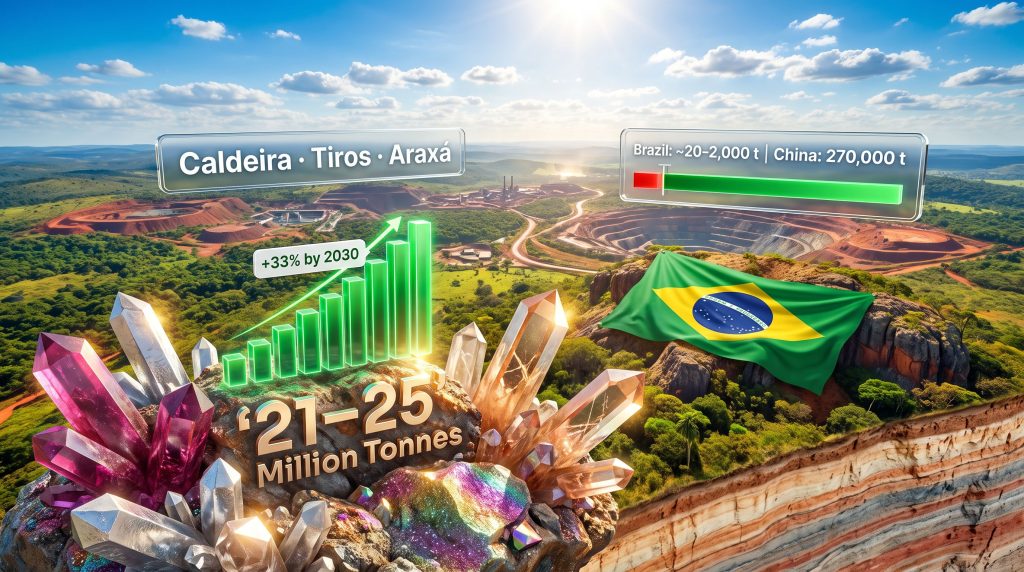
Brazil holds an estimated 21 to 25 million tonnes of rare earth reserves, positioning it among the most endowed nations globally by raw volume. This figure places Brazil in a tier occupied only by China, Vietnam, and Russia in terms of total geological endowment. Critically, Minas Gerais accounts for a disproportionately large share of this national total, hosting several of the country's most advanced and prospective REE deposits across distinct geological settings.
For context, China produces approximately 270,000 tonnes of rare earth oxides annually, a figure that represents the vast majority of global supply. Brazil's current output, by contrast, sits at a nascent level, with estimates ranging from as low as 20 tonnes to a few thousand tonnes per year depending on the reporting methodology and which processing stages are included. This gap between reserve endowment and productive capacity defines the central challenge, and opportunity, that Minas Gerais presents.
Deposit Typology: Ionic Clay vs. Carbonatite and Hard-Rock Systems
One of the lesser-understood aspects of Minas Gerais's rare earth geology is the diversity of deposit types hosted within the state. This matters enormously for processing economics and project timelines.
Ionic clay deposits, similar to those that have underpinned southern China's heavy rare earth dominance for decades, are found in weathered profiles overlying granitic basement rocks. These deposits are prized because the REEs are adsorbed onto clay minerals rather than locked within hard crystalline structures, meaning they can be extracted using simple leaching methods without energy-intensive crushing or smelting. This dramatically reduces capital expenditure and operating costs relative to hard-rock alternatives.
Carbonatite-hosted deposits, such as those associated with the Araxá alkaline complex in Triângulo Mineiro, represent a different geological setting. Carbonatites are igneous rocks with high carbonate mineral content, and they frequently host elevated concentrations of light rare earth elements alongside niobium, a critical mineral in its own right. The Araxá region is already globally significant for niobium production, with CBMM operating the world's largest niobium mine at the site, making rare earth co-production a logistically attractive proposition.
Hard-rock deposits require more conventional mining and processing approaches, typically involving flotation, cracking, and solvent extraction circuits that demand greater capital investment and technical sophistication.
The coexistence of these deposit types within a single state creates both complexity and optionality for project developers and investors evaluating the Minas Gerais rare earth demand supply equation.
Major Projects Advancing in Minas Gerais
Project Pipeline: Stage, Scale, and Strategic Significance
| Project | Region | Deposit Type | Development Stage | Key REEs Targeted |
|---|---|---|---|---|
| Caldeira / Colossus | Poços de Caldas | Ionic Clay / Hard Rock | Advanced Exploration | NdPr, Dy, Tb |
| Tiros | Alto Paranaíba | Carbonatite-associated | Pre-Feasibility | NdPr, La, Ce |
| Araxá | Triângulo Mineiro | Carbonatite | Feasibility / Advanced | NdPr, Nb (co-product) |
| Morro do Ferro | Southern MG | Hard Rock | Early Exploration | Mixed REE |
The Caldeira project in the Poços de Caldas region is particularly noteworthy given its ionic clay component. Ionic clay REE deposits have historically been underexplored in Brazil compared to Southeast Asia, and Poços de Caldas sits atop one of the largest alkaline complexes in South America, a geological environment known to concentrate rare earth elements through prolonged weathering processes.
The Tiros project in Alto Paranaíba targets carbonatite-associated mineralisation with a focus on neodymium and praseodymium (NdPr), the two elements most directly linked to permanent magnet manufacturing. Given that NdPr prices are closely tied to electric vehicle motor demand, projects with strong NdPr endowments carry a strategic premium in the current market environment.
The critical distinction for investors evaluating Minas Gerais rare earth projects is not simply total resource tonnage, but the distribution of mineralisation across the magnet rare earth elements: neodymium, praseodymium, dysprosium, and terbium. Deposits enriched in these four elements command fundamentally different commercial profiles than those dominated by lanthanum and cerium, which face chronic oversupply and weak pricing.
Global Demand Forces and Their Impact on the Minas Gerais Supply Equation
The Clean Energy Transition as a Structural Demand Catalyst
The IEA's rare earth analysis has documented that demand for magnet rare earth elements has doubled since 2015 and is forecast to grow by approximately one-third by 2030 under current policy trajectories. This is not a speculative projection driven by optimistic assumptions — it reflects contracted EV production targets, installed wind capacity pipelines, and defence procurement programmes already underway across major economies.
To understand what this means in physical terms, consider the following:
- A single electric vehicle uses approximately 1 to 2 kilograms of NdFeB permanent magnet material, containing meaningful quantities of neodymium and praseodymium, with dysprosium added for high-temperature performance in traction motors.
- A 3 MW direct-drive offshore wind turbine can require up to 600 kilograms of rare earth permanent magnets per unit.
- Industrial robots, aerospace actuators, and defence systems including missile guidance and radar add further demand layers that are often excluded from consumer-facing demand forecasts.
This demand structure creates a compounding effect: as vehicle electrification rates climb and wind installation targets escalate, the marginal tonne of NdPr becomes progressively harder to source from existing rare earth supply chains.
The Magnet REE Premium: Why Not All Rare Earths Are Equal
A critical point frequently misunderstood by generalist investors is that the rare earth sector is not homogeneous. The 17 elements classified as rare earths span an enormous range of applications, prices, and supply dynamics. Lanthanum and cerium, the most abundant light rare earths, trade at commodity-level prices and face persistent oversupply. By contrast, terbium and dysprosium, the heavy rare earths used to improve magnet coercivity at elevated temperatures, can trade at prices 10 to 50 times higher per kilogram than their light counterparts.
This pricing bifurcation means that deposit quality in Minas Gerais must be assessed not by total REE content but by the basket value of the specific elements present, weighted by their respective market prices and the processing cost required to separate them.
Brazil's Push Toward Domestic Processing and Value-Added Manufacturing
Beyond Raw Ore Export: The Strategic Logic of Vertical Integration
Brazil's approach to rare earth development is increasingly oriented toward building a domestic processing and manufacturing ecosystem rather than simply exporting raw ore or mineral concentrates. This strategic posture reflects an understanding that the majority of value in the rare earth supply chain is captured at the processing and magnet manufacturing stages, not at the mine gate. Furthermore, understanding the rare earth processing challenges that other jurisdictions have faced is central to shaping Brazil's industrial approach.
The economics are stark. A tonne of rare earth ore might sell for a few hundred dollars. The same material, after separation into individual rare earth oxides, commands multiples of that value. Processed into metal alloys and then into finished NdFeB permanent magnets, the value per tonne of original ore content increases by orders of magnitude.
MagBras and LabFabITR: Anchoring the Domestic Value Chain
Brazil's emerging magnet manufacturing initiative, operating under the MagBras framework in conjunction with the LabFabITR industrial fabrication and research facility, represents a deliberate attempt to establish domestic magnet production capability. This is a technically demanding undertaking. Permanent magnet manufacturing requires precise alloy formulation, strip casting, hydrogen decrepitation, jet milling, sintering, and magnetisation processes, none of which are trivial at industrial scale.
Several major industrial partners have been identified as anchoring downstream demand linkages for this initiative:
- Stellantis provides automotive sector demand pull through its electrification programmes across multiple vehicle brands.
- Iveco contributes commercial vehicle electrification demand, particularly relevant given Brazil's substantial trucking sector.
- LabFabITR functions as both a research node and an industrial prototyping facility, bridging the gap between academic rare earth science and commercial magnet production.
This approach broadly mirrors the strategy pursued by Australia through Lynas Rare Earths, which built processing capacity outside China to reduce single-source dependency, though Brazil's initiative is at an earlier stage of development.
Competitive Benchmarking: Where Does Minas Gerais Stand Globally?
Jurisdiction Comparison
| Jurisdiction | Key Projects | Processing Capability | Geopolitical Risk | Relative Maturity |
|---|---|---|---|---|
| Minas Gerais, Brazil | Caldeira, Tiros, Araxá | Early-stage, developing | Low to Moderate | Emerging |
| Western Australia | Mount Weld, Yangibana | Advanced (Lynas) | Low | Established |
| Mountain Pass, USA | MP Materials | Operational | Low | Established |
| Greenland | Kvanefjeld | Pre-development | Moderate | Early |
| Myanmar | Multiple ionic clay | Limited formal capacity | High | Fragmented |
Brazil's competitive positioning relative to established producers like Lynas in Australia and MP Materials in the United States is characterised by larger reserve endowment but less developed processing infrastructure and a shorter track record of commercial rare earth production. However, the Western rare earth supply chain is actively seeking new entrants, which creates a genuine strategic opening for Minas Gerais.
The next major ASX story will hit our subscribers first
Key Risks and Barriers to Development
The Structural Challenges That Determine Timelines
Several interconnected barriers could delay or constrain the realisation of Minas Gerais's rare earth potential:
-
Environmental licensing complexity. Brazil's regulatory framework for mining licences, particularly in ecologically sensitive regions, involves multiple federal and state-level approvals. The Minas Gerais state government has faced scrutiny over mining regulation following historical environmental incidents, adding procedural risk to project timelines.
-
Capital intensity. Moving a rare earth project from advanced exploration through feasibility, construction, and into production typically requires hundreds of millions of dollars in investment. Rare earth projects face particular challenges in capital markets because the separation and processing complexity makes project finance structuring more difficult than for simpler commodity projects.
-
Skilled labour and technical capacity gaps. Brazil does not yet have a deep domestic talent pool in rare earth metallurgy, hydrometallurgical processing, or magnet manufacturing. Building this capability requires sustained investment in education, training, and institutional knowledge transfer.
-
Infrastructure requirements. REE processing operations require reliable energy supply, water access, and logistics connectivity. Some of the most prospective geological areas in Minas Gerais are not optimally served by existing infrastructure networks.
-
Rare earth price volatility. REE prices have historically been subject to extreme cycles, including the dramatic price spike of 2010 to 2012 followed by an equally sharp correction. Project economics must be stress-tested against a range of price scenarios, including extended periods of weak pricing.
Strategic Scenarios: Three Pathways for Minas Gerais by 2030 to 2035
Scenario A: Accelerated Development
Multiple advanced-stage projects including Caldeira, Tiros, and Araxá reach commercial production simultaneously by 2032. Domestic processing infrastructure scales alongside mine output, and Brazil establishes itself as a credible third-party supplier to Western magnet manufacturers. Under this scenario, Minas Gerais rare earth demand supply dynamics could see the state approach a 20% share of global rare earth supply, though this figure is contingent on the simultaneous resolution of capital, regulatory, and infrastructure constraints.
Scenario B: Moderate Progression
Two or three projects advance to production while processing infrastructure develops incrementally. Brazil becomes a meaningful niche supplier of specific REEs, particularly NdPr, without achieving full supply chain sovereignty. This is arguably the most probable near-term outcome given historical capital formation timelines in the sector.
Scenario C: Structural Stagnation
Regulatory delays, capital market disinterest, and infrastructure deficits collectively push meaningful production beyond 2035. The geological endowment remains intact but strategically inert as competing jurisdictions consolidate their positions in the post-China REE market. Consequently, China's rare earth strategy would continue to dominate global supply chains during this period.
The defining variable for Minas Gerais is not geology. The resource base is well-established and internationally recognised. The critical determinant is whether Brazil can construct the institutional, financial, and industrial architecture necessary to convert geological advantage into sovereign supply chain influence before other jurisdictions close the window.
Frequently Asked Questions: Minas Gerais Rare Earth Demand Supply
What rare earth elements are most abundant in Minas Gerais deposits?
Minas Gerais deposits host a broad spectrum of REEs, but the most commercially significant concentrations in current advanced-stage projects include neodymium, praseodymium, dysprosium, and terbium — the magnet rare earths — alongside lanthanum and cerium in carbonatite-associated deposits. The ionic clay occurrences near Poços de Caldas are particularly noted for their heavy rare earth content.
How much of global rare earth demand could Minas Gerais realistically supply by 2030?
Based on current resource assessments and project development pipelines, Minas Gerais has the geological capacity to contribute an estimated 20% of global rare earth supply. However, this figure depends on multiple projects reaching full production simultaneously, the establishment of domestic processing infrastructure at scale, and sustained capital deployment across the project pipeline.
What is the current state of rare earth processing infrastructure in Brazil?
Brazil's rare earth processing infrastructure is at an early to pilot stage. Initiatives such as MagBras and LabFabITR represent meaningful steps toward building domestic separation and magnet manufacturing capability, but commercial-scale processing capacity has not yet been established.
Which industries are creating domestic demand for rare earth elements in Minas Gerais?
The primary domestic demand drivers are the automotive and commercial vehicle sectors, particularly through electrification programmes anchored by manufacturers such as Stellantis and Iveco. Brazil's wind energy sector and broader industrial machinery base also represent growing sources of domestic REE demand.
How does Brazil's rare earth reserve base compare to China's?
China holds the world's largest known rare earth reserve base at approximately 44 million tonnes, according to United States Geological Survey estimates. Brazil's 21 to 25 million tonne reserve position represents roughly half of China's endowment by volume, though China's processing and manufacturing infrastructure gives it a functional supply chain advantage that Brazil is working to close.
What role does the Brazilian government play in rare earth supply chain development?
Brazil has established national minerals policy frameworks that identify rare earths as strategic minerals. Government-affiliated research institutions and industrial policy instruments have supported initiatives like LabFabITR. However, the translation of policy priority into project-level support, permitting velocity, and capital mobilisation remains uneven across the project pipeline.
Key Takeaways: Minas Gerais Rare Earth Supply and Demand
- Brazil holds 21 to 25 million tonnes of rare earth reserves, with Minas Gerais as the primary concentration zone across multiple deposit types.
- Current national production remains at early-stage levels, far below the country's geological potential and well under China's 270,000 tonne annual output.
- Global magnet REE demand has doubled since 2015 and is projected to grow approximately 33% by 2030 according to International Energy Agency modelling.
- Key projects including Caldeira/Colossus, Tiros, and Araxá are advancing through exploration and feasibility stages but remain pre-production.
- Brazil's strategic priority is domestic processing and magnet manufacturing rather than raw ore export, with MagBras and LabFabITR as central institutional vehicles.
- Industrial anchors including Stellantis and Iveco are providing downstream demand linkages for Brazil's emerging magnet supply chain.
- The magnet rare earths — neodymium, praseodymium, dysprosium, and terbium — command 10 to 50 times the per-kilogram price of abundant light REEs like lanthanum and cerium, making deposit basket value the critical investment assessment metric.
- Minas Gerais has the geological capacity to supply an estimated 20% of global rare earth demand, contingent on capital mobilisation, regulatory alignment, and infrastructure development proceeding in parallel across the project pipeline.
This article contains forward-looking statements and projections based on publicly available data, including International Energy Agency forecasts and Brazilian geological surveys. Mineral resource estimates, demand projections, and project timelines are subject to change and should not be construed as investment advice. Readers should conduct independent due diligence before making investment decisions related to the rare earth sector.
Want to Track the Next Major Rare Earth Discovery Before the Market Does?
Discovery Alert's proprietary Discovery IQ model delivers real-time alerts on significant ASX mineral discoveries — including critical and rare earth elements driving the clean energy transition — instantly translating complex geological data into actionable investment insights for traders and long-term investors alike. Explore how historic mineral discoveries have generated extraordinary returns and begin your 14-day free trial today to position yourself ahead of the market.