August 23, 2026
The global economy operates on a foundation of critical minerals energy security that most consumers never see. While public attention focuses on mining operations and final products, the most consequential bottleneck exists in the sophisticated chemical processing that transforms raw ore into usable materials. This midstream processing represents where true strategic leverage resides, particularly in the rare earth elements that power everything from electric vehicle motors to precision-guided defence systems.
China's stranglehold on rare earth refining extends far beyond simple market share. The nation controls approximately 80-90% of global rare earth separation capacity, creating a dependency that affects critical industries across multiple continents. This dominance stems not from geological advantages or superior technology, but from deliberate strategic choices made over decades that Western nations are only beginning to fully comprehend.
The Hidden Battlefield: Understanding Rare Earth Refining vs. Mining
What Makes Rare Earth Processing So Complex?
The technical complexity of rare earth refining represents one of the most challenging aspects of modern metallurgy. Unlike traditional mining operations that extract relatively distinct materials, rare earth elements occur together in tightly bound geological formations with remarkably similar chemical properties. Separating individual elements like neodymium from praseodymium, or dysprosium from terbium, requires sophisticated solvent extraction processes that must be executed with extraordinary precision.
The separation process typically involves multiple sequential solvent-extraction stages, each designed to isolate specific elements from the complex mixture. These operations demand purpose-built equipment capable of handling both hazardous chemicals and radioactive residues. A single error in the process can contaminate entire batches, making quality control paramount throughout the operation.
Key Technical Challenges Include:
• Chemical similarity between different rare earth elements requiring highly specialised separation techniques
• Multiple sequential processing stages, each requiring precise control and monitoring
• Management of radioactive waste streams and hazardous chemical byproducts
• Stringent quality control requirements to prevent cross-contamination between elements
• High energy consumption and complex waste treatment systems
The Economics Behind China's Processing Monopoly
China's stranglehold on rare earth refining emerged through a combination of strategic state investment and tolerance for environmental externalities that other jurisdictions found unacceptable. Beginning in the 1980s, Chinese leadership recognised the strategic potential of rare earth dominance and invested accordingly, treating processing facilities as strategic infrastructure rather than purely commercial ventures.
The capital intensity required for separation facilities creates significant barriers to entry. Modern rare earth processing plants require hundreds of millions in initial investment, specialised engineering expertise, and years of operational optimisation before achieving commercial viability. These economic realities, combined with China's willingness to subsidise operations and accept environmental costs, created an insurmountable competitive advantage.
Economic Factors Driving Chinese Dominance:
• State-backed financing reducing capital cost burdens for Chinese processors
• Lower environmental compliance costs due to regulatory differences
• Accumulated economies of scale from decades of continuous operation
• Integrated supply chains from mining through finished magnet production
• Cross-subsidisation between profitable and strategic processing operations
When big ASX news breaks, our subscribers know first
How Did China Build Its Rare Earth Processing Empire?
Strategic Investment Timeline (1980s-2020s)
China's path to rare earth processing dominance began with a clear strategic vision articulated in the 1980s. This long-term approach recognised that controlling the midstream processing would provide greater leverage than simply mining raw materials. Over four decades, Chinese investment focused on building not just processing capacity, but the institutional knowledge and human capital necessary to maintain technological leadership.
The development strategy emphasised workforce training at scale, with Chinese institutions producing hundreds of specialists in hydrometallurgy and rare earth chemistry while Western universities reduced similar programs. This human capital development proved as crucial as physical infrastructure, creating the operational expertise necessary to run complex processing operations reliably.
Furthermore, in December 2023, China formalised its strategic approach by implementing export controls on rare earth processing technology and magnet-related know-how. These restrictions signal Beijing's recognition that technological knowledge represents perhaps the most valuable component of its rare earth dominance.
Timeline of Strategic Developments:
• 1980s-1990s: Initial state investment in rare earth processing infrastructure
• 2000s-2010s: Rapid capacity expansion and workforce development programs
• 2010s-2020s: Integration of supply chains and technology advancement
• December 2023: Implementation of technology export controls
• 2024-2025: Further restrictions on knowledge transfer and equipment exports
The Western Retreat: Why Companies Abandoned Processing
Western nations' withdrawal from rare earth processing resulted from a combination of economic rationalisation and regulatory burden. As environmental standards tightened in developed countries, the cost and complexity of operating rare earth separation facilities increased dramatically. Companies found it economically attractive to outsource processing to China while focusing on higher-value downstream activities.
This offshoring decision created a cascade of consequences. Universities reduced research programs in extractive metallurgy as industry demand decreased. Experienced professionals retired without replacement, and institutional knowledge gradually migrated to Chinese operations. Consequently, the result was not just capacity migration, but a complete erosion of Western technical competence in rare earth processing.
The environmental compliance costs that deterred Western investment involved both direct operational expenses and regulatory risk. Rare earth processing produces radioactive waste streams and requires sophisticated environmental management systems that add significant cost to operations. Chinese facilities operated under different regulatory frameworks, creating cost advantages that proved impossible to overcome through operational efficiency alone.
What Are the Real-World Consequences of Processing Dependence?
Supply Chain Vulnerability Analysis
China's stranglehold on rare earth refining creates cascading vulnerabilities across critical technology sectors. Electric vehicle production depends on rare earth permanent magnets for efficient motor operation. Wind turbine generators require significant quantities of neodymium and dysprosium for optimal performance. In addition, defence systems from precision-guided munitions to advanced fighter aircraft rely on rare earth elements for electronic systems and propulsion components.
| Industry Sector | Critical Applications | Chinese Processing Dependence |
|---|---|---|
| Electric Vehicles | Motor magnets, sensors | 85-90% of processing capacity |
| Renewable Energy | Wind turbine generators | 80-90% of processing capacity |
| Defence Systems | Guidance systems, electronics | 85-90% of processing capacity |
| Consumer Electronics | Smartphone components | 80-90% of processing capacity |
The vulnerability extends beyond simple supply disruption to include potential for economic coercion and strategic leverage. Recent export control escalations demonstrate how processing dependence translates into geopolitical influence, with Chinese authorities able to restrict technology transfer and impose licensing requirements that affect global supply chains.
Recent Export Control Escalations
Chinese export control measures implemented in December 2023 marked a significant escalation in the strategic use of rare earth processing dominance. These controls target technology transfer and processing know-how rather than finished products, indicating a sophisticated understanding of where true leverage resides in the supply chain.
The restrictions specifically encompass magnet-related technology and processing equipment, areas where Chinese companies have accumulated decades of operational experience. By limiting access to this knowledge, China aims to prevent the development of competitive processing capacity in other jurisdictions while maintaining its technological leadership.
According to breaking China's stranglehold on rare earth refining, these export controls represent a calculated move to protect China's technological advantages in rare earth processing. The restrictions affect not only equipment exports but also technical consulting services and process optimisation knowledge that foreign companies need to establish competitive operations.
Can the West Break China's Refining Stranglehold?
Current Western Processing Projects Assessment
Western efforts to rebuild rare earth processing capacity face significant challenges in both capital requirements and human resources. Several major projects are currently underway, though each confronts unique obstacles in achieving commercial-scale operations.
Major Non-Chinese Rare Earth Processing Initiatives:
| Project | Location | Capacity | Timeline | Government Support |
|---|---|---|---|---|
| MP Materials | California, USA | Mixed REO | Operational | $150M federal funding |
| Energy Fuels | Utah, USA | Heavy REE | Early production | DoD contracts |
| Lynas | Texas, USA | Light REE | Development stalled | $120M government backing |
| Ucore | Alaska/Louisiana, USA | Planned | Development phase | Defence funding |
MP Materials represents the most advanced Western processing operation, having secured $150 million in federal funding to expand domestic refining capabilities. The company previously operated under a China-dependent model, shipping concentrate to Chinese processors for separation before returning finished products. Recent geopolitical tensions forced a strategic pivot toward domestic processing.
Energy Fuels claims to have achieved separated rare earth oxide production at its White Mesa facility in Utah, potentially representing a breakthrough in heavy rare earth processing capability. However, the sustainability and scalability of these operations remain to be proven at commercial volumes.
The Human Capital Crisis
Perhaps the most significant barrier to breaking China's stranglehold on rare earth refining involves workforce limitations. Across the United States, Europe, and Japan combined, only dozens of professionals possess deep, hands-on experience in operating rare earth separation facilities at commercial scale. This compares to hundreds or potentially thousands of trained specialists in China.
Critical Workforce Challenges:
• Skills Shortage: Fewer than 100 experienced rare earth processing specialists across all Western nations
• Training Timeline: 5-10 years required to develop operational expertise in solvent extraction systems
• University Programs: Limited academic programs focused on extractive metallurgy and hydrometallurgy
• Institutional Knowledge: Loss of operational experience through decades of offshoring
• Recruitment Difficulty: Limited career pathways in rare earth processing discouraging new entrants
The workforce shortage affects every aspect of facility development, from initial plant design through daily operations. Solvent extraction systems require operators who can diagnose problems, optimise performance, and maintain quality control under varying conditions. This expertise develops through years of hands-on experience that cannot be easily replicated through classroom training.
What Would True Supply Chain Independence Require?
Financial Investment Scenarios
Achieving meaningful independence from China's stranglehold on rare earth refining would require sustained financial commitment at levels comparable to semiconductor reshoring initiatives. Processing facilities require hundreds of millions in initial capital investment, followed by years of operational subsidies to achieve cost competitiveness with established Chinese operations.
Furthermore, the European CRM supply initiatives demonstrate the scale of coordinated investment required across multiple jurisdictions to achieve processing independence. European Union efforts to establish critical raw materials facilities indicate that successful rare earth processing independence requires multinational cooperation and shared investment burdens.
Breaking China's grip requires treating refineries not as profit centres, but as infrastructure like shipyards and power grids that serve strategic national interests.
The economic reality of rare earth processing makes private investment alone insufficient. High capital costs, uncertain pricing, stringent environmental requirements, and competition from state-subsidised Chinese operations create risk profiles that deter commercial funding. Government intervention becomes necessary to bridge the gap between strategic necessity and economic viability.
Investment Requirements for Processing Independence:
• Initial Capital: $500M-$1B per major processing facility
• Operational Subsidies: 5-10 years of cost support to achieve competitiveness
• Workforce Development: $100M+ for training programs and university partnerships
• Environmental Infrastructure: Specialised waste treatment and management systems
• Research and Development: Ongoing technology improvement and process optimisation
Technology and Workforce Development Roadmap
Developing sustainable rare earth processing independence requires coordinated investment in both technology advancement and human capital development. Current Western processing technology lags Chinese capabilities in efficiency, yield, and environmental performance, necessitating focused research and development efforts.
Workforce development presents an even greater challenge, requiring coordination between industry, universities, and government agencies to rebuild educational pipelines and operational expertise. Training programs must encompass not only technical skills but also the institutional knowledge necessary to optimise complex processing systems.
For instance, the mining industry evolution demonstrates how technological advancement and workforce development must proceed simultaneously to achieve competitive capabilities. The evolution of mining technologies provides insights into the timelines and investment levels required for comparable advancement in processing technologies.
Strategic Development Priorities:
- University Partnership Programs: Rebuild academic expertise in extractive metallurgy and hydrometallurgy
- Technology Transfer Initiatives: Secure access to proven processing technologies through allied partnerships
- Operational Training Centres: Establish facilities for hands-on training in solvent extraction systems
- International Collaboration: Share costs and risks through multinational processing initiatives
- Research and Development Investment: Advance processing efficiency and environmental performance
How Do Other Critical Minerals Follow the Same Pattern?
Lithium and Cobalt Processing Concentration
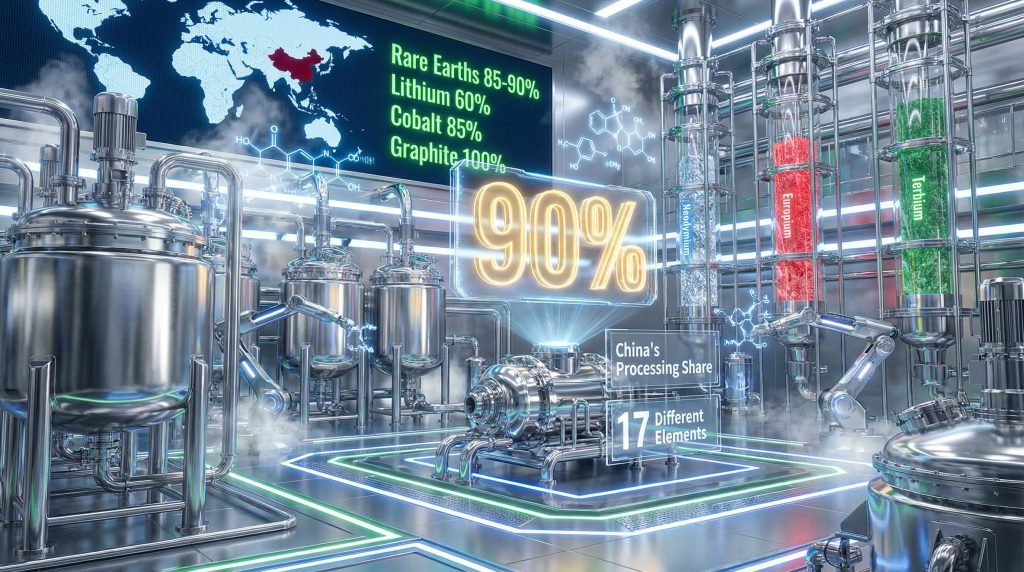
China's stranglehold on rare earth refining represents part of a broader pattern of critical mineral processing concentration. Similar dynamics exist across lithium, cobalt, and graphite processing, where Chinese companies have achieved dominant market positions despite more geographically diverse mining operations.
Processing Concentration Across Critical Minerals:
| Mineral | China's Processing Share | Strategic Importance |
|---|---|---|
| Rare Earths | 85-90% | EVs, Defence, Wind turbines |
| Lithium | 60-65% | Battery production |
| Cobalt | 80-85% | Battery cathodes |
| Graphite | 90-95% | Battery anodes |
| Manganese | 90-95% | Steel production, batteries |
The pattern across critical minerals reveals a systematic approach to securing midstream processing dominance. Chinese companies invested heavily in refining capacity while Western nations focused on mining rights and downstream applications. This strategy provides leverage across multiple supply chains simultaneously.
However, recent policy developments like the critical minerals order indicate growing Western recognition of these vulnerabilities. Government initiatives are beginning to address processing dependencies across multiple critical mineral supply chains rather than focusing solely on individual materials.
Lessons from Semiconductor Reshoring Efforts
The semiconductor industry's experience with supply chain concentration offers valuable insights for critical mineral processing. The CHIPS and Science Act demonstrated the scale of investment and policy coordination necessary to rebuild domestic manufacturing capacity in strategically important sectors.
Semiconductor reshoring required not only direct facility investment but comprehensive support including workforce development, research partnerships, and regulatory streamlining. Similar comprehensive approaches will be necessary for critical mineral processing, with even greater environmental and safety considerations.
Key Lessons from Semiconductor Policy:
• Scale Matters: Billions in investment required for meaningful capacity development
• Timeline Expectations: 5-10 years minimum for significant production capacity
• Ecosystem Approach: Success requires coordination across suppliers, manufacturers, and customers
• International Partnerships: Allied cooperation essential for cost sharing and technology access
• Sustained Commitment: Long-term political support necessary despite changing administrations
The next major ASX story will hit our subscribers first
What Are the Long-Term Strategic Implications?
Geopolitical Leverage Scenarios
China's stranglehold on rare earth refining provides multiple avenues for exercising geopolitical influence. Export controls on processing technology limit the ability of other nations to develop independent capacity. Licensing requirements for finished products create administrative leverage over global supply chains. Processing capacity concentration enables selective supply restriction for political objectives.
The December 2023 technology transfer restrictions demonstrate how processing dominance translates into strategic advantage. By controlling access to separation know-how and processing equipment, China can effectively prevent the development of competitive capacity while maintaining its technological leadership.
Recent trade tensions illustrate the vulnerability created by processing dependence. When geopolitical relationships deteriorate, supply chain dependencies become weapons that can be deployed for economic coercion or strategic advantage. How to loosen China's stranglehold on rare earths analyses suggest that breaking these dependencies requires comprehensive policy intervention across multiple dimensions.
Investment and Policy Recommendations
Breaking China's stranglehold on rare earth refining requires coordinated policy intervention treating processing capacity as strategic infrastructure rather than commercial enterprise. The scale and timeline of necessary investment exceed what private markets can deliver without substantial government support.
The defense minerals strategy provides a framework for understanding how critical mineral processing independence aligns with national security objectives. Defence applications for rare earth elements make processing independence a priority for military readiness and strategic autonomy.
Five-Point Framework for Processing Independence:
- Treat Processing as Strategic Infrastructure: Provide sustained government funding and policy support comparable to defence shipbuilding or strategic petroleum reserves
- Develop International Partnerships: Share costs and risks through allied cooperation and burden-sharing arrangements
- Invest in Workforce Development: Rebuild educational pipelines and operational expertise through decade-long training initiatives
- Create Regulatory Frameworks: Balance environmental protection with national security imperatives through streamlined permitting processes
- Establish Strategic Reserves: Buffer supply disruptions through stockpiling and emergency production capacity
These recommendations recognise that market forces alone cannot overcome the accumulated advantages of China's state-backed processing industry. Strategic intervention becomes necessary when commercial logic conflicts with national security requirements.
Frequently Asked Questions About Rare Earth Processing Dependence
Why Can't Countries Just Use Their Own Mined Rare Earths?
Mining rare earths produces concentrated ore containing multiple elements that must be separated through sophisticated chemical processes. Raw rare earth ore cannot be used directly in manufacturing applications, requiring separation into individual elements or element groups before industrial use.
The separation process demands specialised facilities, trained personnel, and environmental management systems that most countries have not maintained. Even nations with significant rare earth mining operations, such as the United States and Australia, have historically shipped concentrate to Chinese processors for separation.
Technical complexity, capital requirements, and environmental considerations make rare earth processing far more challenging than mining operations. This explains why mining capacity remains geographically distributed while processing concentrates in China.
How Long Would It Take to Build Processing Independence?
Achieving meaningful processing independence requires coordinated development across multiple dimensions with different timelines. Facility construction typically requires 3-5 years from initial permitting through commissioning. Workforce development demands 5-10 years to train sufficient specialists for commercial-scale operations.
Technology development and process optimisation add additional years before facilities achieve optimal performance. The total timeline for substantial processing independence likely extends 10-15 years with sustained investment and political commitment.
Development Timeline Components:
• Facility Permitting and Construction: 3-5 years
• Workforce Training and Development: 5-10 years
• Technology Optimisation and Scaling: 2-5 years
• Supply Chain Integration: 3-7 years
• Competitive Cost Achievement: 5-15 years
What Role Does Recycling Play in Reducing Dependence?
Recycling rare earth elements from electronic waste and end-of-life products represents a potential pathway for reducing dependence on Chinese processing. Current recycling rates remain below 1% for most rare earth elements, indicating significant untapped potential.
However, rare earth recycling faces similar technical challenges to primary processing. Electronic waste contains complex mixtures of elements requiring sophisticated separation processes. Recycling facilities need similar expertise and infrastructure to primary processing operations.
Economic barriers also limit recycling expansion. The distributed nature of electronic waste, collection logistics, and processing costs often exceed the value of recovered materials. Government intervention may be necessary to make recycling economically viable at scale.
The Path Forward: Building Resilient Supply Chains
Short-Term Risk Mitigation Strategies
While long-term processing independence develops, immediate strategies can reduce vulnerability to supply chain disruption. Strategic stockpiling provides buffer capacity during temporary disruptions. Diversified supplier relationships reduce concentration risk within Chinese processing capacity.
Emergency production planning identifies facilities that could rapidly scale rare earth processing during supply emergencies. This requires maintaining core expertise and equipment even when commercial operations remain uneconomical.
Immediate Risk Mitigation Approaches:
• Strategic Stockpiles: Maintain 6-12 months of critical element inventory
• Supplier Diversification: Develop relationships with multiple Chinese and non-Chinese processors
• Emergency Planning: Identify rapid-response processing capabilities
• Allied Coordination: Share supply chain intelligence and emergency capacity
• Demand Substitution: Develop alternative technologies reducing rare earth dependence
Long-Term Independence Scenarios
Meaningful processing independence requires sustained commitment across multiple decades with realistic expectations about timelines and costs. Success demands treating rare earth processing as strategic infrastructure requiring sustained government support rather than purely commercial enterprise.
The timeline for breaking China's stranglehold on rare earth refining extends through 2035-2040 for substantial capacity development, with competitive cost achievement potentially requiring even longer timeframes. Political sustainability across multiple election cycles becomes crucial for maintaining necessary investment levels.
Success Metrics for Supply Chain Resilience:
• Processing Capacity: 50%+ of critical rare earth processing outside China by 2040
• Workforce Development: Hundreds of trained specialists across allied nations
• Technology Leadership: Competitive processing efficiency and environmental performance
• Economic Viability: Operations sustainable with minimal ongoing subsidies
• Strategic Flexibility: Ability to scale production during supply emergencies
The path forward requires recognising that China's stranglehold on rare earth refining represents a strategic challenge demanding comprehensive policy response. Market forces alone cannot overcome the accumulated advantages of state-backed Chinese processing capacity. Breaking this dependence requires treating processing independence as a national security priority worthy of sustained investment and political commitment comparable to other strategic industries.
Disclaimer: This analysis contains forward-looking projections based on current market conditions and policy trends. Actual outcomes may vary significantly based on technological developments, policy changes, and geopolitical factors. Investment in rare earth processing involves substantial risks including regulatory changes, environmental liabilities, and market volatility.
Ready to Capitalise on Critical Minerals Market Volatility?
Discovery Alert's proprietary Discovery IQ model delivers instant notifications on significant ASX mineral discoveries, including critical minerals that drive tomorrow's technologies. With geopolitical tensions reshaping supply chains and creating unprecedented investment opportunities, subscribers gain immediate access to actionable trading insights ahead of broader market recognition. Begin your 30-day free trial today and position yourself to profit from the critical minerals revolution transforming global markets.