August 14, 2026
The global mining sector is experiencing unprecedented transformation as critical minerals energy transition requirements reshape traditional commodity markets. Nations worldwide recognise that control over strategic mineral resources determines technological sovereignty and economic competitiveness in an increasingly electrified world. Middle East critical minerals development represents a fundamental shift from hydrocarbon dependency toward diversified resource portfolios spanning copper, lithium, rare earth elements, and advanced battery materials.
Strategic Mineral Resources Reshaping Regional Economics
The transition toward renewable energy systems has elevated certain minerals from simple commodities to strategic assets. Copper, lithium, and rare earth elements now function as enablers of national energy security rather than industrial inputs. This evolution reflects growing recognition that mineral supply chains determine the pace of achieving climate objectives and technological competitiveness.
Furthermore, Middle East critical minerals development occurs within broader economic transformation frameworks designed to reduce hydrocarbon dependency. The region's substantial financial resources, accumulated through decades of energy exports, provide capital availability for large-scale mineral sector investments spanning exploration, extraction, processing, and downstream manufacturing.
Gulf Cooperation Council nations demonstrate systematic approaches to mineral resource development that extend beyond opportunistic market participation. Vision 2030 strategic frameworks across multiple Gulf states emphasise building complete value chains from mining through finished product manufacturing, creating integrated ecosystems rather than simple extraction operations.
The International Energy Agency's World Energy Outlook 2025 projects peak electricity demand growth of approximately 40% between 2025 and 2035 across Middle Eastern markets. This domestic demand growth supports project economics for regional processing facilities while reducing exposure to global market volatility.
When big ASX news breaks, our subscribers know first
Regional Investment Architecture and Sovereign Capital Deployment
Gulf sovereign wealth funds pursue strategic mineral asset acquisitions extending beyond passive investment into active supply chain control mechanisms. Rather than acquiring minority stakes, the predominant approach emphasises controlling interests and strategic partnerships positioned to influence production allocation and market access.
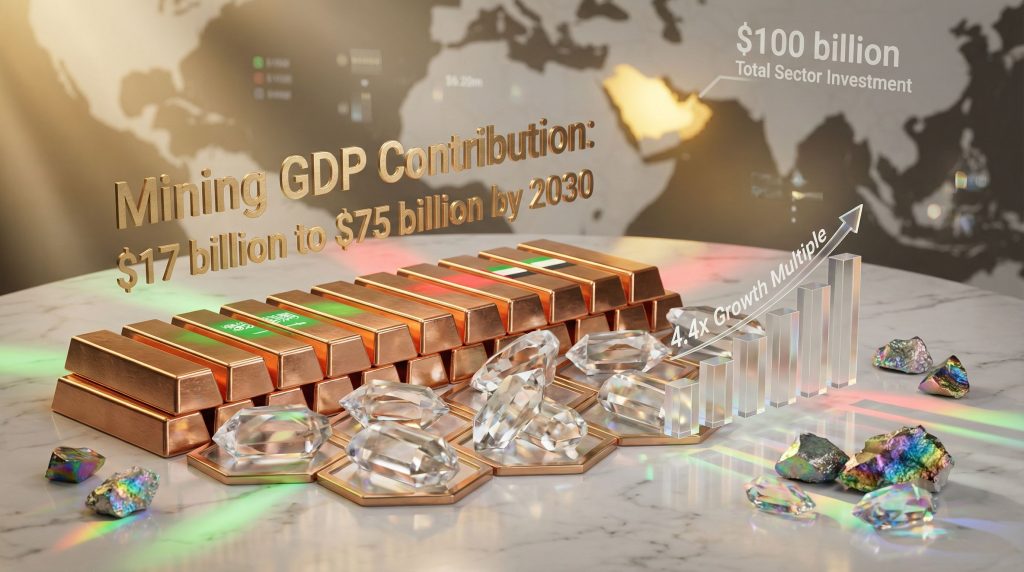
Saudi Arabia's Mineral Sector Investment Framework (2024-2030)
| Metric Category | Current Baseline | 2030 Target | Growth Factor |
|---|---|---|---|
| Mining GDP Contribution | $17 billion | $75 billion | 4.4x expansion |
| Total Sector Investment | — | $100 billion | Record deployment |
| Exploration Spending (2024) | $279.8 million | — | Historic peak |
The Saudi Arabian Ministry of Industry and Mineral Resources documented exploration spending reaching 1.05 billion riyals ($279.8 million) in 2024. This exploration surge reflects confidence in geological prospectivity and regulatory framework stability supporting long-term project development.
Multi-Jurisdictional Acquisition Strategies
Manara Minerals, established through partnership between Maaden and Saudi Arabia's Public Investment Fund, acquired a 10% stake in Vale Base Metals operations. This positioning provides Saudi investors access to Vale's global trading networks and technical expertise spanning multiple commodities and geographic regions.
In addition, Abu Dhabi's International Resource Holding implemented more aggressive acquisition approaches, securing 51% controlling interest in Mopani Copper Mines (Zambia) and majority ownership in Alphamin Resources (Democratic Republic of Congo). These controlling positions enable operational influence over production decisions and downstream value capture.
The ADQ-Orion Resource Partners joint venture committed $1.2 billion initial deployment targeting critical minerals supply security. This partnership structure combines Abu Dhabi's capital availability with Orion's operational expertise in mineral project identification and development across multiple jurisdictions.
Qatar Investment Authority demonstrates technology-focused acquisition patterns distinct from Saudi and Abu Dhabi approaches. Investments span:
- Ascend Elements (US battery recycling technology)
- TechMet (critical minerals investment platform)
- Ivanhoe Mines (diversified base metals production)
These diversified strategies reflect recognition that supply security requires exposure across extraction, processing, recycling, and downstream manufacturing capabilities rather than concentration in single value chain segments.
Copper Market Transformation and Regional Positioning
Middle East critical minerals development occurs against the backdrop of unprecedented copper market dynamics. Treatment charges for copper concentrates reached historic lows, with Fastmarkets' Asia Pacific index assessment at negative $69.70 per tonne as of January 2026. Negative treatment charges indicate smelters pay feedstock suppliers to accept copper concentrates, creating severe margin compression for processing operations.
Regional Copper Consumption Growth Patterns (January-October 2025 vs 2024)
| Country | 2024 Usage | 2025 Usage | Volume Increase | Growth Rate |
|---|---|---|---|---|
| UAE | 358,100 tonnes | 368,100 tonnes | 10,000 tonnes | 2.79% |
| Saudi Arabia | 162,300 tonnes | 181,000 tonnes | 18,700 tonnes | 11.51% |
Saudi Arabia's substantially higher copper consumption growth rate (11.51% versus UAE's 2.79%) reflects more aggressive infrastructure electrification under Vision 2030 implementation. This differential demonstrates varying speeds of economic transformation across Gulf nations, highlighting opportunities for copper and uranium investments globally.
Regional Premium Dynamics Reversal
Middle Eastern copper pricing dynamics experienced dramatic reversal between 2025 and 2026. Regional traders documented shifts from $20-30 per tonne discounts in 2025 to substantial premiums in early 2026. This transformation indicates tightening regional supply conditions and emerging supply-demand imbalances favouring regional producers.
One regional trader noted that 2025 conditions required market participants to utilise the Middle East as a liquidation point for excess inventory. By 2026, the same trader reported premiums had increased dramatically, with CIF Jebel Ali equivalent grade material offers at substantially higher levels than 2025 long-term contract pricing.
Fastmarkets assessed spot copper equivalent cathode premiums at $150-170 per tonne CIF Europe pricing during January 2026. This represents 18-34% premium elevation above historical averages, reflecting supply tightness in European markets and increased logistical costs.
Major Processing Infrastructure Development
Vedanta announced $2 billion investment commitment for Saudi Arabian copper processing infrastructure comprising:
- 400,000 tonnes per year greenfield smelter and refinery
- 300,000 tonnes per year copper rod production facility
This integrated approach combines primary processing with downstream manufacturing, enabling value capture across multiple supply chain segments while serving growing regional demand for electrical infrastructure components.
Global mining company Glencore committed to partnership development for Saudi Arabia's first copper smelter with 400,000 tonnes per year planned capacity. These combined projects represent recognition of sustained regional demand growth fundamentals supporting processing economics despite challenging global treatment charge conditions.
Iran maintains position as the largest regional mined copper producer with 336,000 tonnes produced in 2024, representing 1.46% of global mined production according to International Copper Study Group data. Iran additionally exported approximately 114,000 tonnes of refined copper in 2024, making it the region's only substantial refined copper exporter.
Aluminium Market Premium Optimisation and Export Flexibility
Gulf Cooperation Council aluminium producers leverage their 9% global primary aluminium supply share to optimise export allocation across European, Asian, and US markets. This flexibility enables strategic market selection maximising revenue capture amid volatile regional premium conditions.
Premium Rally Performance Analysis (Q4 2025 to January 2026)
| Regional Market | Q4 2025 Range | January 2026 Range | Absolute Change | Percentage Growth |
|---|---|---|---|---|
| Europe Rotterdam | $320-350/tonne | $330-360/tonne | $10-20/tonne | 3.1% |
| US Midwest | 74-76 cents/lb | 93-96 cents/lb | 19-20 cents/lb | 25.7% |
The asymmetric premium development across regional markets demonstrates varying supply-demand conditions. US Midwest premium escalation (25.7%) substantially exceeds European premium growth (3.1%), reflecting distinct competitive pressures and logistical constraints affecting aluminium availability.
London Metal Exchange aluminium cash pricing exceeded $3,000 per tonne during January 2026, driven by broader base metals momentum and intensifying competition among nation states for supply security. This elevated pricing environment benefits Gulf producers through higher baseline pricing before regional premium additions.
However, the European duty-paid aluminium premium market experienced 33% rally since Q4 2025, reflecting supply disruptions and competitive bidding for available material. Gulf producers benefit from ability to redirect volumes toward highest-premium markets while maintaining production flexibility, similar to the European CRM facility approach.
Rare Earth Elements and Strategic Partnership Development
Strategic joint venture formation between Maaden, MP Materials, and the US Department of Defense (announced November 2025) establishes alternative rare earth processing capabilities outside traditional supply chain structures. This partnership addresses geopolitical supply chain resilience concerns while providing technology transfer mechanisms supporting regional processing competency development.
The rare earth refinery development in Saudi Arabia represents a systematic approach to building downstream capabilities for elements essential to defence technologies, renewable energy equipment, and advanced electronics manufacturing. This vertical integration strategy ensures domestic consumption pathways for refined materials while supporting employment creation objectives.
EV Metals Group's planned lithium supply innovations refinery development complements rare earth processing infrastructure, creating integrated battery materials production capabilities. Combined with domestic electric vehicle brands Ceer and Lucid, this establishes complete supply chains from mineral processing through finished vehicle manufacturing.
Investment Flow Analysis and Market Psychology
Middle East critical minerals investment patterns reflect long-term strategic positioning rather than short-term market speculation. Sovereign wealth fund deployment across multiple jurisdictions creates diversified exposure while building domestic processing capabilities, addressing both supply security and economic diversification objectives simultaneously.
The regional approach emphasises controlling interests and operational influence rather than passive financial exposure. This strategy acknowledges that supply security requires operational control mechanisms beyond simple equity participation, particularly for minerals with concentrated global production and processing.
Investment Psychology and Risk Management
Gulf sovereign wealth funds demonstrate patient capital approaches, accepting longer payback periods for strategic mineral assets compared to traditional financial investments. This patient capital availability provides competitive advantages in acquisition processes where operational buyers compete against financial buyers with shorter time horizons.
Furthermore, the multi-jurisdictional investment approach spreads geological, regulatory, and operational risks across different countries and mineral types. This diversification strategy reduces dependency on single-source suppliers while building expertise across different operational environments and regulatory frameworks, reflecting the broader critical minerals strategy pivot occurring globally.
The next major ASX story will hit our subscribers first
Geological Factors and Resource Assessment
Middle Eastern geological diversity extends beyond hydrocarbon resources to encompass significant mineral endowments across multiple commodity categories. Saudi Arabia's mineral resource strategy leverages geological surveys documenting substantial phosphate, zinc, copper, and rare earth element concentrations supporting large-scale development projects.
The region's central geographic positioning between Asian production centers and European/African consumption markets provides logistical advantages for processing hub development. This positioning reduces transportation costs while enabling flexible market access supporting premium optimisation strategies.
Technical Processing Considerations
Copper equivalent grade cathodes represent the highest purity standard for electrical applications, commanding premium pricing in terminal markets. The distinction between equivalent grade and standard cathode specifications reflects trace element content affecting electrical conductivity and mechanical properties essential for wire rod production.
Negative treatment charges for copper concentrates create unprecedented challenges for smelter project economics. Traditional smelting models assume positive treatment charges compensating processors for refining services; negative charges require alternative economic justification through long-term supply agreements or integrated operations.
According to analysis from the Middle East Institute, the region's mineral resources are becoming increasingly vital to the global clean energy transition. This strategic importance aligns with the broader geopolitics of Gulf states' push for critical minerals development.
Regulatory Framework Evolution and Policy Integration
Vision 2030 strategic frameworks across Gulf nations integrate mineral sector development with broader industrial diversification and employment creation objectives. These policy alignments provide regulatory stability supporting long-term capital deployment while ensuring mineral development contributes to economic transformation goals.
Bilateral agreements with major consuming nations facilitate technology transfer, investment flows, and market access for regional producers. These international partnerships provide frameworks for collaborative development while addressing supply security concerns across multiple jurisdictions.
Future Scenario Assessment
Energy transition acceleration creates sustained demand growth for critical minerals, supporting continued regional investment despite commodity price volatility. Supply chain diversification imperatives drive consuming nations toward alternative suppliers, favouring regions with stable regulatory frameworks and processing capabilities.
Technological advancement in extraction and processing methods offers opportunities for regional operators to achieve competitive positioning through operational efficiency rather than simply low-cost production. Advanced processing systems and sustainable production methods align with environmental objectives while supporting premium pricing.
Regional competition between Gulf nations for mineral processing leadership could accelerate development timelines while improving operational efficiency through competitive dynamics. This competition creates positive spillover effects including workforce development, technology adoption, and infrastructure improvement.
Risk Factors and Uncertainties
Processing capacity expansion requires substantial technical expertise development and infrastructure investment addressing current capability gaps. Transportation networks, skilled workforce availability, and specialised equipment access remain critical success factors for realising regional mineral potential.
Global treatment charge dynamics and commodity pricing volatility create economic uncertainties for processing facility project justification. Alternative economic models including integrated operations or long-term supply agreements may be required for project viability under challenging market conditions.
Middle East critical minerals development represents a strategic pivot toward resource diversification and supply chain control that extends far beyond traditional commodity market participation. The convergence of geological endowments, financial capacity, and strategic positioning creates unprecedented opportunities for regional leadership in critical minerals supply chains essential to global energy transition and technological advancement.
Disclaimer: This analysis contains forward-looking statements based on current market conditions and available information. Commodity markets involve significant risks including price volatility, regulatory changes, and operational uncertainties. Investment decisions should be based on comprehensive due diligence and professional financial advice.
Want to Capitalise on Critical Minerals Investment Opportunities?
Discovery Alert delivers real-time notifications on significant ASX mineral discoveries using its proprietary Discovery IQ model, helping investors identify actionable opportunities in critical minerals and exploration companies before the broader market reacts. Explore how major mineral discoveries have generated substantial returns by visiting Discovery Alert's dedicated discoveries page and begin your 30-day free trial today to position yourself ahead of the market.