August 6, 2026
The recent critical minerals energy transition demonstrates how cross-continental energy partnerships are fundamentally reshaping how African nations approach energy security and economic diversification. The traditional model of bilateral infrastructure agreements between neighbouring countries is giving way to strategic alliances that span continents, bringing together resource-rich African nations with Gulf sovereign wealth funds seeking geographic diversification. These partnerships represent more than simple project financing arrangements; they create integrated frameworks for technology transfer, operational expertise, and long-term economic cooperation that can transform entire regional energy markets.
Understanding the Strategic Context Behind Cross-Continental Energy Alliances
Botswana's Energy Security Imperatives in 2026
Botswana's electricity infrastructure faces critical capacity constraints that threaten long-term economic growth across multiple sectors. The country's installed generation capacity of approximately 1,400-1,500 MW relies heavily on the aging Morupule B coal-fired power station, which frequently operates below its designed capacity due to maintenance challenges and infrastructure limitations. This capacity shortfall forces Botswana to import 60-70% of its electricity from South Africa through the Southern African Power Pool, creating vulnerability to grid instability and external price fluctuations.
The economic implications extend beyond simple supply security. Furthermore, Botswana's annual electricity import costs exceed $300-400 million USD, representing substantial foreign exchange outflows that could be redirected toward domestic infrastructure development. Projected demand growth of 4-6% annually through 2030, driven by urbanisation and mining sector expansion, will exacerbate these challenges without significant capacity additions.
Diamond mining operations, which constitute approximately 30% of Botswana's GDP, require consistent power supply for competitiveness in global markets. The Jwaneng diamond mine and emerging copper-nickel operations have experienced production disruptions during South African power crisis periods, demonstrating how energy dependency creates cascading economic vulnerabilities across critical revenue sectors.
Oman's Africa Strategy: Beyond Traditional Gulf Partnerships
The Sultanate of Oman's African investment strategy reflects calculated geographic diversification distinct from traditional Gulf approaches to regional expansion. While UAE's Masdar focuses primarily on established North African markets and Saudi Arabia's ACWA Power concentrates on Arabian Peninsula-adjacent regions, Oman is strategically positioning itself across sub-Saharan Africa where Gulf presence remains comparatively limited.
Oman's sovereign wealth funds, including the reconstituted State General Reserve Fund, have allocated substantial capital toward African infrastructure investments as part of broader economic diversification away from oil-dependent revenues. The O-Green initiative represents commitments exceeding 3 GW of renewable capacity across African markets through 2030, establishing Oman as a credible alternative partner to Western development institutions.
This strategy encompasses multiple bilateral agreements across diverse African regions:
- Morocco (April 2025): Multiple cooperation agreements spanning renewable energy and trade facilitation
- Algeria (May 2025): Joint investment fund established with $300 million USD capital commitment
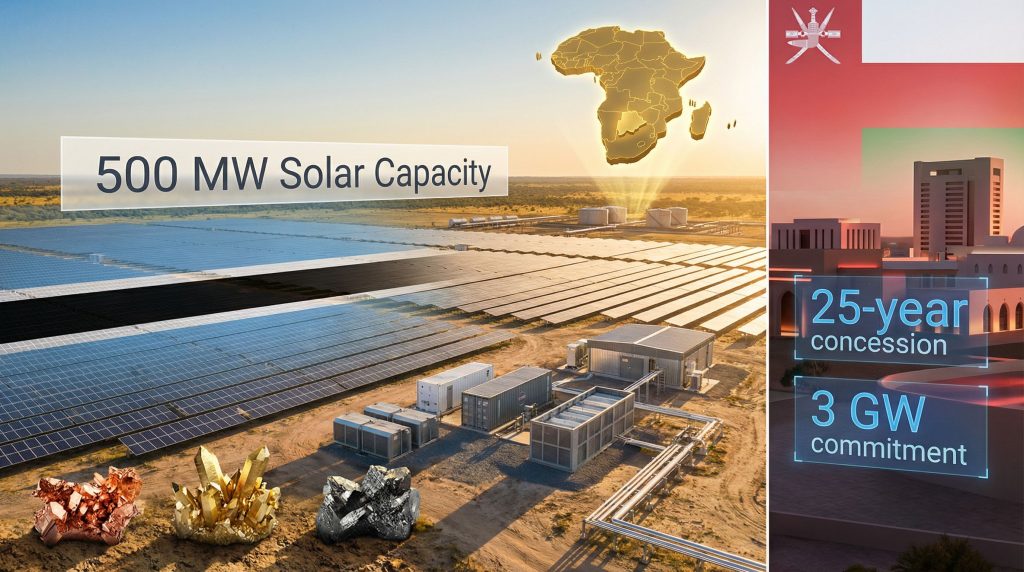
- Botswana (April 2026): Three-agreement package including 500 MW solar project, mining collaboration, and petroleum infrastructure
However, the approach demonstrates preference for co-investment structures and shared risk profiles with host governments rather than Build-Operate-Transfer models that maintain complete capital control. This framework creates sustainable partnership relationships while establishing first-mover advantage in emerging African renewable markets.
When big ASX news breaks, our subscribers know first
What Makes the 500 MW Maun Solar Project a Regional Game-Changer?
Project Scale and Infrastructure Specifications
The Botswana solar energy agreement with Oman centres on a 500 MW photovoltaic installation that represents the largest single solar development planned in Botswana and among the most significant in the Southern African Development Community region. The project's technical specifications include integrated battery energy storage systems, creating the first major grid-scale storage deployment across the SADC framework.
| Project Component | Specification | Regional Significance |
|---|---|---|
| Solar Capacity | 500 MW photovoltaic (DC) | Largest planned installation in Botswana |
| Storage Integration | Grid-scale lithium-ion battery system | First major storage deployment in SADC |
| Concession Period | 25-year operational agreement | Long-term energy supply guarantee |
| Developer | Naqaa Sustainable Energy LLC | Gulf capital entry into Southern Africa |
| Location | Maun, Northern Botswana | Strategic positioning for transmission optimisation |
The integration of battery storage fundamentally alters Botswana's energy profile by enabling temporal load-shifting, storing excess midday solar generation for evening peak demand periods. This technical capability addresses grid stability concerns that typically constrain renewable energy integration in smaller regional systems where demand variability creates operational challenges for grid operators.
Comparative analysis with regional projects demonstrates the Maun installation's significance. For instance, South Africa's Mulilo Middlepunt solar project (337 MWdc capacity) operates under similar financial structures within the Renewable Energy Independent Power Producer Procurement Programme framework, indicating institutional maturity for large-scale renewable energy development across Southern Africa.
Investment Structure and Risk Distribution
The Design-Build-Finance-Operate-Maintain delivery model transfers operational and maintenance risks from the public sector to private developers, aligning incentives for long-term performance while addressing government capacity constraints. The 25-year concession period provides sufficient revenue certainty to justify private capital deployment despite sovereign credit rating limitations in emerging African markets.
Risk Allocation Framework:
- Design Phase: Technical adequacy and regulatory compliance responsibility allocated to developer
- Construction: Schedule adherence, cost overrun management, and quality assurance
- Financing: Cost of capital optimisation and refinancing risk management
- Operations: Asset performance, revenue generation, and grid integration compliance
- Maintenance: Preventive and corrective maintenance ensuring system availability targets
Currency hedging mechanisms are critical for project viability, as electricity tariffs denominated in Botswana Pula must support international debt servicing in hard currency. Typical hedging approaches include cross-currency swaps, partial USD revenue indexation in Power Purchase Agreements, and reserve accounts denominated in hard currency to manage foreign exchange exposure.
Performance guarantees include minimum availability requirements exceeding 95% annual uptime, with financial penalties for underperformance. Grid integration requirements mandate compliance with SAPP technical standards including frequency response, voltage regulation, and fault ride-through capability essential for regional grid stability.
Southern African Power Pool Strategic Positioning
The Botswana solar energy agreement with Oman positions the country for potential transformation from electricity importer to regional exporter within the Southern African Power Pool framework. SAPP membership includes 12 countries across Southern Africa, creating opportunities for cross-border energy trading once domestic surplus capacity is established.
Current SAPP trading volumes exceed 15,000 GWh annually, with South Africa serving as the primary exporter to neighbouring countries including Botswana, Namibia, and Zambia. The Maun solar project's 500 MW capacity, combined with battery storage, could enable Botswana to participate actively in regional energy markets while maintaining domestic energy security.
Technical requirements for SAPP integration include:
- Frequency Stability: Maintaining 50 Hz standard across interconnected networks
- Voltage Regulation: Supporting grid voltage levels during demand fluctuations
- Ramp Rate Management: Controlling rapid power output variations from renewable sources
- Protection Coordination: Preventing cascading failures across cross-border transmission lines
Consequently, the project's battery storage component enables compliance with SAPP dispatch requirements within specified response times, typically under 5 minutes for combined solar and storage systems. This capability positions Botswana as a reliable energy trading partner while supporting regional grid stability objectives.
How Do Multi-Sector Agreements Amplify Bilateral Economic Integration?
Mining Sector Collaboration Framework
The partnership between Botswana Geoscience Institute and Minerals Development Oman creates complementary revenue streams that extend beyond energy infrastructure into strategic minerals development. Joint exploration targeting copper, gold, graphite, and iron ore deposits leverages Omani expertise in desert mining operations while providing technology transfer opportunities for local geological assessment capabilities.
Botswana's untapped mineral potential extends significantly beyond its established diamond mining operations. Geological surveys indicate substantial copper deposits in the Kalahari Copper Belt, graphite resources suitable for battery recycling breakthrough applications, and iron ore reserves that could support regional steel production. Omani operational experience in challenging desert environments provides technical expertise directly applicable to Botswana's geological conditions.
The collaboration framework includes:
- Exploration Technology Transfer: Advanced geological survey techniques and mineral assessment methodologies
- Processing Infrastructure Development: Joint investment in beneficiation facilities for value-added mineral processing
- Export Market Diversification: Access to Gulf processing facilities and Asian commodity markets
- Supply Chain Integration: Coordination between mining operations and Gulf-based industrial customers
This approach creates sustainable economic relationships beyond single-project development, establishing long-term partnership structures that support ongoing bilateral trade growth and technology exchange across multiple industrial sectors.
Petroleum Infrastructure Development Strategy
The joint venture between OQ S.A.O.C. and Botswana Oil Limited focuses on strategic petroleum infrastructure development including Walvis Bay coastal storage facilities and Tshele Hills Strategic Petroleum Depot expansion. This infrastructure creates regional fuel security mechanisms while establishing price stabilisation capabilities for Botswana and neighbouring landlocked countries.
Walvis Bay's strategic location on Namibia's Atlantic coast provides access to international petroleum markets while serving multiple Southern African countries through established transportation corridors. The coastal storage facility development enables bulk petroleum imports with reduced transportation costs compared to current supply chains through South African ports.
The Tshele Hills depot expansion creates strategic petroleum reserves essential for economic resilience during supply disruptions or price volatility periods. Combined storage capacity improvements enable:
- Supply Security: Reduced dependency on single-source petroleum imports
- Price Management: Strategic reserve deployment during market volatility periods
- Regional Hub Development: Fuel distribution capabilities serving neighbouring countries
- Economic Integration: Enhanced trade relationships through energy infrastructure cooperation
This petroleum infrastructure development occurs parallel to renewable energy expansion, creating dual-track energy policy implementation that ensures interim energy security during the renewable capacity building phase while maintaining long-term transition objectives.
What Regional Development Patterns Emerge from Gulf-Africa Energy Partnerships?
Comparative Analysis with Similar Cross-Continental Deals
The Botswana solar energy agreement with Oman follows established patterns of Gulf sovereign wealth fund deployment across African markets, with distinctive characteristics that differentiate it from alternative regional approaches. Morocco's agreements with Oman (April 2025) emphasised tourism and trade facilitation rather than energy infrastructure, indicating sector-specific partnership development based on comparative advantages and strategic priorities.
Algeria's joint investment fund with Oman ($300 million established May 2025) demonstrates preference for co-investment structures rather than direct project financing. This model creates shared risk profiles with host governments while enabling portfolio diversification across multiple projects and sectors within single-country relationships.
Regional Comparison Framework:
| Country | Agreement Type | Investment Scale | Primary Sectors | Strategic Focus |
|---|---|---|---|---|
| Morocco | Bilateral cooperation agreements | Undisclosed | Tourism, trade, renewable energy | North Africa gateway positioning |
| Algeria | Joint investment fund | $300 million USD | Infrastructure, manufacturing | Diversified portfolio approach |
| Botswana | Project-specific agreements | $400-500 million estimated | Energy, mining, petroleum | Southern Africa market entry |
This pattern indicates Oman's systematic approach to African market penetration through diversified geographic positioning rather than concentrated regional focus. The strategy creates competitive advantages against UAE and Saudi competitors by establishing first-mover presence in underserved markets.
Economic Diversification Outcomes and Projections
Botswana's post-diamond economy transition receives significant acceleration through renewable energy sector development and associated job creation potential. The solar and battery storage project is projected to create 500-800 direct construction jobs during the development phase, with 50-100 permanent operational positions supporting long-term employment in emerging energy sectors.
Manufacturing opportunities emerge from reliable power supply availability, particularly for energy-intensive industries including mineral processing, agricultural value addition, and light manufacturing. Consistent electricity availability at competitive pricing enables industrial development that was previously constrained by import dependency and supply uncertainty.
Regional hub positioning for Southern African energy markets creates additional economic opportunities through:
- Energy Trading Revenue: Export earnings from surplus renewable capacity sales to neighbouring countries
- Technical Services: Maintenance and operational expertise for regional renewable energy projects
- Financial Services: Project financing and risk management capabilities for cross-border energy investments
- Technology Transfer: Training and capacity building services for regional renewable energy development
In addition, the diversification impact extends beyond direct energy sector benefits to create multiplier effects across the broader economy, reducing dependence on diamond mining revenues while establishing sustainable alternative income sources.
How Will This Partnership Influence Regional Energy Transition Pathways?
Southern African Development Community Implications
The Botswana solar energy agreement with Oman introduces competitive pressure within SADC renewable energy development while demonstrating alternative financing mechanisms for energy transition challenges. South Africa's renewable energy programme, which has faced implementation delays and grid integration challenges, now faces regional competition from Botswana's accelerated solar deployment through Gulf capital partnerships.
Namibia's green hydrogen ambitions require substantial renewable energy capacity to support electrolysis operations for hydrogen production. The Botswana model demonstrates how sovereign wealth fund partnerships can accelerate renewable energy development timelines while providing operational expertise for large-scale project implementation.
Zimbabwe's ongoing energy crisis, characterised by chronic electricity shortages and aging thermal generation infrastructure, could benefit from similar partnership models. The successful implementation of Botswana's solar project may establish a replicable framework for Gulf investment in other SADC countries facing energy security challenges.
Cross-border energy trading evolution within SAPP benefits from additional renewable generation capacity that improves overall regional energy security. The Maun project's battery storage component provides grid stability services that support broader renewable energy integration across the interconnected network.
Investment Climate and Foreign Direct Investment Patterns
Gulf capital deployment trends in African energy markets reflect systematic sovereign wealth fund strategies for geographic diversification and portfolio risk management. Oman's approach emphasises bilateral government partnerships rather than purely commercial arrangements, creating diplomatic relationships that support broader economic integration beyond single-project development.
The coordination between multilateral development banks and bilateral investment agreements creates opportunities for blended finance structures. The World Bank and African Development Bank have established climate finance mechanisms that can complement Gulf sovereign wealth fund investments, reducing overall project costs through concessional financing components.
Investment Pattern Analysis:
- UAE Masdar: Focus on established North African markets with proven regulatory frameworks
- Saudi ACWA Power: Emphasis on large-scale thermal and renewable hybrid projects across Middle East and Africa
- Oman O-Green: Strategic positioning in underserved sub-Saharan African markets with integrated partnership approaches
This competitive positioning creates opportunities for African governments to access diverse financing sources while maintaining negotiation leverage through alternative partnership options. The success of the Botswana solar energy agreement with Oman may attract additional Gulf investors seeking similar market entry strategies.
The next major ASX story will hit our subscribers first
What Are the Long-Term Strategic Implications for Energy Security?
Scenario Planning for 2030-2035 Energy Landscape
Base Case Scenario projects successful implementation of the 500 MW Maun solar project by 2027, with potential expansion to achieve 1,000+ MW renewable capacity by 2030 through additional phases or complementary projects. This trajectory positions Botswana as a net electricity exporter within SAPP by 2030, generating annual export revenues of $50-100 million while ensuring domestic energy security.
Oman's established position as leading Gulf investor in African renewables emerges through successful project delivery and expansion into additional African markets. The O-Green initiative's 3 GW target across Africa becomes achievable through replication of the Botswana model in countries including Tanzania, Rwanda, and Ghana.
Alternative Risk Scenarios address potential implementation challenges including:
- Grid Integration Difficulties: Technical challenges connecting 500 MW intermittent generation to smaller national grids require substantial transmission infrastructure investment
- Political Risk Factors: Changes in government policies or diplomatic relationships could affect project implementation timelines
- Market Demand Fluctuations: Regional economic conditions may affect electricity demand growth projections and export market opportunities
Mitigation strategies include phased implementation approaches, political risk insurance mechanisms, and flexible financial structures that accommodate demand uncertainty while maintaining project viability.
Policy Framework Evolution Requirements
Regulatory harmonisation across jurisdictions becomes essential for effective cross-border energy trading and investment protection. Botswana's energy sector regulatory framework requires updates to accommodate large-scale renewable energy integration, battery storage operations, and Independent Power Producer agreements with international developers.
The Botswana solar energy agreement with Oman establishes precedents for cross-border investment protection mechanisms that could be replicated across SADC countries. Standardised power purchase agreement frameworks and dispute resolution mechanisms create operational certainty for international investors while protecting host country interests.
Environmental and social governance standards alignment becomes increasingly important as Gulf sovereign wealth funds face international scrutiny regarding sustainable investment practices. Furthermore, the battery metals investment landscape requires careful consideration of ESG standards, and the Botswana project's compliance with international ESG standards may influence similar projects across Africa and establish benchmarks for responsible investment in emerging markets.
Regional energy market integration acceleration requires SADC energy protocol implementation that supports standardised trading mechanisms, technical standards harmonisation, and coordinated grid planning across member countries. Consequently, investors seeking effective investment strategies 2025 will need to consider these regional integration dynamics when evaluating opportunities in the energy sector.
Investment and Risk Disclaimer: This article contains forward-looking statements regarding energy infrastructure development, economic projections, and market dynamics. Actual outcomes may differ materially from projections due to political, economic, technical, and market factors beyond the control of project developers or participants. Readers should conduct independent research and consult qualified advisors before making investment decisions related to African energy markets or renewable energy projects. Past performance of similar projects does not guarantee future results, and all investments carry risk of loss.
Looking to Capitalise on Cross-Continental Energy Investment Trends?
Discovery Alert's proprietary Discovery IQ model delivers real-time alerts on significant ASX mineral discoveries that often drive major energy transition partnerships, instantly empowering subscribers to identify actionable opportunities ahead of the broader market. Explore how historic discoveries can generate substantial returns and begin your 14-day free trial today to position yourself ahead of emerging cross-continental investment trends.