May 15, 2026
The Engineering Bottleneck Nobody Talks About in the Critical Minerals Race
The conversation around critical minerals tends to fixate on geology. Where are the deposits? How large are the reserves? What are the grades? These are important questions, but they increasingly miss the point. Across North America, South America, and the broader western hemisphere, the limiting factor in bringing critical minerals demand to market is not the presence of ore in the ground. It is the capacity to engineer, design, process, and build the facilities that transform raw extraction into battery-ready materials.
This is the structural gap that makes Worley Americas critical minerals work so strategically significant right now. Two recently confirmed contract awards, one in Louisiana and one in Brazil, illustrate how a full-lifecycle engineering partner is positioning itself across the entire critical minerals value chain, from electrolyte chemistry plants in the southern United States to niobium and rare earth development studies in one of Brazil's most mineralised regions.
Understanding why these contracts matter requires stepping back from the headline commodity numbers and examining the actual mechanics of project delivery in an industry that is simultaneously under-engineered and over-demanded.
When big ASX news breaks, our subscribers know first
Why Processing Capacity Is the Real Supply Chain Vulnerability
Global demand for battery-grade materials has grown faster than the downstream processing infrastructure needed to supply it. Exploration activity in the Americas has produced a pipeline of promising deposits, but the pathway from mineralised ground to refined, specification-grade product requires a distinct category of engineering expertise that is structurally different from traditional mine development.
Consider the difference between operating a hard rock lithium mine and manufacturing lithium hexafluorophosphate. The former involves geology, blasting, crushing, and flotation. The latter involves fluorine chemistry, precision process engineering, strict purity specifications, and compliance with chemical manufacturing safety standards. These are fundamentally different engineering disciplines, and conflating them has led some developers and investors to underestimate the true complexity of building out battery material supply chains.
The same distinction applies to niobium and rare earth processing. Extracting mineralised material from the Araxa district in Brazil is not the primary technical challenge. Converting that material into specification-grade products for steel alloy, aerospace, or permanent magnet applications involves pyrometallurgical and hydrometallurgical processes that require deep process engineering expertise, careful tailings management, and regulatory navigation across one of the world's most complex environmental licensing systems.
This is where engineering firms with demonstrated cross-disciplinary capability become critical infrastructure in their own right. Furthermore, rare earth supply chains remain among the most geopolitically sensitive components of the entire energy transition equation.
What the LiPF6 Facility in Louisiana Actually Represents
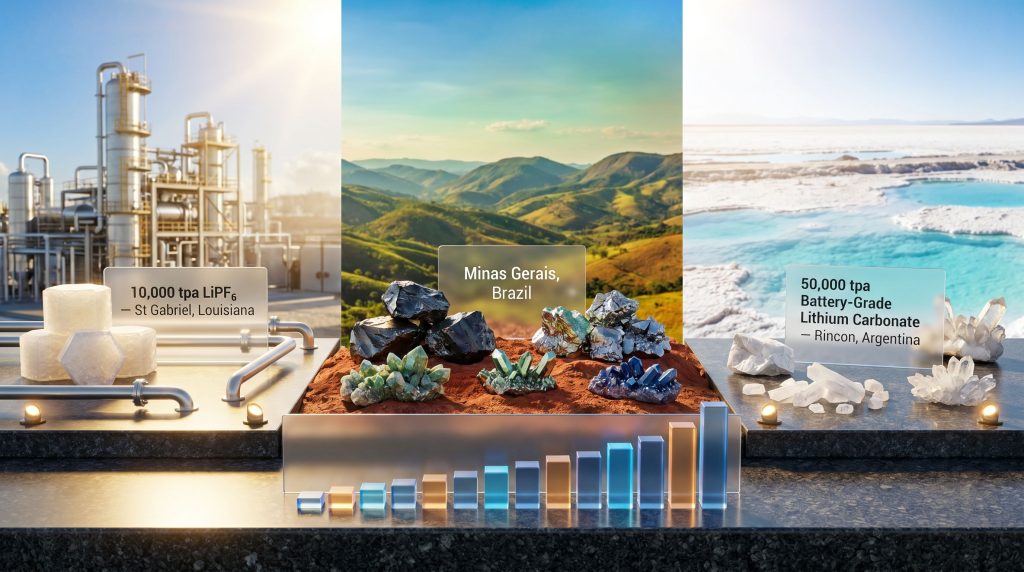
Orbia Fluor and Energy Materials has engaged Worley to engineer and design a 10,000 tonne per annum LiPF6 production facility located in St Gabriel, Louisiana. The contract covers full facility design, supply chain services, modularisation strategy, and construction support, delivered through Worley's Louisiana office.
LiPF6, or lithium hexafluorophosphate, is the primary electrolyte salt used in lithium-ion batteries. Without it, the electrochemical reactions that make battery cells function cannot occur. Every electric vehicle battery, every grid-scale storage system, and every consumer electronics battery relies on electrolyte chemistry, and LiPF6 dominates that chemistry across commercial lithium-ion formats.
What makes this project particularly noteworthy is not just its scale, but what it represents structurally. The United States has historically been dependent on overseas suppliers for LiPF6, with production concentrated in Asia. Building domestic manufacturing capacity for this foundational input directly addresses a recognised vulnerability in the U.S. battery supply chain.
Worley CEO Chris Ashton noted that the contract reflects the company's capability to support growing customer demand for energy transition materials work, and that Worley had already been involved in earlier project phases, making this a continuation of a multi-phase engagement rather than a new relationship.
Several technical dimensions make LiPF6 manufacturing more engineering-intensive than it might appear:
- LiPF6 is highly sensitive to moisture and must be produced and handled under strictly controlled anhydrous conditions
- Fluorine chemistry requires specialist materials of construction, containment systems, and scrubbing equipment
- Product purity specifications for battery-grade LiPF6 are exceptionally tight, with moisture content, acidity, and metallic impurities all tightly controlled
- Modularisation strategies, which involve prefabricating major process units offsite, can reduce construction schedule risk significantly in chemical plant construction
The 10,000 tpa capacity figure also deserves context. While this is not the largest chemical plant ever built, it represents meaningful domestic production capacity for a material that has been almost entirely imported. At a high level, battery-grade LiPF6 consumption scales with the number of battery cells manufactured, meaning the facility's relevance will grow as domestic battery cell production expands. This aligns closely with broader mining electrification trends reshaping how industrial facilities are designed and powered.
The Araxa District: Understanding Why This Niobium and Rare Earths Project Matters
Worley has also been appointed by St George Mining to provide technical advisory services at its Araxa niobium and rare earths project in Minas Gerais, Brazil. The scope of work is comprehensive, covering metallurgical and process engineering, feasibility and cost study development, process plant design and optimisation, mine planning and scheduling, tailings management strategy, procurement advisory, and plant construction planning.
The Araxa region carries genuine geological significance. Minas Gerais is home to some of the most concentrated niobium mineralisation on the planet, and the Araxa district in particular has a long history of industrial mineral production. For context, Brazil is the dominant global supplier of niobium, accounting for the overwhelming majority of worldwide production, and the Araxa area sits at the heart of that endowment.
Why Niobium Deserves More Attention Than It Gets
Niobium rarely commands the same investor attention as lithium or cobalt, but its supply chain characteristics arguably make it more strategically concentrated than either. The vast majority of global niobium supply originates from a single operational complex in Brazil, creating a degree of single-source dependency that raises legitimate supply security questions for industrial users.
Niobium's primary applications span:
- High-strength low-alloy (HSLA) steel used in structural applications, pipelines, and automotive manufacturing
- Superalloys for jet engines, gas turbines, and aerospace components requiring performance at extreme temperatures
- Emerging battery technology where niobium-based anode materials are being investigated as a potential pathway to faster-charging lithium-ion cells
- Superconducting applications in particle physics and medical imaging equipment
The emerging battery application is particularly worth monitoring. Niobium-based anodes, specifically niobium tungsten oxide and related compounds, have demonstrated fast-charging characteristics in laboratory settings that could complement or supplement graphite-based anode chemistries. While this remains a developing area and should not be treated as a commercially confirmed application, it represents an optionality dimension that adds a speculative but credible long-term demand argument.
The Rare Earth Dimension of Araxa
The Araxa project's rare earth component adds another layer of strategic interest. Rare earth elements from mineralised Brazilian carbonatite complexes often include both light and heavy rare earths, with composition varying by deposit. The magnet-related rare earths, primarily neodymium and praseodymium for NdFeB permanent magnets, are the most commercially significant given their role in EV motors and wind turbine generators.
One technical consideration that investors and developers in rare earth projects sometimes underestimate is the presence of thorium as a co-occurring radioactive element in carbonatite-hosted rare earth deposits. Thorium co-occurrence complicates processing and tailings management, requires specialised regulatory approvals, and can affect the economics of rare earth separation. The inclusion of tailings management in Worley's scope of work for Araxa reflects the technical complexity that responsible project development in this mineralisation type demands.
St George Mining Executive Chairman John Prineas described Worley as bringing extensive and relevant expertise to support the company in advancing what he characterised as a world-class project. He also noted that Worley would work with the company's in-country engineering team, whose members carry decades of combined experience in plant construction, mining, and mineral production specifically within the Araxa region.
The Value of Six Decades of In-Country Engineering Presence
Worley has operated in Brazil for more than 60 years, and this is not a trivial detail for investors or developers assessing the quality of project advisory engagements in Latin America.
Brazil's regulatory environment for mining and processing is among the most complex in the world. The country's environmental licensing system operates across federal, state, and municipal levels, with the Conselho Nacional do Meio Ambiente (CONAMA) framework governing environmental standards and the state-level secretariats managing licensing processes. Navigating this system requires institutional relationships, local knowledge, and familiarity with Brazilian legal and regulatory norms that cannot be replicated quickly by firms entering the market opportunistically.
Worley Senior Vice President for LATAM&C Tom Foster noted that the partnership reflects the company's long-standing track record in Brazil and its capability to support complex resources projects from initial studies through to operational phases.
This kind of in-region depth has material value at the project level. It reduces permitting risk, supports community and stakeholder engagement, provides access to established local supply chain relationships, and can accelerate the pace at which pre-feasibility and definitive feasibility studies progress through regulatory review stages.
Mapping Worley's Americas Critical Minerals Portfolio
The Louisiana and Araxa contracts are best understood in the context of a broader Americas strategy rather than as standalone awards. Together with Worley's previously reported involvement in Rio Tinto's Rincon lithium project in Argentina, the portfolio spans three major jurisdictions and multiple commodity types.
| Project | Country | Commodity | Client | Worley Scope |
|---|---|---|---|---|
| Orbia LiPF6 Facility | USA (Louisiana) | Lithium electrolyte salt | Orbia Fluor & Energy Materials | Engineering design, supply chain, modularisation, construction support |
| Araxa Niobium and REE Project | Brazil (Minas Gerais) | Niobium, rare earths | St George Mining | Technical advisory, feasibility, process engineering, mine planning, tailings |
| Rincon Lithium Project | Argentina | Battery-grade lithium carbonate | Rio Tinto | Project delivery support |
The Rincon project targeting 50,000 tonnes per annum of battery-grade lithium carbonate in Argentina's Lithium Triangle adds a third leg to this Americas positioning. Argentina sits within the world's most lithium-rich brine geology, alongside Chile and Bolivia, and is an increasingly active jurisdiction for lithium development. Consequently, direct lithium extraction technologies are becoming increasingly relevant to projects operating in this geological setting.
What the portfolio reveals about Worley's strategic positioning is worth examining carefully:
- Commodity diversification: Electrolyte chemistry, niobium, rare earths, and lithium carbonate cover distinct segments of the battery and energy transition materials market
- Client type diversification: The portfolio spans junior developers such as St George Mining, industrial conglomerates such as Orbia, and major global miners such as Rio Tinto, each requiring different engagement styles and risk frameworks
- Lifecycle stage diversification: Technical advisory at Araxa, engineering and design at the Louisiana facility, and project delivery support at Rincon collectively cover the pre-feasibility through construction phases
The next major ASX story will hit our subscribers first
What This Means for Developers Seeking Engineering Partners
For project owners in the critical minerals space, the pattern Worley is establishing in the Americas carries practical implications. Access to credentialled engineering advisory services has become a de facto prerequisite in two critical contexts: securing project financing from institutional lenders and advancing offtake negotiations with downstream buyers.
Institutional project finance lenders require bankable feasibility studies prepared or reviewed by firms with recognised technical credentials. Downstream offtake counterparties, particularly in the battery supply chain, increasingly conduct technical due diligence on proposed production facilities before committing to purchase agreements. Having a globally credentialled engineering partner on record from the pre-feasibility stage strengthens both of these processes.
Modularisation strategies, a key element of Worley's delivery model for the Louisiana facility, also have direct implications for project financing. By prefabricating major process modules offsite and reducing the complexity of on-site construction, modularisation approaches can:
- Reduce on-site labour requirements and associated schedule risk
- Improve quality control for precision process equipment
- Compress overall project schedules, reducing the period during which capital is deployed without generating revenue
- Lower peak capital requirements by enabling phased commissioning of modules
For junior developers with constrained balance sheets, these factors can improve the bankability of a project and reduce the capital intensity of the first production phase. Worley's resources and mining services platform is specifically structured to address these challenges across the full project lifecycle.
The Broader Engineering Capability Framework
Behind the specific contract wins, Worley Americas critical minerals positioning rests on a technical capability stack that spans the full project lifecycle:
- Early-stage geoscience and resource characterisation that frames the technical and economic parameters of a potential project
- Metallurgical test work interpretation that translates laboratory data into plant design parameters
- Process plant design and flowsheet development covering equipment selection, sizing, and layout engineering
- Modularisation strategy for facilities where off-site fabrication creates schedule and quality advantages
- Tailings and environmental management design including closure planning and regulatory compliance documentation
- Procurement advisory and supply chain integration covering vendor selection, logistics, and materials management
- Construction management and commissioning support from site mobilisation through to operational handover
The integration of sustainability and digital engineering capabilities alongside these traditional disciplines is increasingly relevant. Water management engineering is becoming a critical constraint in arid and semi-arid regions, while renewable energy integration into mine-site and processing plant power supply is now a standard design consideration. Furthermore, as explored in Worley's insights on energy transition opportunities, the convergence of decarbonisation and digitalisation is fundamentally reshaping how engineering firms approach Worley Americas critical minerals work and project delivery more broadly. In addition, SP Global's coverage of Worley's critical minerals initiative highlights how the firm is fast-tracking project pipelines across key jurisdictions to meet accelerating global demand.
Disclaimer: This article contains forward-looking statements and references to project timelines, production targets, and market dynamics. These involve inherent uncertainties and should not be interpreted as investment advice. Project specifications, production targets, and company strategies are subject to change. Readers should conduct independent due diligence before making investment decisions.
For further industry coverage of Worley Americas critical minerals work and related developments across the mining value chain, visit Mining Beacon.
Want to Identify the Next Major Critical Minerals Discovery Before the Market Does?
Discovery Alert's proprietary Discovery IQ model delivers real-time alerts on significant ASX mineral discoveries — instantly transforming complex geological and commodity data into actionable investment insights for both short-term traders and long-term investors. Explore why historic mineral discoveries have generated substantial returns and begin your 14-day free trial today to position yourself ahead of the market.