June 11, 2026
When Physical Scarcity Meets Geopolitical Shock: Inside the LME Aluminium Rally
Commodity markets have a well-established memory. When physical supply tightens rapidly and the reasons are geopolitical rather than cyclical, the resulting price movements tend to be sharper, more compressed in time, and harder to forecast using conventional demand-side models. That is precisely the environment unfolding in the global aluminium market right now. The LME aluminium price four-year high recorded on May 14, 2026, is not the product of surging construction demand or accelerating electric vehicle adoption. It is the signature of a market suddenly confronted with a supply corridor under severe stress.
Understanding what is actually happening requires moving beyond the headline number and examining the underlying mechanics: the structure of the futures curve, the behaviour of warehouse inventories, the dynamics of the feedstock market, and the positioning choices available to producers, end users, and traders operating across very different risk profiles. Furthermore, the interplay between tariffs and supply chains adds another layer of complexity that market participants must navigate carefully.
When big ASX news breaks, our subscribers know first
Breaking Down the May 14, 2026 Price Movement
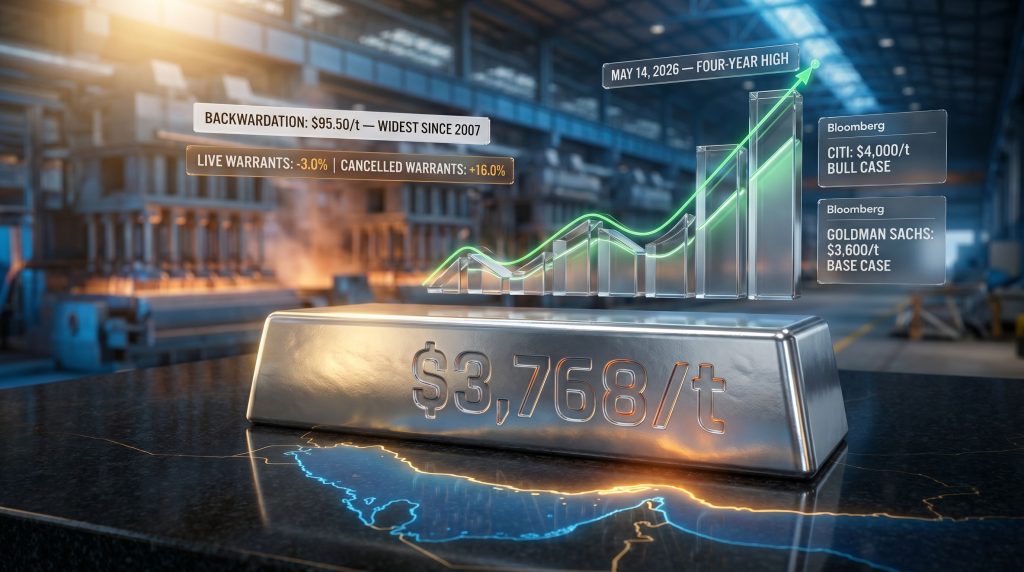
The LME aluminium cash offer reached $3,768 per tonne on May 14, 2026, continuing a multi-session rally that has elevated prices to their highest point since March 2022. What makes this move analytically significant is not just the absolute level but the distribution of gains across the futures curve.
| Contract Type | Previous Close | May 14 Level | Change |
|---|---|---|---|
| Cash Bid | $3,729.00/t | $3,767.00/t | +$38.00 (+1.0%) |
| Cash Offer | $3,729.50/t | $3,768.00/t | +$38.50 (+1.0%) |
| 3-Month Bid | $3,649.00/t | $3,665.50/t | +$16.50 (+0.5%) |
| 3-Month Offer | $3,650.00/t | $3,666.00/t | +$16.00 (+0.5%) |
| December 2027 Bid | $3,180.00/t | $3,190.00/t | +$10.00 (+0.3%) |
| December 2027 Offer | $3,185.00/t | $3,195.00/t | +$10.00 (+0.3%) |
| Asian Reference Price | $3,652.50/t | $3,657.50/t | +$5.00 (+0.1%) |
The gradient tells a clear story. Spot contracts appreciated by 1.0%, three-month forwards moved by 0.5%, and December 2027 contracts shifted by just 0.3%. This progressive decay in price appreciation across the curve is the textbook fingerprint of a supply-shock-driven rally rather than a demand-led structural repricing. When demand fundamentals are improving, the entire curve tends to lift more uniformly. When near-term physical supply is suddenly constrained, the spot end of the curve bears the full weight of that scarcity premium.
The steepest gains are concentrated in the spot contracts, while longer-dated contracts show only modest appreciation. This differential is the market's way of communicating that it expects disruptions to be temporary rather than structural.
The Backwardation Signal and What It Reveals
The spot-to-futures spread widening to approximately $95.50 per tonne represents the deepest backwardation seen in LME aluminium since 2007. In a normally functioning aluminium market, futures prices tend to trade at a modest premium to spot prices, reflecting storage costs and cost of carry. When this relationship inverts sharply, it communicates several things simultaneously:
- Physical buyers are paying a significant premium to secure immediate delivery rather than waiting for forward-dated supply
- The market expects disruptions to ease over a medium-term horizon, hence the more moderate forward pricing
- Holders of physical inventory in LME-registered warehouses face a strong financial incentive to release that metal into the market now, accelerating drawdowns
- Speculative positioning shifts toward short-dated physical-linked instruments rather than longer-dated paper contracts
This backwardation structure is self-reinforcing in the short term. As physical holders release metal to capture the spot premium, they simultaneously draw down the inventory buffer that markets would normally rely on to absorb supply shocks. The result is a feedback loop where reduced inventory reinforces higher spot prices, which in turn incentivises further drawdowns.
The Geopolitical Engine: Strait of Hormuz and Gulf Smelter Exposure
The proximate catalyst for the current rally is disruption to Persian Gulf shipping lanes stemming from escalating geopolitical tensions and a blockade of the Strait of Hormuz. This narrow waterway connecting the Persian Gulf to the Gulf of Oman is one of the world's most consequential maritime chokepoints. For the aluminium market specifically, its significance is magnified by the concentration of primary aluminium smelting capacity in Gulf Cooperation Council (GCC) nations.
Gulf-based smelters have historically enjoyed a structural cost advantage rooted in access to subsidised or low-cost energy, predominantly natural gas. This energy advantage has allowed GCC producers to operate at the lower end of the global cost curve, making them highly competitive in international markets. When that energy security is threatened, or when the logistics corridors connecting these smelters to their export markets are disrupted, the competitive calculus shifts with unusual speed.
Key operational consequences flowing from the current disruption include:
- Production curtailments and temporary halts at major regional smelting facilities, including operations at Aluminium Bahrain (Alba), one of the world's largest single-site primary aluminium producers
- Elevated energy input costs flowing through to operating margins across GCC smelting operations
- Significant rerouting of cargo vessels to avoid the Strait of Hormuz, adding substantial time and logistical cost to delivered aluminium prices in consuming markets
- Insurance premium escalation on vessels transiting conflict-adjacent waters, creating an additional cost layer absorbed somewhere across the supply chain
A lesser-known dimension of this disruption is that GCC smelters typically operate on relatively thin inventory buffers between production and export, given their proximity to port infrastructure. Any disruption to outbound logistics can rapidly translate into production curtailments if storage capacity fills and smelters have no domestic market to redirect output toward.
Why GCC Aluminium Production Cannot Easily Be Redirected
Unlike some commodities where producers can switch between export and domestic markets with relative flexibility, the GCC aluminium sector is overwhelmingly export-oriented. Domestic consumption in Gulf states remains modest relative to production capacity. This structural characteristic means that when export corridors are blocked, the only near-term option for producers is curtailment. There is no meaningful domestic demand buffer to absorb displaced export volumes.
This export dependency is precisely why Strait of Hormuz disruptions translate so quickly and directly into LME price movement. The disruption does not merely raise the cost of aluminium reaching global markets. It physically reduces the volume available to those markets within a timeframe that spot market participants cannot easily hedge around. Consequently, major aluminium producers outside the disruption zone are well positioned to capture the resulting price premium.
LME Inventory Drawdown: Reading the Warehouse Data
The inventory movements recorded on May 14, 2026, provide granular confirmation of the physical tightening thesis. Three separate metrics all point in the same direction.
| Inventory Metric | Previous Level | May 14 Level | Change |
|---|---|---|---|
| Opening Stock | 351,000 tonnes | 348,750 tonnes | -2,250t (-1.0%) |
| Live Warrants | 301,725 tonnes | 291,725 tonnes | -10,000t (-3.0%) |
| Cancelled Warrants | 47,025 tonnes | 54,775 tonnes | +7,750t (+16.0%) |
The 16% single-session surge in cancelled warrants is the most analytically striking data point in this table. To understand why, it helps to clarify what a cancelled warrant actually represents in LME market mechanics.
Understanding LME Warrants: A Technical Primer
In the LME system, a warrant is a document of title to a specific lot of metal stored in an LME-approved warehouse. Warrants come in two states:
- Live warrants: Actively circulating receipts representing metal available for immediate trading and delivery within the LME system
- Cancelled warrants: Receipts that have been flagged by the holder for physical withdrawal, meaning the metal behind that receipt is in the process of leaving LME custody
A large single-day increase in cancelled warrants indicates that physical buyers are actively pulling metal out of the LME system. This is distinct from paper trading activity. It represents a decision by a market participant to take physical possession of aluminium rather than continue holding it as a financial instrument within the exchange infrastructure. A 16% single-day surge is well outside normal fluctuation ranges and signals genuine, urgent physical demand from buyers who are not willing to wait for forward-dated supply.
The 3% single-day decline in live warrants is equally significant. As live warrants contract, the exchange's ability to function as a buffer against sudden demand surges diminishes. Price volatility in the spot market tends to increase as the freely available physical stock decreases, reinforcing the backwardation dynamic already underway.
Bank Forecasts and Scenario Architecture
Two of the most closely watched commodity research operations have updated their aluminium price frameworks in response to the current supply environment.
| Institution | Base Case Target | Bull Case Scenario |
|---|---|---|
| Citi | $3,600/tonne | $4,000/tonne |
| Goldman Sachs | $3,600/tonne (disruption exceeds 1 month) | Not disclosed |
The convergence of both institutions on a $3,600/tonne floor as a near-term base case is meaningful in itself. It suggests that even under a relatively optimistic resolution scenario, the structural impact of current disruptions has permanently repriced the near-term floor for aluminium. Citi's bull case of $4,000/tonne implies approximately 6% further upside from May 14 levels and would position prices within striking distance of the all-time LME aluminium high of $4,103/tonne set in March 2022.
Readers should note that bank price forecasts represent internal research estimates and are subject to rapid revision as geopolitical conditions evolve. These figures should not be construed as investment advice.
Three Scenarios That Could Determine the Next Price Chapter
Scenario 1: Rapid Resolution (Under 30 Days)
Supply corridors through the Strait of Hormuz normalise, GCC smelters resume full output, and the geopolitical risk premium embedded in spot prices unwinds. Aluminium likely retreats toward the $3,400 to $3,500 per tonne range as the extraordinary backwardation compresses back toward normal contango territory.
Scenario 2: Extended Disruption (30 to 90 Days)
The Goldman Sachs base case of $3,600/tonne holds as a floor, with physical inventory drawdowns deepening to the point where the LME system's buffer capacity is meaningfully reduced. Spot premiums in physical markets outside the LME system, particularly in Asian and European regional markets, could widen significantly beyond LME pricing.
Scenario 3: Escalation and Broader Conflict
A more severe deterioration of regional stability triggers production losses extending beyond GCC facilities, energy cost spikes across global smelting operations, and a potential challenge of the $4,000 to $4,103 per tonne zone that represents the historical ceiling for LME aluminium pricing. In addition, US aluminium tariffs could amplify the impact of any escalation on North American supply chains.
The Alumina Divergence: A Critical Market Signal
While primary aluminium prices have surged, the feedstock market is moving in the opposite direction. The LME Alumina Platts price declined by $0.60 per tonne (-0.2%) to $305.90 per tonne on May 14. This divergence between alumina and primary aluminium carries important analytical weight that is often overlooked in coverage focused purely on LME price headlines.
Alumina softness in this environment communicates that upstream refining capacity is not yet experiencing the same stress as downstream smelting. Bauxite mining and alumina refinery operations, which are geographically distributed across Australia, Guinea, Brazil, and Jamaica among others, are largely insulated from Persian Gulf logistics disruptions. The result is a widening spread between feedstock cost and finished metal price, which translates directly into improved margins for integrated producers. The broader dynamics of aluminum alumina markets suggest this divergence could persist for some time.
The alumina-to-aluminium price spread is one of the least-discussed but most important metrics for assessing smelter profitability. When aluminium prices rise sharply while alumina prices remain flat or soften, integrated producers capture a disproportionately large share of the value created by the price rally.
However, if the current disruption persists, bauxite and alumina trade flows routed through or near the Persian Gulf could eventually face their own logistical constraints, creating a potential second-order upward pressure on feedstock costs that is not yet priced into the market.
The next major ASX story will hit our subscribers first
Impact Across the Supply Chain: Winners, Losers, and Adapters
The current market configuration distributes costs and benefits unevenly across the aluminium supply chain. Understanding which participants benefit, which are disadvantaged, and which face complex trade-offs is essential for assessing the broader economic implications of the LME aluminium price four-year high. Furthermore, this analysis should be read alongside the global steel outlook for a fuller picture of how metals markets are responding to geopolitical stress.
Primary Aluminium Producers (Outside Disruption Zone)
- Revenue per tonne at $3,768/t is dramatically higher than 12-month-ago pricing, with Canadian, Norwegian, and Australian smelters positioned to capture substantial margin expansion
- Vertically integrated producers with captive alumina supply benefit most from the widening feedstock-to-finished-metal spread
- Producers operating in politically stable regions face no operational disruption while capturing the full geopolitical price premium
GCC-Based Smelters
- Higher aluminium prices partially offset the revenue loss from curtailed production volumes
- Operational uncertainty remains elevated as long as logistics corridors remain disrupted
- Energy cost exposure creates downside risk to margins even at elevated aluminium prices
Downstream Manufacturers and End Users
- Automotive, aerospace, packaging, and construction sectors face materially higher input costs with limited ability to pass these through to customers in the short term
- Procurement teams are under pressure to secure forward contracts before further price escalation, but the wide backwardation structure makes buying futures more expensive than spot in cost-of-carry terms
- Long-term supply agreements signed before the current rally now represent significant cost advantages for buyers who locked in pricing below current spot levels
Traders and Commodity Investors
- The backwardation structure creates a dynamic where holding physical metal or physical-linked instruments outperforms paper long positions in forward contracts
- Cancelled warrant data provides a real-time leading indicator of physical demand acceleration and should be monitored daily
- The $4,000 per tonne Citi bull case represents a clearly defined upside target zone for positioned participants
Frequently Asked Questions
What is the LME aluminium cash offer price as of May 14, 2026?
The LME aluminium cash offer reached $3,768 per tonne on May 14, 2026, the highest level recorded in approximately four years. According to live aluminium pricing data, this represents a significant departure from the range that had prevailed through most of 2024 and 2025.
What is driving the LME aluminium price four-year high?
The primary driver is geopolitical disruption to Persian Gulf shipping routes, specifically the impact of a Strait of Hormuz blockade on GCC aluminium production and export logistics. This has triggered smelter curtailments, elevated delivered costs, and a sharp drawdown in LME warehouse inventories.
What does backwardation mean in the aluminium market?
Backwardation occurs when spot prices exceed forward prices. The current spot-to-futures spread of approximately $95.50 per tonne, the widest since 2007, signals acute near-term physical scarcity and incentivises holders of physical inventory to release metal immediately rather than hold it for future delivery.
What are cancelled warrants and why do they matter?
Cancelled warrants are LME warehouse receipts flagged for physical withdrawal. A 16% single-day surge signals that buyers are actively pulling physical metal out of the exchange system, reducing available supply and typically supporting further spot price increases.
How does alumina pricing relate to the current aluminium rally?
Alumina, the feedstock for aluminium smelting, declined to $305.90 per tonne on May 14. This divergence from rising aluminium prices widens the margin for integrated producers who control their upstream supply, while also suggesting that upstream refining operations are not yet impacted by the same supply disruptions affecting primary aluminium.
How far is the current price from the all-time LME aluminium high?
The all-time LME aluminium high stands at $4,103 per tonne, set in March 2022. At $3,768 per tonne, current pricing remains approximately 8% below that record level.
Key Takeaways at a Glance
- LME aluminium cash offer reached $3,768/tonne on May 14, 2026, marking a confirmed four-year high
- The rally is geopolitically driven, centred on Strait of Hormuz supply disruption affecting GCC smelter operations and export logistics
- Spot contracts gained 1.0% versus only 0.3% for December 2027 futures, confirming a supply-shock rather than demand-led market dynamic
- Live warrants fell 3.0% in a single session and cancelled warrants surged 16%, signalling accelerating physical withdrawal from LME inventory
- Backwardation of approximately $95.50/tonne represents the widest spot-to-futures inversion since 2007
- Citi targets $4,000/tonne in a bull scenario; Goldman Sachs anchors at $3,600/tonne if disruptions exceed one month
- Alumina softened to $305.90/tonne, widening the processing margin for integrated producers outside the disruption zone
- The all-time LME aluminium record of $4,103/tonne set in March 2022 remains approximately 8% above current levels, representing a credible target in an escalation scenario
This article is intended for informational purposes only and does not constitute financial or investment advice. Commodity price forecasts referenced herein represent third-party analyst estimates and are subject to change. Readers should conduct their own due diligence before making any investment or procurement decisions.
Want to Capitalise on the Next Major Commodity Discovery Before the Market Moves?
When geopolitical shocks reshape commodity markets this rapidly, being first to identify emerging ASX opportunities can make all the difference — Discovery Alert's proprietary Discovery IQ model delivers real-time alerts on significant mineral discoveries, turning complex market signals into actionable insights the moment they hit the ASX. Explore why historic discoveries have generated extraordinary returns on Discovery Alert's dedicated discoveries page, and begin your 14-day free trial today to position yourself ahead of the next major market move.