May 20, 2026
The American industrial landscape faces unprecedented challenges as critical minerals energy transition requirements intersect with national security imperatives. Project Crucible FAST-41 permitting represents a watershed moment where federal coordination mechanisms converge to address systematic supply chain vulnerabilities through accelerated infrastructure development. Furthermore, this initiative demonstrates how coordinated regulatory frameworks can transform traditionally cumbersome approval processes into streamlined pathways for strategic industrial development.
Understanding Federal Permitting Acceleration Through FAST-41
The Fixing America's Surface Transportation Act established Title 41 as a comprehensive framework designed to transform how the United States approaches large-scale infrastructure permitting. This legislative mechanism creates coordinated review processes for projects designated as having substantial economic impact or strategic national importance. Consequently, it fundamentally alters the traditional sequential approval system that has historically extended project timelines.
Legislative Foundation and Operational Structure
The Federal Permitting Improvement Steering Council operates as the central coordinating body, managing interagency collaboration through mandatory timeline alignment and transparency dashboard systems. This structure eliminates the information asymmetries that traditionally prevented agencies from understanding interdependent review requirements. In addition, it creates predictable approval pathways for complex infrastructure developments.
Project Crucible FAST-41 permitting designation represents a significant application of this framework, with the Department of Defense serving as the lead coordinating agency. However, this coordination extends across multiple federal departments for environmental reviews, economic impact assessments, and regulatory compliance.
Strategic Infrastructure Designation Criteria
Projects qualifying for FAST-41 coverage must demonstrate substantial economic impact thresholds and alignment with national security considerations. The framework prioritises manufacturing sector investments, particularly those addressing supply chain vulnerabilities in critical materials processing. Furthermore, it emphasises defense industrial base capabilities that strengthen domestic manufacturing capacity.
The geographic distribution of covered projects reflects strategic emphasis on regions capable of supporting large-scale industrial development. Moreover, these regions provide workforce and logistics infrastructure necessary for complex manufacturing operations that require specialised technical capabilities.
When big ASX news breaks, our subscribers know first
Federal-State Coordination Mechanisms in Practice
Traditional permitting frameworks suffer from temporal misalignment between federal environmental reviews and state-level economic development approvals. This creates cascading delays where projects await sequential completions across jurisdictional boundaries. However, modern coordination approaches seek to synchronise these processes through formal agreements that align review timelines and eliminate redundant assessments.
Tennessee's Coordination Framework Implementation
The February 2026 memorandum of understanding between Tennessee and the Federal Permitting Improvement Steering Council establishes precedent for state-federal timeline coordination on major infrastructure projects. This agreement creates unified review schedules where environmental impact assessments proceed simultaneously with economic development evaluations and regulatory compliance reviews.
Governor Bill Lee's administration has positioned Tennessee as a first-mover in implementing coordinated permitting approaches. Consequently, this recognises that timeline predictability provides competitive advantages in attracting large-scale industrial investments. Similarly, Senator Marsha Blackburn has emphasised the strategic importance of permitting efficiency for maintaining manufacturing competitiveness in global markets.
Multi-Level Government Integration Strategies
Lead agency designation protocols under FAST-41 prevent contradictory requirements from multiple federal departments by establishing clear hierarchical coordination. The Department of Defense's oversight role for Project Crucible ensures that national security considerations receive priority. However, this maintains compliance with environmental protection requirements and state economic development objectives.
Environmental review coordination across agencies eliminates situations where Environmental Protection Agency assessments conflict with Army Corps of Engineers evaluations. Furthermore, it prevents conflicts with state environmental agency requirements, reducing legal challenges and regulatory uncertainties that historically extended project timelines.
Addressing Critical Minerals Processing Capacity Deficits
American industrial policy has witnessed a systematic erosion of domestic minerals processing capabilities over the past six decades. Facility closures have occurred without corresponding replacement investments, creating strategic vulnerability where raw materials extraction capacity exists domestically. However, conversion into usable industrial materials requires dependence on foreign processing operations, highlighting the need for a comprehensive critical minerals strategy.
Domestic Refining Infrastructure Analysis
The United States has not constructed a new zinc smelter since the 1970s, representing approximately 50 years of industrial capacity stagnation. This affects a sector essential to manufacturing and defense applications, creating a processing gap where domestic mining operations must export ore concentrates to foreign facilities. Consequently, they reimport refined materials at significantly higher costs and with supply chain vulnerability exposure.
China's dominance in midstream minerals processing extends across multiple critical materials, creating systematic dependency relationships. American manufacturers rely on Chinese refining capacity for materials essential to high-technology applications, defense systems, and infrastructure development.
Critical Metals Portfolio Integration
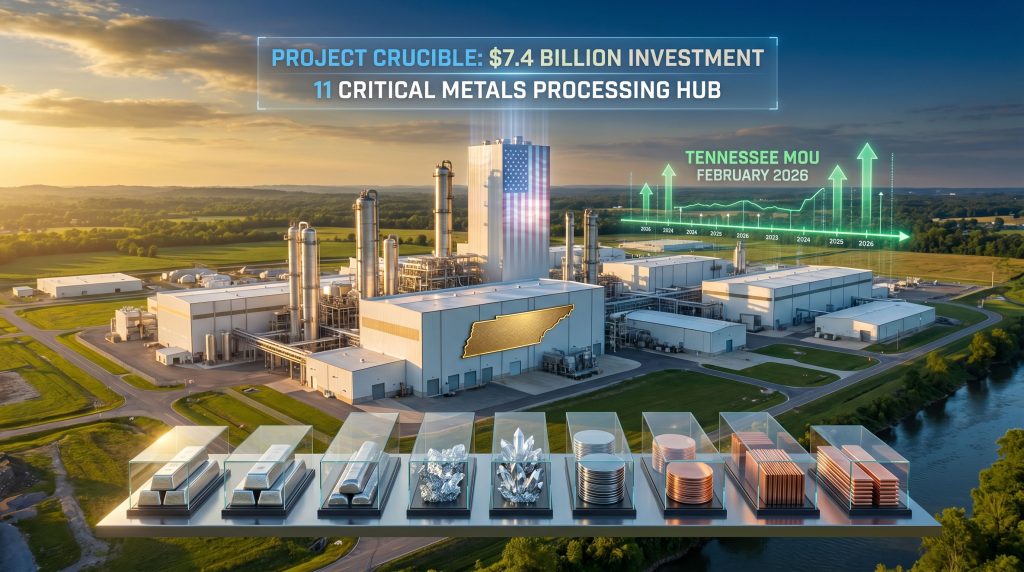
Project Crucible's proposed production capability encompasses eleven critical materials: antimony, copper, gallium, germanium, indium, lead, zinc, gold, and semiconductor-grade sulfuric acid. This integrated approach addresses multiple supply chain vulnerabilities simultaneously rather than focusing on single-material solutions, similar to strategies employed in the strategic antimony loan program.
Semiconductor-grade materials processing represents particularly strategic capability, as gallium, germanium, and indium require specialised refining processes. These achieve the >99.9999% purity specifications necessary for integrated circuit manufacturing, optoelectronic components, and photovoltaic applications.
Korea Zinc's Onsan facility technology transfer brings world-leading metallurgical processes to domestic operations. Furthermore, it utilises proprietary smelting techniques and control systems that have established South Korea as a major global processing hub for speciality metals.
Geopolitical Risk Mitigation Through Supply Chain Diversification
Global supply chain architecture for critical materials exhibits dangerous concentration patterns where single geographic regions control substantial percentages of processing capacity. These chokepoint vulnerabilities create leverage opportunities for adversarial nations and exposure to disruption during regional conflicts. Moreover, they create vulnerabilities during political instability, as demonstrated by ongoing US-China trade impacts affecting global supply chains.
Supply Chain Chokepoint Vulnerabilities
The Strait of Hormuz represents a critical vulnerability for global sulfur supply chains, with approximately 50% of world production transiting through this narrow waterway. Historical disruptions during regional conflicts demonstrate the real-world impact of geographic concentration. Consequently, shipping interruptions create immediate shortages in downstream manufacturing processes.
Semiconductor-grade sulfuric acid production concentrated in Middle Eastern facilities creates additional strategic vulnerability. This material is essential for semiconductor fabrication processes and cannot be easily substituted or stockpiled due to handling and storage requirements.
Technology Transfer and Operational Excellence
Korea Zinc's Onsan Works operates as the world's largest single-site smelter by production capacity, utilising advanced metallurgical processes. These achieve exceptional material purity and operational efficiency whilst maintaining environmental compliance standards. The technology transfer agreement for Project Crucible brings these proprietary systems to American facilities, providing domestic access to world-class processing capabilities.
The 7-million-square-foot facility scale enables integrated processing across multiple material streams, creating operational synergies. Shared infrastructure reduces per-unit processing costs and improves overall facility efficiency compared to single-material operations.
Federal Investment Structure and Project Viability
Large-scale critical infrastructure projects typically require public-private partnership structures where government investment addresses national security objectives. However, private operators maintain commercial viability and operational control, creating a risk-sharing approach that aligns incentives between public strategic goals and private sector efficiency.
Department of Defense Investment Framework
The $1.4 billion conditional federal investment represents approximately 19% of Project Crucible's total $7.4 billion development cost. This provides strategic capital subsidy whilst maintaining private majority investment responsibility. Furthermore, this structure ensures that government funding addresses national security priorities without assuming full commercial risk or operational management.
Conditional investment terms tie federal funding disbursement to specific project milestones, including permitting completion and construction progress benchmarks. In addition, these include production capacity achievements following established protocols from the comprehensive permitting process guide. This performance-based funding approach protects taxpayer investment whilst maintaining project momentum through predictable capital availability.
Economic Impact and Regional Development
Project Crucible represents Tennessee's largest direct foreign investment, creating substantial regional economic impacts through direct employment and supplier relationships. Moreover, it generates multiplier effects from increased economic activity, providing high-skill manufacturing employment in a region with established industrial workforce capabilities.
Regional economic multiplier effects from large-scale manufacturing investments typically generate 2.5-3.5 indirect jobs for each direct manufacturing position. This creates broader economic development impacts beyond the immediate facility workforce requirements.
Optimising Development Through Historical Site Utilisation
Brownfield industrial site reuse provides significant advantages over greenfield development through pre-existing infrastructure and established workforce pools. Furthermore, it offers simplified environmental permitting processes where sites with continuous industrial history provide regulatory frameworks and community acceptance that reduce development timelines.
Clarksville Industrial Heritage and Infrastructure
The Clarksville facility location maintains over 130 years of continuous metals production history, establishing deep industrial infrastructure including electrical transmission capacity. Additionally, it provides water treatment systems, transportation networks, and specialised workforce capabilities that enable rapid facility development without requiring complete infrastructure construction.
Proximity to existing Nyrstar operations provides additional operational synergies through shared logistics networks, technical expertise, and supplier relationships. The integration of complementary industrial operations creates cost efficiencies and reduces operational complexity compared to isolated facility development.
Brownfield Development Advantages
Environmental permitting for established industrial sites benefits from existing baseline documentation, historical remediation records, and established regulatory relationships. These facilitate review processes where sites with documented industrial history avoid extensive environmental characterisation required for greenfield locations.
Transportation and logistics infrastructure at the Clarksville location includes rail access, highway connections, and proximity to major distribution networks. This supports both raw material inputs and finished product distribution without requiring new transportation infrastructure investment.
The next major ASX story will hit our subscribers first
National Security Integration and Defence Industrial Base
Critical minerals processing capability directly supports defence industrial base resilience by ensuring domestic availability of materials essential to military systems. Furthermore, it provides materials for aerospace applications and defence technology manufacturing, addressing vulnerabilities where adversaries can disrupt defence supply chains through export restrictions.
Defence Industrial Base Strengthening
Project Crucible FAST-41 permitting represents the first new U.S. zinc smelter construction since the 1970s, reversing five decades of industrial decline. This affects a sector essential to defence applications where zinc serves critical roles in military systems through galvanising processes, alloy production, and specialised applications in defence electronics.
The 50-year industrial capacity gap has created systematic dependency on foreign processing for materials essential to defence manufacturing. This creates vulnerability where supply disruptions could impact military readiness and defence system production capabilities.
Technology Competitiveness Enhancement
Semiconductor materials domestic production addresses critical vulnerabilities in advanced electronics supply chains supporting defence systems. Moreover, it supports communications equipment and precision guidance technologies where gallium, germanium, and indium processing capabilities ensure domestic availability of materials that cannot be easily substituted or stockpiled.
Advanced electronics supply chain resilience extends beyond defence applications to commercial technology sectors. American companies currently depend on foreign processing for materials essential to competitive product development and manufacturing capabilities.
Future Implications for Critical Minerals Infrastructure
Project Crucible's successful development could establish precedent for similar large-scale processing facilities across the United States. This creates a template for public-private partnerships that address strategic supply chain vulnerabilities whilst maintaining commercial viability and operational efficiency.
FAST-41 Program Expansion Potential
The coordinated permitting model demonstrated through Project Crucible FAST-41 designation provides replicable framework for accelerating similar critical infrastructure projects. State-federal coordination mechanisms developed in Tennessee offer models for other states seeking to attract large-scale industrial investments through permitting efficiency.
Investment attraction mechanisms combining federal strategic funding with streamlined regulatory processes create competitive advantages for regions implementing coordinated development approaches. Consequently, this potentially catalyses broader industrial policy evolution toward manufacturing sector revitalisation.
What Are the Long-Term Strategic Benefits?
Critical minerals processing as economic development catalyst represents broader shift toward strategic industrial policy that prioritises supply chain resilience and national competitiveness. The success of integrated approaches combining permitting reform, strategic investment, and technology transfer could influence future infrastructure development across multiple sectors.
Supply chain resilience as national competitiveness factor reflects growing recognition that economic security and national security are increasingly interdependent. This requires industrial policy approaches that address both commercial viability and strategic vulnerability simultaneously.
The convergence of accelerated permitting frameworks, strategic federal investment, and advanced technology transfer through Project Crucible represents a comprehensive approach. Furthermore, it addresses systematic supply chain vulnerabilities whilst potentially catalysing broader industrial renaissance in critical materials processing that could fundamentally alter America's strategic position in global supply chains.
Success in this integrated model demonstrates how effective coordination between federal agencies, state governments, and private sector partners can accelerate critical infrastructure development. Moreover, it establishes precedent for future projects requiring similar public-private partnership structures and regulatory coordination mechanisms. For more information on federal permitting processes, visit the Federal Permitting Dashboard and review FAST-41 covered projects.
This analysis is based on publicly available information and should not be considered as investment advice. Readers should conduct independent research and consult with qualified professionals before making investment decisions. Future project outcomes depend on numerous factors including regulatory approvals, market conditions, and successful execution of complex industrial development plans.
Want to Stay Ahead of Critical Minerals Investment Opportunities?
Discovery Alert's proprietary Discovery IQ model delivers real-time alerts on significant ASX mineral discoveries, instantly empowering subscribers to identify actionable opportunities in critical minerals and strategic materials before the broader market responds. Begin your 14-day free trial today and secure your market-leading advantage whilst major infrastructure projects like Project Crucible reshape global supply chains.