August 26, 2026
The Geology Beneath the Geopolitics: Understanding India's Critical Mineral Vulnerability
The global competition for critical minerals is not simply an economic contest. It is a structural reshaping of industrial power, one measured not in barrels or tonnes of steel, but in the atomic properties of elements that make modern technology function. Rare earth elements enable the permanent magnets inside wind turbine generators. Lithium stores the electrons that power electric vehicles. Cobalt stabilises the chemistry of high-density battery cathodes. Vanadium strengthens the steel in defence platforms and stores energy in grid-scale flow batteries. Nations that control access to these materials hold leverage over the entire clean energy and advanced manufacturing supply chain.
India's position within this landscape is one of significant geological promise constrained by decades of under-investment in systematic mineral exploration. The country's landmass spans several of the world's most mineralogically prospective geological formations, yet large portions remain incompletely mapped at the resolution required for modern resource assessment. The G Kishan Reddy mission mode mining of critical minerals directive, issued following high-level review meetings in Bengaluru, represents a formal acknowledgement that the exploration pipeline must accelerate at a pace commensurate with India's industrial ambitions.
When big ASX news breaks, our subscribers know first
Why Import Dependency in Critical Minerals Is Structurally Different From Energy Imports
India's fossil fuel import dependency is substantial, but its effects are mediated by a global commodity market with dozens of producers, transparent pricing mechanisms, and deep liquidity. Critical mineral supply chains operate under fundamentally different conditions. Furthermore, critical minerals demand is intensifying globally, placing additional pressure on nations like India that remain heavily reliant on imports. For rare earth elements, a single country, China, controls approximately 60% of global mine production and over 85% of global processing capacity, according to the International Energy Agency's Critical Minerals Market Review. For lithium, three countries — Australia, Chile, and China — account for the overwhelming majority of global supply.
This concentration creates a category of risk that commodity price hedging cannot fully address. When supply disruptions occur in critical mineral markets, they are frequently geopolitical in origin and therefore not correctable through financial instruments. India's exposure spans three compounding demand vectors:
- Clean energy infrastructure, where lithium, cobalt, and rare earth elements are essential inputs for battery storage, wind power, and solar manufacturing components
- Advanced electronics and semiconductor manufacturing, where rare earth phosphors, tungsten filaments, and specialty alloys underpin precision component production
- Defence systems and platforms, where rare earth permanent magnets, tungsten-based armour penetrators, and platinum group element catalysts are integral to operational capability
What makes India's situation particularly acute is timing. The country's renewable energy targets, electronics manufacturing ambitions, and defence indigenisation programme are all scaling simultaneously, creating compounding demand pressure at precisely the moment when global critical mineral supply chains are tightening.
The Mission-Mode Framework: What It Actually Means for Exploration Agencies
The term mission-mode carries specific governance implications that distinguish it from conventional project management. In India's administrative context, it refers to a structured accountability architecture in which agencies operate against fixed delivery milestones, outcome-based performance metrics, and inter-agency coordination protocols with named accountability at the senior official level.
For mineral exploration, this matters because the traditional pathway from geological survey to resource estimation has historically been measured in years or decades. Institutional inertia, technological gaps between field data collection and analytical processing, and coordination failures between agencies conducting overlapping survey programmes have all contributed to a situation where India's geological data richness has not translated into commensurate exploration outcomes.
The directive issued by Union Minister G Kishan Reddy formalises mission-mode functioning across four central institutions operating under the Ministry of Mines:
- Geological Survey of India (GSI) — primary geological mapping and resource assessment
- Indian Bureau of Mines (IBM) — regulatory oversight, sustainable extraction standards, and critical mineral recovery from secondary sources
- National Institute of Rock Mechanics (NIRM) — mining safety engineering, infrastructure support, and seismic monitoring
- Remote Sensing and Aerial Survey (RSAS) Division — hyperspectral and airborne geophysical survey programmes
Each agency brings a distinct capability set, and the directive's emphasis on coordinated execution with fixed timelines is designed to eliminate the sequential delays that arise when these organisations operate in isolation from one another.
GSI's Five-Year Roadmap: AI-Enabled Exploration and the Karnataka-Goa Corridor
The Geological Survey of India's presentation at the Bengaluru review meetings revealed the scope of its updated exploration programme. The five-year roadmap encompasses AI-enabled geological exploration across approximately 48,000 square kilometres, representing one of the most technologically ambitious domestic survey programmes in GSI's history.
The integration of artificial intelligence into exploration workflows is not cosmetic. AI in exploration is reshaping how machine learning models are trained on existing geological datasets to identify mineralisation signatures, classify lithological units from spectral data, and generate probabilistic drill target rankings across terrain that would require years of ground-based investigation to assess manually. For a country with GSI's mandate and geographic coverage obligations, AI represents a force multiplier that converts the same field data into substantially richer exploration intelligence.
Significant preliminary findings in Karnataka and Goa add immediate substance to the programme's credibility. Identified potential reserves include gold, copper, nickel, and cobalt across geological formations that are consistent with the types of magmatic and hydrothermal mineralisation systems that host world-class deposits elsewhere. Karnataka's Dharwar Craton, one of the oldest geological terranes on the Indian subcontinent, is prospective for a range of base and precious metal deposits. The structural controls that concentrate gold mineralisation in the Hutti belt, for example, are geologically analogous to Archean greenstone belt systems in Western Australia and parts of West Africa that host significant producing mines.
Understanding the geological architecture of India's prospective terranes is critical context for evaluating exploration potential. Archean cratons globally tend to host gold and nickel sulphide systems, while Proterozoic sedimentary basins are frequently associated with lithium-bearing pegmatites and stratiform copper deposits. India's geological diversity across these formation types means the exploration prize could be substantially larger than current resource estimates suggest.
The RSAS Programme: 650,000 Square Kilometres of Subsurface Intelligence
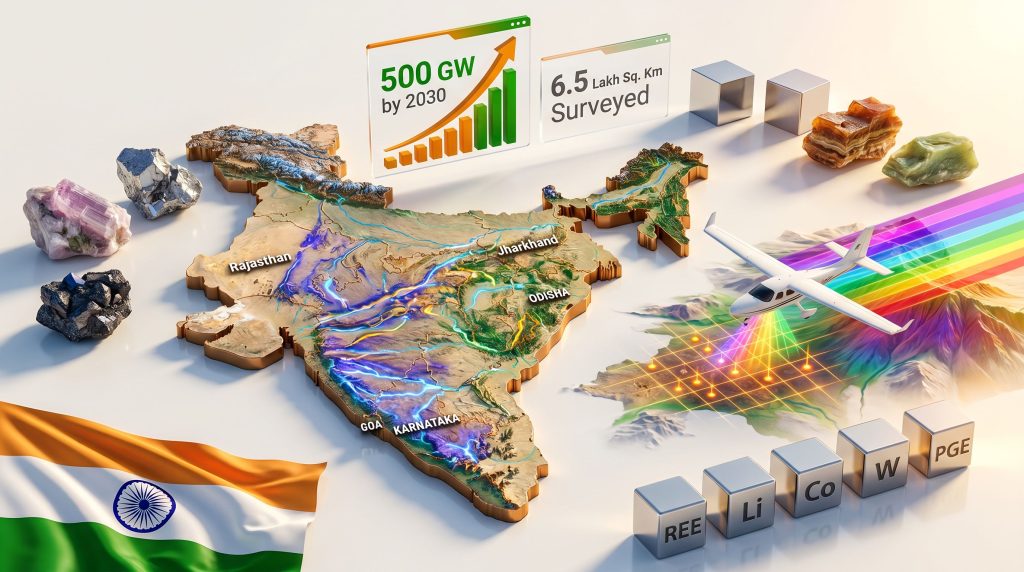
The Remote Sensing and Aerial Survey division's contribution to India's mineral intelligence base is substantial and somewhat underappreciated in public discourse. The National Aerogeophysical Mapping Programme has now covered more than 6.5 lakh square kilometres, approximately 650,000 sq km, using a combination of hyperspectral imaging and airborne geophysical survey methods including gravity gradiometry, airborne magnetics, and radiometrics.
These technologies deserve explanation because their significance is not self-evident. Hyperspectral imaging captures reflected electromagnetic radiation across hundreds of wavelength bands simultaneously, enabling the identification of specific mineral assemblages at the surface and near-surface level based on their unique spectral signatures. Iron-bearing clays, carbonates, hydroxyl-bearing minerals, and certain oxide assemblages all produce distinctive spectral responses that can be mapped from aircraft at regional scale with precision previously achievable only through intensive ground sampling.
Airborne magnetics measures variations in the Earth's magnetic field caused by subsurface rock types, identifying geological structures, intrusive bodies, and magnetite-bearing formations that are frequently associated with mineral deposits. Radiometrics measures the natural radioactive decay of potassium, uranium, and thorium at the surface, providing lithological discrimination and identifying areas of hydrothermal alteration.
When these datasets are processed together, exploration geologists gain a multi-dimensional picture of subsurface geology that dramatically improves drill targeting. The RSAS programme's coverage of 650,000 sq km has directly enabled more than 200 downstream exploration projects, demonstrating the leverage effect of systematic remote sensing investment on the broader exploration ecosystem.
| Survey Technology | What It Detects | Exploration Application |
|---|---|---|
| Hyperspectral Imaging | Surface and near-surface mineral assemblages | Alteration mapping, direct mineral identification |
| Airborne Magnetics | Subsurface magnetic contrasts | Structural mapping, intrusive body detection |
| Gravity Gradiometry | Density variations in the subsurface | Basin architecture, mafic/ultramafic body detection |
| Radiometrics | K, U, Th surface emissions | Lithological discrimination, hydrothermal alteration |
Critical Mineral Recovery From Secondary Sources: IBM's Overlooked Contribution
One of the less-discussed dimensions of India's critical minerals strategy involves recovery of valuable minerals from mine waste, tailings, and legacy stockpiles. The Indian Bureau of Mines has active programmes in this area, and the potential supply contribution is more significant than it might initially appear.
Historically, Indian mining operations extracted primary commodities while discarding material containing co-products and by-products that were either not recognised as valuable or not economically recoverable with available technology. As critical mineral prices have risen and processing technology has advanced, these legacy waste streams represent a genuinely accessible near-term supply source.
Rare earth supply chains, for instance, frequently depend on the recovery of elements occurring as by-products in iron ore, phosphate, and heavy mineral sand deposits. India's large iron ore mining operations in Odisha, Jharkhand, and Karnataka generate tailings that in some cases contain commercially meaningful concentrations of rare earth elements that have never been recovered. Similarly, coal fly ash, produced in enormous quantities by India's thermal power fleet, contains recoverable concentrations of gallium, germanium, and rare earth elements.
The recovery of critical minerals from secondary sources represents an underappreciated supply pathway that does not require new land access, environmental clearances for greenfield exploration, or the lengthy timelines associated with bringing new primary deposits into production.
The next major ASX story will hit our subscribers first
India's Position in the Global Critical Mineral Strategy Race
India enters this competitive landscape later than several peer economies but with advantages that are not yet fully priced into assessments of its strategic positioning.
| Country | Primary Strategic Instrument | Notable Mechanism |
|---|---|---|
| China | State-directed resource acquisition | SOE-led domestic and overseas asset control |
| Australia | Critical Minerals Strategy 2023 | Government co-investment, export partnerships |
| United States | IRA and DoE Critical Minerals programmes | Tax credits, domestic processing incentives |
| European Union | Critical Raw Materials Act | Strategic project benchmarking |
| Japan | JOGMEC overseas investment programme | Long-term offtake and equity stakes |
| India | National Critical Mineral Mission + Mission-Mode Directive | Agency accountability, AI mapping, RSAS programme |
India's structural advantages include a geologically diverse landmass that has not been systematically explored using modern methods, a large technically trained geoscience workforce, and an established set of bilateral critical mineral partnerships with Australia, Canada, and the United States through frameworks including the Mineral Security Partnership. These diplomatic relationships provide access to overseas critical mineral assets and technical expertise that can supplement domestic production during the exploration-to-production transition.
The Processing Gap: India's Most Significant Structural Challenge
Accelerating exploration addresses the front end of the critical mineral development pipeline. However, raw mineral extraction without downstream processing capacity exports value and perpetuates a different form of supply chain vulnerability. India currently lacks commercially scaled processing and refining infrastructure for most of its priority critical minerals.
Rare earth processing, in particular, is technically complex, environmentally demanding, and capital intensive. The hydrometallurgical separation of individual rare earth elements from mixed concentrates requires solvent extraction circuits, acid processing facilities, and specialist technical knowledge that China has accumulated over decades of deliberate investment. Building equivalent capability requires time, capital, and regulatory frameworks that accommodate the environmental challenges associated with rare earth chemistry.
Lithium processing technologies present different but comparably significant challenges. Converting lithium-bearing spodumene concentrate or lithium brine into battery-grade lithium carbonate or lithium hydroxide requires processing infrastructure that India does not yet possess at meaningful scale.
The mission-mode directive addresses exploration acceleration within existing agency mandates. Translating exploration success into industrial mineral supply will, however, require parallel progress on:
- Investment frameworks that attract private capital into processing infrastructure
- Environmental regulatory pathways that enable responsible refinery development
- Technology transfer provisions within international partnership agreements
- Workforce development programmes targeting hydrometallurgical and processing engineering skills
The Mineral-to-Megawatt Equation: Why the Energy Transition Cannot Proceed Without This Strategy
India's renewable energy target of 500 GW of installed capacity by 2030 creates a mineral demand profile that is quantifiable and substantial. Wind turbines using permanent magnet generators require neodymium and dysprosium. Utility-scale battery storage systems require lithium and cobalt. Solar manufacturing equipment and power electronics require specialty materials including indium, tellurium, and rare earth elements for certain phosphor applications.
The IEA has estimated that achieving global net-zero emissions by 2050 will require a sixfold increase in critical mineral production compared to current levels. India's 500 GW target, pursued alongside similar ambitions in Europe, the United States, and Southeast Asia, forms part of that demand surge. Without a credible domestic supply development programme running in parallel, India's energy transition timeline is externally constrained by supply chains it does not control.
The G Kishan Reddy mission mode mining of critical minerals initiative therefore connects directly to the country's energy security architecture. Consequently, India is actively working to break its critical mineral dependence and position itself as a global leader in the sector. Mineral security and energy security are not parallel policy tracks; they are the same policy track viewed from different angles.
Frequently Asked Questions
What is mission-mode mining as directed by G Kishan Reddy?
Mission-mode mining refers to a governance model in which exploration and mining agencies under India's Ministry of Mines operate with fixed project timelines, measurable outcome targets, and structured inter-agency coordination. The directive issued following Bengaluru review meetings formalises this approach to eliminate institutional delays in critical mineral exploration and development.
Which minerals are the priority focus of India's critical mineral programme?
India's Ministry of Mines has designated rare earth elements, lithium, cobalt, nickel, tungsten, vanadium, and platinum group elements as the highest-priority critical minerals based on their strategic importance to clean energy, electronics manufacturing, and defence supply chains combined with India's current high dependency on imports.
How does AI improve mineral exploration outcomes?
Machine learning models applied to geological datasets can identify mineralisation patterns, classify rock types from spectral and geophysical data, and generate probabilistic rankings of drill targets. This compresses the time required for early-stage exploration targeting from years to months and reduces the cost per unit of exploration intelligence generated.
What is the National Aerogeophysical Mapping Programme?
This is the RSAS division's national-scale aerial survey programme employing hyperspectral imaging, airborne magnetics, gravity gradiometry, and radiometrics. Coverage has exceeded 650,000 square kilometres and has directly enabled over 200 exploration projects by providing comprehensive subsurface geological data.
Why is processing capacity as important as exploration success?
Discovery of mineral deposits is the first step in a multi-stage development pipeline. Converting ore into battery-grade or industrial-grade mineral products requires processing and refining infrastructure. Without domestic processing capacity, India would export raw mineral concentrates and remain dependent on overseas refiners, particularly China, for the value-added products its industries actually require.
Disclaimer: This article contains forward-looking statements, policy projections, and analytical assessments that involve inherent uncertainty. Readers should not interpret commentary on exploration potential, production timelines, or strategic outcomes as investment advice or confirmed government commitments. Mineral resource estimates referenced are preliminary in nature unless stated otherwise.
Want to Track the Next Major Mineral Discovery Before the Market Does?
Discovery Alert's proprietary Discovery IQ model delivers real-time alerts on significant ASX mineral discoveries across more than 30 commodities — including the critical minerals reshaping the global energy transition — instantly converting complex geological data into actionable investment insights for traders and long-term investors alike. Explore historic examples of major mineral discoveries and their market returns, then begin your 14-day free trial at Discovery Alert to position yourself ahead of the market.