June 25, 2026
When Environmental Ambition Collides With Supply Chain Reality
Every major climate-linked trade policy eventually faces the same stress test: what happens when the regulatory architecture outpaces the physical and logistical realities of the industries it targets? The European Union's methane regulation is now confronting precisely that moment, and Qatar and the U.S. warn EU of gas crunch over methane regulation in terms that European policymakers can no longer afford to dismiss. The framework, adopted with considerable fanfare as a landmark extension of domestic climate standards into global energy supply chains, has triggered a coordinated pushback from four of the world's most consequential gas exporters. Understanding why requires looking past the political theatre and into the mechanics of how LNG supply chains actually function.
When big ASX news breaks, our subscribers know first
What the EU Methane Regulation Actually Demands
The Architecture of an Extraterritorial Standard
The EU methane regulation, adopted approximately two years before its 2026 enforcement phase, represents something genuinely unprecedented in energy trade policy. For the first time, a major trading bloc has attempted to impose domestic environmental compliance standards on foreign suppliers as a condition of market access. The framework operates through a monitoring, reporting, and verification (MRV) structure that requires all energy suppliers to the EU, including those operating entirely outside its jurisdiction, to demonstrate traceability of methane emissions across the full supply chain.
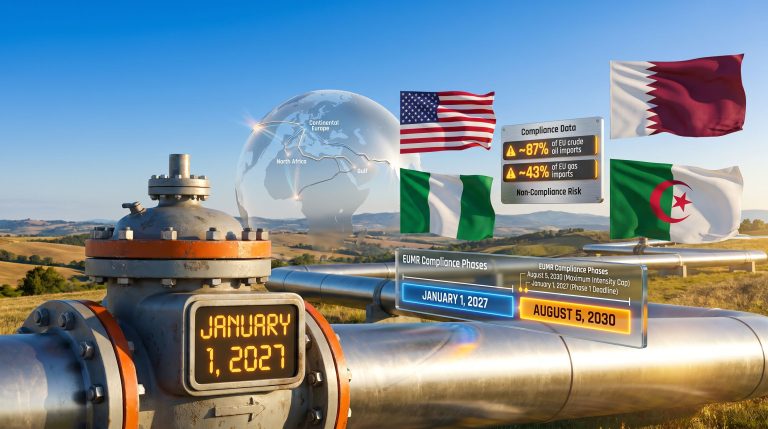
The compliance obligations are structured in phases:
- Initial adoption and baseline reporting (2024-2025): Suppliers establish emissions inventories and begin documentation frameworks.
- Full applicability threshold (2027): Active compliance requirements come into force, meaning contracts signed for 2027 delivery must satisfy the standard.
- Methane intensity cap (2030): A binding ceiling on the methane intensity of gas supplied to the EU, creating hard exclusion criteria for non-compliant volumes.
A critical distinction shapes the entire enforcement architecture. Domestic EU producers are subject to direct regulatory enforcement by member state authorities. Foreign LNG suppliers, however, face an equivalency standard, meaning they must demonstrate their own regulatory frameworks and monitoring systems produce outcomes equivalent to those the EU would require domestically. In practice, this equivalency pathway is largely untested and lacks clear definitional precision.
"The EU methane regulation represents one of the first instances of a major trading bloc attempting to apply domestic environmental standards extraterritorially to energy supply chains. Whether it functions as climate policy or as a structural trade barrier depends entirely on one's vantage point in the supply chain."
Why U.S. Shale Gas Is Structurally Incompatible With the Compliance Model
The technical objection raised by U.S. exporters is not merely rhetorical. It reflects a genuine structural incompatibility between the regulation's compliance model and the architecture of American natural gas production. Furthermore, the LNG supply outlook heading into 2027 makes this incompatibility even more consequential for European buyers.
U.S. shale gas is produced by hundreds of independent operators across multiple basins, including the Permian, Marcellus, Haynesville, and Eagle Ford. Output from these operators is commingled in shared pipeline infrastructure before reaching Gulf Coast liquefaction terminals operated by entities such as Cheniere Energy, Venture Global, and Sempra. Once gas from multiple sources enters a shared pipeline grid, molecule-level attribution of emissions becomes physically impractical under any currently deployed monitoring system.
This stands in sharp contrast to the supply structures of other major exporters:
| Compliance Dimension | U.S. LNG Exporters | Qatar (QatarEnergy) | Algeria (Sonatrach) | Nigeria (NLNG) |
|---|---|---|---|---|
| Supply chain structure | Fragmented / multi-producer | Vertically integrated | State-controlled | Joint venture |
| Methane tracking feasibility | Technically complex | More tractable | Moderate | Moderate |
| Estimated compliance readiness | Low | Low-Medium | Medium | Medium |
| Current EU import share | ~59-64% | Significant | Moderate | Moderate |
Qatar's QatarEnergy, by contrast, operates a vertically integrated supply chain from the North Field through the Ras Laffan liquefaction complex to LNG carrier delivery, which makes point-of-origin emissions tracking considerably more tractable in theory. Yet even QatarEnergy has characterised the EU's compliance framework as unworkable, suggesting the objection extends beyond the technical fragmentation problem unique to U.S. shale. According to analysis by AGSI, both Qatar and the U.S. have formally targeted the EU directive as a structural market access obstacle.
How Exposed Is Europe to the Suppliers Pushing Back?
The Concentration Risk Nobody Wanted to Acknowledge
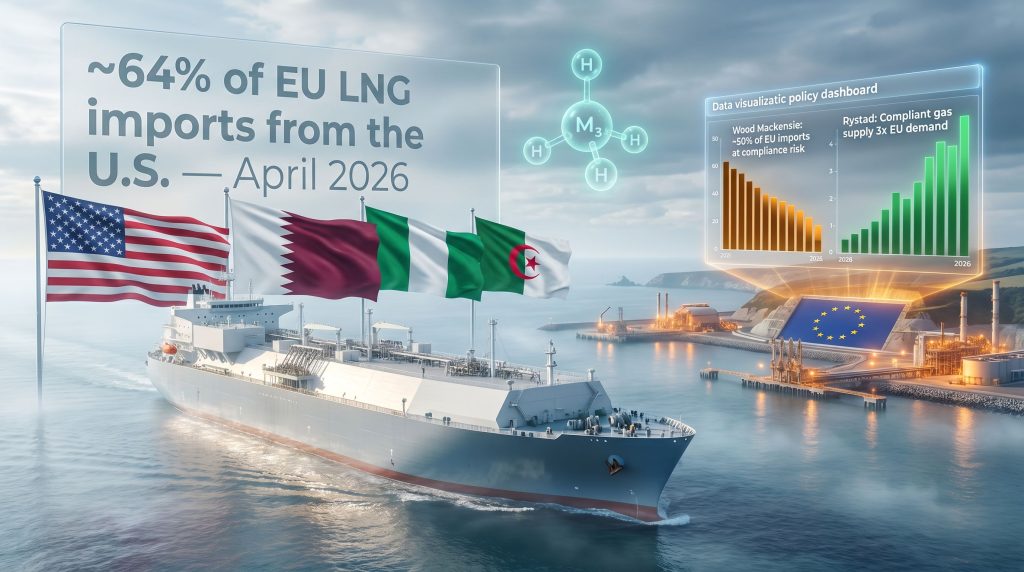
Europe's post-2022 energy pivot created a dependency that was always understood to carry long-term risks, even as it solved the immediate crisis of Russian pipeline gas withdrawal. According to Bloomberg analysis by Javier Blas, the EU sourced approximately 59% of its LNG imports from the United States in 2026, with that figure rising to an estimated 64% in April 2026 alone. That degree of single-supplier concentration in a critical energy commodity would raise structural alarm bells in any strategic context.
The energy export challenges facing major producing nations compound this picture, as competing supply pressures reduce the flexibility available to European importers. The limited availability of near-term alternatives compounds the problem significantly:
- Norwegian pipeline gas remains Europe's most stable non-Russian source, but Norwegian production is operating near capacity with limited upside volume potential.
- Azerbaijani volumes via the Southern Gas Corridor are constrained by pipeline infrastructure limits and are unlikely to scale meaningfully in the short term.
- African pipeline suppliers, including Algeria via the Trans-Mediterranean pipeline, face their own infrastructure bottlenecks and domestic demand pressures.
- Emerging LNG suppliers in East Africa and elsewhere remain years away from delivering volumes at scale relevant to European import requirements.
"The four nations that signed the joint warning letter, the United States, Qatar, Nigeria, and Algeria, collectively account for the dominant share of Europe's LNG import portfolio. This creates a near-monopsonistic supplier dynamic in which the EU's leverage as a buyer is considerably weaker than its regulatory posture implies."
The Contracting Paralysis Problem
One of the least-discussed but most operationally significant consequences of the regulatory uncertainty is what industry participants describe as contracting paralysis. LNG cargoes for 2027 delivery, the first year of full regulatory applicability, are being negotiated and contracted in 2026. European importers and their LNG supplier counterparts are reluctant to sign long-term agreements that could subsequently be deemed in violation of EU law.
Even the EU's partial concession, suspending financial penalties until 2030, does not resolve this problem. The legal compliance obligation itself remains intact. Any contract signed under the current framework carries residual legal exposure that neither buyers nor sellers are willing to absorb. The result is a chilling effect on long-term contracting at precisely the moment when European energy security requires the opposite.
The Data War: Two Studies, Two Incompatible Conclusions
Why the Numbers Cannot Both Be Right
The methane regulation debate has generated a striking methodological conflict between two credible energy research organisations that have reached diametrically opposed conclusions using largely overlapping underlying data.
Wood Mackenzie (March 2026, industry-commissioned): Estimated that close to half of the EU's current LNG import volumes could face compliance difficulties under the proposed MRV standards, implying a material near-term supply gap if the regulation proceeds as written.
Rystad Energy (commissioned by the Environmental Defense Fund): Concluded that globally available compliant gas volumes are approximately three times larger than total EU import demand, implying that no structural shortage risk exists and that European buyers could theoretically source entirely compliant volumes if they chose different suppliers.
The methodological gap between these conclusions is attributable to several divergent assumptions:
- Differing definitions of what constitutes "compliant" gas under the equivalency framework
- Contrasting treatment of gas commingling and the technical feasibility of attribution in shared pipeline systems
- Varying assumptions about how quickly upstream operators could retrofit continuous emissions monitoring equipment
- Different views on supplier willingness versus actual technical capability
"When two credible research organisations using similar data produce conclusions this far apart, the most likely explanation is that the regulation's compliance framework lacks sufficient definitional precision to be consistently interpreted. This ambiguity is itself a form of regulatory failure."
The International Energy Agency adds a third dimension to this analytical landscape. The IEA has estimated that 100 billion cubic metres (BCM) of additional gas could be unlocked globally through targeted methane emission reductions, suggesting the efficiency potential is real. However, the gap between theoretical global potential and the practical contracting timelines facing European importers purchasing 2027 cargoes today is not bridgeable in the available timeframe.
Brussels' Partial Retreat and Why Exporters Rejected It
The Penalty Suspension That Satisfied Nobody
Facing mounting supplier resistance, Brussels announced it would suspend financial penalties under the methane regulation until 2030. This was positioned as a transitional accommodation, intended to provide additional time for suppliers to develop compliant monitoring and verification systems.
The four-nation exporter coalition, comprising the U.S., Qatar, Nigeria, and Algeria, collectively rejected this concession as inadequate. Their stated reasoning is legally coherent. A penalty suspension preserves the underlying compliance obligation in EU law. Any contract signed under that legal architecture remains technically non-compliant, regardless of whether penalties are currently being enforced. The legal risk does not disappear; it is merely deferred.
U.S. Energy Secretary Chris Wright characterised the regulation publicly as a critical non-tariff trade barrier that places undue burdens on American exporters and damages the broader transatlantic trade relationship. This framing connects the methane regulation to the wider global trade war impacts reshaping energy commerce, elevating it from an energy sector dispute into a broader diplomatic friction point.
Qatar had already issued what amounted to a public ultimatum in 2025, signalling that it would redirect LNG exports away from European buyers if the regulation remained in force. As reported by the Business Post, this joint pressure from the U.S. and Qatar represents an unprecedented alignment of the world's two most influential LNG exporters against a single regulatory framework. Given that Qatar is one of the world's largest LNG producers and a key European supply source, this was not a statement to dismiss lightly.
The Hidden Policy Objective: Is This Really About Methane?
Demand Reduction Dressed as Emissions Management
One of the more revealing aspects of the methane regulation debate concerns the stated objectives of its most vocal proponents. Organisations that have publicly championed the regulation frame it not primarily as an emissions reduction mechanism but as a tool for reducing European gas consumption altogether. The logic runs that by making LNG procurement conditions sufficiently burdensome, European buyers will accelerate the transition away from gas dependency.
This framing creates a fundamental internal tension within EU energy policy:
- Climate ambition track: Reduce fossil fuel consumption, accept short-term price increases as transition costs, position the EU as a global standard-setter for climate-linked trade policy.
- Energy security track: Maintain affordable, reliable gas supply, diversify away from single-supplier concentration, protect industrial competitiveness during the transition period.
These objectives are not merely in tension at the margin. Under the current regulatory timeline, they are operationally incompatible. European industrial energy consumers have made precisely this argument in opposing the regulation's trajectory, noting that higher energy costs accelerate industrial offshoring rather than energy transition. Indeed, the broader commodity market tariff effects flowing from such regulatory frameworks demonstrate how quickly policy friction can translate into real supply disruption.
The next major ASX story will hit our subscribers first
Three Scenarios for European Energy Security in 2027
The regulatory outcome in the coming months will have direct consequences for European energy markets heading into the critical 2027-2028 heating season period. Three broad scenarios frame the likely range of outcomes:
| Scenario | Regulatory Outcome | Supply Impact | Price Outcome |
|---|---|---|---|
| Scenario A: Full enforcement | Regulation applied as written from 2027 | Significant volume reduction risk | High TTF price pressure |
| Scenario B: Targeted amendments | Compliance definitions revised; tracking simplified | Moderate supply continuity | Contained price impact |
| Scenario C: Regulation shelved | Full suspension or cancellation | Supply normalises | Near-term price stability |
Scenario B, involving targeted definitional amendments that simplify the tracking obligation for structurally complex supply chains like U.S. shale, represents the most politically achievable resolution. However, it also sets a precedent that supplier coalitions can successfully negotiate the terms of EU climate-linked trade regulation through coordinated pressure. This carries significant implications for future carbon border adjustment mechanisms and other extraterritorial environmental standards.
Key Data Summary
| Metric | Figure | Source |
|---|---|---|
| EU LNG imports from the U.S. (2026 average) | ~59% | Bloomberg / Javier Blas |
| EU LNG imports from the U.S. (April 2026) | ~64% | Bloomberg / Javier Blas |
| EU imports potentially non-compliant (Wood Mackenzie) | ~50% | March 2026 industry study |
| Globally compliant gas vs. EU demand (Rystad Energy) | 3x greater | Environmental Defense Fund-commissioned |
| Additional gas unlockable via methane cuts (IEA) | 100 BCM | IEA methane efficiency modelling |
| EU financial penalty suspension period | Until 2030 | EU regulatory concession |
| Nations signing joint warning letter | 4 (U.S., Qatar, Nigeria, Algeria) | Financial Times reporting |
Frequently Asked Questions: EU Methane Regulation and LNG Supply Security
What is the EU methane regulation?
A framework requiring all energy suppliers to the EU, including foreign LNG exporters, to monitor, report, and reduce methane emissions across their full supply chains. Full applicability begins in 2027, with a binding methane intensity cap from 2030.
Why is U.S. LNG difficult to bring into compliance?
American natural gas is produced by hundreds of independent operators whose output is combined in shared pipeline networks before reaching Gulf Coast liquefaction terminals. Attributing emissions to specific molecules from specific producers is technically impractical under current monitoring infrastructure.
How much of Europe's LNG comes from the United States?
Approximately 59% of total EU LNG imports in 2026, rising to an estimated 64% in April 2026, making the U.S. the bloc's largest single LNG supplier by a considerable margin.
Which countries signed the joint warning letter to the EU?
The United States, Qatar, Nigeria, and Algeria, representing the dominant share of Europe's LNG import base.
Has the EU made any concessions?
Brussels suspended financial penalties under the regulation until 2030, but exporting nations have rejected this as insufficient. Their position is that the legal compliance obligation itself, not merely the penalty mechanism, must be addressed before contractual activity can normalise.
What the Standoff Reveals About the Future of Climate Trade Policy
The methane regulation dispute is ultimately a test case for whether the EU can design and enforce climate-linked trade standards without first securing supply-side buy-in from the producers those standards will affect. The answer, so far, is that it cannot, at least not without accepting either significant supply risk or significant diplomatic cost.
The broader lesson extends well beyond LNG. As the EU advances its Carbon Border Adjustment Mechanism across steel, cement, aluminium, fertilisers, and electricity, it will encounter similar structural objections from exporting nations. The geopolitical trade landscape of 2025 and beyond suggests that extraterritorial environmental standards will increasingly be framed as disguised protectionism by exporting nations, raising the diplomatic stakes considerably.
Consequently, how Brussels resolves the standoff in which Qatar and the U.S. warn EU of gas crunch over methane regulation will establish the template for how those future confrontations unfold. For European energy consumers, the most immediate concern remains practical: whether sufficient LNG volumes will be available at manageable prices during the 2027 heating season. That answer depends not on climate ambition but on whether European policymakers can navigate the gap between regulatory idealism and supply chain reality before the contracting window closes.
This article is for informational purposes only and does not constitute financial or investment advice. Scenario projections involve assumptions and uncertainties that may differ materially from actual outcomes.
Want To Stay Ahead of the Resource and Energy Discoveries Driving These Market Shifts?
As geopolitical tensions reshape global energy and commodity supply chains, Discovery Alert's proprietary Discovery IQ model delivers real-time alerts on significant ASX mineral discoveries, turning complex resource data into actionable investment insights — explore historic discovery returns on Discovery Alert's discoveries page to see what's possible, and begin your 14-day free trial at Discovery Alert to position yourself ahead of the market.