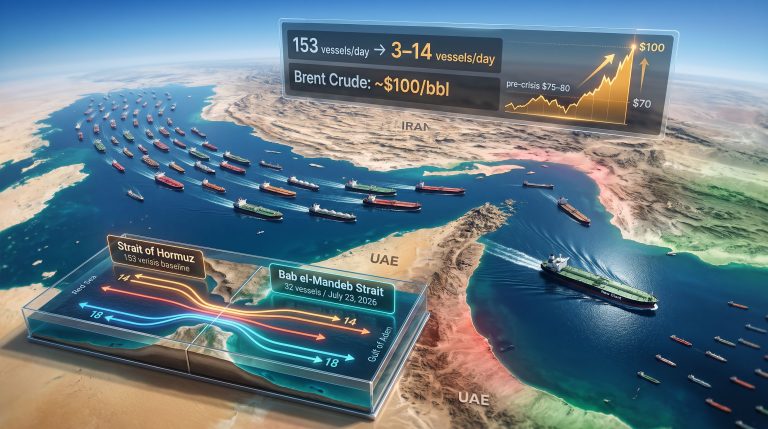
July 25, 2026
The World's Most Dangerous Waterway Is Still Open — But for How Long?
Every few decades, a single geographic feature becomes the hinge point of global economic stability. The Strait of Hormuz has occupied that position for generations, and despite recent assertions from Washington that the threat has been neutralised, Iran's ability to close the Strait of Hormuz remains a live strategic question. Understanding what has actually changed, and what remains dangerously unresolved, requires moving beyond political statements and into the mechanics of maritime power, asymmetric warfare, and the fragile architecture of a 60-day agreement that has no guaranteed successor.
When big ASX news breaks, our subscribers know first
Why the Strait of Hormuz Cannot Be Replaced
The physical geography of the Persian Gulf creates an irreplaceable dependency on a single exit corridor. Every barrel of crude oil exported by Saudi Arabia, Iraq, Kuwait, and the UAE must pass through a navigable channel roughly 21 nautical miles wide at its narrowest point. Before the conflict that erupted in early 2026, approximately 20% of the world's entire oil supply transited this waterway under normal operating conditions, according to CNBC reporting citing trade intelligence data.
There is no realistic pipeline or overland alternative capable of absorbing that volume. The existing bypass options, including Saudi Arabia's East-West Pipeline terminating at Yanbu on the Red Sea coast, carry meaningful but ultimately insufficient capacity to substitute for full strait access. This structural dependency is precisely why questions surrounding geopolitical oil price tensions and the strait's viability matter so much to energy markets, shipping operators, and governments worldwide.
What Closure Actually Looks Like in Practice
The binary framing of the strait as either open or closed obscures the more operationally relevant reality. Iran possesses the ability to operate across a spectrum of disruption that includes:
- Full closure through coordinated mine deployment and missile interdiction
- Selective interdiction targeting vessels linked to specific nations or operators
- Conditional access requiring IRGC naval approval before vessels may transit
- Harassment operations using fast attack craft to slow or deter commercial shipping
- Toll enforcement, which Iran initially attempted to impose before the current agreement
Each point on this spectrum carries significant economic consequences. Shipping insurance markets, tanker routing decisions, and WTI and Brent futures all respond to conditional access with nearly the same sensitivity as they do to outright closure. This is a critical distinction that tends to be lost in political discourse about whether the strait is open or shut.
What the U.S. Energy Secretary's June 2026 Claim Actually Means
At a Reuters-hosted conference in New York City in late June 2026, U.S. Energy Secretary Chris Wright stated that American military escorts had effectively ended Iran's ability to close the Strait of Hormuz going forward, framing strait access as Iran's primary source of geopolitical leverage and describing U.S. policy as systematically removing that leverage.
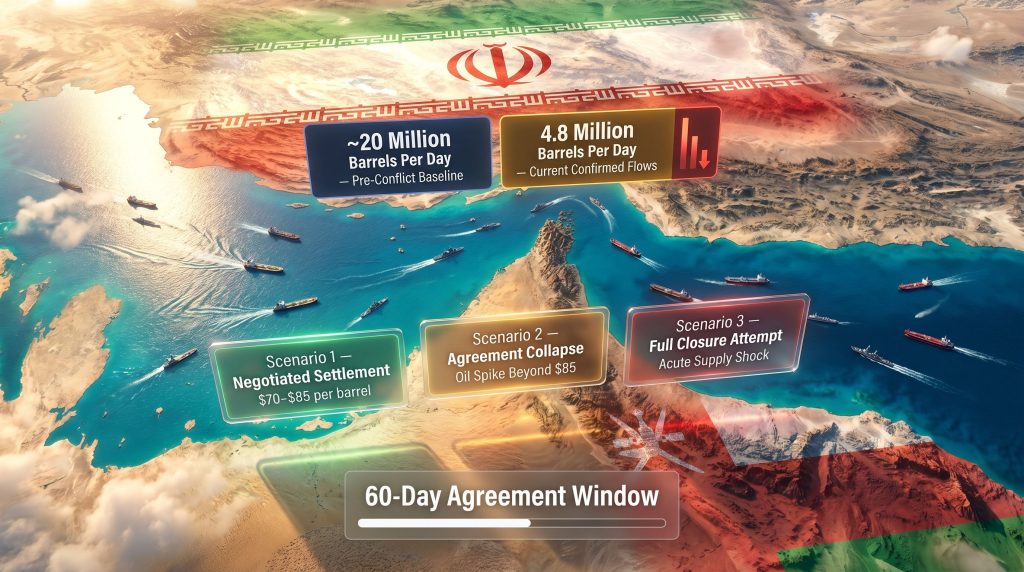
Wright cited specific data points to support this position. He noted that 17 million barrels of oil moved through the strait during a weekend when Iran declared the waterway closed, and that 72 commercial vessels carrying approximately 19 million barrels had transited within a single 24-hour period following the access agreement. Trade intelligence firm Kpler subsequently confirmed approximately 4.8 million barrels per day exiting the strait since the U.S. and Iran reached their agreement the prior week.
The 60-Day Agreement: A Detailed Breakdown
The agreement underpinning current strait access is a carefully bounded arrangement with significant gaps. The table below summarises its key elements:
| Agreement Element | Detail |
|---|---|
| Duration | 60 days from signing |
| Iran's Commitment | Allow commercial passage without toll collection |
| U.S. Commitment | Lift naval blockade of Iran |
| Sanctions Waiver | 60-day waiver on Iranian oil sales |
| Frozen Iranian Funds | Not released as of late June 2026 |
| Post-60-Day Framework | Subject to negotiation between Iran, Oman, and Gulf neighbors |
Wright was explicit that the sanctions waiver does not represent a substantive gain for Tehran. Washington had not released any frozen Iranian assets as of the time of his remarks, and he framed further economic relief as contingent on Iran delivering concrete outcomes on security and non-proliferation priorities. The Trump administration simultaneously signalled its willingness to reimpose a naval blockade if Iran fails to meet U.S. demands, describing the consequences for Tehran in stark terms.
Furthermore, the oil price trade war impact of any agreement collapse would extend well beyond regional actors, rippling through global supply chains with considerable force. The post-60-day governance structure is entirely unresolved, and no permanent framework exists with no timeline for those talks publicly confirmed.
Does Iran Still Have the Military Capability to Disrupt the Strait?
This is the central question that political rhetoric tends to elide. The honest answer, supported by independent military analysis, is yes. Iran retains a substantial asymmetric warfare arsenal that U.S. naval escorts can deter but cannot fully neutralise. The assets most relevant to strait interdiction include:
- Naval mines: Historically among the most cost-effective tools for disrupting commercial shipping lanes. Mines can be deployed rapidly across navigable channels and are exceptionally difficult to locate and clear under operational conditions.
- Shore-based anti-ship cruise missiles: Mobile platforms positioned along Iran's coastline can target vessels throughout the strait's navigable corridor. These systems were degraded but not eliminated by U.S. and Israeli strikes beginning February 28, 2026.
- IRGC fast attack craft: Small, highly manoeuvrable vessels capable of swarming tactics against both commercial ships and their naval escorts.
- Submarine assets: Iran operates a small but operationally relevant submarine fleet in Persian Gulf waters.
- Air defence systems: Partially degraded following the February 2026 airstrike campaign but not rendered inoperational.
Independent military analysts broadly assess that Iran retains sufficient asymmetric capability to halt or severely impede strait traffic for at least one month under a fully coordinated interdiction scenario, even accounting for active U.S. naval presence. According to analysis from the Belfer Center, the escort mechanism provides meaningful deterrence against overt interdiction of protected convoys but offers no protection against mines already in the water, missile strikes on unescorted vessels, or harassment operations in corridors outside the escort route.
The February 2026 Conflict: Context That Markets Cannot Ignore
Iran began targeting commercial shipping in the strait following the launch of a joint U.S.-Israeli airstrike campaign on February 28, 2026. The disruption that followed was described by analysts as the largest oil supply shock in recorded history, with strait traffic collapsing and energy markets moving into crisis before the subsequent access agreement temporarily stabilised flows. This sequence is critical context: Iran demonstrated both the willingness and the operational capability to impose severe disruption within weeks of a triggering event.
Three Scenarios for What Happens After the 60-Day Window Closes
The post-agreement period represents the most consequential variable in current global energy risk. Three distinct trajectories are analytically plausible:
Scenario 1: Negotiated Settlement and Permanent Access Framework
This outcome requires successful diplomatic progress on nuclear or broader security arrangements, economic relief meaningful enough to give Tehran a stake in compliance, and effective Gulf state mediation coordinated through Oman. If achieved, this scenario supports the $70–$85 per barrel oil price range cited by S&P Global's Dan Yergin as reasonable under current conditions, with Oman emerging as the institutional administrator of a formalised transit governance structure.
Scenario 2: Agreement Collapse and Return to Selective Interdiction
Trigger conditions for this scenario include a U.S. decision to reimpose its naval blockade, renewed Israeli military action, or failure to deliver the economic concessions Tehran views as necessary. Wright's own remarks implicitly acknowledged this risk, framing the threat of reimposed blockade as an explicit policy tool. Market consequences would include oil price movement beyond $85 per barrel, surging war risk insurance premiums, and widespread tanker rerouting via the Cape of Good Hope, adding weeks to voyage times and material cost to global supply chains.
Scenario 3: Escalation and Full Closure Attempt
The lowest-probability but highest-consequence outcome involves ceasefire violations, continued strikes on Iranian proxy networks, or domestic political pressure within Iran forcing a more confrontational posture. Iran invoked Article 51 of the UN Charter to justify its earlier restrictions on passage by vessels linked to what it characterised as aggressor states. This legal framework's implications remain available as political justification for future closure attempts. A sustained full closure would almost certainly trigger coordinated IEA strategic petroleum reserve releases and carries meaningful global recession risk analysis given the concentration of Gulf crude in Asian supply chains.
Based on current diplomatic positioning, Scenario 1 remains the most likely near-term trajectory, with Scenario 2 as the dominant tail risk. Scenario 3 cannot be priced out of energy market risk assessments entirely.
How Energy and Shipping Markets Are Pricing Hormuz Risk Right Now
The gap between confirmed current flows and pre-conflict baseline volumes tells a story that market commentary often overlooks. Consider the following comparison:
| Metric | Pre-Conflict Baseline | Current (Post-Agreement) |
|---|---|---|
| Daily oil throughput | ~20 million barrels per day | ~4.8 million barrels per day (confirmed by Kpler) |
| Strait status | Open, unescorted | Conditionally open, escorted |
| War risk insurance | Standard commercial rates | Significantly elevated |
| Tanker routing | Direct Gulf transit | Contingency Cape routes maintained |
The roughly 75% gap between pre-conflict throughput and current confirmed flows is not simply a data lag. It reflects ongoing IRGC vessel screening, operator risk aversion, insurance constraints, and the simple reality that many cargo owners are not yet treating the strait as reliably safe. LNG cargo diversions have partially restructured Asian supply chains, with some buyers accelerating long-term contract commitments with Australian and U.S. liquefied natural gas exporters.
Options market positioning continues to embed meaningful upside risk to $100 per barrel or beyond, suggesting that professional traders are not treating the current diplomatic arrangement as a durable resolution. Furthermore, OPEC's market influence on production decisions is increasingly calibrated against Hormuz scenario probabilities rather than pure demand fundamentals, adding a layer of complexity to supply forecasting that was largely absent before the February 2026 conflict.
The next major ASX story will hit our subscribers first
The Mechanics of U.S. Naval Escort Operations and Their Limits
The operational mechanism behind Wright's claim centres on U.S. naval vessels escorting commercial ships through Oman's territorial waters in the strait's southern corridor. Oman's long-standing diplomatic neutrality, maintained across decades of regional conflict, makes its territorial waters the natural routing option for vessels seeking to avoid direct exposure to Iranian interdiction in the northern channel.
What this arrangement achieves is genuine but bounded:
- It deters overt Iranian interdiction of vessels within the escort corridor.
- It provides a political and legal framework for continued transit that Iran cannot easily dismiss without confronting the U.S. Navy directly.
- It creates a documented compliance record that strengthens Washington's negotiating position.
However, what it cannot achieve is equally important to understand:
- Mine threats already deployed in the navigable channel are not neutralised by surface escorts.
- Missile strikes on vessels outside the escort corridor or ahead of convoy formation remain viable Iranian options.
- IRGC harassment operations in waters adjacent to the escort route fall into legal and operational grey zones that complicate response protocols.
- The escort mechanism requires sustained U.S. naval presence at significant operational cost, creating a resource commitment that is not indefinitely sustainable at current intensity.
Oman's role extends beyond providing territorial waters as a transit corridor. Muscat is also the mandated intermediary for the post-60-day governance negotiations between Iran and Gulf states. Given that those talks have not yet produced a framework, Oman's diplomatic capacity will be tested considerably in the months ahead.
Frequently Asked Questions: Iran, the Strait of Hormuz, and Global Energy Security
Has Iran permanently lost the ability to close the Strait of Hormuz?
No. Iran retains naval mines, anti-ship missile systems, IRGC fast attack craft, and the demonstrated operational willingness to target commercial shipping. U.S. naval escorts provide meaningful deterrence but do not eliminate Iran's underlying capacity to impose access conditions or conduct interdiction operations against non-escorted vessels.
What happens when the 60-day agreement expires?
Post-expiry governance is subject to negotiation between Iran, Oman, and Gulf neighbors under the agreement's terms. No permanent framework currently exists. If those talks fail to produce a durable arrangement, all three risk scenarios outlined above are reactivated simultaneously.
Why is current oil throughput so far below pre-conflict levels?
Confirmed flows of approximately 4.8 million barrels per day represent partial resumption, not full normalisation. IRGC vessel screening, elevated war risk insurance, operator caution, and ongoing uncertainty about the post-60-day framework are all suppressing traffic below the roughly 20 million barrels per day that transited under pre-conflict conditions.
What leverage does Washington hold over Tehran?
The U.S. holds several interdependent tools: the ability to reimpose a naval blockade, full reinstatement of oil sanctions, the withholding of frozen Iranian assets not yet released, and the option of coordinated military action. The effectiveness of these tools depends on sustained allied coordination and sustained domestic political will within the United States.
What role does international law play in Iran's closure strategy?
Iran invoked Article 51 of the UN Charter, the right to self-defence, to justify restricting passage to vessels it characterised as linked to aggressor states. This legal framework, while contested under customary international law governing transit passage rights, provides Tehran with a political justification it can deploy again if conflict conditions re-emerge.
The Strategic Bottom Line on Iran's Ability to Close the Strait of Hormuz
The assertion that Iran's ability to close the Strait of Hormuz has permanently ended represents a significant overstatement of what U.S. military escorts can durably achieve. The current arrangement is better characterised as a tactically successful but strategically incomplete pause in a broader confrontation whose resolution remains genuinely uncertain.
Several realities demand clear-eyed acknowledgment:
- Iran's asymmetric warfare toolkit remains operationally viable despite degradation from the February 2026 airstrike campaign.
- The 60-day agreement lacks a successor framework, and the negotiations required to produce one involve parties with deeply divergent interests.
- Energy markets are pricing partial normalisation, not permanent security, as evidenced by the persistent gap between current throughput and pre-conflict baselines.
- The most consequential variable over the next 60 to 90 days is not U.S. military posture but the outcome of Iran-Oman-Gulf state governance negotiations that have barely begun.
For investors, policymakers, and energy market participants, the appropriate analytical posture is one of cautious optimism constrained by structural uncertainty. The strait is currently open. Whether that condition persists beyond the immediate agreement window depends on diplomatic variables that no naval escort programme can substitute for.
Readers seeking further context on global energy security and the geopolitics of the Strait of Hormuz can explore additional reporting and analysis via CNBC's Energy coverage at cnbc.com/energy.
Want to Stay Ahead of the Next Major Resource Discovery?
While geopolitical tensions continue reshaping global energy and commodity markets, Discovery Alert's proprietary Discovery IQ model scans ASX announcements in real time, delivering instant alerts on significant mineral discoveries so subscribers can act before the broader market reacts — explore historic discovery returns on Discovery Alert's discoveries page and begin a 14-day free trial to secure a genuine market-leading edge.