July 25, 2026
When Chokepoints Speak: Understanding India's Crude Oil Vulnerability
Energy markets have always been hostage to geography. The world's most critical oil supply routes were not designed with redundancy in mind, and when political or military forces close them, the consequences ripple outward with arithmetic precision. For India, a nation that sources nearly 90% of its crude oil from overseas, the relationship between distant chokepoints and domestic petrol pump prices is not abstract. It is immediate, measurable, and politically charged.
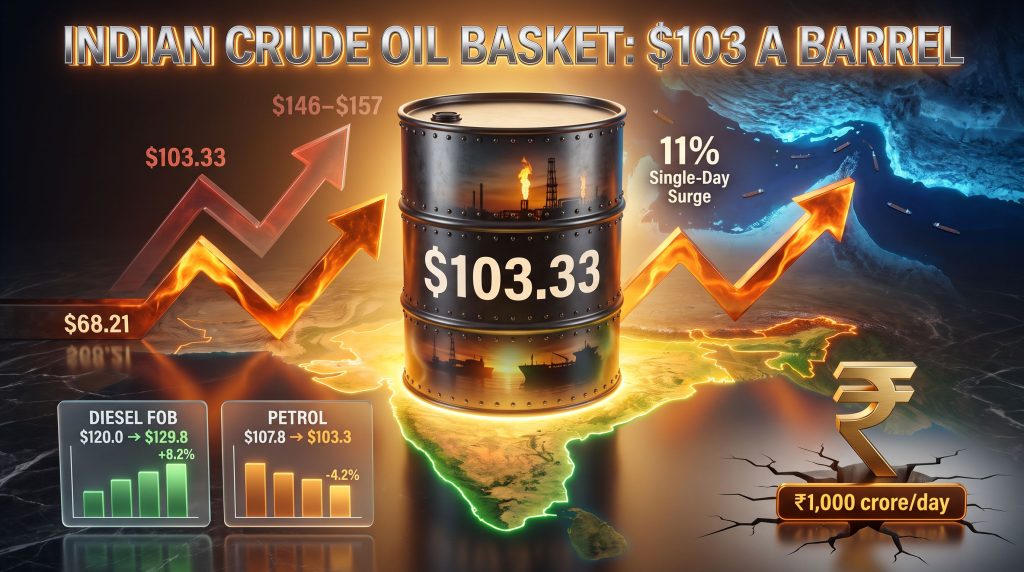
The Indian crude oil basket up 11% to $103 a barrel on July 25, 2026, serves as a sharp reminder of how exposed Asia's third-largest economy remains to supply route fragility. To understand what this number means, and what it portends, requires looking well beyond the headline figure. Furthermore, understanding the broader crude oil price trends provides essential context for interpreting this surge.
When big ASX news breaks, our subscribers know first
The Indian Crude Oil Basket: A Benchmark Built on India's Actual Import Reality
How the Basket Is Constructed and Why It Differs from Brent
Most casual observers assume crude oil prices are synonymous with Brent crude, the globally referenced benchmark quoted in financial media. For India, however, the relevant measure is structurally different. The Indian crude oil basket is a weighted average price calculated from the specific grades of crude that Indian refiners actually purchase, blending three regional benchmarks: Brent crude, Oman crude, and Dubai crude.
This composition matters because Oman and Dubai grades, which are heavier and sourer than Brent, are priced differently and serve different refinery configurations. Indian refineries, many of which were built or upgraded to process heavier Gulf grades, have limited short-term flexibility to switch to lighter Atlantic Basin alternatives when Persian Gulf supply tightens.
The Indian crude oil basket is not interchangeable with Brent crude. In periods of regional supply stress, the basket can trade at a meaningful premium to Brent because it captures freight cost pressures, regional supply tightness, and refinery-specific grade requirements that Brent pricing does not reflect.
Following extreme price volatility during earlier West Asian tensions in early 2026, India revised the basket's weighting formula in March 2026 to assign greater emphasis to Brent crude. This recalibration was designed to better reflect India's evolving import mix and to reduce the formula-driven amplification of regional price shocks. Whether this change has meaningfully dampened volatility remains a question worth examining, given that the basket still surged 11% in a single trading session on July 25.
Why International FOB Prices Add Another Layer of Pressure
A further complexity is that India's retail fuel prices are linked not directly to crude oil prices but to international FOB (free-on-board) product prices, which incorporate refining costs, freight charges, and marketing margins layered on top of raw crude. This structural relationship means that even a moderate crude price increase can translate into a disproportionately larger movement in the fuel prices that Indian consumers and businesses ultimately face. According to data tracked by PPAC, these international price movements are monitored closely to inform India's domestic fuel pricing decisions.
The July 2026 Price Surge: Anatomy of an 11% Single-Day Move
Dual Disruptions, Compounded Risk
The catalyst for the July 25 spike was not a single event but the convergence of two simultaneous supply disruptions:
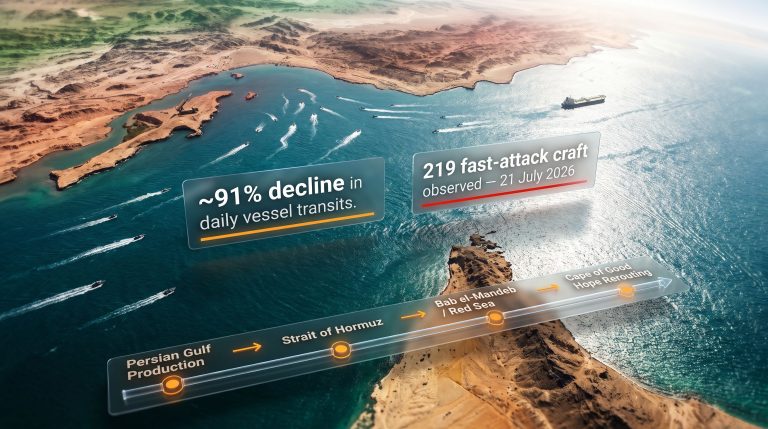
- The closure of the Strait of Hormuz, the narrow waterway connecting the Persian Gulf to the Gulf of Oman through which approximately 20% of global oil supply transits daily
- Houthi militia attacks on commercial shipping vessels in the Red Sea, raising freight insurance costs and forcing tankers to consider longer, more expensive alternative routes around the Cape of Good Hope
The significance of both corridors being threatened simultaneously cannot be overstated. The Strait of Hormuz is the exit point for crude exports from Saudi Arabia, Iraq, the UAE, Kuwait, and Iran. The Red Sea is a critical downstream transit route through which much of that crude reaches Asian refiners. When both are disrupted concurrently, Indian refiners face a supply squeeze from two directions at once. These geopolitical trade tensions are consequently reshaping the entire landscape of global energy supply chains.
The Price Trajectory in Context
| Date | Indian Basket Price (USD/barrel) | Key Development |
|---|---|---|
| July 3, 2026 | $68.21 | Pre-disruption baseline |
| July 25, 2026 | $103.33 | Strait of Hormuz closure + Red Sea attacks |
| March 2026 Peak | ~$146-$157 | West Asian conflict escalation |
The July 25 reading of $103.33 per barrel represented the highest basket price in two months and a rise of approximately 51% from the July 3 baseline of $68.21. Global benchmark Brent crude crossed $100 per barrel on Thursday before easing marginally to approximately $97.08 by Friday evening, confirming that the Indian basket was tracking, and in some respects exceeding, the broader market move.
It is important to contextualise this surge appropriately. While $103.33 is a significant and economically consequential level, it remains materially below the ~$146-$157 per barrel range recorded at the March 2026 peak. Nevertheless, as the under-recovery dynamics explored below make clear, $103 is more than sufficient to trigger serious fiscal and policy consequences for India.
Under-Recovery Dynamics: How $103 Oil Threatens India's Fuel Price Stability
The Mechanics of Under-Recovery for Indian OMCs
Under-recovery is a concept specific to India's partially regulated fuel pricing architecture. It represents the gap between what it costs an oil marketing company (OMC) to supply petrol or diesel at international parity pricing and the regulated retail price actually charged at the pump. When crude prices rise sharply but retail prices remain fixed, OMCs absorb the difference as a loss.
The May 2026 experience provides the most relevant recent benchmark. When the Indian basket averaged above $110 per barrel that month, OMCs were collectively incurring under-recoveries exceeding ₹1,000 crore per day. The government's response was to raise retail petrol and diesel prices by approximately ₹7.5 per litre over several days, which partially restored OMC margins but passed a significant cost burden to consumers.
At $103.33, the basket is approaching but has not yet reached the sustained $110+ level that triggered the May intervention. However, the trajectory matters as much as the absolute level. The broader oil price shock experienced by energy-dependent economies elsewhere offers instructive parallels for how quickly manageable pressures can escalate into full fiscal crises.
The Asymmetric Pressure Between Diesel and Petrol
A nuance often overlooked in headline coverage is that the FOB product price pressures for petrol and diesel are moving in opposite directions, creating an asymmetric policy challenge.
| Fuel Product | July 2026 Avg. FOB Price (USD/barrel) | June 2026 Avg. FOB Price (USD/barrel) | Month-on-Month Change |
|---|---|---|---|
| Diesel | $129.8 | $120.0 | +8.2% |
| Petrol | $103.3 | $107.8 | -4.2% |
Diesel FOB prices have risen sharply by 8.2% month-on-month while petrol FOB prices are actually 4.2% lower than in June. This divergence carries significant downstream implications. Diesel is the fuel of India's logistics networks, agricultural machinery, and industrial generators. Diesel-driven cost inflation propagates through the economy far more broadly than equivalent petrol price movements, affecting food supply chains, manufacturing input costs, and freight rates simultaneously.
When diesel prices rise while petrol prices fall, the inflationary impact on India's real economy is disproportionate to what aggregate fuel price indices might suggest. Logistics-dependent sectors such as food distribution, construction, and e-commerce bear the greatest exposure.
The Macro Inflation Cascade
The transmission pathway from crude oil basket to consumer price index follows a well-established sequence:
- Indian basket price rises sharply
- International FOB product prices for diesel surge
- OMC under-recoveries accumulate at pace
- Government faces pressure to raise retail pump prices
- Transport and logistics costs increase across the economy
- Food prices, manufactured goods, and services experience inflationary pass-through
- Headline CPI rises, complicating the Reserve Bank of India's monetary policy stance
The RBI has historically been sensitive to fuel-driven inflation given its persistence and its tendency to anchor inflation expectations. A sustained crude basket above $100 creates a difficult environment for monetary easing, even if other components of inflation remain subdued. In addition, the broader impact of tariffs on commodity markets is further complicating the global pricing environment that Indian policymakers must navigate.
The Lukoil Factor: A Compounding Risk on the August 22 Horizon
One of the least discussed but potentially most consequential variables in India's crude oil outlook is the Lukoil International GmbH sanctions timeline. According to a notice posted on the US Treasury Department's website, certain transactions involving Lukoil are permitted to continue only until August 22, 2026.
Following Western sanctions imposed on Russia after 2022, India significantly expanded its purchases of discounted Russian crude, with Lukoil-linked barrels becoming an important component of India's import mix. These volumes helped moderate the Indian basket price during periods of Gulf supply tightness, effectively providing a partial hedge against Persian Gulf disruption risk.
If Lukoil transaction permissions are not extended beyond August 22, Indian refiners could lose access to a meaningful volume of discounted supply at precisely the moment when Strait of Hormuz and Red Sea disruptions are already constraining Gulf alternatives. The compounding risk is significant, particularly given the ongoing trade war and oil markets dynamics that are simultaneously reshaping global crude flows.
If Lukoil-linked supply becomes unavailable to Indian refiners after August 22 and Persian Gulf disruptions persist into late July and August, the Indian crude oil basket could face upward pressure toward the $120-$130 range that characterised mid-2026 elevated pricing. This is not a baseline forecast but represents a plausible adverse scenario that merits close monitoring.
The above scenario involves speculative projections based on current geopolitical conditions. Readers should treat such forecasts as analytical frameworks rather than predictive certainties.
India's Policy Response Options: A Constrained Menu
Retail Price Adjustment and Its Political Limits
India's track record on fuel pricing reveals a consistent pattern of delayed adjustment followed by abrupt correction. The government tends to absorb under-recoveries through OMC balance sheets for as long as politically feasible, then implement price hikes in concentrated bursts. The May 2026 ₹7.5 per litre adjustment is a recent illustration of this pattern.
At current basket levels, the fiscal arithmetic is uncomfortable. Under-recovery rates approaching ₹1,000 crore per day are unsustainable over extended periods. Yet retail price hikes carry their own political cost, particularly when food inflation is already elevated and urban consumers are sensitive to pump price increases.
Strategic Petroleum Reserve Deployment
India maintains Strategic Petroleum Reserves (SPRs) at underground rock caverns in Visakhapatnam, Mangaluru, and Padur, with a combined capacity of approximately 5.33 million metric tonnes. Emergency SPR releases are typically considered when price shocks are acute and supply disruptions are assessed as short-duration events. At $103 per barrel, the case for SPR deployment is building but has not yet reached the threshold typically associated with emergency release decisions, which have historically been linked to more severe or prolonged disruptions.
Import Diversification: Structural Necessity, Short-Term Constraint
India has been actively pursuing crude import diversification, expanding engagement with US WTI suppliers, West African producers, and Latin American exporters. However, many Indian refineries were configured to process heavier, higher-sulphur Gulf crudes. Switching to lighter Atlantic Basin grades requires refinery modifications that cannot be executed quickly, limiting the pace at which diversification can serve as a genuine buffer against Persian Gulf supply shocks.
The next major ASX story will hit our subscribers first
Frequently Asked Questions
What is the Indian crude oil basket price and why did it reach $103?
The Indian crude oil basket is a weighted average price reflecting the actual blend of crude grades imported by India, incorporating Brent, Oman, and Dubai crude. On July 25, 2026, the Indian crude oil basket up 11% to $103 a barrel was driven by the closure of the Strait of Hormuz and Houthi militia attacks on Red Sea shipping, reaching $103.33 per barrel in a single session.
How is the Indian crude oil basket different from Brent crude?
Brent crude is a globally traded benchmark primarily reflecting North Sea oil. The Indian basket blends multiple grades weighted to India's actual import profile, including heavier Gulf grades. As a result, the basket can trade at a premium or discount to Brent depending on regional supply conditions, freight costs, and the specific crude grades Indian refiners require. Historical price data from NDTV illustrates how sharply geopolitical events have previously driven the basket to multi-month highs.
Will petrol and diesel prices increase in India following this crude surge?
Whether retail prices rise depends on how long the basket sustains elevated levels. In May 2026, when the basket averaged above $110 per barrel, OMC under-recoveries exceeded ₹1,000 crore per day and the government raised prices by ₹7.5 per litre. At $103, under-recovery pressure is building again. A sustained stay above $100-$105 would likely force a policy response, though the timing and magnitude of any adjustment remains a government decision.
What is under-recovery and why does it matter?
Under-recovery occurs when the cost of supplying fuel at international parity prices exceeds the regulated retail price charged to consumers. The difference is absorbed by oil marketing companies as a financial loss. At scale, these losses become fiscally unsustainable and either require government subsidy support or retail price corrections.
Key Takeaways: Three Layers of Risk for India's Energy Economy
The Indian crude oil basket up 11% to $103 a barrel on July 25, 2026, is best understood through three compounding risk layers rather than as a single headline event:
- Geopolitical supply disruption: The simultaneous closure of the Strait of Hormuz and Houthi attacks on Red Sea shipping have constrained India's two most critical crude import corridors at the same time, creating a supply squeeze that a highly import-dependent economy like India is structurally ill-equipped to absorb quickly.
- Domestic price and inflation pressure: FOB diesel prices averaging $129.8 per barrel in July are driving asymmetric cost pressures through India's logistics-dependent economy, with the ₹1,000 crore per day under-recovery benchmark from May 2026 providing a sobering reference point for what sustained $100+ basket prices mean in fiscal terms.
- The Lukoil deadline: The August 22 expiry of certain US Treasury permissions for Lukoil-linked transactions represents a near-term compounding risk that could simultaneously reduce India's access to discounted Russian crude at precisely the moment when Gulf supply routes are most constrained.
While $103 per barrel is meaningfully below the ~$150 levels recorded during the March 2026 peak, it sits well above the comfort zone for Indian OMC margins. For policymakers, the question is not whether a response will eventually be required, but how much fiscal cushion can be absorbed before retail prices must move again.
For India, energy market shocks have never been purely a commodity story. They are simultaneously a fiscal management challenge, a monetary policy constraint, a political economy calculation, and a structural vulnerability that decades of import dependence have baked into the economy's foundations. The $103 basket price is a reminder that all four dimensions activate at once.
This article contains forward-looking assessments and scenario analyses based on publicly available information as of July 25, 2026. Energy price projections involve inherent uncertainty and should not be construed as investment or financial advice. Readers are encouraged to consult current market data and professional advisers before making financial decisions.
For ongoing coverage of Indian oil and gas market developments, ET EnergyWorld at energy.economictimes.indiatimes.com provides detailed reporting and analysis on India's energy sector.
Want to Stay Ahead of the Next Major Commodity Market Shift?
Discovery Alert's proprietary Discovery IQ model scans ASX announcements in real time, delivering instant alerts on significant mineral discoveries — including those in energy commodities — so subscribers can identify actionable opportunities before the broader market reacts. Explore how historic discoveries have generated substantial returns and begin your 14-day free trial today to secure a market-leading edge.