June 15, 2026
The Industrial Waste Economy: How Secondary Streams Are Redefining Critical Mineral Supply
Across the global economy, trillions of tonnes of industrial residue sit in ponds, piles, and pipelines — quietly holding concentrations of lithium, cobalt, rare earth elements, and manganese that primary mining operations would consider commercially significant. The challenge has never been whether these materials exist within industrial waste streams. The challenge has always been whether extracting them is technically feasible and economically rational. In 2025, a convergence of rising critical minerals demand, maturing hydrometallurgical technology, and shifting regulatory frameworks is rapidly answering both questions in the affirmative.
Understanding how to exsolve critical minerals from industrial streams requires moving beyond the conventional mining mindset entirely. This is not about finding new ore bodies. It is about recognising that decades of industrial activity have already concentrated recoverable metals into accessible, continuous-flow feedstocks that sit at the intersection of environmental liability and commercial opportunity.
When big ASX news breaks, our subscribers know first
What Industrial Feedstocks Hold the Most Promise?
The range of industrial streams capable of yielding recoverable critical minerals is broader than most industry observers appreciate. Six major feedstock categories have emerged as the primary targets for recovery-focused processing:
| Feedstock Type | Key Recoverable Minerals | Industrial Source |
|---|---|---|
| Coal fly ash | Rare earth elements, gallium, germanium | Coal-fired power stations |
| Acid mine drainage (AMD) | Iron, manganese, cobalt, nickel, zinc | Legacy mining sites |
| Produced water and brines | Lithium, strontium, bromine, iodine | Oil and gas, geothermal wells |
| Mine tailings | REEs, titanium, copper, gold | Active and legacy mine sites |
| Phosphate process streams | Uranium, REEs, fluorine | Fertiliser manufacturing |
| Industrial wastewater | Nickel, chromium, manganese | Metal plating, smelting |
One critically underappreciated point is that the economic case for recovery from these streams does not depend solely on high commodity prices. It depends on the absence of costs that conventional mining cannot avoid: no drilling, no blasting, no ore haulage, no primary crushing. When those capital and operating cost categories are removed from the equation, the minimum viable concentration threshold for a commercially recoverable deposit drops considerably.
Furthermore, urban mining opportunities across built environments and legacy industrial sites are increasingly being recognised alongside these process stream recoveries, broadening the total addressable supply base significantly.
"The economic calculus for industrial stream recovery is structurally different from primary mining. The feedstock is already moving, already processed to some degree, and already accessible. What remains is a separation challenge, not a mining challenge."
Historically, regulatory frameworks cemented these streams in the "waste" category, creating permitting ambiguity and deterring investment. That classification is now being actively revised across the United States, European Union, and Australia, unlocking a significant pipeline of development activity that previously had no clear commercial pathway.
The Six Core Technologies Used to Exsolve Critical Minerals from Industrial Streams
Recovering minerals from dilute, chemically complex industrial feeds demands a layered technical approach. No single technology handles the full recovery challenge alone. Instead, leading practitioners sequence multiple methods to move target metals from trace concentrations in mixed-matrix feeds through to battery-grade or specification-grade mineral products.
1. Chemical Precipitation
pH adjustment or targeted reagent addition forces dissolved metal ions out of solution as solid precipitates. This method is widely deployed in acid mine drainage treatment and delivers cost-effective throughput at large volumes. Its principal limitation is selectivity: distinguishing between target metals and competing species requires additional downstream steps.
2. Ion Exchange
Functional resin beads selectively bind target metal ions from flowing solution, then release them in concentrated form during regeneration cycles. Ion exchange is particularly powerful for dilute streams including lithium-bearing brines and REE-containing leachates. Resin regeneration extends operational life and improves unit economics significantly at scale.
3. Membrane Filtration
Nanofiltration and reverse osmosis membranes physically separate dissolved species by molecular size and ionic charge. These systems are most valuable as pre-concentration stages before solvent extraction or ion exchange, reducing the volume of material requiring expensive downstream processing. Research into divalent metal ion separation from complex aqueous matrices using nanofiltration membranes has shown particularly strong results in recent years.
4. Adsorption Technologies
Activated carbon, zeolites, and functionalised nanomaterials selectively bind target metals from large-volume, low-concentration streams. A less widely known development in this space is the growing application of biosorbents derived from algae and agricultural waste derivatives. These materials offer potentially significant cost advantages for trace REE recovery from high-volume industrial effluent where conventional adsorbents would be economically prohibitive.
5. Solvent Extraction
Liquid-liquid extraction transfers metal species from an aqueous phase into an organic solvent phase, enabling separation of target metals from complex multi-species matrices. Solvent extraction is the industry standard for copper, cobalt, and nickel refining and is being adapted for REE separation from phosphogypsum and fly ash leachates. Careful solvent management is essential to prevent secondary contamination of the treated aqueous stream.
6. Electrochemical Treatment
Electrodeposition, electrocoagulation, and electrodialysis deliver high-purity metal recovery with reduced chemical reagent consumption compared to wet chemistry alternatives. Of particular commercial interest is the capacity to produce battery-grade metal powders and oxides directly from process streams, skipping several intermediate refining steps that would otherwise add cost and complexity.
| Technology | Best Feedstock Match | Output Form | Scalability |
|---|---|---|---|
| Chemical precipitation | AMD, industrial wastewater | Metal hydroxides, salts | High |
| Ion exchange | Brines, leachates, produced water | Concentrated eluates | Medium to High |
| Membrane filtration | Saline streams, produced water | Pre-concentrated solutions | High |
| Adsorption | Dilute aqueous streams, REE leachates | Loaded sorbent to eluate | Medium |
| Solvent extraction | Complex multi-metal feeds | High-purity metal solutions | High |
| Electrochemical | Plating wastewater, process streams | Metal powders, oxides | Medium |
"In practice, the most commercially viable recovery systems combine multiple technologies in sequence. A common architecture involves membrane pre-concentration, followed by ion exchange capture, followed by solvent extraction refining. This stacked approach handles complex, multi-metal industrial feeds in ways that no single-technology system can replicate economically."
The Concentration Challenge: A Factor That Separates Industrial Stream Recovery from Conventional Mining
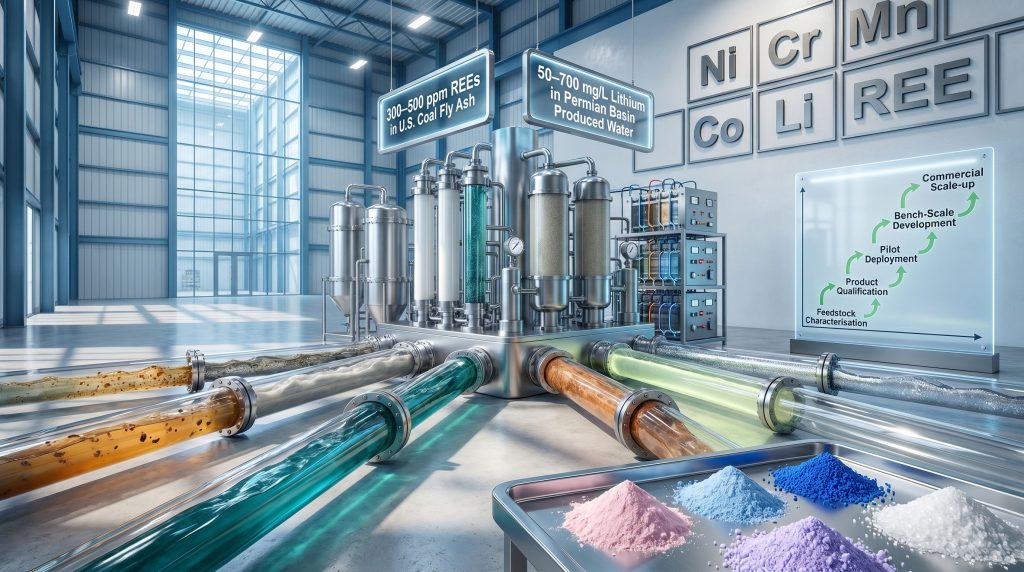
One of the most significant technical barriers that practitioners must address when attempting to exsolve critical minerals from industrial streams is the concentration problem. Industrial streams routinely carry target minerals at concentrations far below what would constitute an economically mineable ore grade in a conventional deposit. For context, U.S. Department of Energy NETL research identifies REE concentrations in coal combustion residuals averaging 300 to 500 parts per million across major U.S. coal basins. Permian Basin produced water lithium concentrations range from 50 to 700 milligrams per litre depending on the specific formation and operator.
These figures are not trivial in isolation, but they present real processing challenges:
- Target minerals are dissolved or entrained within complex matrices containing multiple competing species
- Seasonal and operational variability in stream composition affects process stability and product consistency
- High water volumes must be processed to recover commercially meaningful quantities of target minerals
- Energy costs for high-throughput membrane and electrochemical systems can erode unit economics if not carefully managed
Pre-concentration is therefore a prerequisite for downstream refining viability, not an optional upgrade. Projects that attempt to apply solvent extraction or ion exchange directly to raw, unconditioned industrial feeds without adequate pre-concentration typically encounter rapid deterioration in selectivity, reagent consumption, and product quality.
From Pilot to Commercial Scale: The Five-Stage Development Pathway
The pathway from initial stream assessment to commercial mineral production follows a structured progression that differs meaningfully from conventional mine development timelines and capital profiles.
Stage 1: Feedstock Characterisation
Comprehensive chemical analysis of the target industrial stream establishes metal concentrations, competing ion matrices, pH ranges, temperature profiles, and volumetric flow rates. Critically, this stage must also address regulatory classification: whether the stream is treated as waste, byproduct, or secondary mineral resource under the applicable jurisdiction determines the permitting pathway and liability structure for the entire project.
Stage 2: Bench-Scale Process Development
Laboratory testing of candidate recovery technologies against representative stream samples identifies the optimal technology sequence. Selectivity testing is particularly important where target metals must be separated from chemically similar competing species, such as lithium versus sodium in brine streams or individual REEs within complex leachate matrices.
Stage 3: Pilot Facility Deployment
Modular pilot units are constructed to process representative stream volumes under real operating conditions. This stage validates recovery rates, reagent consumption, and product specifications against the bench-scale predictions. U.S.-based pilot operations targeting mineral powder production from industrial feedstocks at facilities including Detroit-based processing sites represent the current commercial frontier at this development stage.
Stage 4: Product Qualification and Offtake Development
Recovered mineral products must meet specification requirements for downstream buyers including battery manufacturers, alloy producers, and chemical processors. This qualification process is frequently underestimated in project planning timelines. Battery manufacturers in particular apply rigorous product specification testing before committing to offtake arrangements.
Stage 5: Commercial Scale-Up
Engineering scale-up from pilot throughput to full commercial volumes requires integration with host industrial facility operations. The guiding design principle for well-structured projects is zero operational disruption to the host facility, positioning the recovery module as an additive revenue stream rather than an operational complication.
Target Minerals and Their Highest-Value Recovery Pathways
Lithium
Produced water from North American oil and gas operations represents one of the most immediately actionable lithium recovery opportunities globally. Some Permian Basin brines carry lithium at concentrations sufficient to make commercial recovery viable at scale, with direct lithium extraction technology increasingly capable of processing these highly saline, complex-matrix feeds. Geothermal brines in the western United States, Iceland, and the Salton Sea region of California carry lithium concentrations that have attracted substantial investment in DLE technology deployment.
Rare Earth Elements
Coal fly ash generated by U.S. coal-fired power stations contains REE concentrations that NETL-linked research programmes have consistently identified as commercially significant at aggregate processing volumes. Phosphogypsum, a byproduct of phosphate fertiliser manufacturing, represents another high-volume REE-bearing stream where recovery economics improve significantly as processing scale increases.
A less commonly understood aspect of phosphogypsum is that it also contains recoverable uranium, creating a dual-commodity recovery opportunity that materially improves project economics in high-volume processing scenarios.
Nickel, Cobalt, and Manganese
High-pressure acid leach operations treating nickel laterite ores generate raffinate streams containing residual nickel and cobalt concentrations that are frequently vented or neutralised without recovery. Industrial wastewater from electroplating and metal smelting operations carries recoverable concentrations of nickel, chromium, and manganese suited to electrochemical or ion exchange capture. Tailings storage facility supernatant, particularly at older operations without modern containment engineering, represents a continuous low-cost recovery opportunity that simultaneously addresses environmental compliance obligations.
In addition, the battery recycling process is generating increasingly significant volumes of secondary nickel, cobalt, and manganese streams that intersect directly with industrial stream recovery methodologies.
The next major ASX story will hit our subscribers first
ESG and Environmental Advantages: The Dual-Value Proposition
The environmental case for recovering minerals from industrial streams is frequently underweighted in financial analysis, even though it directly affects project economics through liability reduction and ESG premium valuation.
Key environmental advantages include:
- Reducing the volume and toxicity of industrial waste requiring long-term containment and monitoring
- Converting AMD treatment obligations from pure cost centres into net-revenue operations
- Achieving significantly lower carbon intensity per tonne of recovered mineral compared to primary mining, as no open-pit blasting, ore haulage, or primary crushing is required
- Generating clean water outputs alongside mineral recovery in wastewater treatment applications, creating dual compliance value
- Supporting Scope 3 emissions reduction targets for downstream manufacturers seeking lower-carbon mineral supply chains
Life cycle assessment studies across multiple recovery technologies and feedstock types consistently demonstrate lower carbon dioxide equivalent emissions per unit of recovered critical mineral from secondary streams compared to equivalent primary mining production. This is not a marginal advantage in the current ESG investment environment. It is a structurally differentiated value proposition that affects offtake pricing, financing terms, and institutional investor eligibility.
Policy Frameworks Shaping the Sector
The U.S. Department of Energy's Critical Minerals and Materials programme, administered through NETL, has explicitly targeted extraction from coal fly ash, acid mine drainage, produced waters, and mineral-processing streams as priority development pathways for domestic mineral supply security. Funded pilot-scale projects have advanced recovery from industrial facilities and legacy waste sites toward commercial-scale mineral production.
Internationally, the European Union's critical raw materials transition agenda includes provisions that encourage recovery from mining waste and industrial byproducts as part of the EU's target to source at least 10% of annual critical mineral consumption domestically. Australia's Critical Minerals Strategy similarly acknowledges secondary and unconventional sources as components of the national resource inventory, and further detail on Australia's export finance framework for critical minerals illustrates how government-backed mechanisms are being aligned with these priorities.
"The reclassification of industrial byproducts from regulated waste to secondary mineral resources is among the most consequential policy shifts currently active in the critical minerals sector. It does not simply improve project economics: it changes the fundamental legal and investment architecture of industrial stream recovery."
This reclassification trend is particularly significant for legacy industrial site operators carrying long-term environmental remediation liabilities. A tailings facility or AMD drainage system that previously represented a net-cost environmental obligation can be repositioned as a permitted secondary mineral production asset under revised regulatory frameworks, fundamentally altering the balance sheet treatment of those assets.
The Strategic Outlook: A Three-Phase Transition
| Time Horizon | Key Developments |
|---|---|
| 2025 to 2030 | Scale-up of lithium recovery from North American produced water; REE extraction from coal ash at DOE-supported facilities; AMD metal recovery expansion |
| 2030 to 2040 | Industrial stream recovery integrated into battery supply chain planning; mineral recovery modules embedded in new industrial facility designs |
| 2040 and beyond | Secondary recovery contributing a meaningful share of global critical mineral supply; no industrial process stream treated as purely waste |
The long-term structural trajectory points toward a critical minerals economy in which industrial operators simultaneously function as mineral producers, environmental remediation managers, and ESG-credentialed supply chain partners. Companies that develop the technical capability and regulatory relationships to exsolve critical minerals from industrial streams today are positioning for a supply chain role that will carry considerable strategic value as primary mineral supply constraints intensify through the 2030s.
Key Reference Data
| Metric | Data Point | Source Context |
|---|---|---|
| REE concentration in U.S. coal fly ash | 300 to 500 ppm average | DOE NETL research programme |
| Lithium in Permian Basin produced water | 50 to 700 mg/L (site-dependent) | U.S. produced water studies |
| EU domestic processing target under CRMA | 10% of annual consumption | EU Critical Raw Materials Act |
| Core hydrometallurgical recovery methods | 6 primary technologies | Technical literature |
| Primary industrial feedstock categories | 6 major stream types | DOE and academic research |
Disclaimer: This article contains forward-looking statements and projections relating to technology development timelines, commodity markets, and regulatory trends. These reflect current analysis and publicly available research and should not be construed as financial or investment advice. All investment decisions should be made with reference to independent professional advice and current market conditions.
Want to Stay Ahead of the Next Major Critical Minerals Discovery?
Discovery Alert's proprietary Discovery IQ model scans ASX announcements in real time, instantly identifying significant mineral discoveries across lithium, rare earths, cobalt, and manganese — the very commodities reshaping the critical minerals supply chain. Explore how historic discoveries have generated substantial returns or start your 14-day free trial today to position yourself ahead of the broader market.