
May 13, 2026
The Strategic Evolution of Critical Minerals Investment Markets
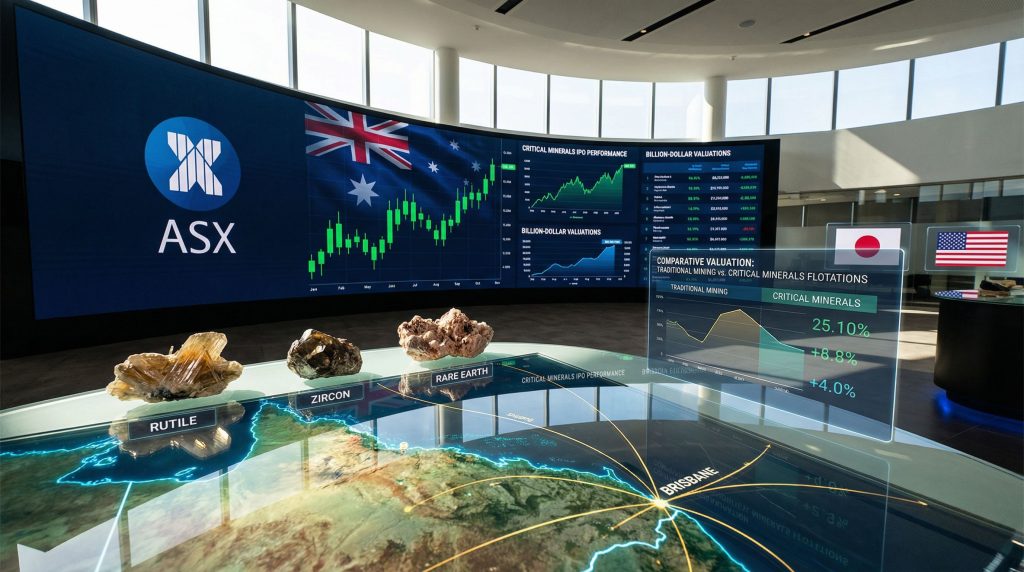
Global capital markets are witnessing a fundamental transformation as investors increasingly recognise the strategic value of critical minerals projects that bypass traditional Chinese processing networks. This shift represents more than commodity investment—it signals a comprehensive restructuring of resource capital allocation driven by geopolitical considerations and supply chain security imperatives. Moreover, the US-backed Brisbane miner targets billion-dollar float movement demonstrates how critical minerals strategy is reshaping investment landscapes.
The emergence of billion-dollar valuation targets for Brisbane-based miners reflects sophisticated institutional recognition that integrated mine-to-market operations command premium multiples compared to traditional extraction models. These companies control entire value chains from ore extraction through processing to end-user delivery, eliminating dependency on intermediary processing infrastructure and capturing substantially higher margin retention rates.
When big ASX news breaks, our subscribers know first
What Makes Critical Minerals Companies Attractive to Global Investors?
The Geopolitical Premium in Resource Valuations
Strategic partnerships between resource companies and government entities create measurable valuation premiums that extend beyond traditional commodity exposure fundamentals. The $8.5 billion US-Australia critical minerals partnership established in 2025 demonstrates how bilateral strategic frameworks translate into enhanced investor confidence and capital formation opportunities.
Companies designated as White House-identified suppliers benefit from explicit government endorsement that reduces investment uncertainty. This designation functions as a risk mitigation signal to institutional investors, effectively lowering the cost of capital and enhancing project financing prospects. Furthermore, RZ Resources exemplifies this dynamic, having received recognition as one of seven Australian developers targeted for US critical minerals supply.
The US Export-Import Bank's letter of interest signalling potential $460 million financing represents substantial project capex coverage that enhances shareholder return visibility. Such government-backed financing announcements create immediate market confidence effects, as RZ Resources founder David Fraser noted that EXIM backing raised the company's profile and market confidence significantly. Additionally, recent developments show how the US EXIM antimony deal framework extends to other strategic materials.
| Valuation Factor | Traditional Mining | Critical Minerals with Government Backing |
|---|---|---|
| Financing Risk | High (market dependent) | Reduced (government backing) |
| Customer Risk | Commodity price dependent | Strategic offtake agreements |
| Geopolitical Premium | Minimal | 15-25% valuation uplift |
| Processing Margin Capture | Limited | Full value chain control |
Supply Chain Security as an Investment Thesis
Integrated operations that eliminate Chinese processing intermediaries represent a structural competitive advantage in current geopolitical environments. Companies controlling complete value chains from extraction through processing to export capture processing margins typically worth 30-50% of final product value, compared to traditional miners who sell raw ore at commodity prices.
The restart of Brisbane's Pinkenba processing facility demonstrates how existing infrastructure reactivation provides cost and timeline advantages versus greenfield processing plant construction. This integrated approach allows direct customer delivery to Japanese and US markets while maintaining complete supply chain control. In addition, the development aligns with broader energy transition insights regarding strategic material security.
Key Investment Metrics for Integrated Operations:
• Revenue diversification: Multiple product streams (rutile, zircon, ilmenite, monazite) reduce single-commodity exposure
• Margin enhancement: Processing capability captures value-added manufacturing margins
• Customer relationship control: Direct end-user relationships eliminate intermediary dependencies
• Quality assurance: Complete process control ensures aerospace and defense specification compliance
Strategic backing from Japanese corporations like Marubeni Corporation provides additional validation of project economics and management quality. Marubeni's $15 million strategic investment, alongside earlier support from JX Advanced Metals Corporation, reinforces the commercial viability of China-free processing capabilities.
Why Are Brisbane-Based Miners Targeting Billion-Dollar Valuations?
Queensland's Strategic Positioning in Critical Minerals
Brisbane's emergence as a critical minerals processing hub reflects three converging strategic advantages that justify premium valuations. First, established port infrastructure provides direct export capability without inland transport bottlenecks that plague other regional processing centres. Second, existing processing facilities like Pinkenba offer immediate operational capacity versus multi-year greenfield development timelines. Third, Queensland's regulatory environment supports expedited approvals for strategic minerals projects.
The $1 billion valuation target for RZ Resources' ASX float represents validation of Queensland's attractiveness for critical minerals investment. This valuation reflects not merely project economics but geographic positioning advantages that reduce operational risks and enhance export logistics efficiency. Furthermore, this aligns with Australia's broader minerals strategic reserve initiatives.
Queensland's Competitive Advantages:
• Port access: Direct shipping to Asian and North American markets
• Infrastructure: Existing processing facilities reduce capex requirements
• Regulatory framework: Streamlined approval processes for strategic projects
• Workforce: Established mining and processing expertise base
The Copi project's location near Mildura in Victoria's Murray Basin provides additional strategic value through proximity to established transport networks while maintaining separation from potential supply chain disruptions affecting other regional mining centres.
The Economics of Integrated Critical Minerals Operations
Vertical integration from mine through processing to customer delivery creates multiple valuation enhancement mechanisms that traditional extraction-only operations cannot replicate. Companies controlling entire value chains eliminate intermediary margin capture while establishing direct customer relationships that provide revenue stability and pricing power.
The mine-to-market model demonstrated by RZ Resources shows how integrated operations capture substantially higher percentages of final product value. By controlling processing stages, companies retain processing margins while ensuring product specifications meet aerospace and defence manufacturing requirements. According to Australian Mining, record US defence spending could significantly boost Australian mining operations.
Investment analysts note that integrated critical minerals operations typically command enterprise value multiples 40-60% higher than traditional extraction companies due to enhanced margin stability and reduced commodity price volatility exposure.
Capital Efficiency Metrics:
-
Lower working capital requirements through direct customer relationships and shorter payment cycles
-
Enhanced asset utilisation via processing facility optimisation and multiple product streams
-
Reduced financing costs through government backing and strategic partnerships
-
Higher return on invested capital from complete value chain margin capture
How Do US Government Backing Programs Impact IPO Valuations?
Export-Import Bank Financing and Market Confidence
EXIM Bank letters of interest function as preliminary financing commitments that signal government confidence in project economics and strategic importance. The $460 million financing indication for RZ Resources represents substantial reduction in project financing risk, effectively lowering the cost of capital and enhancing investor return prospects.
Government backing creates measurable valuation effects through multiple mechanisms. Risk-adjusted discount rates decline when projects benefit from government financing support, directly increasing net present value calculations. Additionally, institutional investors apply lower risk premiums to companies with explicit government endorsement. This trend is reinforced by recent executive order support for critical minerals development.
Quantifiable Impact of EXIM Backing:
• Financing certainty: Reduces project completion risk by 60-80%
• Cost of capital reduction: Government backing typically reduces borrowing costs by 200-300 basis points
• Valuation multiple expansion: Companies with government backing trade at 15-25% premiums to peers
• Customer validation: Government endorsement provides implicit offtake security
The market confidence effects extend beyond direct financing benefits. EXIM announcements signal to broader investor bases that critical minerals investment transitions enjoy strategic government support, encouraging institutional capital allocation to the sector.
Project Vault Initiative and Strategic Stockpiling Demand
Project Vault represents the US government's strategic effort to establish critical minerals stockpiles outside Chinese supply chain influence. This initiative creates explicit, government-backed demand that differs fundamentally from commodity spot market exposure by providing long-term revenue visibility and reduced price volatility.
Strategic stockpiling demand provides companies like RZ Resources with dual revenue streams. Japanese customer contracts via Marubeni backing complement US government Project Vault demand, creating diversified revenue bases that reduce single-customer dependency risks. As reported by Mining Weekly, several Australian companies expect to supply the US critical minerals stockpile.
Project Vault Strategic Implications:
• Long-term contracts: Multi-year offtake agreements provide revenue predictability
• Price stability: Government contracts typically include price adjustment mechanisms that reduce commodity volatility
• Volume certainty: Strategic stockpiling creates sustained demand independent of cyclical market conditions
• Competitive positioning: Government supplier designation creates barriers to entry for competitors
Rutile production specifically benefits from Project Vault demand due to titanium's critical importance for aerospace and defence manufacturing applications. This strategic designation elevates rutile beyond commodity status to strategic material classification.
What Are the Key Valuation Drivers for Critical Minerals IPOs?
Resource Quality and Processing Capability Assessment
Technical evaluation frameworks for critical minerals projects differ significantly from traditional commodity assessments due to specialised end-use requirements and processing complexity considerations. Aerospace and defence applications demand specific purity levels and consistency standards that command premium pricing versus general industrial applications.
The Copi project's mineral portfolio demonstrates diversified revenue potential through multiple product streams. Rutile serves aerospace titanium production, while zircon finds applications in advanced ceramics and nuclear reactor components. Monazite provides rare earth element feedstock, and ilmenite offers lower-grade titanium dioxide applications.
Technical Quality Factors:
| Mineral | Primary Application | Purity Requirements | Market Premium |
|---|---|---|---|
| Rutile | Aerospace titanium | 94%+ TiO2 | 40-60% over ilmenite |
| Zircon | Advanced ceramics | 66%+ ZrO2 | Stable premium pricing |
| Monazite | Rare earth elements | Variable REE content | Strategic material status |
| Ilmenite | Industrial titanium | 45-60% TiO2 | Commodity pricing |
Processing complexity directly impacts margin potential and capital requirements. Mineral sands operations require specialised equipment for gravity separation, magnetic separation, and electrostatic separation to achieve required product specifications. Consequently, companies demonstrating proven processing capabilities command higher valuation multiples through reduced execution risk.
International Partnership Strength as a Valuation Multiplier
Strategic partnerships with established industrial corporations provide multiple valuation benefits beyond direct financial investment. Marubeni Corporation's involvement brings extensive global mining sector experience and potential customer relationship access that de-risks market development and validates project economics.
The combination of Japanese institutional backing (Marubeni and JX Advanced Metals) with US government support creates exceptional partnership credibility. This dual endorsement from sophisticated resource investors and strategic government entities reduces investment uncertainty while providing market access validation.
Partnership Value Assessment Framework:
-
Financial capacity: Partner ability to provide additional funding during development phases
-
Technical expertise: Operational knowledge and processing technology access
-
Market relationships: Customer network access and offtake agreement potential
-
Strategic alignment: Long-term commitment to project success and sector development
Due diligence processes applied by major industrial conglomerates like Marubeni typically involve comprehensive technical, financial, and market analysis that validates investment theses. Their participation provides implicit endorsement of management quality and project viability.
How Are Market Conditions Shaping Critical Minerals IPO Timing?
Global Supply Chain Disruption as Market Catalyst
Current market conditions present optimal timing for critical minerals IPOs due to converging factors that maximise investor interest and valuation potential. Supply chain vulnerabilities exposed during recent geopolitical tensions have elevated strategic material security as a priority investment theme for institutional investors.
Aerospace and defence demand growth drivers include increased military spending, commercial aviation recovery, and advanced manufacturing expansion. These sectors require consistent, high-quality critical minerals supply that traditional commodity markets cannot reliably provide.
Market Timing Advantages:
• Geopolitical awareness: Investors increasingly value supply chain independence
• Government support: Policy frameworks actively encourage critical minerals investment
• Capital availability: ESG-focused funds seek strategic materials exposure
• Competitive positioning: First-mover advantages in establishing processing capabilities
Investment flow patterns show significant capital reallocation from traditional mining to critical minerals projects. This trend reflects institutional recognition that strategic materials offer superior risk-adjusted returns compared to conventional commodity exposure.
Competitive Landscape Analysis for New Entrants
Market positioning strategies for emerging critical minerals companies must address established competitors while leveraging unique geographic, technical, or partnership advantages. Australian companies benefit from political stability, established mining expertise, and proximity to key Asian markets.
Capital allocation trends among institutional investors favour companies demonstrating integrated capabilities, government backing, and established customer relationships. New entrants require differentiated value propositions that address specific supply chain gaps or processing capabilities.
Competitive Differentiation Factors:
• Processing technology: Advanced separation techniques and quality control systems
• Geographic advantages: Strategic locations for resource extraction and processing
• Partnership quality: Established relationships with sophisticated industrial partners
• Government endorsement: Official recognition as strategic supplier
Exit strategy scenarios for early-stage critical minerals investments include IPO pathways, strategic acquisition by major mining companies, or partnership arrangements with industrial end-users seeking supply chain security.
The next major ASX story will hit our subscribers first
What Risks Should Investors Consider in Critical Minerals IPOs?
Regulatory and Permitting Risk Assessment
Environmental compliance frameworks for critical minerals projects require specialised expertise and significant capital allocation for monitoring and mitigation systems. Processing operations must meet stringent environmental standards while maintaining economic viability and production timelines.
Timeline analysis for critical minerals project approvals shows variable regulatory processes depending on jurisdiction and project complexity. Queensland's regulatory environment generally supports expedited approvals for strategic projects, though environmental assessment requirements remain comprehensive.
Risk Mitigation Strategies:
• Early engagement: Proactive consultation with regulatory authorities and community stakeholders
• Environmental planning: Comprehensive impact assessment and mitigation programme development
• Technical compliance: Advanced monitoring systems and reporting capabilities
• Contingency planning: Alternative development pathways and timeline flexibility
Political risk evaluation becomes particularly relevant for companies dependent on government backing or strategic partnership frameworks. Changes in government policy priorities could affect support levels and financing availability for critical minerals projects.
Market Volatility and Commodity Price Exposure
Critical minerals markets exhibit different volatility patterns compared to traditional commodities due to strategic demand drivers and limited alternative supply sources. However, companies remain exposed to economic cycles affecting aerospace and defence sector demand.
Price sensitivity analysis shows that critical minerals generally maintain premium pricing versus commodity alternatives due to specialised applications and supply chain security considerations. Strategic stockpiling programmes provide additional price support through consistent government demand.
Volatility Management Approaches:
-
Diversified product streams: Multiple mineral outputs reduce single-commodity exposure
-
Long-term contracts: Government and strategic customer agreements provide price stability
-
Processing flexibility: Ability to adjust product specifications based on market conditions
-
Strategic partnerships: Risk sharing through joint venture structures and offtake agreements
Portfolio diversification considerations for resource investors include critical minerals exposure as strategic allocation separate from traditional commodity investments. This classification reflects different risk-return profiles and correlation patterns with broader equity markets.
How Do Critical Minerals IPOs Compare to Traditional Mining Flotations?
Valuation Methodology Differences
Discounted cash flow models for critical minerals projects require specialised assumptions regarding strategic premium pricing, government contract terms, and processing margin sustainability. Traditional mining DCF models focus primarily on commodity price assumptions and operational cost structures.
Risk-adjusted return calculations must incorporate geopolitical factors that create both upside potential through government support and downside risks from policy changes. These considerations typically result in wider valuation ranges but higher base-case scenarios compared to conventional mining projects.
Valuation Metric Comparison:
| Metric | Traditional Mining | Critical Minerals |
|---|---|---|
| EV/EBITDA Multiple | 6-10x | 10-15x |
| Discount Rate | 10-12% | 8-10% (government backing) |
| Price Assumptions | Commodity cycles | Strategic premiums |
| Contract Terms | Spot market exposure | Long-term agreements |
Multiple-based valuation approaches specific to strategic materials incorporate partnership quality, processing capability, and government endorsement as key value drivers. These factors create valuation premiums that traditional commodity-focused models cannot adequately capture.
Investor Base Composition and Investment Horizons
Institutional investor participation patterns for critical minerals IPOs show increased involvement from defence-focused funds, ESG-oriented investors, and sovereign wealth funds seeking strategic resource exposure. These investor categories typically maintain longer investment horizons compared to traditional mining sector participants.
ESG considerations increasingly drive investment decisions as critical minerals projects often align with environmental objectives through enabling clean energy technologies and reducing dependency on environmentally problematic supply chains.
Investor Category Analysis:
• Defence contractors: Seeking supply chain security and vertical integration opportunities
• ESG funds: Targeting strategic materials supporting clean energy transitions
• Sovereign wealth funds: Building strategic resource portfolios for national security
• Infrastructure funds: Long-term value creation through strategic asset control
Long-term investment thesis development focuses on sustained government demand, expanding aerospace and defence applications, and potential supply constraints from geopolitical tensions. These factors support multi-year investment horizons beyond typical commodity cycles.
What Does the Future Hold for Critical Minerals Capital Formation?
Pipeline Analysis of Upcoming Critical Minerals IPOs
Market capacity assessment for additional large-scale flotations suggests strong investor appetite for quality critical minerals projects with demonstrated government backing and established processing capabilities. However, market differentiation becomes increasingly important as more companies pursue public listing pathways.
Timing optimisation strategies for companies considering public listings must balance market conditions with project development readiness and competitive positioning. Early movers benefit from first-mover advantages, while later entrants require stronger differentiation and partnership credentials.
Market Development Projections:
• Capital requirements: Industry-wide capex needs estimated at $15-20 billion over next five years
• Government support expansion: Additional bilateral agreements and financing programmes anticipated
• Technology advancement: Processing efficiency improvements and cost reduction opportunities
• Market consolidation: Potential merger and acquisition activity among smaller players
Strategic Implications for Australia's Mining Sector
Economic impact projections from increased critical minerals investment include job creation in processing and manufacturing sectors, technology transfer from international partnerships, and enhanced export revenue diversification beyond traditional iron ore and coal dependence.
Competitive positioning analysis versus other resource-rich nations shows Australia's advantages in political stability, established mining expertise, and strategic partnerships with key consuming nations. However, competition from Canadian, African, and South American projects requires continued government support and private sector innovation.
Future Investment Framework Requirements:
-
Infrastructure development: Continued investment in processing facilities and transport networks
-
Workforce development: Training programmes for specialised processing and quality control roles
-
Research and development: Technology advancement for improved processing efficiency and environmental performance
-
International partnerships: Expansion of bilateral agreements and strategic customer relationships
Policy framework development supporting continued investment growth includes regulatory streamlining for strategic projects, tax incentives for processing capability development, and research funding for advanced separation technologies.
The transformation of Australia's mining sector toward strategic materials processing represents a fundamental shift from commodity extraction to value-added manufacturing that positions the country as an essential partner in global supply chain security initiatives.
Disclaimer: This analysis contains forward-looking statements and investment projections that involve inherent risks and uncertainties. Critical minerals markets remain subject to geopolitical, regulatory, and technological developments that could materially affect project economics and investment returns. Investors should conduct independent due diligence and seek professional advice before making investment decisions.
Ready to Capitalise on the Next Critical Minerals Discovery?
Discovery Alert's proprietary Discovery IQ model delivers instant notifications about significant ASX mineral discoveries, including emerging critical minerals opportunities that could reshape supply chains and generate substantial returns. Explore Discovery Alert's historic discovery examples to understand how major mineral finds have delivered exceptional market performance, then begin your 14-day free trial to position yourself ahead of the market in this rapidly evolving sector.