June 20, 2026
The Supply Chain Sovereignty Thesis Reshaping Global Mining Capital
For most of the past two decades, mining M&A operated on a relatively simple premise: bigger reserves, lower costs, and longer mine lives attracted the most capital. Geological quality and operational efficiency were the primary languages buyers and sellers spoke. That framework has not disappeared, but it is no longer sufficient to explain what is happening across Latin America right now.
A more complex set of motivations is driving the current wave of deal activity. Strategic acquirers are not simply chasing production growth. They are competing to control specific points in global supply chains, lock in jurisdictional exposure ahead of permitting windows that may close, and position themselves within geopolitical alignment frameworks that are increasingly shaping who gets access to financing, offtake agreements, and long-term industrial partnerships.
The result is that critical minerals in Latin American mining M&A have moved from a secondary theme to a primary deal driver in a remarkably short period of time.
When big ASX news breaks, our subscribers know first
How the Deal Logic Has Fundamentally Changed
Traditional mining acquisitions in Latin America were anchored in tangible, measurable variables: reserve tonnage, strip ratios, cash cost per pound, and infrastructure proximity. The asset was the investment.
Today's critical minerals deals involve a different calculus entirely. Acquirers are paying premiums for three things that do not always show up in a discounted cash flow model:
- Jurisdictional control over assets located in politically aligned, Western-accessible territories
- Processing optionality, meaning the ability to develop downstream refining capacity within the asset's host country rather than relying on Asian processing networks
- Geopolitical alignment value, the implicit premium attached to assets that qualify for Western government co-investment, offtake facilitation, or development finance participation
This shift reflects three structural forces converging simultaneously. Critical minerals demand is accelerating faster than new supply can be permitted and constructed. Western governments are actively incentivising diversification away from Asia-dominant processing networks, particularly for rare earths, lithium, and battery-grade nickel. Furthermore, permitting timelines in North America, Europe, and Australia have become so extended that Latin American assets with existing environmental approvals carry an enormous time-to-market advantage.
Critical minerals M&A in Latin America is no longer purely a mining story. It is a supply chain sovereignty story, with acquirers as motivated by what they are locking out of competitor hands as by what they are securing for themselves.
Latin America's Share of Global Mining M&A: What the Numbers Actually Mean
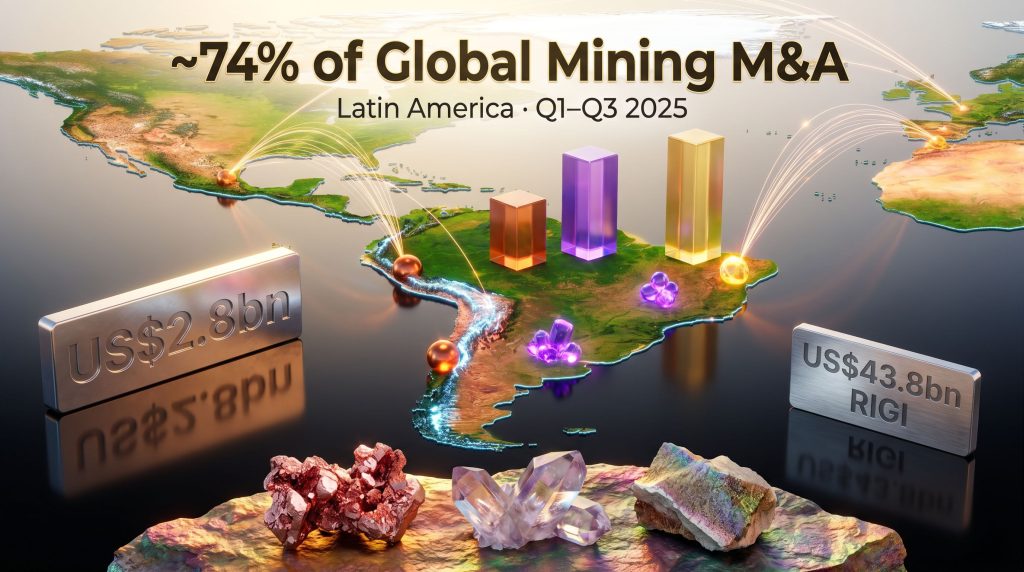
The headline figure is striking. Latin America accounted for approximately 74% of global mining M&A value in the first three quarters of 2025. For context, no single region has historically commanded this proportion of global deal value for an extended period without reflecting either a commodity supercycle or a structural realignment of capital.
This is the latter.
| Metric | Data Point |
|---|---|
| Latin America's share of global mining M&A value (Q1-Q3 2025) | ~74% |
| Primary driver by deal value | Copper |
| Fastest-growing deal category | Rare earths and lithium |
| Most active country for critical minerals transactions | Brazil |
| Largest rare earth deal in the period | US$2.8bn (magnetic rare earths, Brazil) |
| Largest nickel deal under negotiation | US$500mn+ (Brazilian assets) |
| Argentina RIGI mining portfolio | US$43.868bn |
| POSCO RIGI-approved lithium project (Sal de Oro) | US$600mn+ |
A concentration of this magnitude signals something beyond opportunistic dealmaking. It reflects both the exceptional quality of the region's resource endowment and the relative accessibility of its permitting environment compared to peer jurisdictions. Latin America hosts the world's largest copper reserves, one of the largest lithium brine systems, and one of the only significant concentrations of magnetic rare earth elements outside Asia.
When those geological facts are combined with geopolitical urgency, the 74% figure becomes less surprising and more inevitable. According to McKinsey's analysis of global mining M&A flows, this concentration reflects a structural rather than cyclical shift in how capital is being allocated across the sector.
A Mineral-by-Mineral Breakdown of the M&A Landscape
Copper: The Anchor That Remains Dominant by Value
Copper continues to generate the largest absolute deal values in the region, concentrated primarily across Chile and Peru, the world's two largest copper-producing nations. The investment case is straightforward: long-life, large-scale assets with established smelting and export infrastructure, proven metallurgy, and demand growth that is structurally tied to grid expansion and electrification.
What is less commonly appreciated is how copper's role in the deal landscape is subtly changing. Historically, copper acquisitions were pursued for their production profiles. Increasingly, they are being evaluated for their optionality as copper-critical mineral hybrids, particularly where deposits carry meaningful byproduct credits in cobalt, molybdenum, or rhenium. The copper supply crunch is consequently elevating the strategic value of these hybrid asset profiles beyond their headline production metrics.
Rare Earths: Brazil's Breakout Moment and What It Signals
The most strategically significant transaction of the current cycle is the US$2.8bn acquisition of Mineração Serra Verde by USA Rare Earth, securing control of one of the few meaningful sources of magnetic rare earth elements located outside Asia.
This deal deserves more analytical attention than it typically receives. Magnetic rare earths — specifically neodymium, praseodymium, and dysprosium — are the essential inputs for neodymium-iron-boron (NdFeB) permanent magnets, which are the dominant magnet technology used in EV traction motors, direct-drive wind turbine generators, and a wide range of advanced defence applications.
China currently controls an estimated 85–90% of global NdFeB magnet production capacity, making alternative upstream sources a genuine national security priority for Western industrial economies. Brazil's Serra Verde deposit is not simply a mining asset. It is infrastructure-level strategic real estate for any nation seeking to build an independent permanent magnet supply chain.
A less commonly understood aspect of rare earth geology in Brazil is that the region's deposits tend to be ion adsorption clay-type in character in some areas, similar to deposits in southern China. These can yield higher proportions of the heavier rare earths, including dysprosium and terbium, which command significant price premiums and face even more concentrated rare earth supply chains than the lighter magnetic rare earths.
Lithium: Three Jurisdictions, Three Different Investment Stories
Chile, Argentina, and Brazil are all attracting lithium-focused capital, but for structurally different reasons that investors need to disaggregate carefully.
- Chile holds the world's largest lithium reserves in the Atacama brine system, with established SQM and Albemarle infrastructure, but evolving state participation frameworks add deal complexity
- Argentina offers Lithium Triangle brine exposure across the Puna plateau, with growing investor interest in direct lithium extraction technology that can potentially improve recovery rates from lower-grade brines
- Brazil is developing hard-rock lithium assets, particularly spodumene pegmatite deposits in Minas Gerais, that complement the country's broader critical mineral profile with a different product chemistry suited to specific battery cathode applications
DLE technology deserves particular attention in the Argentine context. Conventional brine evaporation ponds require 12–24 months to produce lithium carbonate and consume enormous tracts of land in high-altitude ecosystems facing water stress. DLE processes can theoretically reduce this to days, dramatically improving recovery rates and reducing the environmental footprint. Commercial viability at scale remains partially unproven, but acquirers with DLE technology exposure are effectively buying optionality on a potential step-change in brine processing economics.
Nickel: The Electrification Input That Buyers Are Quietly Accumulating
MMG's negotiation to acquire Anglo American's Brazilian nickel portfolio for US$500mn plus contingent payments illustrates a dynamic playing out across the major diversified miners: strategic portfolio reshaping through deliberate divestiture of assets that fall outside core strategic focus, creating acquisition opportunities for buyers with specific critical mineral mandates.
The contingent payment structure in this deal is worth examining. Rather than a fixed all-in price, the arrangement ties a portion of the consideration to future production milestones or commodity price thresholds. This architecture has become increasingly standard in critical minerals in Latin American mining M&A because it resolves a fundamental valuation tension between buyers and sellers.
Country-Level Rankings: Which Jurisdictions Are Winning?
| Country | Primary Critical Minerals | M&A Intensity | Key Structural Advantage |
|---|---|---|---|
| Chile | Copper, Lithium | Very High | World's largest copper and lithium reserves |
| Brazil | Rare Earths, Niobium, Lithium | High and Rising | Only significant rare earth source outside Asia in Western Hemisphere |
| Argentina | Lithium | High | Lithium Triangle brine access; RIGI investment incentive framework |
| Peru | Copper, Polymetallics | Moderate-High | Large copper pipeline; established mining infrastructure |
| Mexico | Silver, Base Metals | Moderate | Active but less critical-mineral-focused than Andean peers |
Argentina's RIGI Framework: Is Policy Design a Capital Catalyst?
Argentina's Régimen de Incentivo para Grandes Inversiones (RIGI) represents one of the more instructive case studies in how structured policy frameworks can directly translate into committed capital. The RIGI mining portfolio has surpassed US$43.868bn, with the Super RIGI framework anticipated to attract further industrial-scale investment.
POSCO's approval of a RIGI-structured lithium project at Sal de Oro, valued at over US$600mn, demonstrates the mechanism in action. The RIGI framework provides participating investors with fiscal stability guarantees, simplified regulatory processing for large investments, and currency access provisions that address one of the most persistent risks in Argentine investment history.
It is important to note that RIGI is a general investment incentive framework, not a project-specific endorsement or government backing arrangement. The distinction matters: investors benefit from the framework's structural provisions, but individual project outcomes remain subject to operational, geological, and market risks that exist independently of the policy environment.
Brazil's Regulatory Bottleneck: The Risk Inside the Opportunity
Brazil's emergence as the region's most strategically important jurisdiction for non-copper critical minerals comes with a significant caveat. A budget freeze affecting Brazil's regulatory agencies is creating real capacity constraints within the permitting system. Project approval timelines that were already measured in years may extend further as the agencies responsible for environmental licensing operate with reduced resources.
This creates a nuanced risk profile. The geological opportunity in Brazil is genuine and significant. However, the regulatory pathway to converting that geology into permitted, financeable projects is under pressure. Acquirers buying advanced-stage assets with existing environmental licences are effectively paying a premium for having already cleared the bottleneck. Acquirers buying earlier-stage assets are consequently accepting meaningful regulatory timeline risk.
The Four Structural Catalysts Behind the Urgency
1. Supply Concentration Risk Has Crossed a Threshold
China's control over critical mineral processing is not a new observation, but its practical implications have become substantially more concrete in the past two years. For rare earth processing, the concentration exceeds 85%. For battery-grade graphite, it approaches 95%. For NdFeB magnets, it sits above 85%. Western governments have moved from commissioning studies about this problem to deploying capital to address it, creating a co-investment environment that reduces risk for private acquirers.
2. The Permitting Time Arbitrage Is Real and Measurable
New mine development in North America typically requires 15–20 years from initial discovery to first production. Australian projects average 10–15 years for large-scale development. Latin American assets at advanced feasibility or permitting stage can potentially reach production in 3–7 years from acquisition. That differential is a decisive factor in deal rationale for buyers trying to meet commitments to offtake counterparties.
3. Offtake-Linked Financing Has Changed the Capital Stack
The emergence of development finance institutions as active co-investors in critical mineral projects has created a blended capital stack that materially changes the risk calculus for private acquirers. When a Western development finance institution participates alongside private equity or a strategic buyer, it typically brings preferential financing terms, implicit political risk coverage, and often an offtake facilitation role. This architecture reduces individual acquirer exposure while accelerating deal closure timelines.
4. Structural Demand Certainty Over a Multi-Decade Horizon
Unlike commodity cycles driven by speculative demand, the critical mineral demand trajectory is embedded in physical infrastructure commitments. Every EV traction motor requires permanent magnets. Every grid-scale battery system requires lithium. Every wind turbine using direct-drive technology requires rare earths. These are structural requirements of the energy transition architecture that governments across the developed world have committed to building.
Disclaimer: The demand projections referenced above reflect broad industry consensus based on publicly available energy transition modelling. Individual investment outcomes will vary based on commodity price cycles, technological substitution, project-specific risks, and macroeconomic conditions. Nothing in this article constitutes financial advice.
The next major ASX story will hit our subscribers first
Frequently Asked Questions: Critical Minerals M&A in Latin America
What percentage of global mining M&A occurred in Latin America in 2025?
Latin America accounted for approximately 74% of global mining M&A value in the first three quarters of 2025, a concentration that reflects the region's dominant position in critical mineral endowment and the strategic urgency driving acquisition activity from Western-aligned buyers.
Which country in Latin America is most active for rare earth M&A?
Brazil is the most active jurisdiction for rare earth-focused transactions, hosting one of the only significant concentrations of magnetic rare earth elements located outside Asia. The US$2.8bn acquisition of Mineração Serra Verde by USA Rare Earth represents the largest deal of its type in the Western Hemisphere in recent years.
What is the RIGI framework and why does it matter for mining investors?
RIGI is Argentina's large-investment incentive framework, providing fiscal stability, regulatory streamlining, and currency access provisions for qualifying projects. The RIGI mining portfolio has exceeded US$43.868bn, with POSCO's Sal de Oro lithium project exceeding US$600mn serving as a prominent example of committed capital under the framework. The Super RIGI iteration is designed to attract even larger industrial-scale investments.
Why are rare earth deals in Latin America strategically significant beyond mining?
Magnetic rare earths are the essential upstream input for NdFeB permanent magnets used in EV motors, wind turbines, and advanced defence systems. With China controlling the overwhelming majority of global magnet production, Western-aligned access to upstream rare earth sources is a supply chain sovereignty priority that elevates these transactions beyond conventional mining deals.
What deal structures are most prevalent in critical minerals M&A today?
The three most common structures are: contingent payment arrangements that tie a portion of deal consideration to production or price milestones; offtake-linked financing where supply commitments underpin the capital structure; and joint ventures or minority stakes that provide supply optionality without requiring full development risk absorption.
The 2026 Outlook: Three Scenarios for the Next Phase
Base case: Continued strong deal flow across copper, lithium, and rare earths. Brazil consolidates its position as the most active M&A market by transaction count. Argentina's RIGI framework continues converting policy design into committed capital, with DLE technology interest adding a new dimension to brine asset valuations.
Upside case: Escalating competition between Western and Asian-aligned capital creates a bidding premium for strategically located Latin American assets. Government-to-government facilitated transactions become more prominent. DLE commercialisation at scale unlocks a new wave of lithium brine acquisitions across Argentina and Chile.
Downside risk: Commodity price weakness in lithium and nickel dampens opportunistic deal activity. Brazil's regulatory budget constraints create meaningful permitting delays. Political uncertainty in Peru creates episodic transaction friction. Deals become more selective, concentrating in copper and the most advanced-stage rare earth assets.
Even the downside scenario does not fundamentally challenge the structural thesis. The geopolitical mining landscape, combined with energy transition demand certainty and the supply chain alignment premium, are not cyclical phenomena that reverse with commodity prices. The question is not whether this wave of critical minerals in Latin American mining M&A continues, but at what pace capital can navigate the geological, regulatory, and political complexities unique to each jurisdiction within the region.
Furthermore, White & Case's analysis of US critical minerals strategy in Latin America highlights how government-level frameworks are increasingly underpinning private capital flows into the region, reinforcing the structural nature of the current M&A cycle.
Want To Identify The Next Major Critical Minerals Discovery Before The Market?
Discovery Alert's proprietary Discovery IQ model delivers real-time alerts on significant ASX mineral discoveries — including critical minerals driving the current supply chain sovereignty wave — instantly converting complex geological data into actionable investment insights for both short-term traders and long-term investors. Explore historic examples of exceptional discovery returns or start your 14-day free trial today to position yourself ahead of the market.