
July 11, 2026
The Hidden Architecture of Iran's Oil Export Network
Few energy market mechanisms are as opaque, resilient, or consequential as the infrastructure Iran has built over years of operating under sanctions. Long before the ink dried on any diplomatic agreement, Tehran had already engineered a sophisticated parallel export system involving shadow fleets, AIS manipulation, offshore transfer hubs, and friendly refinery networks spanning thousands of kilometres. Understanding that architecture is essential context for interpreting what happened when Iran ships 20 million barrels of oil after the U.S. peace deal signed in June 2026.
The tanker movements detected in the days following the interim memorandum of understanding (MOU) between Washington and Tehran were not simply the result of a diplomatic handshake. They were the visible tip of a supply system that had been operating in the shadows for years, suddenly stepping into daylight. Furthermore, the broader context of sanctions on oil trade provides important background for understanding how such parallel systems develop and persist.
When big ASX news breaks, our subscribers know first
What the Tanker Data Actually Reveals
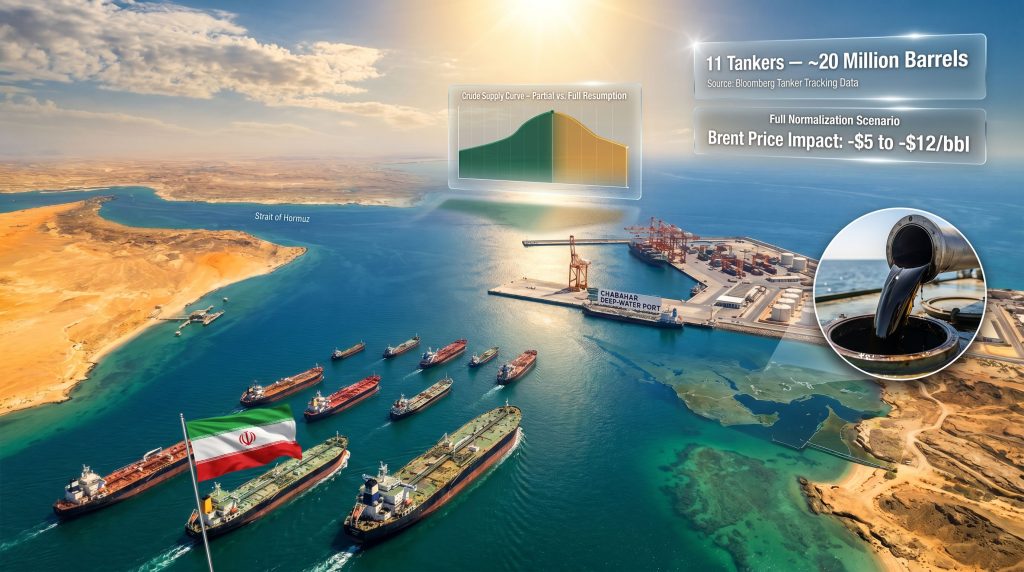
Bloomberg shipping data confirmed that 11 tankers departed from Chabahar port on the Gulf of Oman in the week following the MOU signing, carrying a combined volume of approximately 20 million barrels (MMbbl). These vessels had not been free to sail outward into the Indian Ocean due to active U.S. military interdiction, which had formed a key pillar of the maximum pressure campaign designed to limit Tehran's access to petrodollar revenues.
The significance of Chabahar's location cannot be overstated. Sitting just outside the Persian Gulf near Iran's border with Pakistan, this deep-water port operates entirely outside the Strait of Hormuz corridor. This geographic positioning gives Iran an export route that functions independently of the chokepoint, which handles roughly 20 to 21% of global oil supply on any given day.
However, the 20 MMbbl figure demands careful interpretation before it can be treated as a market-moving supply event.
| Claim | Verification Status | Source Basis |
|---|---|---|
| 11 tankers carrying ~20 MMbbl departed Chabahar | Confirmed via shipping data | Bloomberg tanker tracking |
| ~5 MMbbl moved via three NITC tankers pre-deal | Confirmed | Independent shipping analysis |
| ~20 MMbbl held offshore Malaysia in ship-to-ship transfers | Reported, covert network, not post-deal flow | Windward AI via Fox News |
| Full normalization of Iranian exports imminent | Unverified, logistical barriers remain | Reuters, BBC, Trading Economics |
A critical distinction exists between three separate categories of Iranian crude in motion at any given time:
- Oil in transit actively moving through legitimate or semi-legitimate shipping channels post-deal
- Floating storage held offshore in stationary vessels awaiting buyer confirmation or pricing windows
- Formally exported oil underpinned by documentation and traceable buyer contracts
The Chabahar departures primarily represent accumulated, suppressed supply being unlocked rather than new production capacity entering the market. Weeks-long normalisation delays are expected as mine clearance operations, port congestion, tanker scheduling backlogs, and the unresolved Hormuz transit toll framework all create friction in the system.
Market participants should resist the temptation to treat this tanker movement as equivalent to a full resumption of Iranian crude exports. The barrels being shipped represent a backlog release, not a structural increase in supply velocity.
Hormuz: Chokepoint, Lever, and Diplomatic Battleground
The Strait of Hormuz functions as far more than a nautical transit corridor. It is a geopolitical instrument of asymmetric leverage. Iran's Persian Gulf State Authority, the entity established to oversee vessel transits, published documentation requiring shippers to follow designated routes and outlined how toll frameworks would apply to passage. This institutional apparatus gives Tehran a mechanism to monetise, regulate, or selectively restrict traffic regardless of what any diplomatic agreement stipulates.
The most striking illustration of Hormuz's sensitivity appeared in the tanker traffic data itself. On Thursday, vessels carrying nearly 10 MMbbl were observed either transiting or positioned near the strait. By Friday morning, according to BBC reporting, no non-Iranian tankers were detected moving outbound from the Persian Gulf at all. That single-day reversal captures precisely why the Hormuz situation resists simple analysis.
Vessels navigating with AIS (Automatic Identification System) transponders switched off further complicate the picture. Dark vessel movements, particularly those hugging Oman's coastline, are a long-established feature of Iran's sanctions-evasion logistics. This practice means official shipping data almost certainly understates actual export volumes, creating a persistent gap between tracked and real flows.
Why Switzerland Matters to Oil Traders
The postponement of scheduled permanent peace deal negotiations in Switzerland, which followed overnight clashes between Israeli forces and Iran-backed Hezbollah militants in southern Lebanon, introduced immediate uncertainty into an already fragile diplomatic process. The MOU signed on Wednesday was always intended as an interim framework, not a conclusive resolution. The gap between an interim MOU and a permanent agreement represents the critical fault line in assessing how durable any export normalisation will prove.
Proxy conflict escalation introduces what analysts describe as a deal fragility premium into crude pricing, a risk buffer that persists as long as the regional security environment remains unstable. Hezbollah activity in southern Lebanon is directly linked to Iranian strategic positioning, meaning that military flare-ups on that front can instantaneously reverberate into Hormuz transit calculus. In addition, broader geopolitical trade tensions across the region continue to amplify these pricing pressures.
Iran's Shadow Fleet: Engineering Resilience Under Pressure
To understand the scale of what is now potentially being normalised, it helps to understand how Iran maintained meaningful export volumes throughout the maximum pressure sanctions era. The infrastructure that evolved is technically sophisticated and geographically distributed.
Key mechanisms of Iran's sanctions-era export architecture:
- Flag hopping – vessels regularly re-registered under different national flags to obscure Iranian origin
- Beneficial ownership layering – complex corporate structures across multiple jurisdictions masking Iranian state ownership
- AIS manipulation – transponders switched off or spoofed to show false location data
- Ship-to-ship (STS) transfers – crude transferred between vessels at sea, primarily near Malaysia, to break the chain of custody documentation
- Chinese teapot refineries – independent Chinese refiners absorbing discounted Iranian crude outside the major integrated refinery networks that face stronger Western compliance pressure
China has absorbed the vast majority of Iranian crude throughout the sanctions period. Iranian oil has historically traded at a discount of $5 to $15 per barrel relative to Brent, depending on sanctions intensity and enforcement activity. This discount has been the economic engine keeping teapot refineries competitive and sustaining Chinese petrochemical feedstock cost advantages.
If Iranian exports normalise into legitimate channels, that discount structure may narrow substantially, directly affecting Chinese refinery margins and the cost competitiveness of downstream petrochemical producers across Asia.
Scenario Modelling: Three Pathways for Iranian Supply
The range of plausible outcomes from the current diplomatic moment is wide. The following scenario framework outlines the most analytically defensible trajectories.
| Scenario | Iranian Export Volume | Estimated Brent Price Impact | OPEC+ Response Probability |
|---|---|---|---|
| Partial resumption under current MOU | ~1.0 to 1.5 MMbbl/day | -$2 to -$5/bbl | Moderate, wait-and-see posture |
| Full normalization under permanent deal | ~2.3 to 2.5 MMbbl/day | -$5 to -$12/bbl | High, likely production cuts |
| Deal collapse and renewed blockade | <0.5 MMbbl/day | +$8 to +$15/bbl | Low, OPEC+ benefits from price recovery |
Scenario A: Diplomatic Stabilisation
Switzerland talks resume within two to four weeks, Hormuz transit normalises progressively, and Iranian crude re-enters global supply chains at scale. Under this pathway, Brent crude likely gravitates toward the $70 to $75 per barrel range as incremental supply weighs on the market.
Scenario B: Stalled Negotiations
If the Swiss talks delay extends beyond 60 days and the MOU provisions remain ambiguous, partial tanker movement continues but full normalisation stalls. A $5 to $8 per barrel geopolitical risk premium persists in crude pricing, and OPEC+ holds production steady to offset Iranian supply uncertainty. The complexities of oil price geopolitics suggest this scenario carries meaningful probability given current market dynamics.
Scenario C: Deal Collapse and Escalation
Israeli-Hezbollah conflict draws Iranian military assets into a broader confrontation. Hormuz closure risk re-emerges acutely, tanker war risk insurance rates spike sharply, and oil prices surge toward the $95 to $110 per barrel range. Emergency IEA strategic reserve releases would likely follow.
OPEC+ in the Crossfire: Managing the Iranian Re-Entry Problem
For OPEC+, Iranian re-entry at any significant scale creates a structural management challenge. The group has carefully calibrated production cuts through 2025 and 2026 to maintain price floors that satisfy member fiscal requirements. An incremental 1.0 to 1.5 MMbbl/day of Iranian supply above current covert flows would effectively represent production discipline being undermined by diplomatic developments outside the cartel's control.
OPEC's market influence has historically been tested during periods of member supply disruption, and Iran's re-entry represents one of the more complex scenarios the group has faced in recent years. Historical precedent offers a sobering reference point. Following the 2015 JCPOA nuclear agreement, Iranian oil exports recovered rapidly and contributed to a severe oil price correction that saw Brent fall from approximately $65 per barrel in mid-2015 to below $30 per barrel by early 2016, though multiple simultaneous supply and demand factors drove that collapse.
Saudi Arabia faces a particularly difficult dual challenge. As the de facto OPEC+ anchor, it must balance protecting its own fiscal breakeven price, estimated at roughly $80 to $85 per barrel, against maintaining productive relations with Iran as a fellow OPEC member operating under a newly normalised diplomatic framework. Consequently, OPEC production decisions in the coming months will be watched extremely closely by market participants.
The next major ASX story will hit our subscribers first
Beyond Crude: LNG, Petrochemicals, and the Broader Supply Chain Reconfiguration
The implications of Iranian export normalisation extend well beyond crude oil markets. Iran holds the world's second-largest natural gas reserves, and any deal provisions covering gas flows carry significant potential consequences for European LNG import strategies, particularly as the continent continues navigating post-Russian supply restructuring.
For Asian petrochemical producers, normalised access to Iranian feedstocks at competitive prices reshapes the cost structure of the entire regional supply chain. Complex refineries in China and India that have been configured specifically to process Iranian heavy crude grades stand to benefit most directly, as these facilities have made capital investments optimised around Iranian crude specifications that other supply sources do not replicate precisely.
Tanker market dynamics also warrant attention from a less obvious angle. Shadow fleet operators, who have profited significantly from the premium rates associated with sanctioned cargo transport, face a structural demand reduction as Iranian crude moves into legitimate shipping channels. Conversely, conventional tanker operators subject to international compliance standards may see improved rate dynamics as formerly dark cargoes shift toward transparent logistics. Live crude price data continues to reflect these shifting dynamics in real time.
Key Questions Investors Are Asking
How should energy equity investors interpret this development?
Upstream producers in competing regions face the most direct near-term exposure. U.S. shale operators, Canadian oil sands producers, and North Sea operators all face margin pressure scenarios if Iranian supply normalisation progresses along the full-deal pathway. The degree of that pressure will depend critically on whether OPEC+ moves to offset Iranian volumes through compensating cuts elsewhere.
What does the floating storage drawdown signal for futures curves?
The approximately 20 MMbbl held in offshore Malaysia in ship-to-ship transfer configurations represents pre-existing Iranian inventory positioned for rapid deployment, not new production. As this floating storage is drawn down and enters the market, contango structures in crude futures may compress, reducing the financial incentive to hold inventory at sea. Commodity traders with positions built around storage economics need to monitor this dynamic closely.
What are the milestone markers to watch?
- Resumption timing and substantive progress of Switzerland-based permanent deal negotiations
- Resolution of the Hormuz transit toll framework under Iran's Persian Gulf State Authority
- U.S. Treasury sanctions relief licensing timelines and their sequencing
- IAEA verification protocol compliance milestones, which remain a prerequisite for full sanctions removal under any credible permanent framework
Disclaimer: This article contains forward-looking scenarios, market projections, and analytical frameworks based on publicly available information as of June 2026. None of the scenarios or price projections presented constitute financial advice. Energy markets are subject to rapid change driven by geopolitical, logistical, and macroeconomic variables that cannot be fully anticipated. Readers should conduct independent research and consult qualified financial advisors before making investment decisions.
Want to Stay Ahead of the Next Major Commodity Market Shift?
Discovery Alert's proprietary Discovery IQ model delivers real-time alerts on significant ASX mineral discoveries, cutting through market complexity to surface actionable opportunities the moment they emerge — explore historic examples of exceptional returns driven by major discoveries, and begin your 14-day free trial at Discovery Alert to position yourself ahead of the broader market.